
As of: 23 September 2026 · Reading time: 7 min
Key takeaways
- Twelve weeks from the first briefing to the productive MVP – is that realistic?
- Yes, if scope, process and decision speed are correct.
- This post shows week after week what happens when and what conditions must be fulfilled.
Twelve weeks from the first briefing to the productive MVP – is that realistic? Yes, if scope, process and decision speed are correct. This post shows week after week what happens when and what conditions must be fulfilled.
“Digitalization is not an IT project—it is a business strategy.”
– Björn Groenewold, Managing Director, Groenewold IT Solutions
12 weeks from briefing to productive MVP – this is ambitious, but possible. With the emphasis on "possible".
It only succeeds with clear scope, quick decision-making and a well-proven development team.
Anyone who starts with unclear needs, delays decisions or introduces new features every week does not land in week 12 in the market.
However, in week 24 with a semi-finished product. This article realistically shows what happens when – and what needs must be met on the client side.
Requirements for a 12-week MVP
Twelve weeks from the first briefing to the productive MVP – is that realistic?
Those who want to address From the idea to the MVP in 12 weeks: a realistic schedule will find practical points in cost calculator: software development and explore solutions.
Before the first sprint starts, these framework conditions must vote:
Clear Vision, dedicated Product Owner. A person with decision-making power who answers questions within 24–48 hours. Decision storage is the most common reason for delays.
Progressive scope. The team doesn't need to start from zero. First User Stories, coarse Wireframes or a Product Brief make the Discovery Sprint much easier.
Budget released. No 12-week development works with weekly budget discussions. The budget stands, the scope stands – then the team can work.
Some decisions (hosting, database type, framework) must be made quickly. Those who have technical preferences should communicate them in the first meeting.
Week 1–2: Discovery and Scope definition
What happens:
- Kick-off with all stakeholders
- Create User Personas and User Stories for Primary Users.
- Prioritize features by MoSCoW (Must/Should/Could/Won't).
- Set technology architecture (backend, frontend, hosting, database type).
- Clear integration needs (which external systems, APIs).
- MVP-Scope in writing (Scope document).
- Finalize schedule and milestones
Result: Binding scope, technical architecture sketch, sprint plan for weeks 3–12.
In this phase, add features "yet fast". Each feature in Discovery costs 5 times in development.
Week 3–4: UX design and prototype
What happens:
- Wireframes for all core screens.
- Clickable prototype (Figma, InVision or the like).
- First user test with prototype (3–5 people from the target group)- UX adjustments based on feedback.
- Final Design Handoff to the development team.
Result: Clickable, validated prototype. Developers have a clear target.
Current error: Skip or shorten design phase. Then the UX feedback takes place during development – 5x more expensive than before.
Week 5–8: Core Development (Sprint 1 + 2)
Sprint 1 (week 5–6):
- Set up basic infrastructure (database, backend, hosting).
- Rollout of authentication and user roles.
- Developing first core functions of the critical user path.
- Demo at the end of Sprint 1.
Sprint 2 (week 7–8):
- Remaining Must-Have features
- Integrations with external systems (if planned).
- First internal tests and bug fixation.
- Demo at the end of Sprint 2 with stakeholders.
Result: Fully introduced MVP-Scope, in-house tested.
Sprint-Demos skip. Then the feedback is collected at the end – too late for corrections.
Week 9–10: Beta Testing
What happens:
- 5–20 selected first users from the target group get access.
- Structured tasks and observation (or remote testing).
- Qualitative interviews with test users.
- Prioritize critical bugs and fixes.
- Edit Must-Have improvements from user feedback.
Result: Validated MVP, well-known priorities for the first iteration after launch.
Do not carry out beta test with internal employees who know the context. Real target group members must test.
Week 11–12: Hardening and Launch
What happens:
- Remaining bugs fixed
- Performance tests under load
- Basic security checks (input validation, authentication security).
- Set up production deployment
- Monitoring and error tracking (Sentry, Datadog, etc.)
- Onboarding first production user
- Go-live
Result: Productive MVP, first real user in the system.
What happens after week 12
The launch is not the end, but the beginning of real learning. Now count usage metrics, qualitative feedback and retention rate.
The results flow into Sprint 3, 4, 5 – the iteration with which the MVP becomes a mature product.
Typical iteration rhythm after the MVP launch: every 3-4 weeks a new release with improved features – driven by user feedback instead of original assumptions.
Conclusion
Short: 12 weeks to the MVP are realistic – with the right conditions.
12 weeks to the MVP are realistic – with the right conditions. Quick decisions, clear scope, dedicated team.
Those who do not meet the needs should plan 16–20 weeks – that is more honest than false promises. .Our team supports MVP development projects structured from the first scope definition to the productive launch and beyond.
Frequently Asked Questions (FAQ)
What happens if the scope in week 6 is not yet clear?
The project is moving accordingly.
12 weeks of development presupposes that the scope is set at the beginning of week 3. Scope impact after development start typically doubles the project duration.
Can we test and develop parallel?
Yes. Internal tests run parallel to development (QA). Beta testing with real users only begins when the MVP scope is fully introduced.
What if the feedback from the beta test requires fundamental changes?
Then the MVP has fulfilled its purpose – it has revealed wrong decisions before the full budget has been invested.
Basic changes flow into Iteration 1 after the launch, not back into the MVP.
Can feature wishes after Sprint 1 still in the MVP?
Only if another feature is taken out (scope trade). A MVP budget is not an open account – additions only come into the iteration after the launch.
What do I know if the scope is too big?
If more than three separate target groups or delivery items are same time “Must-have”, most of the time prioritization is missing.
For From the idea to the MVP in 12 weeks. A realistic schedule helps a clear pilot with a measurable result.
How do I avoid technical dead ends?
With early architecture reviews, prototype critical uncertainties and repeatable deployments. At wochen, a clean interface strategy pays off.
What role does maintenance play after the launch?
Short: A sustainable solution needs Patch cycles , monitoring and ownership.
A sustainable solution needs Patch cycles, monitoring and ownership. Plan budget for further development – not only for the first release.
Additional notes
Classification: From the idea to the MVP in 12 weeks: A realistic schedule
As mentioned in the core of this article (“Twelf weeks from the first briefing to the productive MVP – is this realistic?
Yes, if scope, process and decision speed are correct.
This post...”), the field can be further structured. idee, mvp and wochen play a role – not as keyword decoration.
However, because clearly here, there are typically needs, risks and success factors.
Instead of rushing into rollout, a clear problem and benefit frame is worth it.
This target group, what process interfaces and what measurable results do you expect within 90 days?
This prevents expensive correction loops and makes priorities in the backlog objectively greenable.
Frequent questions (FAQ)
Conclusion and next steps
From the idea to the MVP in 12 weeks: a realistic schedule can be successfully introduced when technology, organization and measurability match – instead of isolated tool rollouts without process reference.
Use the overview in this article as a basis for discussion on priorities, risks and the first loadable pilot.
Intensify matching topics in category overview Blog category and check operational support via Software development, IT consulting.
Groenewold IT accompanies review, rollout and operation – from the first grouping to scalable releases.
Technical sources and further links
The following separate references complement the grouping on the topics of this Article:
- Bitkom – Digital Economy Association.
- BSI – Federal Office for Information Security.
- European Commission – Digital Strategy.
- MDN Web Docs (Mozilla)
- W3C – World Wide Web Consortium.
"Cloud native is not a self-interest: The benefits arise only when operation, security and costs are transparent to architecture."
— *Björn Groenewold, Managing Director, Groenewold IT Solutions *
About the author

Managing Director of Groenewold IT Solutions GmbH and Hyperspace GmbH
Since 2009 Björn Groenewold has been developing software solutions for the mid-market. He is Managing Director of Groenewold IT Solutions GmbH (founded 2010) and Hyperspace GmbH. As founder of Groenewold IT Solutions he has successfully supported more than 250 projects – from legacy modernisation to AI integration.
Blog recommendations
Related articles
These posts might also interest you.
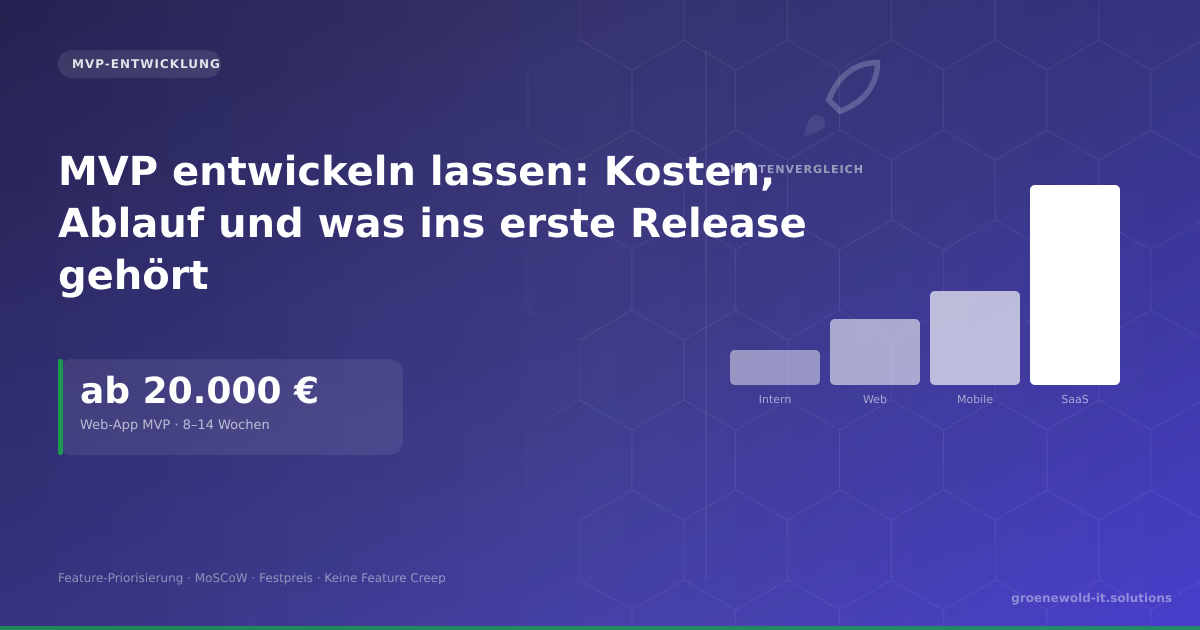
Having an MVP Developed: Costs, Process and What Belongs in the First Release
A web app MVP costs €20,000 to €45,000 and is ready in 8–14 weeks. This article explains what a real MVP is (and not), the Must/Should/Could method and frequent errors that blow up the budget.

Having an MVP Developed: What It Costs and How to Get It Right
A MVP is not a cheap product – it is a smart product. Who defines the minimum in the right place saves development budget and quickly learns what users really want. Costs, procedures and the most…

Digitization in the middle class: The right technology selection as a success factor
Digitization is no longer an option for small and medium-sized enterprises (SMEs), but a need to compete. But Digitalization in the middle class is...
Free download
Checklist: 10 questions before software development
Key points before you start: budget, timeline, and requirements.
Get the checklist in a consultationRelevant next steps
Related services & solutions
Based on this article's topic, these pages are often the most useful next steps.
Related services
Related solutions
Cost calculators
Practical next steps after From the idea to the MVP in 12 weeks: A realistic schedule
From the idea to the MVP in 12 weeks: A realistic schedule addresses a practical choice for product and IT teams. Start with one clear goal: align software scope, technical risk, and business value before the next investment.
Check the current process, the data involved, and the result users need. Then record the main risks and define a small first step. This keeps the decision easy to review and gives your team a shared basis.
For implementation support, our custom software development connects the article's guidance with architecture, delivery, and stable operations. Engineering and project ownership stay with our team in Leer, Germany.
This post belongs to MVP-Entwicklung. Browse the related MVP-Entwicklung articles or use the English software blog for other topics.
When budget is the next question, the software cost calculators provide planning ranges. The IT glossary explains key terms, while in-depth technology guides cover wider decisions.
If the topic affects a live project, book a technical consultation or send the context through our project contact form. We usually reply within one working day.