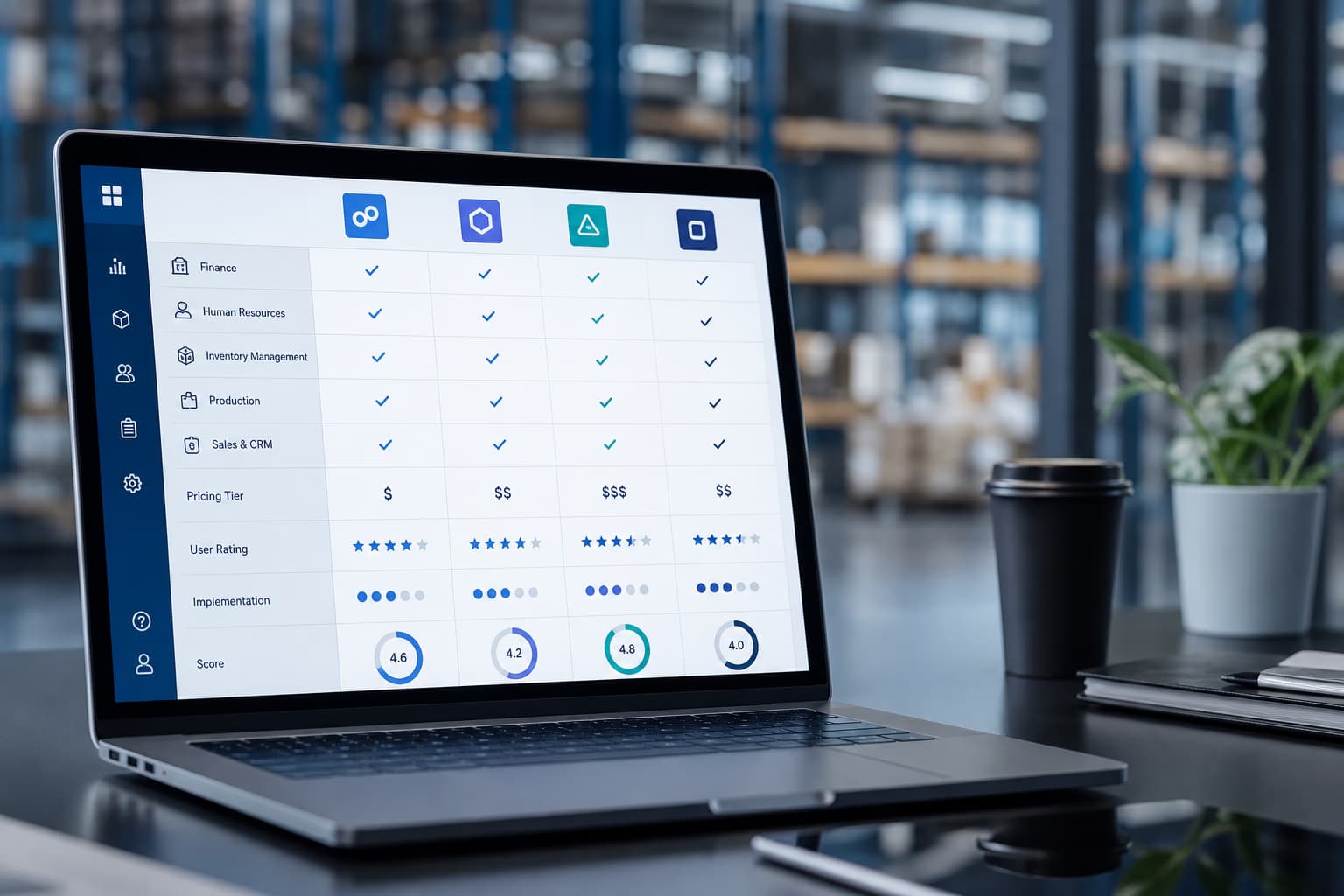
Choosing the right ERP system shapes your company's efficiency and scalability for years. Our ERP systems comparison 2026 compares the most important solutions for the mid-market: Odoo, SAP Business One, Microsoft Dynamics 365, Haufe X360 and weclapp. We compare costs, target group, strengths and weaknesses, and which open source ERP and commercial alternatives suit whom. So you get a sound basis for your ERP comparison mid-market.
Main ERP systems at a glance
| Criterion | Odoo | SAP Business One | Microsoft Dynamics 365 | Haufe X360 | weclapp |
|---|---|---|---|---|---|
| Cost (entry) | Low – open source core, module licenses | High – named user, implementation €50k–200k+ | Medium to high – subscription per user/module | Medium – strong tax/accounting | Medium – cloud-first, subscription |
| Target group | SMEs, growing companies, all industries | Mid-market, standardized processes | Companies in Microsoft ecosystem | SMEs, tax and accounting focus | SMEs, e-commerce, sales |
| Strengths | Flexibility, modularity, Odoo customizing, low entry cost | Stability, SAP support, upgrade path to S/4HANA | Integration with Office 365, Power Platform | Tax and accounting, Germany-focused | E-commerce, sales, modern cloud UI |
| Weaknesses | Partner quality varies, reporting sometimes needs add-ons | High cost, long implementation, less flexibility | Complexity, cost with many modules | Less known outside tax/accounting | Less manufacturing depth than Odoo/SAP |
| Open source | Yes (Community Edition) | No | No | No | No |
An open source ERP like Odoo lets you start without license cost for the core and pay only for desired modules or hosting. SAP, Microsoft and weclapp are pure license or subscription models. Haufe X360 targets companies that want to centralize tax and accounting. For more on selection and implementation see our overview ERP for SMEs.
Odoo vs SAP Business One: detailed comparison
Odoo vs SAP is one of the most common comparisons in the mid-market. Odoo stands out through low entry costs, modular design and high adaptability. The non-binding calculator project range is EUR 8,925 – 93,275 excl. VAT. With Odoo customizing you can tailor processes and interfaces to your workflows.
SAP Business One offers maximum stability, established reporting and a clear path to SAP S/4HANA. Implementation is more complex (6–12 months) and more expensive (€50,000–200,000+ plus VAT). For standardized processes and companies that want to stay in the SAP ecosystem, SAP B1 is a strong choice. For growing companies with specific requirements and limited budget, Odoo is often the more sensible option in the ERP comparison.
Odoo vs Microsoft Dynamics 365: detailed comparison
Odoo vs Microsoft Dynamics 365 matters especially when you already rely heavily on Microsoft 365 (Office, Teams, Azure). Dynamics 365 integrates seamlessly into this ecosystem and offers ERP and CRM modules in one consistent environment. Costs depend on modules and user count and can quickly reach the mid to high five figures per year in the mid-market.
Odoo is platform-independent and can also integrate with Microsoft products – via APIs and interfaces. If you mainly want a powerful, flexible ERP with good value for money and don't necessarily need "everything from one source" from Microsoft, Odoo is often the more cost-effective and adaptable alternative in the ERP comparison. For planned Odoo migration or switching from another system we support you from planning to go-live.
Decision guide: which ERP for which company size and industry?
Small and growing companies (10–100 employees): Odoo or weclapp offer a quick start and scalability without high upfront investment. Odoo is especially suitable if you want to cover manufacturing, warehouse and e-commerce; weclapp scores with a strong focus on sales and e-commerce.
Mid-market with standardized processes (100–500 employees): SAP Business One and Microsoft Dynamics 365 are options if you value established standards and long-term stability. Odoo remains a strong alternative if you prioritize customizations and cost efficiency.
Industry: Manufacturing and retail are well covered by both Odoo and SAP. For a tax and accounting focus, Haufe X360 is worth considering. Media, services and project-based businesses benefit from Odoo's flexibility. Our article ERP for SMEs goes deeper into selection criteria and implementation process.
Why we recommend Odoo
We are an Odoo partner and use Odoo in many mid-market projects – not out of obligation, but because in our view it offers the best balance of cost, flexibility and scalability for most of our clients. You start with a manageable budget, can grow modularly and adapt deeply if needed. We support you with Odoo customizing and Odoo migration from the first version through upgrades and extensions. If your requirements fit SAP or Dynamics better, we tell you honestly – this ERP comparison is meant to help you decide, not to sell one solution.