As of: 23 September 2026 · Reading time: 6 min
Key takeaways
- MVP = smallest unit that proves a hypothesis – not the cheapest version of the full product.
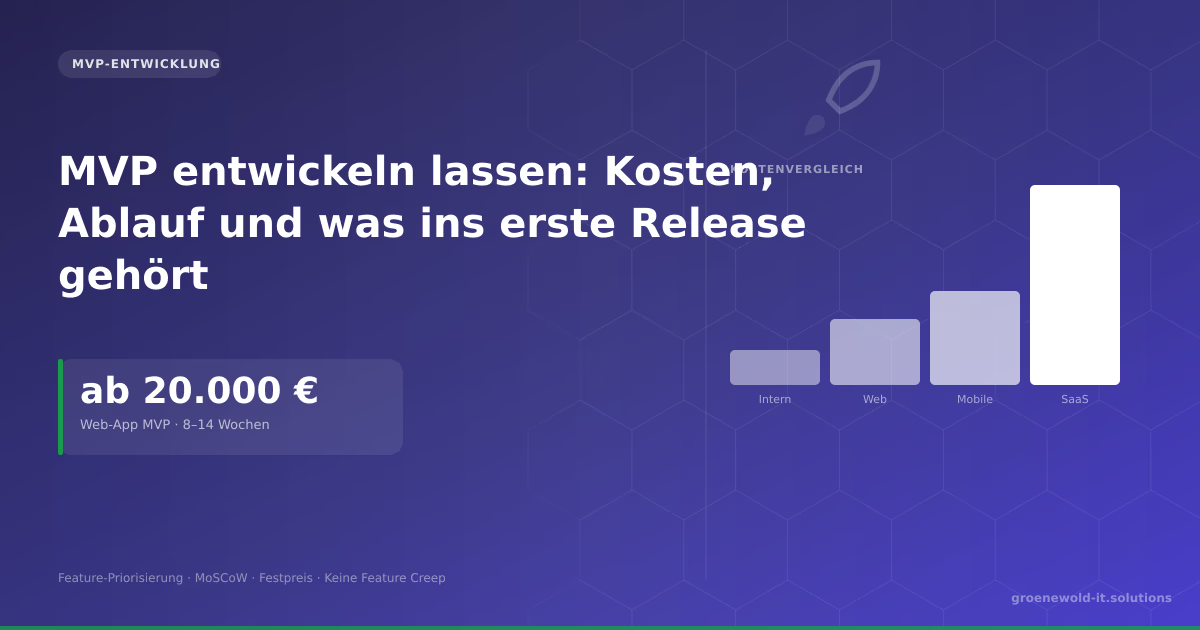
- Web-App MVP: €20,000–45,000, 8–14 weeks.
- Feature Creep is the largest MVP killer – Scope rigoros defend.
- Plan feedback mechanism from the start.
A web app MVP costs €20,000 to €45,000 and is ready in 8–14 weeks. This article explains what a real MVP is (and not), the Must/Should/Could method and frequent errors that blow up the budget.
“Digitalization is not an IT project—it is a business strategy.”
– Björn Groenewold, Managing Director, Groenewold IT Solutions
Having an MVP developed: cost, process and what really belongs to the first release
MVP: What does a minimum Viable Product 2026 cost?
A web app MVP costs €20,000 to €45,000 and is ready in 8–14 weeks.
As a basis for deciding on MVP, costs, execution and what really are in the first... are suitable cost calculator: software development and explore solutions.
A MVP is not a bad version of the full product – it is the smallest thing that proves a hypothesis. Do users want that?
Does it solve her problem? Are they paying for it?
The short answer: An honest web app MVP with a clearly defined use case costs 20.000 to 45,000 € and is finished in 8–14 weeks.
MVPdevelopment costs by type
Groenewold IT Solutions · Experiences from 250+ projects
What is a MVP – and what is not?
A MVP (Minimum Viable Product) contains exactly the features needed to:
- To solve the core problem of the target group Two. Generating real user feedback.
- Testing the most important business hypothesis.
A MVP is not
- Yes. A beta version with all features but bugs.
- Yes. A click thumb without backend.
- Yes. The cheapest version of the full product where you left everything.
The difference is crucial: A real MVP is simple but complete in its scope. It can be used productively and generates real data.
The MVP feature decision: What needs to be pure, what comes later?
The most important document in front of a MVP project is the feature priority list. We work in three categories:
| Category | Description | In MVP? |
|---|---|---|
| Must-Have (M) | Without that, the product is not usable ✓ ✓ Always | |
| Should-Have (S) | Important but not possible without launch ✓ If budget allows | |
| Could-Have (C) | Nice-to-have, clear as later release | ✗ Raus |
| Won't-Have (W) | Conscious decision: not in v1 | ✗ Raus |
Common MVP errors that become expensive
Short: Feature Creep: The greatest enemy of a MVP.
Feature Creep: The greatest enemy of a MVP. New 'absolutely needed' features are added every week. The budget explodes, the launch shifts.
Discipline in the feature list is not Geiz – it is professionalism.
A MVP should validate, not impress. Anyone who builds a MVP to impress investors often builds too much.
Anyone who builds a MVP to solve real user problems is less likely.
No feedback loop: After launch is before the next sprint. A MVP without mechanism to collect and evaluate user feedback is just an expensive experiment.
When do I not need a MVP?
If the needs are fully known (e.g. internal enterprise software according to clear specifications), an MVP is often not needed – then a phase-wise rollout is the better approach.
MVPs are most valuable: new products with unknown market, start-ups, innovation projects and digitization projects, where unclear how users react.
Frequently asked questions
What does it cost to develop a MVP after launch?
With 15–25 % of the MVP budget per release cycle (all 6–12 weeks) in the first two years.
How long does a MVP take?
Honest frame: 8–16 weeks for a web app MVP, 12–20 weeks for mobile. Anyone who promises "4 weeks" often means a click thumb or a prototype without backend.
Can I promote an MVP as a ZIM project?
Yes – if the MVP has a R&E character (new algorithms, new technology). Pure market validation MVPs without technical novelty are rejected by ZIM.
*Groenewold IT Solutions, Empty – MVP development for startups and innovation-driven midsize companies since 2012. Project ideas discuss. *
Conclusion
MVP can be built: cost, process and what really belongs to the first release can then be successfully introduced if technology, organization and measurability match – instead of isolated tool rollouts without process reference.
Use the overview in this article as a basis for discussion on priorities, risks and the first loadable pilot.
Intensify matching topics in category overview Blog category and check operational support via Software development, IT consulting.
Groenewold IT accompanies review, rollout and operation – from the first grouping to scalable releases.
Additional notes
Practical impulse for the topic
In practice, projects often lose drive if Responsible between specialist, IT and external partners remain unclear.
Name Owner for data, security and operation in writing – and link delivery items with acceptance criteria, not only with milestone data.
Groenewold IT
supports architecture, rollout and integration – according to your focus: Software development, IT consulting. If you are unsafe.
This entry is the most risky one, start with a short architecture or discovery workshop instead of a maximum microscope.
Typical stumbling stones – and how you bypass them
Scope-Creep
arises when needs are postponed without new prioritization. Antidote: clear product-over roll, visible backlog and recorded “later” list.
Missing test data
lead to surprises in production. Invest early in anonymized snapshots or generated records covering edge cases.
Knowledge islands
between development and operation cause long incident times.
Joint runbooks, common demos and a common glossary on technical terms reduce friction – especially in complex topics such as MVP: cost, process and what really belongs to the first release .
Security, privacy and compliance
Depending on the industry and data types, Access concepts, encryption, storage and deletion concepts can quickly become a bottleneck. Check early on whether personal data are processed.
This are legal bases and how affected rights are technically supported.
Supplier and open source components should land in a regular review: licenses, known vulnerabilities, update path. This not only protects against incidents.
However, also accelerates audits and alerts – especially when public authorities or regulated markets are in play.
Integration into your IT landscape
Typical integration points are ERP, CRM, identity providers, payment services and industry software. stable contracts, version policy for APIs and transparent error semantics –.
This means partners and internal teams do not have to guess.
If you need support in technical rollout, we arrange MVP to develop: cost, process and what really belongs to the first release to your existing architecture – including prioritization and resilient releases.
Matching entry points: Software development, IT consulting.
Technical sources and further links
The following separate references complement the grouping on the topics of this Article:
- Bitkom – Digital Economy Association.
- BSI – Federal Office for Information Security.
- European Commission – Digital Strategy.
- MDN Web Docs (Mozilla)
- W3C – World Wide Web Consortium.
"Cloud native is not a self-interest: The benefits arise only when operation, security and costs are transparent to architecture."
— *Björn Groenewold, Managing Director, Groenewold IT Solutions *
About the author

Managing Director of Groenewold IT Solutions GmbH and Hyperspace GmbH
Since 2009 Björn Groenewold has been developing software solutions for the mid-market. He is Managing Director of Groenewold IT Solutions GmbH (founded 2010) and Hyperspace GmbH. As founder of Groenewold IT Solutions he has successfully supported more than 250 projects – from legacy modernisation to AI integration.
Blog recommendations
Related articles
These posts might also interest you.

Having an MVP Developed: What It Costs and How to Get It Right
A MVP is not a cheap product – it is a smart product. Who defines the minimum in the right place saves development budget and quickly learns what users really want. Costs, procedures and the most…
From the idea to the MVP in 12 weeks: A realistic schedule
Twelve weeks from the first briefing to the productive MVP – is that realistic? Yes, if scope, process and decision speed are correct. This post shows week after week what happens when and what…

Digitization in the middle class: The right technology selection as a success factor
Digitization is no longer an option for small and medium-sized enterprises (SMEs), but a need to compete. But Digitalization in the middle class is...
Free download
Checklist: 10 questions before software development
Key points before you start: budget, timeline, and requirements.
Get the checklist in a consultationRelevant next steps
Related services & solutions
Based on this article's topic, these pages are often the most useful next steps.
Related services
Related solutions
Cost calculators
Practical next steps after Having an MVP Developed: Costs, Process and What Belongs in the First Release
Having an MVP Developed: Costs, Process and What Belongs in the First Release addresses a practical choice for product and IT teams. Start with one clear goal: align software scope, technical risk, and business value before the next investment.
Check the current process, the data involved, and the result users need. Then record the main risks and define a small first step. This keeps the decision easy to review and gives your team a shared basis.
For implementation support, our custom software development connects the article's guidance with architecture, delivery, and stable operations. Engineering and project ownership stay with our team in Leer, Germany.
This post belongs to MVP-Entwicklung. Browse the related MVP-Entwicklung articles or use the English software blog for other topics.
When budget is the next question, the software cost calculators provide planning ranges. The IT glossary explains key terms, while in-depth technology guides cover wider decisions.
If the topic affects a live project, book a technical consultation or send the context through our project contact form. We usually reply within one working day.