As of: 23 September 2026 · Reading time: 4 min
Key takeaways
- Calculate the ROI of AI trainings: Practical guide with example calculation for the return on investment of your AI further education.
Calculate the ROI of AI trainings: Practical guide with example calculation for the return on investment of your AI further education.
“The best AI training is not theory-only—it lets participants implement their own use cases immediately.”
– Björn Groenewold, Managing Director, Groenewold IT Solutions
At a time when companies invest heavily in artificial intelligence, CFOs and managing directors face a crucial question. Is this really worth it?
In specific, investment in continuing training of employees raises the question of return on investment (ROI). How can the financial benefits of AI training be measured?
This article provides a practical guide to calculate the ROI of your AI training initiatives and to show the true value for your company.
Why the ROI of AI training is crucial
Calculate the ROI of AI trainings: Practical guide with example calculation for the return on investment of your AI further education.
For The ROI of AI trainings: calculate value, Cost Calculator: AI Development, Our Development Process sowie Custom Software Development help you align rollout, scope and budget before you commit.
The introduction of AI is more than just a technical upgrade. It is a strategic corporate decision with far-reaching financial implications.
ROI review is essential to ensure that investments made not only cause costs but generate measurable added value.
A clear business case, supported by a solid ROI calculation, helps not only with budget release.
However, also to anchor the strategic importance of employee qualification across the company.
A model for calculating the ROI of AI trainings
The calculation of the ROI for continuing training can be complex, as not all the benefits can be measured at once in Euro and Cent.
A pragmatic approach combines quantitative and qualitative factors.
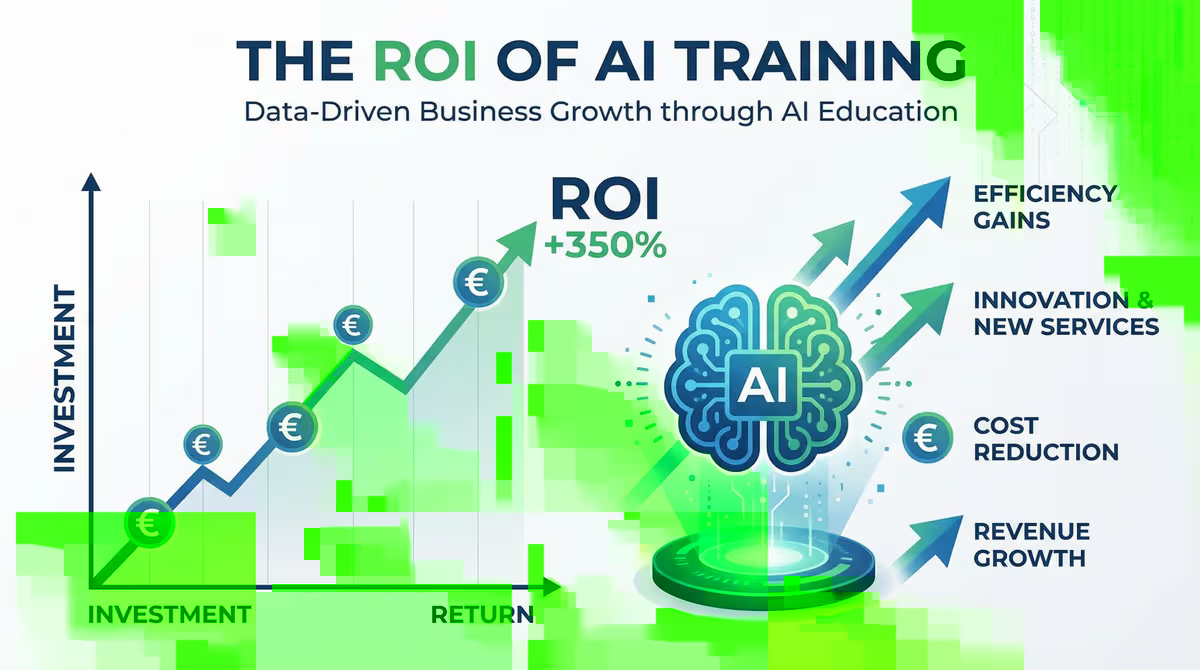
The basic formula is: ROI (%) = (net profit - cost) / cost) × 100
Entering costs of investment
First, all costs incurred must be covered transparently:
Direct training costs: Fees for external trainers, online courses or certifications
Internal costs: Employee working hours during training (living costs)
Technology and infrastructure costs:
Organization effort: Time for planning, planning and follow-up
quantify 2. Net profit of investment
This is the most demanding part of the calculation. The profit consists of different factors:
Increase in efficiency: Time savings in processes, multiplied by personnel costs
Savings through automation and error reduction
Increase in sales: Extra income from AI-based activities
Quality improvement: Reduction of labour costs
Example calculation for a team of 10 employees
Cost overview
| Costs | Amount | Basis of calculation |
|---|---|---|
| Training fees | € 10,000 | 10 employees × € 1,000 |
| Personnel costs (waste time) | € 5,000 | 10 MA × 16h × € 31,25/h |
Total cost € 15,000
Overview of benefits (per year)
Position Value (p.a.) Basis of calculation
Efficiency gain € 30,000 10 MA × 2h/week × 50 weeks × € 30/h
Error reduction € 15,000 Reduction of rework by 50 %
Total benefits € 45,000
Calculated result:
Net profit: € 45,000 - € 15,000 = € 3
Clarity: Where no primary source is named in the text, figures are illustrative; compare Bitkom and Destatis. Project-related statements: Groenewold IT, 2026.
References and further reading
The following separate references complement the topics in this article:
- Bitkom – German digital industry association.
- German Federal Office for Information Security (BSI).
- European Commission – Digital strategy.
- MDN Web Docs (Mozilla)
- W3C – World Wide Web Consortium.
"Cloud-native only pays off when operations, security, and cost model match the architecture—otherwise you ship complexity faster."
— Björn Groenewold, Managing Director, Groenewold IT Solutions
Frequently Asked Questions (FAQ)
What is this article about: “The ROI of AI trainings: calculate value”?
This post explores The ROI of AI trainings. Calculate value from the perspective of needs, typical pitfalls, and sensible next steps. In short.
Calculate the ROI of AI trainings. Practical guide with example calculation for the return on investment of your AI further education.
Who benefits most from the content described here?
Useful for project leads and product owners in AI training who must choose between standard software, custom development, and integration.
How does this topic fit into an IT or digital strategy?
Technically and organizationally, alignment with experienced partners pays off — from requirements to operations; start with the [services overview](/en/services/artificial-intelligence). For multi-system landscapes, [IT consulting and architecture](/en/services/it-consulting) helps align vendors and internal teams.
What are sensible next steps if we need support?
A practical next step: book a consultation and clarify which MVP or pilot fits your team and landscape.
About the author

Managing Director of Groenewold IT Solutions GmbH and Hyperspace GmbH
Since 2009 Björn Groenewold has been developing software solutions for the mid-market. He is Managing Director of Groenewold IT Solutions GmbH (founded 2010) and Hyperspace GmbH. As founder of Groenewold IT Solutions he has successfully supported more than 250 projects – from legacy modernisation to AI integration.
Blog recommendations
Related articles
These posts might also interest you.

AI introduction: How to calculate and show the ROI
The decision for a KI introduction to the company is more than just a technological upgrade – it is a strategic investment in the future. But as with everyone...
AI introduction: your way to the right infrastructure and the optimal technology stack
The transformative force of artificial intelligence (AI) is undeniable and fundamentally changes industries. For companies that do not want to lose the connection, the **KI Introduction U...
AI introduction: Change management and acceptance as key to success
Digital transformation progresses unstoppable and artificial intelligence (AI) develops into a decisive competitive factor for companies of all sizes. The **KI Introduction U...
Free download
Checklist: 10 questions before software development
Key points before you start: budget, timeline, and requirements.
Get the checklist in a consultationRelevant next steps
Related services & solutions
Based on this article's topic, these pages are often the most useful next steps.
Related services
Related solutions
Cost calculators
Practical next steps after The ROI of AI trainings: calculate value
The ROI of AI trainings: calculate value addresses a practical choice for product and IT teams. Start with one clear goal: turn a useful AI idea into a governed process with clear data and risk boundaries.
Check the current process, the data involved, and the result users need. Then record the main risks and define a small first step. This keeps the decision easy to review and gives your team a shared basis.
For the EU AI Act timeline, risk classes and GPAI obligations in practice, see our pillar guide EU AI Act for mid-sized companies.
For implementation support, our AI development for business connects the article's guidance with architecture, delivery, and stable operations. Engineering and project ownership stay with our team in Leer, Germany.
This post belongs to AI training. Browse the related AI training articles or use the English software blog for other topics.
When budget is the next question, the software cost calculators provide planning ranges. The IT glossary explains key terms, while in-depth technology guides cover wider decisions.
If the topic affects a live project, book a technical consultation or send the context through our project contact form. We usually reply within one working day.