
As of: 3 September 2026 · Reading time: 8 min
Key takeaways
- Automation costs depend on process, interfaces and target image.
- Companies plan budget, benefits, risks and operation realistically.
Automation costs depend on process, interfaces and target image. Companies plan budget, benefits, risks and operation realistically.
“Digitalization is not an IT project—it is a business strategy.”
– Björn Groenewold, Managing Director, Groenewold IT Solutions
If you ask for automation, you rarely want a number. Mostly there is a business-critical decision behind it.
Does the investment pay for how quickly it calculates and what risk does the company take? There the subject is often unnecessarily simplified.
Automation is not a product with price tag. However, a project with technical, organizational and economic cuts.
For leaders, so, it is not the most sensible question what automation “costets” but what exactly the budget is used for.
A cleanly defined release process with two interfaces and clear logic is different from a company-wide process chain with legacy connection, role rights, document logic and exceptions.
Anyone who puts both in the same cost drawer does not get clarity or resilient planning.
Which factors determine the automation cost
Automation costs depend on process, interfaces and target image.
For Planning Automation Costs Realistically, Cost Calculator: Legacy Modernisation and Solution: Legacy Reduction are practical starting points. Budget and industry context: Monolith vs. Microservices.
The biggest cost drivers are almost never only in development. It is crucial first of all how clearly the process is described today.
If disciplines live differently, there is an increase in the amount of vote, error risk and project time. Good automation so begins with a sober review.
What happens today, where are media breaks, what exceptions are there, what systems must supply or receive data?
A second factor is the system landscape. If modern APIs exist, the rollout is usually significantly more economical.
If, on the other hand, there are older ERP systems, proprietary specialist applications or manual Excel intermediate steps, the technical connection becomes more complicated.
Not because logic itself would be complicated. However, because stability, data quality and fault treatment must be carefully considered.
The target image also strongly influences the costs.
Some companies want to solve a single bottleneck, such as the automatic processing of input documents or the transfer of data between two systems.
Others plan a scalable platform on which further processes will be set up later. Both can be useful.
But the second variant requires more architectural work, more governance and often also higher needs for rights concepts, monitoring and documentation.
Typical price ranges instead of fantasy numbers
A serious statement on automation costs begins with price ranges, not with curls.
Small automation projects with clear tasks, limited logic and few interfaces often start in the lower to middle five-digit range.
This concerns, for example, lean workflows, defined releases or simple data transfers between two systems.
As soon as several systems, custom business logic, role models or relevant special cases are added, one often moves in the middle five-digit to low six-digit range.
This is not the exception in midsize environments. The reason is simple. The actual value is not in the writing of code.
However, rather in making a business-critical process reliable, manageable and comprehensible to the operation.
Complex automation programs with legacy-modernization, several disciplines, deep ERP integrations or AI-based decisions are correspondingly higher.
It makes sense not only to consider project costs, but to consider a multi-stage investment model. In such cases, companies do not buy an isolated function.
However, rather a resilient digital operational capability.
Why cheap offers often become expensive
Short: Low entry prices are seductive in automation.
Low entry prices are seductive in automation. They act planable and accelerate internal releases. The problem appears later.
If needs are only coarsely recorded, exceptions ignored or interfaces are too optimistic, the effort will shift in change requests, delays and rework.
It becomes especially expensive if technical debts are already created in the project building.
Quickly plugged solutions without clean architecture, without comprehensible documentation and without clear responsibilities may come to the Go level.
In operation, however, they cause support, data errors and dependencies of individuals. Improved for price instead of planability often pays twice.
For risk-sensitive organisations, not the cheapest provider is the most economical. However, the one that makes scope, assumptions and limits transparent.
Especially in the middle and in the public environment, reliability is more important than an artificially pressed project start.
Automation Cost correctly calculate
Short: A burdensome calculation needs more than development hours.
A burdensome calculation needs more than development hours. The separation into four blocks is meaningful: review and conception, rollout, introduction and operation.
The review describes the process in a technical and technical manner. Integrations, business logic, surfaces, tests and documentation are created in the rollout.
The introduction includes training, rollout, acceptance and handover. Maintenance, monitoring, further development and support are added during operation.
The last point is often underestimated. An automation is not a single object. Systems change, specialist logic continues to develop and compliance needs do not stop.
Whoever ignores this, projects are artificially beautiful. Better is a realistic view of total costs over two to five years.
At the same time, the benefits should be compared cleanly. These include saved processing times, reduced error rates, lower throughput times, better data quality and less manual tuning.
In many cases, the economic effect is created not only by saving personnel. However, by faster processes, less escalations and higher delivery capacity.
This is just relevant for growth-oriented companies.
When high automation costs are still worth
Short: Not every project with a higher budget is automatically too expensive.
Not every project with a higher budget is automatically too expensive. It depends on which dependencies are thereby resolved.
If, for example, a critical process has been based on manual knowledge of custom employees, automation can significantly reduce an operating risk.
This often appears too small in classic ROI calculations, but is strategically highly relevant.
It is similar to highly regulated or data-sensitive processes. There are traceability, rights concepts and GDPR-compliant processing often as much as pure speed.
A cheaper solution that works professionally. However, is weak in data protection, logging or auditability, can be the more expensive decision.
Scaling also plays a role. If a company knows that other locations, clients or process variants follow, it is often worth a well-thought construction from the start.
If you start too small, you first save your budget, but later generate migration costs. Whoever plans too big binds capital too soon.
The right decision is usually in between: a clearly limited first scope with sustainable architecture.
How to Reduce Enterprise Automation Costs Without Quality Loss
Short: The most effective lever is a cleanly cut scope.
The most effective lever is a cleanly cut scope. Many projects are expensive because they are to solve everything at once.
More economical is a prioritized start with a clearly measurable core process. Thus a productive benefit is created more quickly.
At the same time, technical foundations are already laid. This means extensions are possible later controlled.
Standardization before automation is equally important. If three departments handle the same process differently, otherwise you can automate mess with software.
First standard, then digitally image - this saves effort and improves acceptance.
Technically it is worth a sober decision between custom development, platform approach and hybrid architecture. Not every task needs a complete custom software.
But not every standard platform fits to built processes, data protection needs or integration realities.
Good planning recognizes where standard is reasonable and where custom rollout provides better long-term value.
What a good offer should include automation costs
If offers are difficult to compare, the needed structure is often lacking.
A resilient offer clearly describes the scope, calls assumptions and demarcations, explains the technical approach and makes visible what performances are contained in review, rollout, test, rollout and operation.
Statements on schedule, contacts, acceptance and change management are equally important.
For many organisations it is also crucial who is actually developing and how long-term control is ensured.
Fixed teams, German-speaking communications, GDPR-compliant rollout and full source code transfer are not marginal topics.
They directly influence the overall economic viability of a project because they affect risk, dependencies and later development.
That is why the view of the rollout partner is worth at least as much as the view of the number under the offer.
Groenewold IT Solutions focuses on transparent project paths, clear scope and development from Germany. For companies seeking planability instead of surprises, this is not an addition.
However, part of the cost truth.
The actual question is not the price, but the taxability
Short: Automation is economical when costs, benefits and risks are shared.
Automation is economical when costs, benefits and risks are shared. A project can start cheaply and end expensively.
However, with a higher initial budget, it can provide significantly more security, better data quality and long-term lower operating costs. .If you are planning automation clean, ask not only about the rollout price.
He asks for process maturity, integration effort, operating model, changeability and measurable business use.
There is a decision that carries in everyday life - not only on the offer side.
Technical sources and further links
The following separate references complement the grouping on the topics of this Article:
- Bitkom – Digital Economy Association.
- BSI – Federal Office for Information Security.
- European Commission – Digital Strategy.
- MDN Web Docs (Mozilla)
- W3C – World Wide Web Consortium.
"Privacy by Design is not a subsequent checkbox, but an architectural question – especially for personal master data."
— *Björn Groenewold, Managing Director, Groenewold IT Solutions *
About the author

Managing Director of Groenewold IT Solutions GmbH and Hyperspace GmbH
Since 2009 Björn Groenewold has been developing software solutions for the mid-market. He is Managing Director of Groenewold IT Solutions GmbH (founded 2010) and Hyperspace GmbH. As founder of Groenewold IT Solutions he has successfully supported more than 250 projects – from legacy modernisation to AI integration.
Blog recommendations
Related articles
These posts might also interest you.
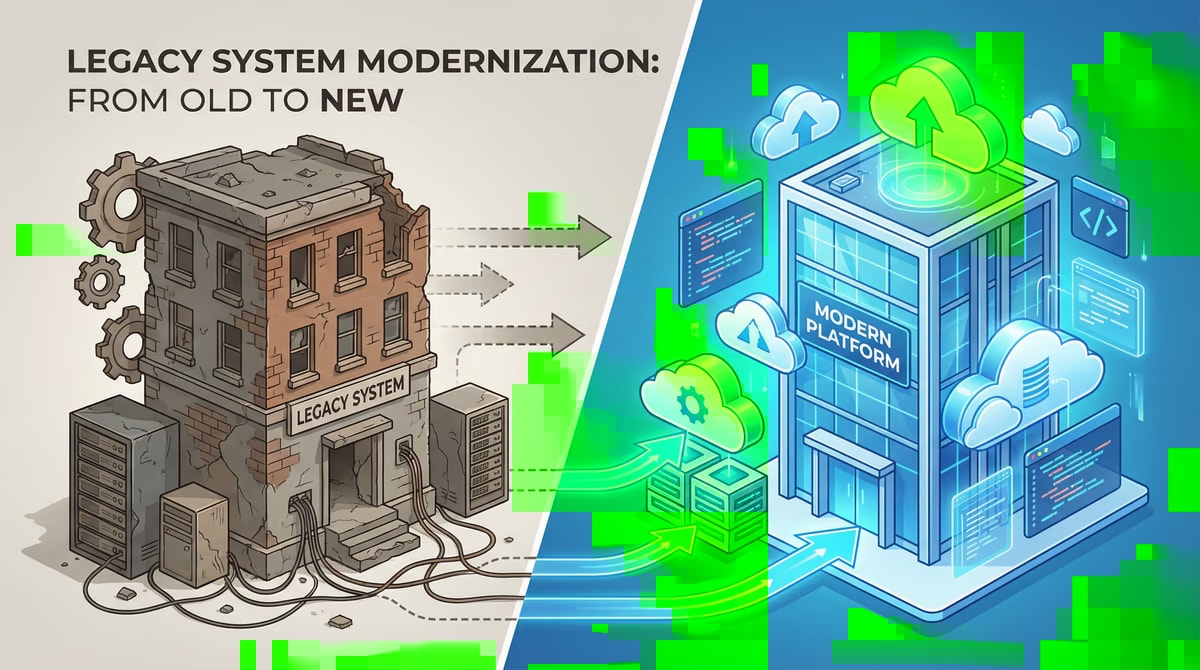
Technical debt in legacy systems: A ticking time bomb?
In the fast-paced world of software development, time and budget are often the driving forces. In order to adhere to deadlines and keep projects within the framework, compromises are often made at...
Replace legacy software: strategies and common pitfalls
In today's fast-paced digital world, outdated software systems, often referred to as legacy software, are one of the biggest challenges for companies. You can find innovations frombrem...
Legacy Migration: Strategies for a smooth transition
In today's rapidly changing digital landscape, outdated IT systems, often referred to as legacy systems, represent a considerable challenge for many companies. Although she...
Free download
Checklist: 10 questions before software development
Key points before you start: budget, timeline, and requirements.
Get the checklist in a consultationRelevant next steps
Related services & solutions
Based on this article's topic, these pages are often the most useful next steps.
Related services
Related solutions
Related comparison
Cost calculators
Practical next steps after Planning Automation Costs Realistically
Planning Automation Costs Realistically addresses a practical choice for product and IT teams. Start with one clear goal: align software scope, technical risk, and business value before the next investment.
Check the current process, the data involved, and the result users need. Then record the main risks and define a small first step. This keeps the decision easy to review and gives your team a shared basis.
For implementation support, our custom software development connects the article's guidance with architecture, delivery, and stable operations. Engineering and project ownership stay with our team in Leer, Germany.
This post belongs to Legacymodernization. Browse the related Legacymodernization articles or use the English software blog for other topics.
When budget is the next question, the software cost calculators provide planning ranges. The IT glossary explains key terms, while in-depth technology guides cover wider decisions.
If the topic affects a live project, book a technical consultation or send the context through our project contact form. We usually reply within one working day.