Legacy Modernization
Sound familiar?

Your legacy system is blocking you?
We modernize without risk.

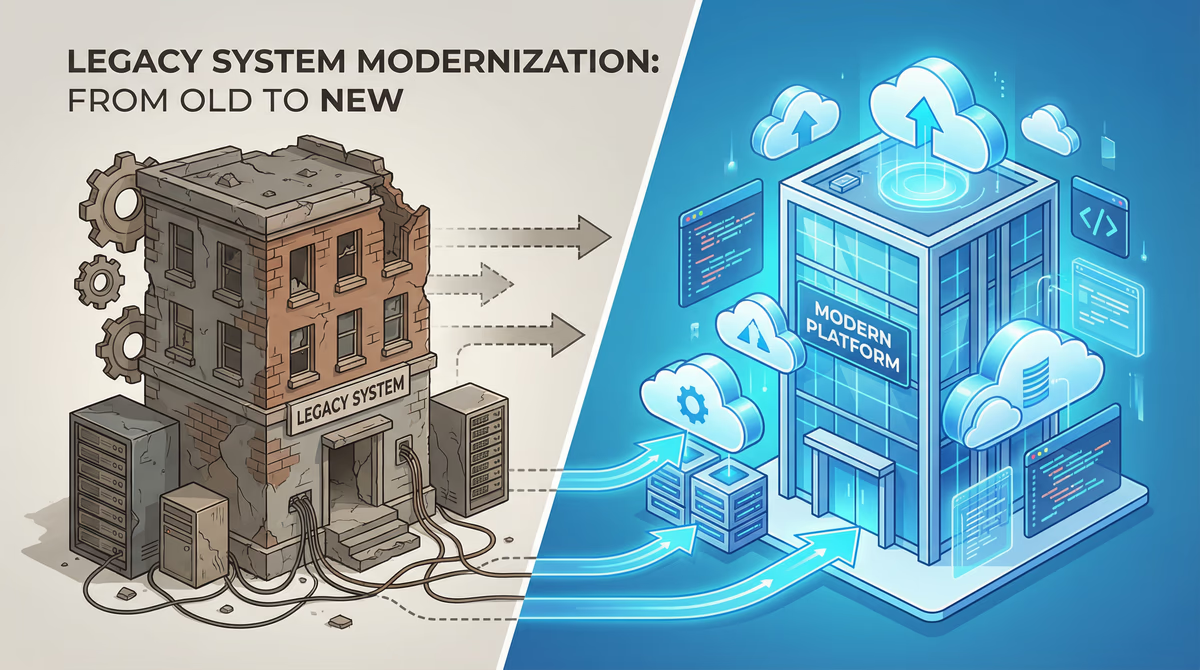
When your legacy system blocks progress, releases take months, and every change is a risk, we modernize step by step – without big bang, without operational disruption.

No Big Bang
Quick Wins in Weeks
Operations Continue

30 min. initial consultation – 100% free & non-binding

Target Audience Check

Is this for you?

Monolith Operators

One big system that does everything – and blocks everything

Long Release Cycles

Releases take weeks or months instead of days

Know-how Risk

Only 1-2 people still understand the system

Technical Debt

Every change creates new problems

Stalled Modernization

Initiatives fail due to risk and complexity

Spaghetti Architecture

Everything depends on everything

Concrete Solution Paths

How We Modernize Legacy Systems

Your ProblemOur ApproachYour Result
System is a black boxSystem landscape map + data flow analysis Full transparency over dependencies
Every change carries riskStrangler Pattern + API facades New features without touching legacy core
Know-how concentrated in few headsDocumentation + pair programming Knowledge secured across the team
Releases take foreverDecoupling + CI/CD setup Releases in days instead of months
Migration seems impossibleStaged migration with milestones Plannable steps, no big bang

Structured Approach

Modernization in 4 Phases

No big bang, but controlled stages with measurable results.

1

Create Transparency

System landscape map, data flows, dependencies. We prioritize by benefit and risk.

2

Decouple

API facades, Strangler Pattern. New features without touching the legacy core.

3

Migrate

Domain by domain, with milestones. Data migrations with backups and rollback plans.

4

Stabilize

Monitoring, SLOs, incident playbooks. Permanently fewer outages and costs.

Björn Groenewold - Managing Director

Legacy system holding you back?

In 30 minutes, we'll analyze your situation together and show you the fastest path to modernization – without risk.

  • Free initial consultation
  • Concrete roadmap

Is modernization worth it?

Compare rising legacy maintenance costs with a modernization investment over 5 years.

Calculate ROI

Frequently Asked Questions

FAQ on Legacy Modernization

Do we need to rebuild everything?

Usually not. We save what's stable and economical, and only replace what's blocking. This reduces risk and accelerates measurable results.

How do we avoid operational downtime?

Through staged migration, parallel operation, clear rollback strategies, and monitoring. Go-lives are controlled – not “all or nothing.”

How long does a modernization take?

That depends on scope and dependencies. Key point: we deliver iteratively. First quick wins are often achievable in weeks, larger programs run over multiple quarters.

What does it cost?

An initial audit starts at approx. 5,000 EUR. For larger programs, we create individual quotes with clear milestones and cost transparency.

Thorsten Frieling – Project Management

Questions about legacy modernization? We're happy to advise on your specific system.

Book consultation

Legacy Modernization: Why Step-by-Step Replacement Is More Economical Than Rebuilding

Legacy systems are the backbone of business processes in many companies. They were built over years or decades, contain valuable domain knowledge, and work – at least in day-to-day operations. But at some point, the ratio tips: maintenance costs rise, modifications take disproportionately long, and the risk with every change grows. When only two or three people in the company understand how the system really works, the dependency becomes a strategic risk.

The obvious reaction – rebuild everything from scratch – fails in practice with alarming frequency. Studies show that over 60 percent of all big-bang migrations significantly exceed budget or timeline, and many are abandoned entirely. The reason is simple: in a mature system, there are hundreds of implicit business rules that are documented nowhere. Anyone who replaces everything at once must first understand all these rules before a single line of new code can be written. This takes months and ties up enormous resources while day-to-day business must continue.

Our approach is fundamentally different. We use the Strangler Fig Pattern, named after tropical strangler figs that slowly grow around an existing tree and eventually replace it. Applied to software, this means: we identify the components of the legacy system that cause the most pain and replace them first – while the rest of the system continues unchanged. An API facade ensures that new and old components work together seamlessly.

This step-by-step approach has several tangible advantages. First, we deliver fast, visible results. Within a few weeks, the first improvements are noticeable: faster releases, fewer errors, better data quality. Second, risk remains controllable. Each migration step is small enough to roll back if problems arise, without endangering the entire operation. Third, everyone involved – your team and ours – learns more about the system with each step and can plan subsequent steps better.

In practice, we begin with a legacy audit where we analyze your existing architecture, quantify technical debt, and create a prioritized modernization roadmap. We consider not only technical factors but also business priorities: which areas have the greatest impact on revenue, customer satisfaction, or operational efficiency? Which dependencies need to be resolved first? Where are quick wins possible that provide immediate relief?

Our modernization projects typically include replacing monolithic architectures with modular services, migrating outdated database systems, introducing automated testing and deployment pipelines, and documenting business logic that previously existed only in the heads of individual employees. Each of these steps reduces dependency on the legacy system while simultaneously increasing your team's capability.

Knowledge transfer is particularly important to us. A modernization is only sustainably successful when your team understands, can maintain, and further develop the new system. That's why we work closely with your developers, conduct pair programming sessions, and document architecture decisions traceably. At the end of the project, there's not just a better system, but also a team that can confidently work with it.
Faster Clarity

Let's sort out scope, risks, and quick wins.

Ideal when you need to make decisions fast – without months of groundwork.

30 min strategy call – 100% free & non-binding

Legacy Modernization | Without Risk