As of: 3 September 2026 · Reading time: 8 min
Key takeaways
- Cloud Migration Companies: How to plan the change clearly, GDPR compliant and measurable - with less risk, better integration.
Cloud Migration Companies: How to plan the change clearly, GDPR compliant and measurable - with less risk, better integration.
“Digitalization is not an IT project—it is a business strategy.”
– Björn Groenewold, Managing Director, Groenewold IT Solutions
If an ERP only runs with workarounds, files are in three systems and need new needs months instead of weeks, the problem is rarely only technical.
At this point, cloud migration becomes an entrepreneurial decision for companies. It is not about simply moving servers to another place.
It is about better operational capability, clearer processes, lower dependencies and an IT that does not slow down growth.
Why cloud migration companies often start later than necessary
Cloud Migration Companies: How to plan the change clearly, GDPR compliant and measurable - with less risk, better integration.
For Planning Cloud Migration for Companies, Cost Calculator: Legacy Modernisation and Solution: Legacy Reduction are practical starting points. Budget and industry context: Monolith vs. Microservices.
If you want to plan Cloud migration correctly for companies, you will find concrete performance paths in Legacy modernization and legacy code analysis in 5 days.
Many firms shift the topic because the existing landscape somehow works.
Operational everyday life has priority, budgets are bound and the risk of a change is greater than the risk of a standstill.
This is clearly the expensive part in many cases.
Because outdated on-premises systems not only cause maintenance costs.
They slow integrations, complicate remote access, increase dependency on custom knowledge and make security and compliance needs more difficult to control over the long term.
Those who wait too long usually pay twice - due to increasing operating costs and missed speed in specialist areas.
For midsize leaders, the right question is so not whether cloud is basically sensible. The better question is.
What systems belong when to the cloud, under what framework conditions and with what specific business benefits?
Cloud Migration Company: Not every system is moved immediately
Short: A clean cloud strategy does not begin with a tool, but with an inventory.
A clean cloud strategy does not begin with a tool, but with an inventory. What applications are business-critical? Where are interfaces to third-party systems?
What data are special data protection or retention duties? And what processes depend on old systems that no one has valued in principle for years?
In practice it quickly shows that not every application should be migrated in the first step. Some systems can be quickly modernized and transferred to a cloud environment.
Others need consolidation, interface cleaning or even functional reorientation beforehand.
Especially in legacy applications a direct move is often the wrong shortcut. .Those who merely shift existing problems into a new infrastructure shift complexity instead of reducing them.
This can look short-term after progress. However, later leads to higher operating costs and unnecessary technical fault.
What must be clarified before migration
Prior to technical decisions, three levels should be considered clean: target, risk and cost-effectiveness. This sounds natural, but is often mixed in projects.
The target image is about what role the cloud should play in the future. Do you want them to scale? Should they improve access?
Is it about cross-site access, faster development or the detachment of outdated infrastructure? Without a clear target state, migration remains a single technical project without a strategic effect.
At risk, topics such as data protection, access concepts, failure security, dependencies and migration order are at the forefront.
Especially in regulated areas or in public areas, it is not enough to select a provider with good standard promises.
It is crucial how architecture, data flows and operating model are introduced.
Finally, economic efficiency should be considered realistic. Cloud is not automatically cheaper. It is often more economical when deliberately planned.
If you take unused resources, calculate load peaks incorrectly or select unsuitable operating models, you can quickly lose the expected savings.
Good projects so not only calculate infrastructure costs. However, also maintenance costs, time-to-market, support capacity and failure risks.
The correct migration strategy decides on effort and results
In many projects there is a desire for a fast lift and lift.
This is understandable, especially when hardware runs out or data center capacities have to be replaced at short notice. This procedure may be useful for certain applications.
It reduces initial conversion and quickly brings systems into a more modern environment.
The disadvantage: the application remains in its previous blank. Old architectural problems, unnecessary couplings or maintenance-intensive operating logics are often preserved.
That's why Lift-and-Shift is a tactical step rather than a long-term modernization. .It is different in a targeted adaptation or partial modernization.
Here, applications are technically reworked prior to migration or parallel thereto, for example by decoupling components, cleaning interfaces or the introduction of contemporary deployment processes.
This increases the project effort, but often improves ease of upkeep, security and later expandability significantly.
A complete reorientation of custom systems continues. This option makes sense when existing solutions are technically overhauled, technologically risky or hardly integrated.
It is not the right way for any project. However, can be the most economical decision in the long term.
Companies with custom process logic often benefit more from tailor-made solutions than from extended operation of unsuitable old applications.
GDPR, operating model and control are not secondary topics
Cloud is only a realistic way for many companies when data protection and control are clearly regulated. Right. The outsourcing of infrastructure does not lose ownership.
On the contrary, governance becomes more important, not smaller.
So, where data are processed, how authorizations are organised, how backups and emergency concepts look and which contractual and technical measures actually take place is crucial.
The topic of source code and manufacturer dependency should also be evaluated early. Those who migrate or restart a mission-critical application need not only a functioning go-live.
However, also long-term taxability.
For this reason, many organisations prefer to work with an implementing partner who plans GDPR-compliant, communicates German-speaking and assumes technical ownership from a single source. mid-sized firms is not only the architecture on paper.
However, the reliability in the project and later operation.
Typical errors in cloud migration for companies
The most common mistake is not a wrong technology decision, but a lack of prioritization.
If everything is to be migrated in the first step, the complexity increases at once. Better is a traceable path with clear dependencies, pilot areas and measurable intermediate targets.
Another mistake is the late integration of the specialist areas. Many problems do not appear in infrastructure, but in processes, permissions and data usage.
If specialist managers are only involved shortly before the go-live, friction losses, acceptance problems and subsequent adjustments arise. .An inadequate interface review is also critical.
In growing system landscapes, applications are often more closely linked than recorded. Those who do not collect these relationships cleanly before migration risk interruptions and unexpected follow-up costs.
Finally, projects also fail to ensure that operation and further development are not considered. A successful migration does not end when moving.
Monitoring, support processes, security updates, change management and recorded competences are part of it from the outset.
How does a resilient project path look like
Short: A sustainable migration project begins with a clear review phase.
A sustainable migration project begins with a clear review phase. Systems, data flows, dependencies, risks and goals are included in a structured manner.
This does not create a generic strategy paper. However, a resilient basis of decision with priorities, effort estimation and recommended action.
In the next step, the target architecture is defined. It decides which applications such as migrating.
This components should be modernized and which needs for safety, integration and operation must be met. Only on this basis is a serious cost and schedule possible.
The stepwise reaction follows. In professionally run projects, no blind work is carried out on a deadline. Instead, test paths, pilot migrations, decreases and fallback options are planned.
This creates clarity and significantly reduces risks in live operation.
The transfer to a stable operation is also important. This includes training, documentation, monitoring, regulated support processes and a realistic plan for further development.
This is clearly where pure migration separates from sustainable digitalization.
When external support is particularly worthwhile
Short: Many internal IT teams know their systems very well.
Many internal IT teams know their systems very well. However, understandably have little capacity for architectural work, migration planning and modernization parallel to the daily business.
External support is especially worthwhile when several systems are connected, legacy technology is in play or data protection and traceability are high priority.
An skilled partner brings not only technical knowledge, but also structure. This means.
Clear scope definition, transparent decisions, burdensome effort estimates and a procedure that takes business risks seriously. For companies not seeking a standard solution from the bar.
However, a individually matching architecture with long-term viability, this is often the decisive difference. .Groenewold IT Solutions accompanies such projects from a single source - from the survey of architecture and migration to operation, support and further development.
This is especially relevant when not only infrastructure is moving. However, processes, interfaces and custom software have to be thought up cleanly.
Cloud migration is useful when it reduces complexity rather than just shifting.
Anyone who plans to change clearly, evaluates risks early and considers the operation from the outset does not create a short-term technical solution.
However, a resilient basis for the next few years.
Technical sources and further links
The following separate references complement the grouping on the topics of this Article:
- Bitkom – Digital Economy Association.
- BSI – Federal Office for Information Security.
- European Commission – Digital Strategy.
- MDN Web Docs (Mozilla)
- W3C – World Wide Web Consortium.
"Privacy by Design is not a subsequent checkbox, but an architectural question – especially for personal master data."
— *Björn Groenewold, Managing Director, Groenewold IT Solutions *
About the author

Managing Director of Groenewold IT Solutions GmbH and Hyperspace GmbH
Since 2009 Björn Groenewold has been developing software solutions for the mid-market. He is Managing Director of Groenewold IT Solutions GmbH (founded 2010) and Hyperspace GmbH. As founder of Groenewold IT Solutions he has successfully supported more than 250 projects – from legacy modernisation to AI integration.
Blog recommendations
Related articles
These posts might also interest you.
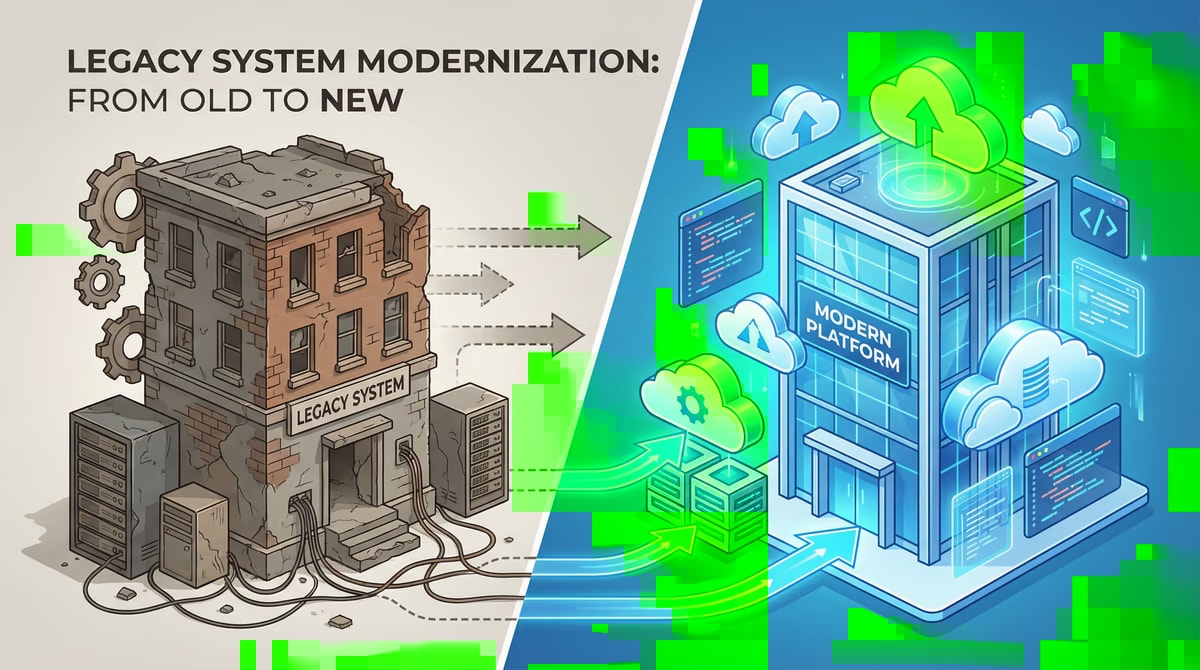
Technical debt in legacy systems: A ticking time bomb?
In the fast-paced world of software development, time and budget are often the driving forces. In order to adhere to deadlines and keep projects within the framework, compromises are often made at...
Replace legacy software: strategies and common pitfalls
In today's fast-paced digital world, outdated software systems, often referred to as legacy software, are one of the biggest challenges for companies. You can find innovations frombrem...
Legacy Migration: Strategies for a smooth transition
In today's rapidly changing digital landscape, outdated IT systems, often referred to as legacy systems, represent a considerable challenge for many companies. Although she...
Free download
Checklist: 10 questions before software development
Key points before you start: budget, timeline, and requirements.
Get the checklist in a consultationRelevant next steps
Related services & solutions
Based on this article's topic, these pages are often the most useful next steps.
Related services
Related solutions
Related comparison
Cost calculators
Practical next steps after Planning Cloud Migration for Companies
Planning Cloud Migration for Companies addresses a practical choice for product and IT teams. Start with one clear goal: reduce legacy risk in controlled steps while daily work and key data remain available.
Check the current process, the data involved, and the result users need. Then record the main risks and define a small first step. This keeps the decision easy to review and gives your team a shared basis.
For implementation support, our legacy software modernization connects the article's guidance with architecture, delivery, and stable operations. Engineering and project ownership stay with our team in Leer, Germany.
This post belongs to Legacymodernization. Browse the related Legacymodernization articles or use the English software blog for other topics.
When budget is the next question, the software cost calculators provide planning ranges. The IT glossary explains key terms, while in-depth technology guides cover wider decisions.
If the topic affects a live project, book a technical consultation or send the context through our project contact form. We usually reply within one working day.