
As of: 19 June 2026 · Reading time: 4 min
Key takeaways
- Learn how the 'Pay-as-you-earn' principle works in software leasing and how it reduces the financial burden during the implementation phase.
Learn how the 'Pay-as-you-earn' principle works in software leasing and how it reduces the financial burden during the implementation phase.
“Digitalization is not an IT project—it is a business strategy.”
– Björn Groenewold, Managing Director, Groenewold IT Solutions
"Pay-as-you-earn" This is behind the...
The pay-as-you-earn model allows companies to pay for software development costs only once the software is already generating revenue.
It is especially suited for startups and projects with predictable revenue streams — but requires clear contractual agreements on revenue sharing and duration.
"Pay-as-you-earn": This is behind the financing model for software leasing
**The introduction of new, complex enterprise software often involves a longer period between the first investment and the moment the software actually generates added value for the company.
In this phase of implementation and training costs arise without revenue or efficiency gains being achieved.
This is precisely where the innovative financing model "Pay-as-you-earn" is used, which is offered by some modern IT leasing providers. We explain what's behind it. **
The problem: Costs before benefit
Short: Executive answer: Learn how the 'Pay-as-you-earn' principle works in software leasing and how it reduces the financial burden during the implementation phase.
Executive answer: Learn how the 'Pay-as-you-earn' principle works in software leasing and how it reduces the financial burden during the implementation phase.
When planning "Pay-as-you-earn" This is behind the... from idea to delivery, View services, Software Financing sowie Software Leasing offer practical next steps on our site.
Imagine you are introducing a new ERP system. The implementation takes six months.
During this time you already pay for licenses, developers and consultants, but your employees are still working with the old system.
Cash flow is double-loaded: the cost of the new system and the remaining productivity increases. This can lead, in particular, to a significant liquidity bottleneck for medium-sized enterprises.
The solution: Coupling rate payments to benefits
Short: The "Pay-as-you-earn" principle (in German, for example: "Pay-as-you-earn" shifts the start of leasing rate payments.
The "Pay-as-you-earn" principle (in German, for example: "Pay-as-you-earn" shifts the start of leasing rate payments.
Instead of paying the rates from the start of the contract, payments only start when the software is productively used – that is, at the time when it begins to create an economic benefit.
In practice, this means:
Implementation phase: During installation, adaptation and training, no or only very small rates are required for your company.
The leasing provider takes over the financing and pays the invoices of the software suppliers.
Productive start (Go-Live): Only when the software is successfully implemented and your employees work with it, the regular rate payment begins.
The advantages of "Pay-as-you-earn"
Short: This model offers decisive advantages that go far beyond a simple stunding:
This model offers decisive advantages that go far beyond a simple stunding:
Maximum liquidity saving: The financial burden will be transferred precisely to the phase in which the software begins to bear its costs by increasing efficiency or revenue growth itself.
Reduced investment risk: The risk of long and expensive implementation phases is reduced, as the costs are only really borne by the success of the project.
More project planning: Companies can concentrate fully on a successful implementation without being cured by immediate payment pressure.
Interest equation: All participants – You, the software provider and the leasing provider have a common interest in a fast and successful introduction of the software.
Which projects are suitable for this model?
Short: "Pay-as-you-earn" is especially valuable for:
"Pay-as-you-earn" is especially valuable for:
- Great ERP or CRM inputs with long implementation
References and further reading
Short: The following independent references complement the topics in this article:
The following independent references complement the topics in this article:
- Bitkom – German digital industry association
- German Federal Office for Information Security (BSI)
- European Commission – Digital strategy
- MDN Web Docs (Mozilla)
- W3C – World Wide Web Consortium
Frequently Asked Questions (FAQ)
What is this article about: “"Pay-as-you-earn" This is behind the...”?
This post explores "Pay-as-you-earn" This is behind the... from the perspective of requirements, typical pitfalls, and sensible next steps.
In short: Learn how the 'Pay-as-you-earn' principle works in software leasing and how it reduces the financial burden during the implementation phase.
Who benefits most from the content described here?
Useful for project leads and product owners in Contributions who must choose between standard software, custom development, and integration.
How does this topic fit into an IT or digital strategy?
Technically and organizationally, alignment with experienced partners pays off — from requirements to operations; start with the [services overview](/en/services/software-development). For multi-system landscapes, [IT consulting and architecture](/en/services/it-consulting) helps align vendors and internal teams.
What are sensible next steps if we need support?
A practical next step: book a consultation and clarify which MVP or pilot fits your team and landscape.
About the author

Managing Director of Groenewold IT Solutions GmbH and Hyperspace GmbH
Since 2009 Björn Groenewold has been developing software solutions for the mid-market. He is Managing Director of Groenewold IT Solutions GmbH (founded 2012) and Hyperspace GmbH. As founder of Groenewold IT Solutions he has successfully supported more than 250 projects – from legacy modernisation to AI integration.
Blog recommendations
Related articles
These posts might also interest you.

Funding for software projects: You should know these programs
The development of individual software solutions is a decisive step for many companies to increase their own competitiveness and to establish innovative business models. Do...
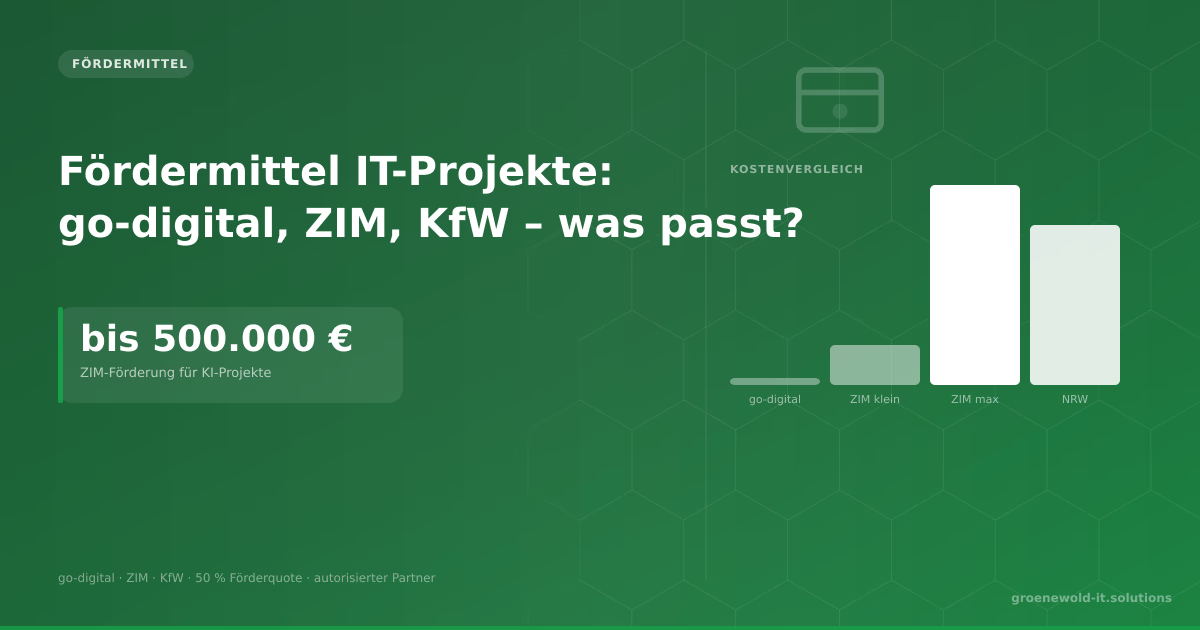
Funding IT projects: go-digital, ZIM, KfW – what fits your company?
IT projects can be funded up to 55%. go-digital (up to €16,500), ZIM (up to €500,000), KfW credit: This article explains what program fits for what project – and how to correct the application.

Digitization in the middle class: How to secure funding and support
Digitization is no longer a trend for small and medium-sized enterprises (SMEs), but a need to remain competitive. But the implementation of digital projects requires invest...
Free download
Checklist: 10 questions before software development
Key points before you start: budget, timeline, and requirements.
Get the checklist in a consultationRelevant next steps
Related services & solutions
Based on this article's topic, these pages are often the most useful next steps.
Related services
Related solutions
More on Contributions and next steps
This article is in the Contributions topic. In our blog overview you will find all articles; under category Contributions more posts on this subject.
For topics like Contributions we offer matching services – from app development and AI integration to legacy modernisation and maintenance. We describe typical use cases under solutions. Our cost calculators give initial estimates. Key terms are in the IT glossary. Books and long-form guides appear on the publications page; deeper articles live under topics.
If you have questions about this article or want a non-binding discussion about your project, you can book a consultation or reach us via contact. We usually respond within one working day.