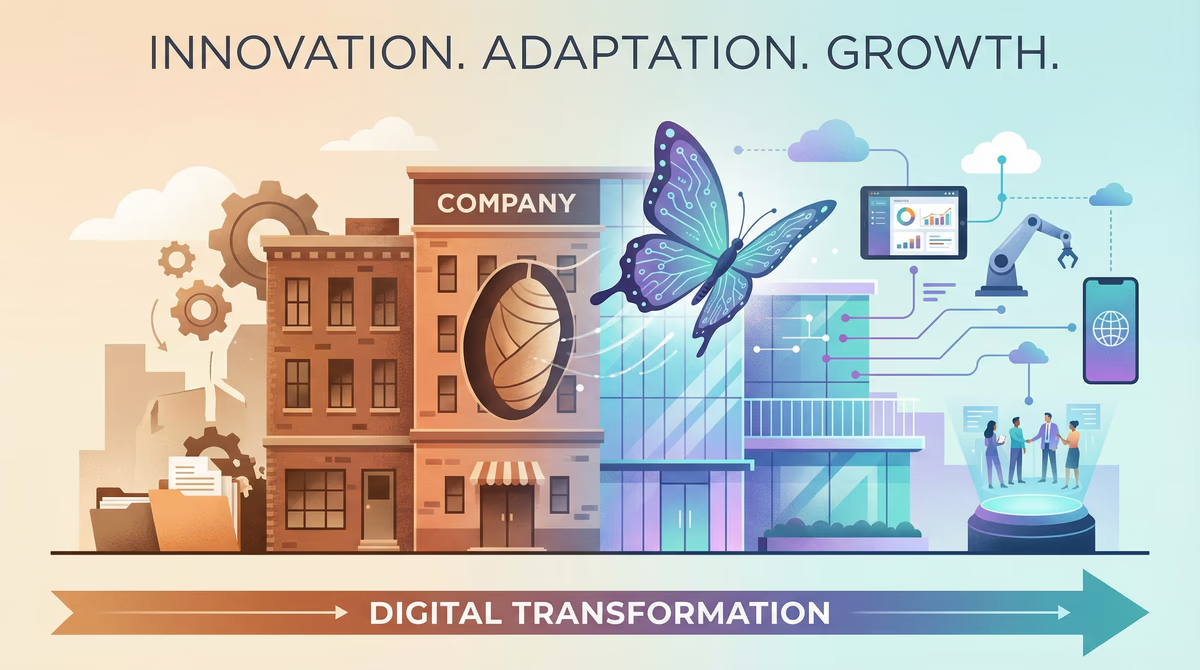
Digitization in the middle class: The right technology selection as a success factor
Digitization is no longer an option for small and medium-sized enterprises (SMEs), but a need to compete. But **Digitalization in the middle class** is...

Estimate budget and expected latency improvements for your optimization initiatives.
In brief
The investment frame is EUR 5,891 – 211,675 excl. VAT. Bottleneck and load profile change the scope inside this frame.
The calculation follows six visible stages. All figures remain planning values until scope and assumptions have been reviewed.
1. Capture inputs
The calculator records the visible project, volume, complexity and operating parameters selected on this page.
2. Add fixed components
Fixed base modules and selected add-ons are added without mixing them with recurring charges.
3. Apply multipliers
Quantity, complexity and scope factors multiply only the cost components identified for them in the calculator model.
4. Create the range
The calculator applies its documented lower and upper uncertainty factors to the base result; ROI views keep investment and savings visible separately.
5. Round and calibrate
Monetary result fields are rounded to the nearest whole euro. Public project-cost components are calibrated with the centrally maintained display factor.
6. Classify the result
The result is shown as non-binding guidance. A binding quote requires scope, data, integrations, risks and acceptance criteria to be reviewed.
Efficiency or discount factor: A central display factor of 0.7 is applied to public project-cost components to keep all calculators aligned with the currently reviewed pricing basis. It is not a customer-specific discount; customer-entered wages, revenues and existing operating costs are not reduced.
Why this is not a binding quote: The calculator cannot verify complete requirements, third-party dependencies, data quality, legal constraints or acceptance criteria.

Concrete project profiles with assumptions and indicative budgets—useful for internal alignment alongside the calculator.
The upfront cost can be spread over 72 months. Terms are on the software financing page.
FAQ
Profiling, targeted fixes and validation runs differ per bottleneck—frontend asset work, API batching or database indexing each carry distinct effort.
Traffic spikes and strict SLAs add load-testing time.
Because meaningful scenarios need data, environments and analysis.
Skipping them often means learning about limits from angry users instead of controlled experiments.

Find the highest-impact bottleneck
We pair metrics with business-critical journeys.
Often yes—less CPU, memory and egress directly follow efficient code paths and caching.
Track both user experience and infrastructure spend.
Yes, otherwise regressions return unnoticed.
Continuous metrics prove each optimisation stuck after the next deploy.
Decisive is the type of bottleneck, such as database, application logic, network or frontend rendering.
Each bottleneck type requires different analysis and solution steps. In this cost calculator you can rank the suspected problem area as a rough cost driver.
Without a reliable measurement there is a risk of optimising in the wrong place and wasting budget.
Profiling, load tests and monitoring show where time and resources are actually lost. Only this data basis makes an economical prioritisation possible.
Defined target values such as response time, throughput or Core Web Vitals prevent endless re-optimisation.
They define when the result is sufficient and the project ends. Without such thresholds the costs often rise uncontrolled.
More hardware works in the short term but masks structural problems and permanently raises the running operating costs.
A targeted optimisation removes the cause and lowers infrastructure costs in the long run. Often a combination of both is the most economical solution.
Faster load times, in our experience, improve conversion, user retention and visibility in search engines.
This gives performance a direct revenue relevance and not just a technical value. This benefit should be part of the profitability assessment.
A focused optimisation of individual bottlenecks often ranges in the low to mid four-figure area, while deep architectural work is higher.
These values are experience values, not fixed prices. The value in this cost calculator provides a first orientation for your planning.
Measurement before any optimization, targeted actions, and re-measurement—so every euro has measurable impact.
1. Baseline measurement
We measure current latency, throughput, error rate, and resource bottlenecks. Without baseline there's no proof of success.
2. Diagnosis and hotspot analysis
We analyze database queries, caches, frontend bundle, Core Web Vitals, and server load. So actions go to the right spots.
3. Targeted optimizations
We calculate actions per hotspot (query optimization, caching, bundle splitting). You see what improvement each brings.
4. Re-measurement and reporting
We repeat measurement and deliver a before/after report. So everyone knows what the investment yielded.
| Model | When it fits | Budget & flexibility | Typical risks |
|---|---|---|---|
| Fixed price (fixed scope) | Clearly defined scope, stable requirements, repeatable delivery. | Predictable total cost; little room for change without a change order. | Scope creep leads to change orders or quality trade-offs. |
| Time & Material | Discovery, legacy, evolving requirements, or close collaboration. | Maximum flexibility; budget transparent via hourly or daily rates. | Without prioritisation, effort can grow—backlog and reviews matter. |
| Retainer / maintenance package | Ongoing operations, updates, small features, and support. | Agreed capacity per month; predictable follow-on cost. | Large changes may still need a separate estimate. |
| Hybrid (milestone + T&M) | MVP or phased releases with clear go-lives, then iterate. | Core delivery fixed price; extensions on a time-and-materials basis. | Define contractually what is in scope vs. extra work. |
Calculators on this page provide indicative ranges; we choose the right model with you based on risk, scope, and planning horizon.
The ranges shown are indicative. For a binding quote we discuss scope, priorities and funding options in a free intro call. Many digitalization projects qualify for grants – try our funding calculator.
Browse all cost calculators, explore services and typical solutions. Questions about performance optimization? Contact us.
After using the performance optimization calculator, validate assumptions in a short intro call.
Browse all cost calculators in the costs overview.
How much does your performance project cost?
Interactive estimate based on your inputs.
Non-binding project range from the software cost calculator: EUR 10,332 – 372,623 excl. VAT.
Methodology: The estimates are based on historical project data, complexity drivers and standard implementation assumptions. Results are a non-binding indication only; effort and price must be calculated individually.
If you are still deciding
If you are ready to implement
Calculator overall range
EUR 5,600–84,000 excl. VAT, depending on SLA and system criticality
The overall range is derived from the valid parameters of the relevant cost calculator.
Typical duration
2–16 weeks to establish the operating model
Main risk drivers
Non-binding indication
This result is only a non-binding indication based on typical assumptions. Effort and price must be calculated individually for your project.
Blog posts that put budget, effort and typical project paths for this calculator in context.

Digitization in the middle class: The right technology selection as a success factor
Digitization is no longer an option for small and medium-sized enterprises (SMEs), but a need to compete. But **Digitalization in the middle class** is...

Digitization in the middle class: How to measure your success
Digitization is no longer a trend for medium-sized enterprises, but a need to remain competitive. But how to measure the success of Digitalisie...

Digital Transformation: Leadership and Change Management as key to success
Digital transformation is more than just the introduction of new technologies. It is a profound change process that affects companies of all sizes. Especially for small and...