As of: 23 September 2026 · Reading time: 6 min
Key takeaways
- Not every old system needs a rewrite – Encapsulate often cheaper.
- Altlast analysis costs €3,000–2,000 and is mandatory.
- Data migration accounts for 15–30 % of the total budget.
- Parallel operation protects production – no Big Bang release.
Replacing legacy software costs € 10,000 to €250,000 depending on the strategy. This article explains the four modernization strategies (Encapsulate, Rehost, Replatform, Rewrite), typical costs and why parallel operation of the Big Bang always strikes.
“Digitalization is not an IT project—it is a business strategy.”
– Björn Groenewold, Managing Director, Groenewold IT Solutions
Replacing Legacy Software: Costs, Risks, and a Step-by-Step Roadmap
What This Is About
Replacing legacy software typically costs between €10,000 and €250,000 depending on your modernization strategy.
When planning replacing legacy software—costs, risks, and a step-by-step roadmap, these resources help: legacy modernization, legacy modernization cost calculator, legacy reduction solution, and our monolith vs. microservices comparison.
A Delphi system that has been running for 15 years is not broken – it is invisible. The entire business logic is in undocumented units.
No developer wants to touch it. Every change costs three times. This is Legacy software.
This article shows what modernization really costs, what strategy fits for what situation, and why the Big Bang is almost always a mistake.
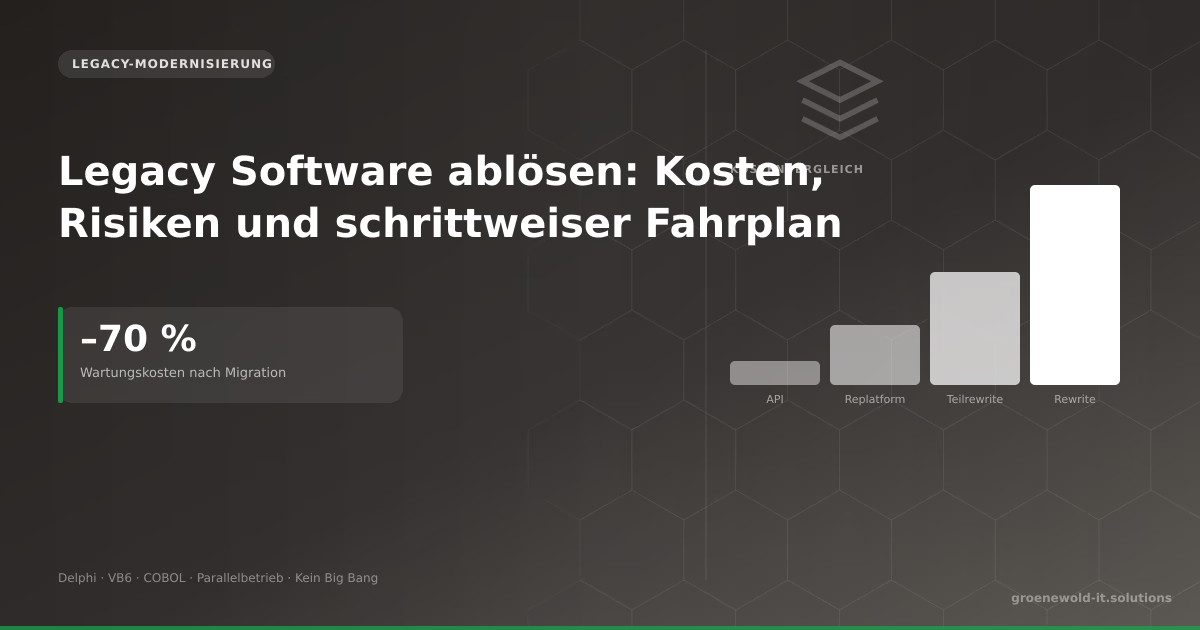
Legacy modernization: costs according to approach
Legacy modernization: costs by approach
Groenewold IT Solutions · Experiences from 250+ projects
Four strategies – not every old system needs a rewrite
The most common mistake in legacy projects: a complete new building (rewrite), although a cheaper strategy leads to the same result.
Strategy 1: Encapsulate (API capsule)
Short: The old system remains unchanged.
The old system remains unchanged. An API layer is built to connect modern applications (new web UI, mobile app, external partners). The old system is no longer visible.
- *When: Core logic is stable, but the UI or interfaces are outdated. Costs: 10,000–30,000 € Risk: Low – old system is not touched.
Strategy 2: Rehost
Short: The system relies on new hardware or cloud infrastructure.
The system relies on new hardware or cloud infrastructure. Software remains identical. Profit: lower operating costs, better access, end of dependency on outdated hardware.
Costs: 5,000–25,000 €
Strategy 3: Replatform
The system is upgraded to a new runtime environment.
E.g. from .NET Framework 4.8 to .NET 8, from PHP 5 to PHP 8, from Delphi 6 to Delphi 12. The code is adjusted.
However, the architecture remains preserved.
Costs: 20.000–80.000 €
Strategy 4: Rewrite (targeted new development)
Short: Only where the old system is no longer structurally viable.
Only where the old system is no longer structurally viable. In practice, this is rarely the entire system, but custom modules.
Risk assessment of the four modernisation strategies
| Strategy/th> | Risk | Duration/th> | Recommended if | Encapsulate (API layer) <'td style="padding:10px 14px;font Not applicable Not applicable : > High/td> | Alt system no longer capable of carrying |
|---|
Groenewold IT Solutions · Experiences from 250+ projects · Stand 2026
What does an legacy system assessment cost?
Before anyone can call a budget for modernization, the old system must be understood. This is not a precaution – it is a duty.
A professional Altlast review includes:
- Code architecture: All undocumented dependencies and business logic decisions.
- Data assessment: Quality, completeness, data base.
- Technology assessment: What runtimes, libraries, operating systems are affected? Risk assessment: What happens if a specific component fails?
- Recommendation report: What strategy makes economic sense?
Cost Legacy system assessment: 3,000–12.000 € (typically: 5 working days fixed price)
The report contains a decision template with budget frameworks for modernization options – no non-binding films.
Data Migration: the underestimated cost factor
In a Delphi system that was used for 15 years, there is often more business knowledge in the database than in the application itself.
Calculation rules that are not recorded elsewhere. Special treatments for custom customers. Historical data that must be stored for GoBD.
Data migration includes:
- Mapping tables (source → target, incl. transformation rules).
- Staging environment for migration trials.
- Reports (Old stock = New stock?)
- Cutover concept with freeze window and rollback plan.
Data migration typically costs 15–30 % of the total project budget.
Proven migration schedule (parallel operation)
Legacy system assessment 2–4 weeks/span>
Code architecture: undocumented business logic, dependencies, data quality
Target image & Strategy · 1–2 weeks/span>
What strategy fits? Which modules first? Risk assessment
Data staging & mapping · 2–4 weeks/span>
data migration concept, mapping tables, quality check
Incremental development (iterativ) · 3–12 months
module for module, parallel operation, permanent adjustment
Parallel Operation & Tests 1–3 months <– <– <– <– <– <– <– <– <– <– <– <– <– <– <– <– <– <– <– <– <– <– <– <– <– <– <– <– <– <– <– <– <– <– <– <– <– <– <– <– <– <– <– <– <– <– <– <– <– <– <– <– <– <– <– <– <– <– <– <– <– <– <– <– <– <– <– <– <– <– <– <– <– <– <– <– <– <– <– <– <– <– <– <– <– <– <– <– <– <– <– <– <– <– <– <– <– <– <– <– <– <– <– <– <– <– <– <– <– <– <– <– <– <– <– <– <– <– <– <– <– <– <– <– <– <–
Old system and new system run parallel, results are compared
Cutover & shutdown · 1–2 weeks/span>
Freeze window, Delta-Sync, Rollback plan, Altsystem shut off
Practice Example: Delphi 6 → .NET 8 (Production Control)
For a manufacturer with 200+ machine connections, we migrated a 15 year old Delphi-6 production control into a .NET-8 web app.
| Parallel operation | 6 months (no production stop) | ||
| Migration duration total | 14 months | ||
| Project volume | about 95,000 € | ||
| Maintenance expenditure after migration | –70 % | ||
| Machine connections via OPC-UA | 200+ |
“A Delphi system running for 15 years is not broken – but it is invisible. The first phase is always archaeology." – Björn Groenewold, Dipl.-Inf.
Frequently asked questions
Can we continue working during migration?
Yes – that is even the normal case. Parallel operation (old system and new system running simultaneously) is the gold standard for critical productive systems.
Only when all tests are green, the old system is switched off.
What happens if the old system is only understood by one person?
We call this "knowledge risk' and is an separate part of the Altlast review.
We conduct structured interviews, document implicit knowledge and create a knowledge repository – before the person retires or leaves the company.
How long does a typical legacy project last?
Capsulation/Rehost: 4–10 weeks. Replatform: 3–8 months. Full rewrite: 9–24 months. With parallel operation at the upper limit, without at the lower.
What does it cost to do nothing?
This is a serious question. Unpatched systems are security risks. Outdated runtimes lose support.
If the only developer who knows the system leaves the company, it can be existentially threatening.
We call this the 'Stylish Price' and calculate it explicitly in our recommendations.
*Groenewold IT Solutions, Empty – Legacy Modernization for the German mid-sized firms since 2012. Request legacy system assessment. *
Technical sources and further links
The following separate references complement the grouping on the topics of this Article:
About the author

Managing Director of Groenewold IT Solutions GmbH and Hyperspace GmbH
Since 2009 Björn Groenewold has been developing software solutions for the mid-market. He is Managing Director of Groenewold IT Solutions GmbH (founded 2010) and Hyperspace GmbH. As founder of Groenewold IT Solutions he has successfully supported more than 250 projects – from legacy modernisation to AI integration.
Blog recommendations
Related articles
These posts might also interest you.
Technical debt in legacy systems: A ticking time bomb?
In the fast-paced world of software development, time and budget are often the driving forces. In order to adhere to deadlines and keep projects within the framework, compromises are often made at...
Replace legacy software: strategies and common pitfalls
In today's fast-paced digital world, outdated software systems, often referred to as legacy software, are one of the biggest challenges for companies. You can find innovations frombrem...
Legacy Migration: Strategies for a smooth transition
In today's rapidly changing digital landscape, outdated IT systems, often referred to as legacy systems, represent a considerable challenge for many companies. Although she...
Free download
Checklist: 10 questions before software development
Key points before you start: budget, timeline, and requirements.
Get the checklist in a consultationRelevant next steps
Related services & solutions
Based on this article's topic, these pages are often the most useful next steps.
Related solutions
Related comparison
Cost calculators
Practical next steps after Replacing Legacy Software: Costs, Risks and a Step-by-Step Roadmap
Replacing Legacy Software: Costs, Risks and a Step-by-Step Roadmap addresses a practical choice for product and IT teams. Start with one clear goal: reduce legacy risk in controlled steps while daily work and key data remain available.
Check the current process, the data involved, and the result users need. Then record the main risks and define a small first step. This keeps the decision easy to review and gives your team a shared basis.
For implementation support, our legacy software modernization connects the article's guidance with architecture, delivery, and stable operations. Engineering and project ownership stay with our team in Leer, Germany.
This post belongs to Legacymodernization. Browse the related Legacymodernization articles or use the English software blog for other topics.
When budget is the next question, the software cost calculators provide planning ranges. The IT glossary explains key terms, while in-depth technology guides cover wider decisions.
If the topic affects a live project, book a technical consultation or send the context through our project contact form. We usually reply within one working day.
Next Step
Need a custom cost estimate for your project?
We provide a realistic effort estimate based on your specific requirements.
30 min strategy call – 100% free & non-binding