
As of: 23 September 2026 · Reading time: 9 min
Key takeaways
- Create mobile app for companies: How to plan goals, functions, interfaces, GDPR and operation for measurable results.
Create mobile app for companies: How to plan goals, functions, interfaces, GDPR and operation for measurable results.
“An ERP system is only as good as its fit to your actual business processes.”
– Björn Groenewold, Managing Director, Groenewold IT Solutions
Anyone who wants to create a mobile app for business rarely faces a pure design question. It is usually a specific business problem.
Slow service processes, lack of clarity in external services, media breaks in sales or insufficient connection to existing systems.
At this point, it decides whether an app is a meaningful lever or just another software project without a clear effect.
When it makes sense to create a mobile app for companies
Create Mobile App for Companies: How to plan goals, functions, interfaces, GDPR and operation for measurable results.
For Create mobile app for companies, API & Integration Projects and Cost Calculator: API Development are practical starting points. Budget and industry context: Solution: Integration Chaos.
Create a mobile app for companies Data Analysis & Business Intelligence and App development are suitable entrances for planning and rollout.
Not every project needs a native app for iOS and Android at once. In many cases, a web application is sufficient, which runs in an improved manner.
A company app is especially worthwhile when mobile use is business-critical.
This is the case, for example, when employees record data on the way, customers regularly interact via the smartphone or certain device functions such as camera, push messages, location or offline operation are needed.
For companies, the app is rarely the actual product. It is usually part of a larger digital process.
A service technician documents on-site deployments, a sales team accesses current customer data, an internal platform controls releases mobile, or a customer app bundles bookings, communication and status messages.
The economic benefits then arise not by the app alone. However, by faster processes, less errors and better data quality.
That is why the first question should not be: what technology do we use? The better question is: What measurable process should be improved with the app?
Define goals before functions
Many projects start with a long wish list. Login, Dashboard, Chat, Upload, Push, Map View, Reporting. That sounds tangible, but is often not prioritized.
If you want to create a mobile app for companies, you need a resilient target.
Should the app reduce processing times, reduce the number of manual inputs, increase service quality or allow new digital sales? ?Without this target image, any functional discussion becomes expensive.
Because then features are built that are technically possible but not relevant for business. For leaders, this is a risk at two levels.
Budget and time are running out of the frame, while the benefit remains difficult to detect.
In practice, a clear scope is proven to start. What user groups are there? Which three to five core processes really need to work in the first version?
What data must be available? And what key figures show after the Go-Live whether the project is successful?
Anyone who answers these questions cleanly at an early stage creates planability.
The largest construction site is often not in the front end
Short: The app interface gets a lot of attention.
The app interface gets a lot of attention. The actual project success often depends on the interfaces in the background. A company app rarely needs to work isolated.
It accesses ERP data, synchronizes customer data from CRM, processes third-party documents or transfers information to internal release processes.
If this system landscape is not conceived early, typical problems arise. Double data retention, inconsistencies, manual exports or vulnerabilities.
So, architecture is not a technical secondary topic, but a management decision. It determines how manageable, expandable and resilient the solution is still in two or five years.
Especially in mid-sized firms you often see historically grown systems with custom adjustments. This is not an exclusion criterion.
It only means that integrations, data models and rights concepts must be planned professionally from the outset. A good app looks simple to the outside.
In the background it is clearly structured, cleanly tied and prepared for operation.
Native, hybrid or web app - what really fits?
The choice of technology should be based on the purpose of use, not on trends.
Native apps offer benefits when performance, deep device access or very specific platform functions are in the foreground.
This can be relevant for complex workflows, hardware connection or challenging offline use.
Cross-Platform approaches are interesting if a company iOS and Android wants to operate in parallel and brings a common code base economic benefits.
This reduces development effort in many cases and simplifies further development. However, this also applies. Not every feature can be introduced identically.
And some special needs increase complexity. .A mobile improved web app is often the right choice when fast access, central updates and lower entry costs are more important than app store presence or deeper system access.
For internal processes, this can be completely sufficient. The right decision is so not a set of beliefs.
However, a balancing of usage scenario, security needs, budget and operating model.
GDPR, rights and security are not rework
Short: Once personal data is processed, data protection is mandatory.
Once personal data is processed, data protection is mandatory. In mobile applications, this concerns not only forms and logins.
However, also push messages, location data, camera uploads, logging and the question where data is stored and processed.
For companies, one thing is important. Security must be created in the project, not just before the Go level.
This includes a comprehensible role and rights concept, encrypted transmission, secure authentication, clear deletion and storage rules. This also covers a loadable documentation.
Those who work in the B2B environment or in the public sector know the effects when these points come too late.
Releases delay, decreases get stuck and confidence sinks into the project.
It is so useful not to consider development, architecture and compliance separately.
Especially in custom applications, a GDPR-compliant rollout is easier to achieve if needs are structured cleanly from the start.
Why standard software is often not enough
There are good standard solutions for simple, widespread applications.
However, if a company has special processes, internal release chains, custom role models or complex interfaces, standard software quickly reaches limits. Then the phase of the workarounds begins.
Employees handle the system, Excel files continue to live, and extra tools close gaps needed.
This is where custom app development becomes economical. Not because custom software is basically better.
However, because it can fit the process instead of compelling the process into a rigid grid. The advantage lies in control, expandability and long-term usability.
However, it is a prerequisite that the project is managed cleanly and does not remain in an open experimentation phase.
How a resilient app project runs
If companies can create a mobile app, they can expect more than pure programming. A structured project path is crucial.
At the beginning there is a technical clarification: goals, users, processes, data sources, risks and priorities. Then follow the solution concept, architecture and a realistic effort estimate.
Only when scope and technical guidelines are clarified is built.
In rollout, an stepwise approach usually works best. Not everything has to be done on the first day.
But each phase should provide a clear result that is technically verifiable. In this way, department and IT keep control of budget, quality and direction.
The transition to operation is equally important. Many projects fail not on the first release. However, on lack of maintenance, unclear responsibilities or complete documentation.
Who thinks in the long term plans support, monitoring, updates and further development from the outset.
For risk-sensitive organisations, this is not an extra, but part of the decision.
What a mobile app costs for companies
The most honest answer is that it comes to scope.
An app with few core functions and manageable interfaces is something completely different than a platform with multiple roles, ERP connection, offline logic and broad security needs.
It is not crucial to call as early as possible any number. It is crucial to make the cost drivers transparent.
These include integrations, rights concepts, custom business logic, data migration, test effort and later operating needs. Companies should so not only ask for development costs.
However, for total costs over the life cycle.
A transparent fixed price makes sense where needs are clearly defined. Where there is still technical uncertainty, it first needs a resilient design phase. Both are legitimate.
It will only be problematic if projects start with seemingly favorable entry prices and become uncontrollable later by supplements.
What to pay attention to decision-makers when choosing a partner
If an app supports business-critical processes, technical rollout strength alone is not sufficient.
Companies need a partner that structured needs, makes risks visible early and takes ownership beyond the go-live.
These include clear contact persons, comprehensible architectural decisions, clean documentation and realistic statements on effort and schedule. .Source code ownership, German development and GDPR-compliant rollout also play a central role for many organisations.
This is not a formal addition, but a question of long-term control. Who is clean here from the start reduces dependencies and creates security for later extensions.
Groenewold IT Solutions works clearly with this claim. Custom software from a single source, with fixed developers in Germany, clear scopes and measurable results.
Especially in mobile applications, this framework is often the difference between a functioning digital product and a project that never really matters.
Anyone who plans a company app today should not think of screens first, but of effect. The best app is not the one with most features.
However, the one that makes an important process noticeably better and wears reliably in everyday life.
Technical sources and further links
The following separate references complement the grouping on the topics of this Article:
- Bitkom – Digital Economy Association.
- BSI – Federal Office for Information Security.
- European Commission – Digital Strategy.
- MDN Web Docs (Mozilla)
- W3C – World Wide Web Consortium.
"Mobile apps need not only UX but also clear offline and security concepts; otherwise, trust and acceptance in the area suffers."
— *Björn Groenewold, Managing Director, Groenewold IT Solutions *
About the author

Managing Director of Groenewold IT Solutions GmbH and Hyperspace GmbH
Since 2009 Björn Groenewold has been developing software solutions for the mid-market. He is Managing Director of Groenewold IT Solutions GmbH (founded 2010) and Hyperspace GmbH. As founder of Groenewold IT Solutions he has successfully supported more than 250 projects – from legacy modernisation to AI integration.
Blog recommendations
Related articles
These posts might also interest you.

Hosting and operation of web applications
Hosting and operation of web applications: What companies should pay attention to in terms of security, scaling, GDPR, support and responsibility in everyday life.
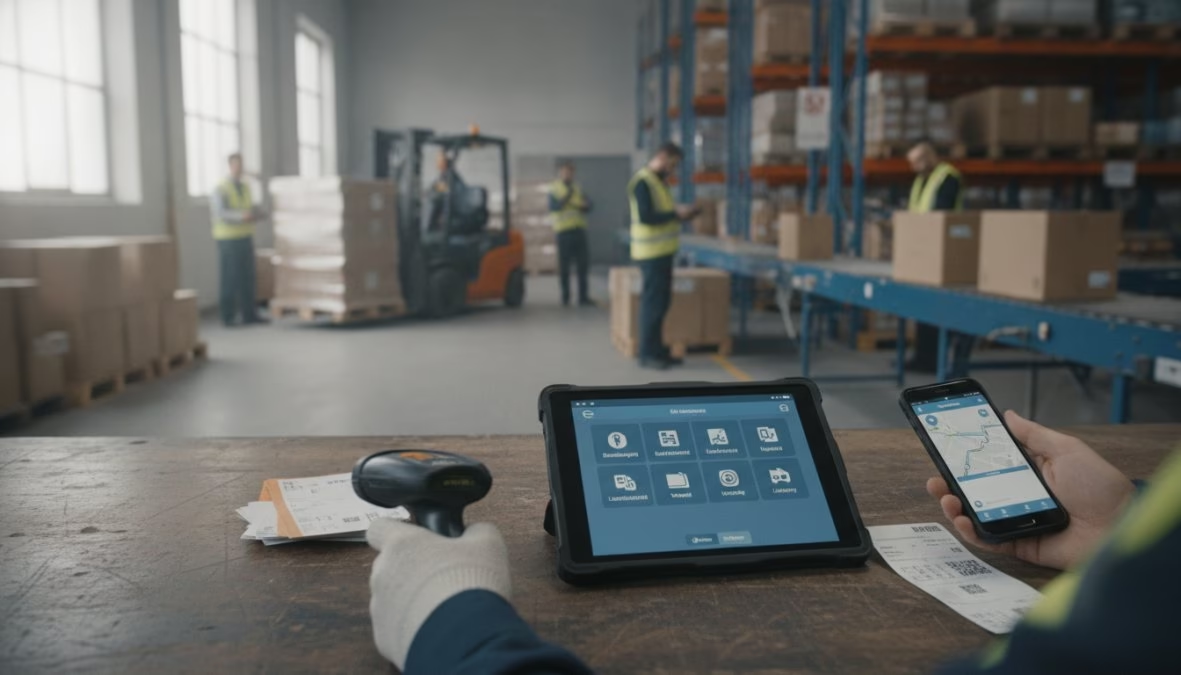
Mobile Applications for Logistics Processes: The Practice Guide
Mobile applications for logistics processes optimize storage, transport and supply chain. Advantages, features and selection at a glance – now discover.

Implementing Automation in Mid-Sized Businesses the Right Way
Automation in mid-sized businesses reduces costs and errors. Learn what processes are worthwhile and how the implementation can be planned.
Free download
Checklist: 10 questions before software development
Key points before you start: budget, timeline, and requirements.
Get the checklist in a consultationRelevant next steps
Related services & solutions
Based on this article's topic, these pages are often the most useful next steps.
Related solutions
Related comparison
Cost calculators
Practical next steps after Create mobile app for companies
Create mobile app for companies addresses a practical choice for product and IT teams. Start with one clear goal: choose an app approach that stays secure, testable, and useful after launch.
Check the current process, the data involved, and the result users need. Then record the main risks and define a small first step. This keeps the decision easy to review and gives your team a shared basis.
For implementation support, our business app development connects the article's guidance with architecture, delivery, and stable operations. Engineering and project ownership stay with our team in Leer, Germany.
This post belongs to ERP & CRM. Browse the related ERP & CRM articles or use the English software blog for other topics.
When budget is the next question, the software cost calculators provide planning ranges. The IT glossary explains key terms, while in-depth technology guides cover wider decisions.
If the topic affects a live project, book a technical consultation or send the context through our project contact form. We usually reply within one working day.