
As of: 19 June 2026 · Reading time: 4 min
Key takeaways
- A detailed cost-benefit analysis that helps you decide whether to lease or buy your next ERP software.
- Financial, strategic and technological aspects are taken into account.
A detailed cost-benefit analysis that helps you decide whether to lease or buy your next ERP software. Financial, strategic and technological aspects are taken into account.
“Digitalization is not an IT project—it is a business strategy.”
– Björn Groenewold, Managing Director, Groenewold IT Solutions
**The introduction of an ERP system (Enterprise Resource Planning) is one of the most strategic and costly IT investments for a company.
It connects all business units and forms the digital backbone of the organization. But with the decision for a system, the question of financing is inevitably raised: leasing or buying?
This cost-benefit analysis highlights the crucial factors to help you choose. **
The cost factor: High initial investment vs. planable rates
Short: Executive answer: A detailed cost-benefit analysis that helps you decide whether to lease or buy your next ERP software.
Executive answer: A detailed cost-benefit analysis that helps you decide whether to lease or buy your next ERP software.
Decision-makers exploring ERP software lease or buy? A cost-benefit analysis can use API & Integration Projects, Cost Calculator: API Development, Solution: Integration Chaos sowie RPA vs. API Integration as structured entry points.
The most obvious difference is the cost structure.
High initial costs are incurred in the ** purchase** of an ERP system. These include not only royalties, but often also costs for implementation, adaptation and training.
This sum can quickly reach six to seven-digit amounts and binds substantial capital that could be missing elsewhere in the company.
This high initial investment is dispensed with at Leasing. Instead, you pay regular, contractually fixed rates. This saves liquidity and converts a large investment output (CapEx) into planned operating expenditure (OpEx).
The cost of implementation and maintenance can often be integrated into the leasing rates.
Strategic considerations: Property vs. Use
The decision is also strategic.
The ** purchase** means property. The ERP system becomes a long-term asset of the company.
This can be useful when it comes to a highly individualized solution, which should form the core of the business processes for many years.
However, the company also carries the full risk of technological ageing.
Leasing focuses on usage. You have the right to use a modern ERP solution without binding to a specific technology in the long term.
After the leasing period expires (typically 3-5 years), you can switch to a newer version or another system. This flexibility is an invaluable advantage in a rapidly changing technology landscape.
Cost-benefit comparison at a glance
A. ERP software lease Buy ERP software
Financial expenditure * * Planable monthly rates (OpEx) High one-time investment (CapEx)
**Liquidity * * If saved, no capital bond heavily loaded
**Technological risk * * Gering, since easy change after runtime possible High, risk of ageing lies with the company
** Tax treatment * * Rats immediately deductible as operating expenses Depreciation over several years
Total cost (TCO) Over time often comparable to purchase High initial costs, but no interest shares
Which model is suitable for whom?
Leasing is especially attractive for:
Growth companies and SMEs: which need to maintain their liquidity and remain flexible.
**Technology oriented Branc
References and further reading
Short: The following independent references complement the topics in this article:
The following independent references complement the topics in this article:
- Bitkom – German digital industry association
- German Federal Office for Information Security (BSI)
- European Commission – Digital strategy
- MDN Web Docs (Mozilla)
- W3C – World Wide Web Consortium
"Cloud-native only pays off when operations, security, and cost model match the architecture—otherwise you ship complexity faster."
— Björn Groenewold, Managing Director, Groenewold IT Solutions
Frequently Asked Questions (FAQ)
What is this article about: “ERP software lease or buy? A cost-benefit analysis”?
This post explores ERP software lease or buy? A cost-benefit analysis from the perspective of requirements, typical pitfalls, and sensible next steps.
In short: A detailed cost-benefit analysis that helps you decide whether to lease or buy your next ERP software. Financial, strategic and technological aspects are taken into account.
Who benefits most from the content described here?
Useful for project leads and product owners in Contributions who must choose between standard software, custom development, and integration.
How does this topic fit into an IT or digital strategy?
Technically and organizationally, alignment with experienced partners pays off — from requirements to operations; start with the [services overview](/en/services/software-development). For multi-system landscapes, [IT consulting and architecture](/en/services/it-consulting) helps align vendors and internal teams.
What are sensible next steps if we need support?
A practical next step: book a consultation and clarify which MVP or pilot fits your team and landscape.
About the author

Managing Director of Groenewold IT Solutions GmbH and Hyperspace GmbH
Since 2009 Björn Groenewold has been developing software solutions for the mid-market. He is Managing Director of Groenewold IT Solutions GmbH (founded 2012) and Hyperspace GmbH. As founder of Groenewold IT Solutions he has successfully supported more than 250 projects – from legacy modernisation to AI integration.
Blog recommendations
Related articles
These posts might also interest you.

Successful funding applications for software development: Best Practices
Innovation is the key to success in the dynamic world of information technology. But especially for small and medium-sized enterprises (SMEs) the financing of ambitious...
Funding for software projects: You should know these programs
The development of individual software solutions is a decisive step for many companies to increase their own competitiveness and to establish innovative business models. Do...
Funding IT projects: go-digital, ZIM, KfW – what fits your company?
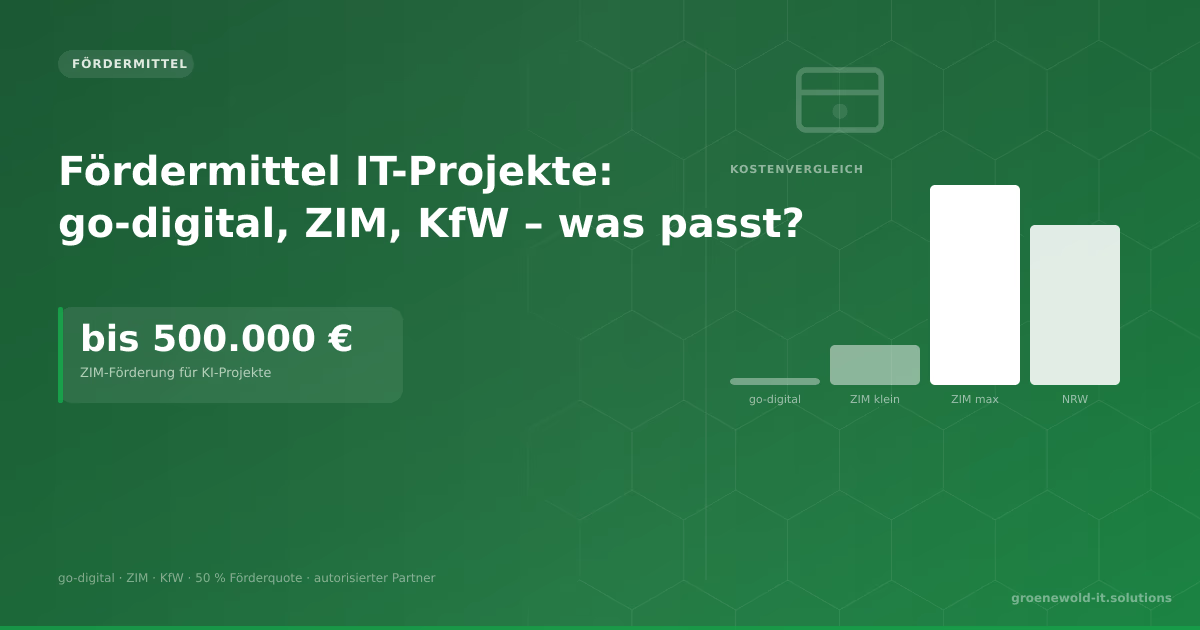
IT projects can be funded up to 55%. go-digital (up to €16,500), ZIM (up to €500,000), KfW credit: This article explains what program fits for what project – and how to correct the application.
Free download
Checklist: 10 questions before software development
Key points before you start: budget, timeline, and requirements.
Get the checklist in a consultationRelevant next steps
Related services & solutions
Based on this article's topic, these pages are often the most useful next steps.
Related services
Related solutions
Related comparison
Cost calculators
More on Contributions and next steps
This article is in the Contributions topic. In our blog overview you will find all articles; under category Contributions more posts on this subject.
For topics like Contributions we offer matching services – from app development and AI integration to legacy modernisation and maintenance. We describe typical use cases under solutions. Our cost calculators give initial estimates. Key terms are in the IT glossary. Books and long-form guides appear on the publications page; deeper articles live under topics.
If you have questions about this article or want a non-binding discussion about your project, you can book a consultation or reach us via contact. We usually respond within one working day.