
As of: 19 June 2026 · Reading time: 4 min
Key takeaways
- The ultimate guide to Odoo Development 2026: Learn everything about module development, customizing, API integration and best practices for customized ERP solutions.
The ultimate guide to Odoo Development 2026: Learn everything about module development, customizing, API integration and best practices for customized ERP solutions.
“For the mid-market, Odoo is what SAP is for large enterprises—only more flexible and cost-efficient.”
– Björn Groenewold, Managing Director, Groenewold IT Solutions
Odoo Development: The ultimate guide for customized ERP solutions (2026)
Short: Published: February 2026 | Reading time: 15 minutes | Category: Odoo Basics
Published: February 2026 | Reading time: 15 minutes | Category: Odoo Basics
Standard solutions are often no longer sufficient in today's digital business world. Small and medium-sized enterprises (SMEs) need flexible, scalable and customised software to map their unique processes and remain competitive. Here comes the Odoo development into play. As an open source ERP system, Odoo offers an incomparable flexibility that allows companies to adapt their software exactly to their needs.
1. What is Odoo?
Short: Executive answer: The ultimate guide to Odoo Development 2026: Learn everything about module development, customizing, API integration and best practices for customized ERP solutions.
Executive answer: The ultimate guide to Odoo Development 2026: Learn everything about module development, customizing, API integration and best practices for customized ERP solutions.
For Odoo Development: The ultimate guide for..., View services, Cost Calculator: Odoo ERP/CRM sowie Discover solutions help you align implementation, scope and budget before you commit.
Odoo is a complete suite of open source business applications that covers all areas of a company.
From accounting to customer relationship management (CRM) to warehouse management and e-commerce, Odoo offers over 30 main applications and thousands of community apps that are seamlessly integrated with each other.
The system is available in two versions: The Odoo Community Edition is completely free and open source, while the Odoo Enterprise Edition offers additional features, professional support and an extended hosting offer.
Did you know? Odoo is used by over 12 million users worldwide, making it one of the most frequently installed ERP systems in the world.
The active community contributes to continuous development with over 36,000 apps.
2. Why Odoo development?
Short: The strength of Odoo lies in its adaptability.
The strength of Odoo lies in its adaptability.
While many ERP systems force companies to adapt their processes to the software, Odoo allows the reverse way: the software is adapted to the processes. This is done by Odoo development.
Advantages of individual Odoo development
Perfect fit: Your software is exactly your business processes, not vice versa.
Competitive advantage: Unique features that your competition does not have.
Scalability: The solution grows with your company.
Integration: Seamless connection to existing systems and third party software.
Cost efficiency: No license fees for the Community Edition, only development costs.
Three. The technology stack of Odoo
To understand the possibilities of Odoo development, a look at the technical architecture is helpful. Odoo is based on proven, modern technologies:
Component Technology Use
Backend Python 3 Business logic, data processing
Frontend JavaScript (OWL Framework) user interface, interactivity
Views & Reports XML, QWeb Forms, lists, reports
Database Postal code Data storage
Web server Tool (Python) HTTP requests
Types of Odoo Development
4.1 Module development
Short: The development of new modules is the core of the Odoo adaptation.
The development of new modules is the core of the Odoo adaptation. A module is a self-contained unit, the new functionalities
Sources: Unless cited inline, market figures and percentages are for orientation; see public sources such as Bitkom (2025) and Destatis. Project budgets and examples: Groenewold IT Solutions, internal reporting 2026.
References and further reading
Short: The following independent references complement the topics in this article:
The following independent references complement the topics in this article:
- Bitkom – German digital industry association
- German Federal Office for Information Security (BSI)
- European Commission – Digital strategy
- MDN Web Docs (Mozilla)
- W3C – World Wide Web Consortium
Frequently Asked Questions (FAQ)
What is this article about: “Odoo Development: The ultimate guide for...”?
Here we cover Odoo Development: The ultimate guide for... — focused on architecture, process, and business outcomes.
In short: The ultimate guide to Odoo Development 2026: Learn everything about module development, customizing, API integration and best practices for customized ERP solutions.
Who benefits most from the content described here?
Typical readers are business and IT leaders in Odoo who want to secure quality, security, and maintainability over the long term.
How does this topic fit into an IT or digital strategy?
In a digital strategy, prioritize stable core processes first, then extensions. See also professional software development and consulting. For multi-system landscapes, IT consulting and architecture helps align vendors and internal teams.
What are sensible next steps if we need support?
If you need support with design, delivery, or modernization: schedule an appointment or outline your project via contact.
About the author

Managing Director of Groenewold IT Solutions GmbH and Hyperspace GmbH
Since 2009 Björn Groenewold has been developing software solutions for the mid-market. He is Managing Director of Groenewold IT Solutions GmbH (founded 2012) and Hyperspace GmbH. As founder of Groenewold IT Solutions he has successfully supported more than 250 projects – from legacy modernisation to AI integration.
Blog recommendations
Related articles
These posts might also interest you.
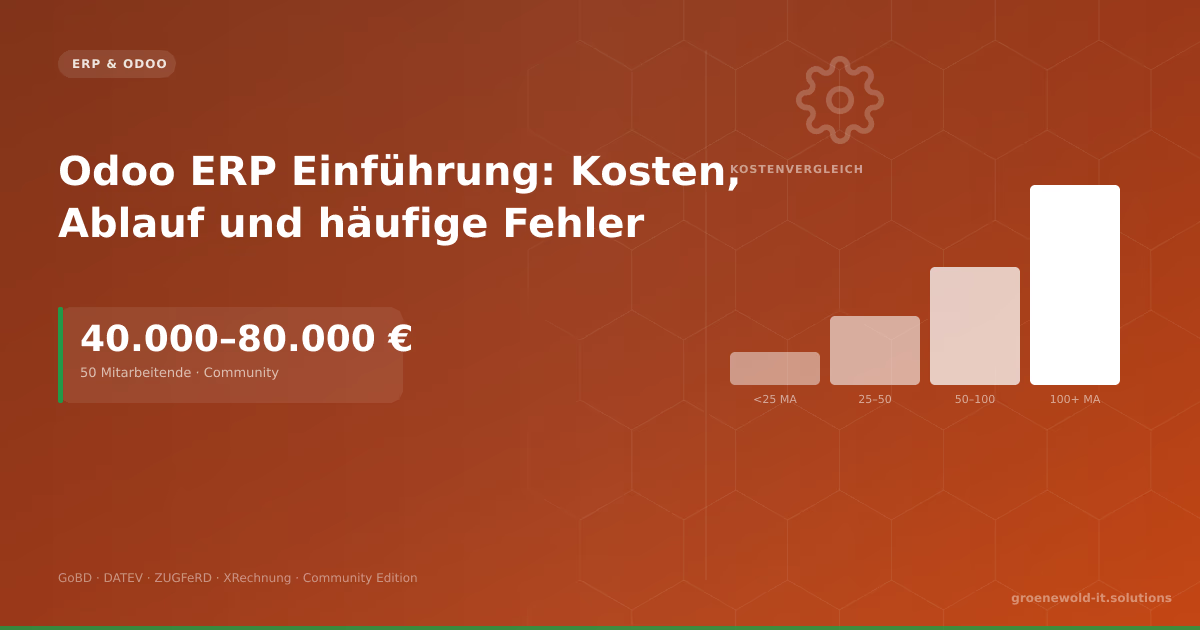
Odoo ERP Introduction: Cost, execution and frequent errors
An Odoo-ERP entry costs typically €40,000-80,000 for 50 employees. This article gives clear figures on Community vs. Enterprise, GoBD requirements, module issues and the five most common project…

Odoo vs. SAP: Which ERP solution fits the middle class?
In today's digital landscape, medium-sized companies face the crucial question of which ERP system (Enterprise Resource Planning) best supports their business processes...
Open Source vs. Proprietary: Odoo and SAP compared
Choosing the right enterprise resource planning (ERP) system is a strategic decision that can significantly influence the success of a company. Two of the best known providers...
Free download
Checklist: 10 questions before software development
Key points before you start: budget, timeline, and requirements.
Get the checklist in a consultationRelevant next steps
Related services & solutions
Based on this article's topic, these pages are often the most useful next steps.
Related services
Related solutions
Cost calculators
More on Odoo and next steps
This article is in the Odoo topic. In our blog overview you will find all articles; under category Odoo more posts on this subject.
For topics like Odoo we offer matching services – from app development and AI integration to legacy modernisation and maintenance. We describe typical use cases under solutions. Our cost calculators give initial estimates. Key terms are in the IT glossary. Books and long-form guides appear on the publications page; deeper articles live under topics.
If you have questions about this article or want a non-binding discussion about your project, you can book a consultation or reach us via contact. We usually respond within one working day.