
As of: 19 June 2026 · Reading time: 4 min
Key takeaways
- The decision for a new ERP system (Enterprise Resource Planning) is one of the most strategic ones a company can make.
- It influences the efficiency of business processes, the Sk...
The decision for a new ERP system (Enterprise Resource Planning) is one of the most strategic ones a company can make. It influences the efficiency of business processes, the Sk...
“For the mid-market, Odoo is what SAP is for large enterprises—only more flexible and cost-efficient.”
– Björn Groenewold, Managing Director, Groenewold IT Solutions
> **Key Takeaway:** Odoo implementation costs for SMEs typically range from EUR 10,000 to 80,000, while SAP projects rarely start below EUR 100,000. The timeline for Odoo is 2–6 months, for SAP Business One 4–12 months. Odoo is more cost-effective and faster; SAP offers deeper industry functionality.
Odoo implementation: cost and time frame compared to SAP
Short: The decision for a new ERP system (Enterprise Resource Planning) is one of the most strategic ones a company can make.
The decision for a new ERP system (Enterprise Resource Planning) is one of the most strategic ones a company can make. It influences the efficiency of business processes, scalability and long-term growth. Two of the most famous systems on the market are Odoo and SAP. But how do they differ in terms of cost and implementation time? This article highlights the most important aspects and helps you make a sound decision.
Odoo vs. SAP: A basic overview
Short: Executive answer: The decision for a new ERP system (Enterprise Resource Planning) is one of the most strategic ones a company can make.
Executive answer: The decision for a new ERP system (Enterprise Resource Planning) is one of the most strategic ones a company can make.
Decision-makers exploring Odoo implementation: cost and time frame compared to SAP can use View services, Cost Calculator: Odoo ERP/CRM sowie Discover solutions as structured entry points.
Before we devote ourselves to the cost and time frame, it is important to understand the fundamental differences between Odoo and SAP.
Odoo: Flexible and modular
Short: Odoo is an open source ERP system known for its flexibility and modular design.
Odoo is an open source ERP system known for its flexibility and modular design.
Companies can start with basic applications such as CRM, sales and warehouse management and add further modules such as manufacturing, accounting or human resources if necessary.
This approach makes Odoo especially attractive for small and medium-sized enterprises (SMEs) seeking a scalable solution.
SAP: Solid and standardized
Short: SAP, especially SAP Business One for SMEs, is a proprietary ERP solution known for its solid and standardized business processes.
SAP, especially SAP Business One for SMEs, is a proprietary ERP solution known for its solid and standardized business processes.
It offers deep integration in finance, supply chain management and customer relationship management and is especially suitable for companies with complex, global processes and high transaction volumes.
Price Comparison: Odoo vs. SAP
Short: The costs for an ERP system can be divided into two main categories: licensing costs and implementation costs.
The costs for an ERP system can be divided into two main categories: licensing costs and implementation costs. There are clear differences between Odoo and SAP.
License costs
Short: For license costs, Odoo is usually the cheaper option.
For license costs, Odoo is usually the cheaper option. The price model of Odoo is transparent and user-based.
The Odoo Enterprise version, which includes all standard apps, begins at about 25 € per user and month.
For a team of five employees, the monthly license costs would be around € 125.
SAP Business One usually has higher license and maintenance costs.
The exact prices are often less transparent and depend on different factors such as e.g. the number of users and the required modules.
Implementation costs
Short: Implementation costs include the establishment of the system, data migration, adaptations and training.
Implementation costs include the establishment of the system, data migration, adaptations and training. Here too, Odoo is often the cheaper choice.
A typical Odoo implementation for a small company can cost between 2,000 € and 10,000 €.
The exact price depends on the complexity of the project, the number of apps to be implemented and the degree of adjustments required.
The implementation of SAP Business One is usually more expensive and more complex. Costs may vary according to P
Transparency: Where no primary source is named in the text, figures are illustrative; compare Bitkom and Destatis. Project-related statements: Groenewold IT, 2026.
References and further reading
Short: The following independent references complement the topics in this article:
The following independent references complement the topics in this article:
- Bitkom – German digital industry association
- German Federal Office for Information Security (BSI)
- European Commission – Digital strategy
- MDN Web Docs (Mozilla)
- W3C – World Wide Web Consortium
Frequently Asked Questions (FAQ)
What is this article about: “Odoo implementation: cost and time frame compared to SAP”?
This article summarizes practical aspects of Odoo implementation: cost and time frame compared to SAP for decision-makers and delivery teams.
In short: The decision for a new ERP system (Enterprise Resource Planning) is one of the most strategic ones a company can make. It influences the efficiency of business processes, the Sk...
Who benefits most from the content described here?
It is especially relevant for organizations in Odoo that need reliable systems, clear interfaces, and predictable delivery — from mid-market teams to specialized departments.
How does this topic fit into an IT or digital strategy?
You can map the topic to service building blocks such as custom software and delivery support: architecture reviews and iterative rollout reduce risk and rework. For multi-system landscapes, IT consulting and architecture helps align vendors and internal teams.
What are sensible next steps if we need support?
For architecture, implementation, or a second expert opinion, book a free initial consultation — including timeline and interface alignment.
About the author

Managing Director of Groenewold IT Solutions GmbH and Hyperspace GmbH
Since 2009 Björn Groenewold has been developing software solutions for the mid-market. He is Managing Director of Groenewold IT Solutions GmbH (founded 2012) and Hyperspace GmbH. As founder of Groenewold IT Solutions he has successfully supported more than 250 projects – from legacy modernisation to AI integration.
Blog recommendations
Related articles
These posts might also interest you.
Odoo ERP Introduction: Cost, execution and frequent errors
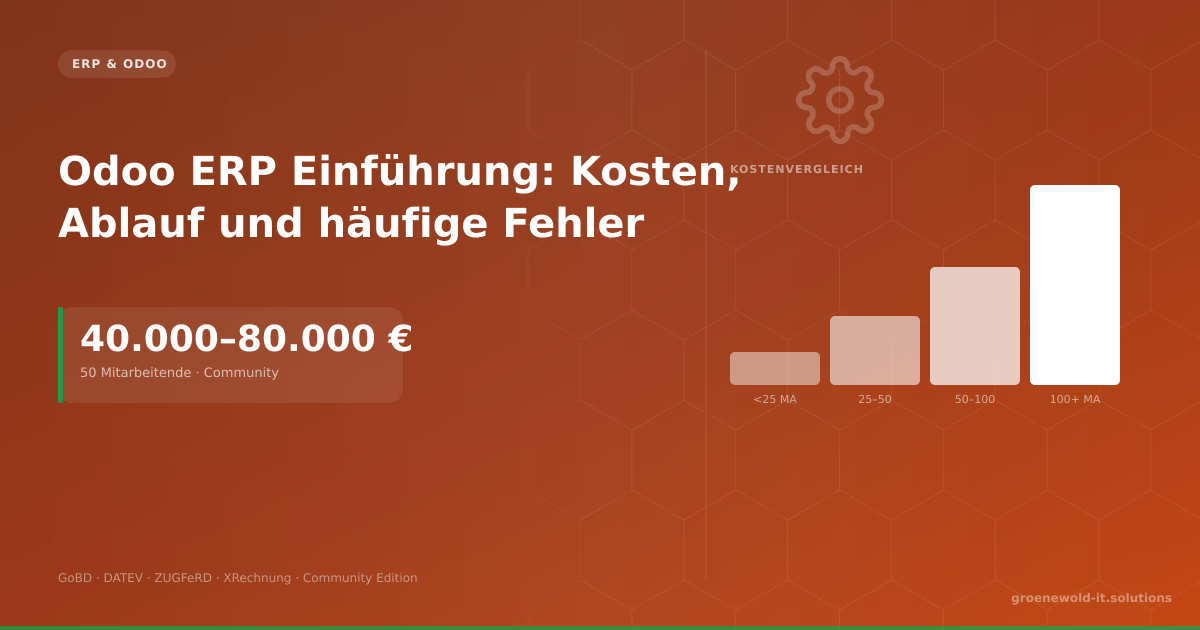
An Odoo-ERP entry costs typically €40,000-80,000 for 50 employees. This article gives clear figures on Community vs. Enterprise, GoBD requirements, module issues and the five most common project…

Odoo vs. SAP: Which ERP solution fits the middle class?
In today's digital landscape, medium-sized companies face the crucial question of which ERP system (Enterprise Resource Planning) best supports their business processes...
Open Source vs. Proprietary: Odoo and SAP compared
Choosing the right enterprise resource planning (ERP) system is a strategic decision that can significantly influence the success of a company. Two of the best known providers...
Free download
Checklist: 10 questions before software development
Key points before you start: budget, timeline, and requirements.
Get the checklist in a consultationRelevant next steps
Related services & solutions
Based on this article's topic, these pages are often the most useful next steps.
Related services
Related solutions
Cost calculators
More on Odoo and next steps
This article is in the Odoo topic. In our blog overview you will find all articles; under category Odoo more posts on this subject.
For topics like Odoo we offer matching services – from app development and AI integration to legacy modernisation and maintenance. We describe typical use cases under solutions. Our cost calculators give initial estimates. Key terms are in the IT glossary. Books and long-form guides appear on the publications page; deeper articles live under topics.
If you have questions about this article or want a non-binding discussion about your project, you can book a consultation or reach us via contact. We usually respond within one working day.