
As of: 19 June 2026 · Reading time: 4 min
Key takeaways
- Choosing the right enterprise resource planning (ERP) system is a strategic decision that can significantly influence the success of a company.
- Two of the best known providers...
Choosing the right enterprise resource planning (ERP) system is a strategic decision that can significantly influence the success of a company. Two of the best known providers...
“For the mid-market, Odoo is what SAP is for large enterprises—only more flexible and cost-efficient.”
– Björn Groenewold, Managing Director, Groenewold IT Solutions
Open-source ERP (Odoo) offers lower entry costs, full customizability, and vendor independence. Proprietary solutions like SAP score with deep industry modules and proven enterprise support.
The decision is not about better or worse, but about company size, IT strategy, and customization needs.
Open Source vs. Proprietary: Odoo and SAP compared
Short: Choosing the right enterprise resource planning (ERP) system is a strategic decision that can significantly influence the success of a company.
Choosing the right enterprise resource planning (ERP) system is a strategic decision that can significantly influence the success of a company.
Two of the best-known providers on the market are Odoo and SAP. While SAP is considered an established giant for large companies, Odoo has become a flexible open source alternative.
But what system is the right one for your company? This post highlights the Odoo vs SAP comparison and helps you make a sound decision.
What is a ERP system?
An ERP system is an integrated software solution that allows companies to manage and automate their business processes.
From accounting to human resources to warehouse management and customer relationship management (CRM) – an ERP system bundles all important functions in a central database.
The aim is to increase efficiency, increase transparency and allow data-based decisions.
Odoo vs. SAP: A detailed comparison
Short: Executive answer: Choosing the right enterprise resource planning (ERP) system is a strategic decision that can significantly influence the success of a company.
Executive answer: Choosing the right enterprise resource planning (ERP) system is a strategic decision that can significantly influence the success of a company.
For Open Source vs. Proprietary: Odoo and SAP compared, View services, Cost Calculator: Odoo ERP/CRM sowie Discover solutions help you align implementation, scope and budget before you commit.
Although both systems are pursuing the same basic objective, they differ substantially. The Odoo vs SAP comparison shows that the choice depends heavily on the individual requirements, size and budget.
Target group and enterprise size
Short: Odoo is primarily aimed at small and medium-sized enterprises (SMEs).
Odoo is primarily aimed at small and medium-sized enterprises (SMEs).
Thanks to its modular design and flexible scalability, it is ideal for growing companies who want to start with a slim solution and add additional functions if needed.
The open-source nature also enables a high adaptability to specific business processes.
SAP, especially with its solutions such as SAP S/4HANA, aims at large corporations and internationally operating companies. These often require complex, industry-specific functionalities and have the necessary resources for implementation and maintenance.
SAP offers an enormous depth of functions that are essential for controlling global supply chains and complex financial processes.
Costs and implementation
Short: Costs are a key factor in Odoo vs SAP Duell.
Costs are a key factor in Odoo vs SAP Duell. Odoo is basically free as an open source software in the community version.
Costs apply to the Enterprise version, implementation, adjustments and support. However, overall costs are usually significantly lower than SAP. The implementation times are shorter because Odoo is more flexible and less complex.
SAP is associated with significant investment. Licence fees, an elaborate implementation by certified consultants and ongoing maintenance costs quickly add up to high amounts.
The introduction of an SAP system is a long-term project that often takes several months or even years
References and further reading
Short: The following independent references complement the topics in this article:
The following independent references complement the topics in this article:
- Bitkom – German digital industry association
- German Federal Office for Information Security (BSI)
- European Commission – Digital strategy
- MDN Web Docs (Mozilla)
- W3C – World Wide Web Consortium
Frequently Asked Questions (FAQ)
What is this article about: “Open Source vs. Proprietary: Odoo and SAP compared”?
This post explores Open Source vs. Proprietary: Odoo and SAP compared from the perspective of requirements, typical pitfalls, and sensible next steps.
In short: Choosing the right enterprise resource planning (ERP) system is a strategic decision that can significantly influence the success of a company. Two of the best known providers...
Who benefits most from the content described here?
Useful for project leads and product owners in Odoo who must choose between standard software, custom development, and integration.
How does this topic fit into an IT or digital strategy?
Technically and organizationally, alignment with experienced partners pays off — from requirements to operations; start with the [services overview](/en/services/software-development). For multi-system landscapes, [IT consulting and architecture](/en/services/it-consulting) helps align vendors and internal teams.
What are sensible next steps if we need support?
A practical next step: book a consultation and clarify which MVP or pilot fits your team and landscape.
About the author

Managing Director of Groenewold IT Solutions GmbH and Hyperspace GmbH
Since 2009 Björn Groenewold has been developing software solutions for the mid-market. He is Managing Director of Groenewold IT Solutions GmbH (founded 2012) and Hyperspace GmbH. As founder of Groenewold IT Solutions he has successfully supported more than 250 projects – from legacy modernisation to AI integration.
Blog recommendations
Related articles
These posts might also interest you.
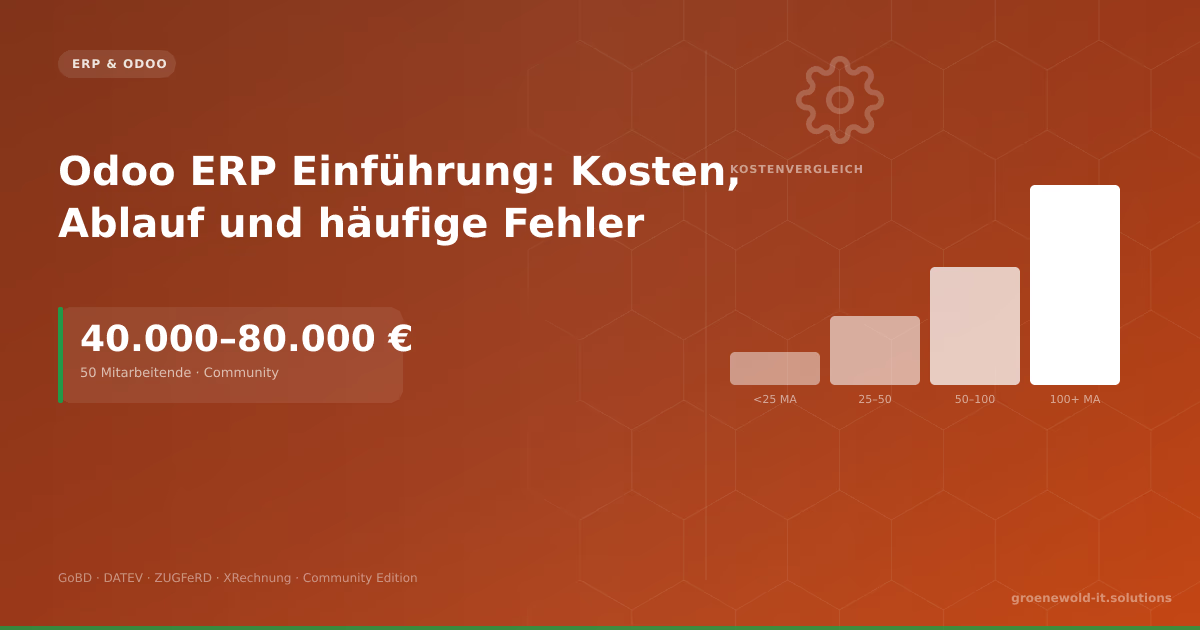
Odoo ERP Introduction: Cost, execution and frequent errors
An Odoo-ERP entry costs typically €40,000-80,000 for 50 employees. This article gives clear figures on Community vs. Enterprise, GoBD requirements, module issues and the five most common project…

Odoo vs. SAP: Which ERP solution fits the middle class?
In today's digital landscape, medium-sized companies face the crucial question of which ERP system (Enterprise Resource Planning) best supports their business processes...
Find Odoo partners: What to look for when choosing
The decision for a new ERP system is a strategic step that sets the course for the future of your company. With Odoo you choose a powerful and flexible open source...
Free download
Checklist: 10 questions before software development
Key points before you start: budget, timeline, and requirements.
Get the checklist in a consultationRelevant next steps
Related services & solutions
Based on this article's topic, these pages are often the most useful next steps.
Related services
Related solutions
Cost calculators
More on Odoo and next steps
This article is in the Odoo topic. In our blog overview you will find all articles; under category Odoo more posts on this subject.
For topics like Odoo we offer matching services – from app development and AI integration to legacy modernisation and maintenance. We describe typical use cases under solutions. Our cost calculators give initial estimates. Key terms are in the IT glossary. Books and long-form guides appear on the publications page; deeper articles live under topics.
If you have questions about this article or want a non-binding discussion about your project, you can book a consultation or reach us via contact. We usually respond within one working day.