As of: 19 June 2026 · Reading time: 4 min
Key takeaways
- In the globalized economy, the outsourcing of software development has become a standard strategy for many companies to remain competitive.
- For a long time the offshore...
In the globalized economy, the outsourcing of software development has become a standard strategy for many companies to remain competitive. For a long time the offshore...
“Good software is not an accident—it comes from a structured development process with clear quality standards.”
– Björn Groenewold, Managing Director, Groenewold IT Solutions
Why Offshoring Alone Often Falls Short
Short: Executive answer: In the globalized economy, the outsourcing of software development has become a standard strategy for many companies to remain competitive.
Executive answer: In the globalized economy, the outsourcing of software development has become a standard strategy for many companies to remain competitive.
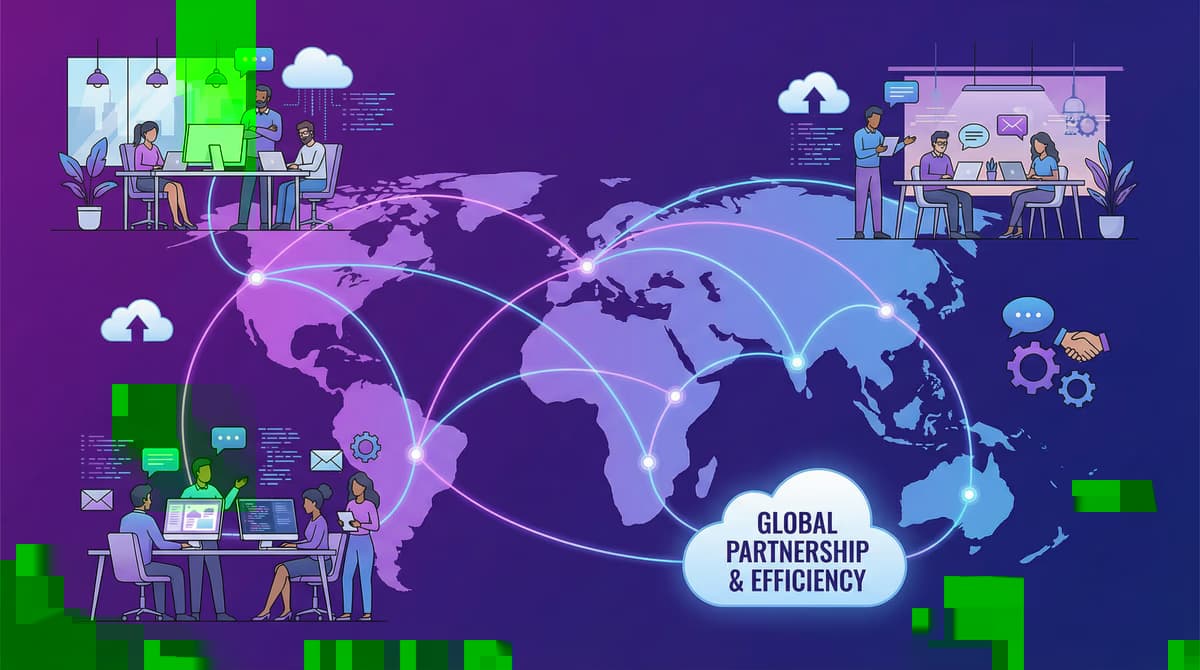
Offshore outsourcing to countries like India or the Philippines offers low hourly rates. But it creates real operational challenges. Large time differences obstruct agile workflows.
Language barriers and cultural differences frequently cause misunderstandings that are expensive to correct.
For complex projects requiring close collaboration, offshore is a deliberate risk trade-off — not a default cost reduction.
Onshore Development: Full Alignment, Higher Cost
What Onshore Means
Short: Onshore means working with a development partner within your own country.
Onshore means working with a development partner within your own country. German companies work with German-based teams. The experience is comparable to an internal department — without long-term employment commitments.
Strengths of the Onshore Model
- Same time zone — no scheduling friction
- No language barriers or cultural obstacles
- Flexible meetings, including on-site coordination
- Full alignment with German legal and compliance requirements
- GDPR compliance is standard, not an add-on
Limitations
Short: German developer rates rank among the highest globally.
German developer rates rank among the highest globally. Finding specialized talent in a tight market adds further complexity. Onshore is a premium option — not suitable for every budget.
When Onshore Makes Sense
Short: Choose onshore when compliance requirements are strict, when the project involves sensitive data, or when fast iteration cycles are critical.
Choose onshore when compliance requirements are strict, when the project involves sensitive data, or when fast iteration cycles are critical. Also appropriate when the project complexity demands constant direct communication.
Nearshore Development: Cost-Efficient, Close Enough
What Nearshore Means
Short: Nearshore bridges the gap between offshore and onshore.
Nearshore bridges the gap between offshore and onshore. Teams are located in geographically proximate regions — typically Eastern Europe. Poland, Czech Republic, Romania, and the Baltic states are common choices.
Travel time is under three hours. Time zone difference is one to two hours at most.
Strengths of the Nearshore Model
- Lower hourly rates than German providers — typically 40–55% less
- Manageable time zone overlap for daily alignment
- Cultural familiarity with European business practices
- EU membership in many countries means GDPR compliance is standard
- Short travel distances allow for periodic on-site workshops
Limitations
Short: Quality varies by provider.
Quality varies by provider. Vetting the team is more demanding than with a local partner. Communication requires more structure — written documentation becomes essential.
When Nearshore Makes Sense
Short: Nearshore suits mid-sized projects where cost control matters but project complexity still requires regular collaboration.
Nearshore suits mid-sized projects where cost control matters but project complexity still requires regular collaboration. It works best when clear specifications exist before development begins.
Direct Comparison: Onshore, Nearshore, Offshore
| Criterion | Onshore (Germany) | Nearshore (Eastern Europe) | Offshore (Asia) |
|---|---|---|---|
| Communication | Simple, same language | Good, small time difference | Challenging, large time gap |
| Quality | Very high (German standards) | Good, varies by provider | Variable, requires close control |
| Data protection | Very high (GDPR standard) | High (often EU-regulated) | Variable, often lower standards |
| Cost | High | Medium | Low |
| Time zone alignment | Perfect | Good | Poor |
The Right Model Depends on Your Project
Short: No model is universally better.
No model is universally better. The decision depends on:
- Project complexity and documentation quality
- Compliance and data protection requirements
- Available budget and timeline
- Existing experience with remote collaboration
Many companies combine models: onshore for architecture and oversight, nearshore for implementation.
"Good software is not an accident — it comes from a structured development process with clear quality standards." — Björn Groenewold, Managing Director, Groenewold IT Solutions
Frequently Asked Questions (FAQ)
What is this article about: “Offshore alternatives: Nearshore and Onshore compared”?
Here we cover Offshore alternatives: Nearshore and Onshore compared — focused on architecture, process, and business outcomes.
In short: In the globalized economy, the outsourcing of software development has become a standard strategy for many companies to remain competitive. For a long time the offshore...
Who benefits most from the content described here?
Typical readers are business and IT leaders in Software development who want to secure quality, security, and maintainability over the long term.
How does this topic fit into an IT or digital strategy?
In a digital strategy, prioritize stable core processes first, then extensions. See also professional software development and consulting. For multi-system landscapes, IT consulting and architecture helps align vendors and internal teams.
What are sensible next steps if we need support?
If you need support with design, delivery, or modernization: schedule an appointment or outline your project via contact.
References and further reading
Short: The following independent references complement the topics in this article:
The following independent references complement the topics in this article:
About the author

Managing Director of Groenewold IT Solutions GmbH and Hyperspace GmbH
Since 2009 Björn Groenewold has been developing software solutions for the mid-market. He is Managing Director of Groenewold IT Solutions GmbH (founded 2012) and Hyperspace GmbH. As founder of Groenewold IT Solutions he has successfully supported more than 250 projects – from legacy modernisation to AI integration.
Blog recommendations
Related articles
These posts might also interest you.
Altsystem migration: How to change without interruption of operation
In today's rapidly changing digital landscape, many companies face the challenge of modernizing outdated IT systems. A Altsystem migration is often unavoidable...
Onshore development: A profit for agile projects
In today's fast-paced digital world, companies increasingly rely on agile development methods to remain competitive. At the same time, the decision for the right sourcin...

Digitization in the middle class: The 8 most common mistakes and how to avoid them
Digitization is no longer a trend for the German middle class, but a need to remain competitive. But the way to the digital future is often paved with hurdles...
Free download
Checklist: 10 questions before software development
Key points before you start: budget, timeline, and requirements.
Get the checklist in a consultationRelevant next steps
Related services & solutions
Based on this article's topic, these pages are often the most useful next steps.
Related services
Related solutions
More on Software development and next steps
This article is in the Software development topic. In our blog overview you will find all articles; under category Software development more posts on this subject.
For topics like Software development we offer matching services – from app development and AI integration to legacy modernisation and maintenance. We describe typical use cases under solutions. Our cost calculators give initial estimates. Key terms are in the IT glossary. Books and long-form guides appear on the publications page; deeper articles live under topics.
If you have questions about this article or want a non-binding discussion about your project, you can book a consultation or reach us via contact. We usually respond within one working day.