
As of: 23 September 2026 · Reading time: 16 min
Key takeaways
- Did you know that unthinkable experiments with artificial intelligence since the 2nd.
- August 2026 Can fines of up to 35 million euros be drawn?
- For many medium-sized decision-makers, the topic AI for SMEs therefore often feels like a wire rope act between innovation pressure and..
Did you know that unthinkable experiments with artificial intelligence since the 2nd. August 2026 Can fines of up to 35 million euros be drawn? For many medium-sized decision-makers, the topic AI for SMEs therefore often feels like a wire rope act between innovation pressure and..
“AI in the mid-market only works when it solves a concrete business problem—not as an end in itself.”
– Björn Groenewold, Managing Director, Groenewold IT Solutions

Did you know that unthinkable experiments with artificial intelligence since the 2nd. August 2026 Can fines of up to 35 million euros be drawn?
For many midsize leaders, the theme AI for SMEs often feels like a wire rope record between innovation pressure and legal risk.
You know that automation is the key to future market strength. However, outdated legacy systems and the legitimate concern about GDPR compliance often slow down the needed progress.
We share your view that technology must not be an end in itself. However, must create a measurable economic benefit.
In this strategic guide, you will learn how to integrate artificial intelligence into your existing IT landscape in a legal and value-creating manner.
We will show you the way from modernising growing structures to implementing autonomous AI agents. This ensure highest data security through a development at the location of Germany.
You will get a clear roadmap for 2026 to sustainably increase your process efficiency without losing control of your sensitive business data.
Key findings
Did you know that unthought experiments with artificial intelligence have since 2.
For AI for SMEs: The strategic guide for SMEs 2026, AI & Machine Learning and API & Integration Projects are practical starting points on our site.
AI for SMEs: The strategic guide for mid-sized firms 2026 arrange AI & Machine Learning, cost calculator: AI development, central digitization and IT- & digital consulting services, solutions.
- Understand the technical change from simple process automation to autonomous AI agents and how these secure your market strength in 2026.
- Learn when standard software meets limits and why an custom AI for SMEs is often the only solution for protecting sensitive core processes.
- Learn how artificial intelligence serves as a bridge to progressively modernise grown legacy systems instead of performing costly and risky complete exchanges.
- Get a structured roadmap for AI deployment that minimizes the risk of misinvestment through targeted audits and technical feasibility studies.- Discover the strategic benefits of software development at the location of Germany, which guarantees maximum data security and GDPR compliance by dispensing with offshoring.
table of contents
What does AI really mean for SMEs in 2026?
- Standard AI vs. Custom Development: What makes sense for SMEs?
- AI as a bridge: modernization of legacy systems.
- Roadmap to AI integration: In 5 steps to success.
- Data security and GDPR: AI development "Made in Germany"
What does AI really mean for SMEs in 2026?
Artificial intelligence is no longer a mere field of experimentation in 2026.
For German mid-sized firms, technology has built into an vital tool to effectively counter the increasing shortage of skilled workers and the global competitive pressure.
If we talk about AI for SMEs today, we don't just mean simply generating texts or images.
It is about deep strategic integration of algorithms into operational value creation.
In order to fully exploit these potentials, a clear understanding of the principles of artificial intelligence is crucial. SMEs today need to distinguish clearly between generic AI.
This creates new content. And classic machine learning that identifies complex patterns in production or management data.
The status quo 2026 shows a clear dynamic.
The Federal Government is pursuing the goal that by 2030 about 10 percent of German economic performance is based on AI-based applications.
Those who wait in this phase risk a massive competitive disadvantage. While competitors are already relying on automated decision-making processes, after-breathers are struggling with inefficient manual processes.
ROI is no longer just about cost savings. The true economic relevance lies in the scalability of processes and a drastically increased data quality.
This only enables sound entrepreneurial decisions.
AI agents vs. simple chatbots
A simple chatbot only provides answers to questions. A modern AI agent, on the other hand, delivers results.
In 2026, the central focus has shifted to so-called multi-agent systems. These autonomous agents act as active process participants.
You perform separate tasks within your existing software instead of providing passive information.
Such an agent, for example, recognizes incoming complaints in the handling of objects, checks the warranty claims in the ERP system and prepares a solution proposal.
The human being only acts as a final control entity.
Mid-level applications
The practical application areas for AI for SMEs are diverse and often depend on the custom IT infrastructure. There are three main focuses:
- Customer communication: Multimodal AI systems process text, image and audio simultaneously to solve customer requests in real time and with high precision.
- Logistics and stockkeeping: Predictive analyses calculate the best stock of goods based on historical patterns and current market trends, which reduces capital retention.
- Back Office automation: Repetitive tasks in accounting or human resources are taken over by smart workflows, allowing employees to become free for value-generating activities.
The modernization of your IT by AI is not a project you should push to the long bank. The technical basis is available; the methodological rollout.
Standard-AI vs. Individual Development: What makes sense for SMEs?
Short: Many companies take the first impulse to produce SaaS solutions.
Many companies take the first impulse to produce SaaS solutions. The entrance is simple. The monthly costs seem to be clear. But often the frightening follows quickly.
When introducing AI for SMEs, the question is usually. Does the tool fit your processes or do you have to bend your proven processes?
Standard software often offers only one unit solution that simply ignores the deep details of midsize niche processes.
An essential aspect is strategic sovereignty. Those who feed sensitive company data into US-based cloud models are at a high risk.
The current research on AI readiness and data protection for SMEs underlines that data security is not an optional extra. She's the basis for trust.
Custom developments allow you to operate models locally or in secure European environments. So keep full sovereignty over your most important asset: your data.
The problem with the standard software
Standard tools are excellent for general tasks such as writing emails. In expert manufacturing or complex management, however, they reach their limits. Adaptability is often severely restricted.
The biggest obstacle remains the lack of integration. If the AI has no access to your internal databases or your ERP system, it remains an isolated tool.
Genuine efficiency only arises when data can flow seamlessly without employees having to copy information manually.
Benefits of customized AI integration
Professional AI & Machine Learning Integration ensures long-term competitive benefits. You have full control over the training parameters.
The AI integrates organically into the existing software environment of your employees. This greatly increases the acceptance of the team. Another advantage lies in copyright.
If you have a solution built individually, the property rights of the code belong to you.
They are no longer dependent on the pricedictates or sudden API changes of large third-party providers.
The decision between standard and custom software is ultimately a question of scalability.
Those who understand AI as core competence for SMEs are investing in a solution that grows with the company and protects their own identity.
AI as a bridge: modernization of legacy systems
In many midsize companies, care is taken that their IT structures grown for years constitute a dead end for modern technologies.
Outdated software, often referred to as legacy system, does not seem to be compatible with the needs of a AI for SMEs at first glance.
Lack of interfaces, complete documentation and proprietary database formats make access to modern algorithms more difficult. But reality in 2026 shows.
AI is not the enemy of these old systems, but the bridge into modernity.
Instead of compelling a risky and costly complete exchange (big-bang release), artificial intelligence allows a gradual transformation.
A central lever is the AI-supported refactoring. Expert models analyze the old source code to extract and document business logics.
This is especially valuable when the original developer knowledge has long left the company. Another strategic approach is data mining within old databases.
Often decades of data treasures are slumbering there, which would hardly be usable without AI support.
Modern AI interfaces allow this information to be extracted today and prepared for predictive analyses without having to replace the underlying software at once.
Legacy-Modernization by AI interfaces
The technical solution is often to put modern web apps in front of existing backend logic as an smart frontend.
The AI acts as an interpreter between the old world and modern cloud or on-premise services. This methodical approach drastically reduces the risk of rollout.
The automatic review of the source code also makes it possible to find and close vulnerabilities in old structures more quickly.
This increases the stability of the overall system. .### Case study. This makes Delphi systems sustainable
Delphi applications are still widespread, especially in manufacturing, as they run extremely high-performance and stable.
Specific expertise in Delphi development is required to open these solutions for AI for SMEs.
We use AI components to integrate smart process monitoring directly into grown ERP systems. Thus, anomalies in production can be detected early without endangering the proven core software.
The aim of this software maintenance is to ensure the ease of upkeep and features for the next ten years.
This will protect your investment while benefiting from the efficiency benefits of state-of-the-art automation.
The modernization of your legacy systems is not an obstacle to AI introduction.
It is the first logical step of a sound digitalization strategy based on reliability and long-term value retention.
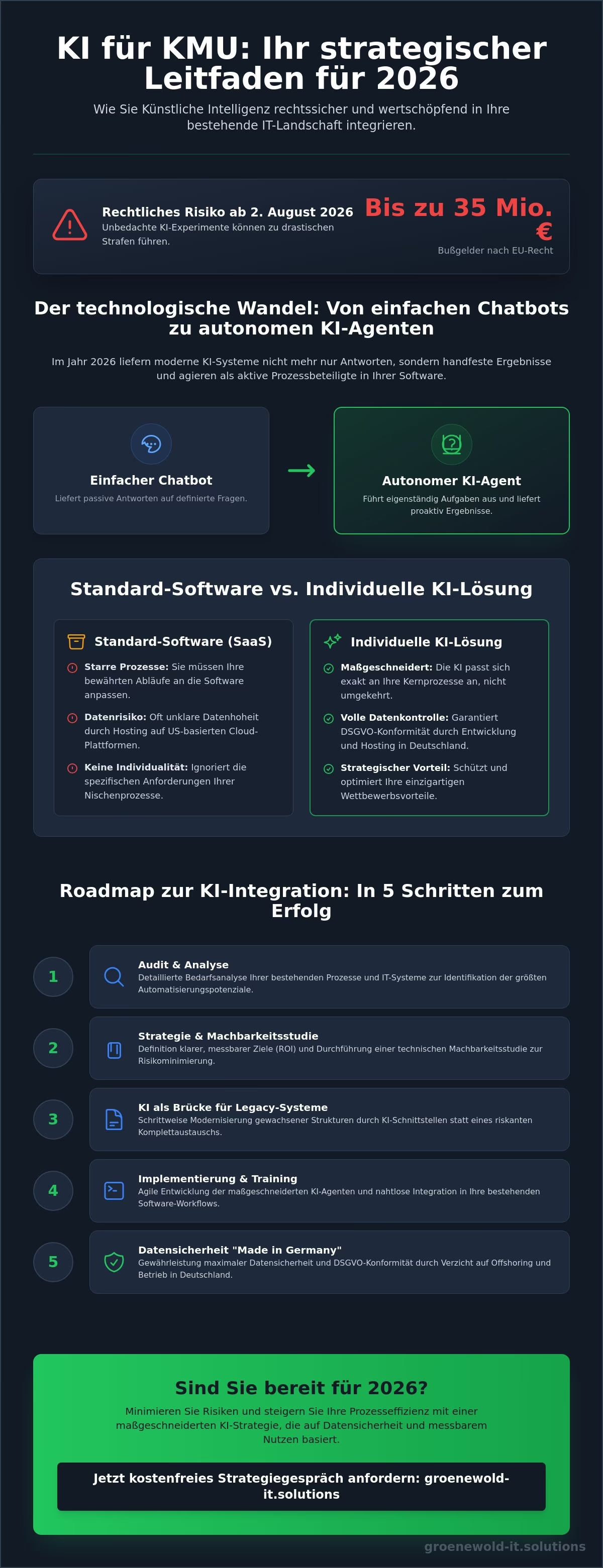
Roadmap for AI Integration: In 5 Steps to Success
Short: A methodological approach separates successful projects from costly misinvestments.
A methodological approach separates successful projects from costly misinvestments. Those who want to implement AI for SMEs must not rely on the principle of chance.
Instead, a structured five-step plan leads to the goal of combining technical feasibility with business economic reason.
- Step 1: AI audit: We jointly find the processes in your company that have the highest potential for automation. Not everything technically possible is also profitable.
- Step 2: feasibility study: Before the first line code is written, we will check the technical obstacles. Is the needed computing power present? Are the interfaces stable?
- Step 3: Data preparation: The quality of your AI depends directly on the quality of your data. We clean existing data records and ensure that the information is consistent and usable.
- Step 4: Agile development (MVP): We start with a "Minimum Viable Product". This first functional prototype allows you to get feedback early and to readjust the solution clearly.
- Step 5: Training and maintenance: An AI is just as good as the people they serve. We accompany the introduction through targeted employee training and ensure long-term stability through continuous maintenance.
The importance of feasibility study
The technical feasibility study (Feasibility Study) is the most important tool for risk mitigation.
It prevents projects from failing due to unforeseen technical barriers in the middle of development. We define clear, measurable KPIs in this phase.
You already know before the start of the project when your investment is amortised.
A sound planning protects you from uncontrolled cost explosions and creates the needed clarity for the management.
IT strategy consulting for mid-sized businesses
Choosing the right technology stack is a decision for the next ten years.
An external IT strategy consulting helps you to find manufacturer-separate solutions that fit exactly to your grown architecture. We also support you in optimally using state funding.
For example, the Land Bremen has been offering the "Digital mid-sized firms KI". Programme since April 2026, which grants projects up to €17,000.
Such funding can reduce the barriers to entry into AI for SMEs and reduce the amortisation time.
A far-sighted planning not only takes into account the status quo. However, prepares your IT infrastructure for future developments in the field of autonomous agents.
Your company remains flexible and secure for the future.
Data Security and GDPR: AI development "Made in Germany"
The legal framework for artificial intelligence has been greatly strengthened by the EU AI Act.
Since 2 August 2026, complete clarity and supervisory duties have been relevant to high-risk AI systems in Germany.
Violations can result in fines of up to 35 million euros or 7 percent of the global annual turnover. For the subject of AI for SMEs this means.
Security is not a technical game, but an existential need.
Those who rely on solutions that allow data to flow uncontrolled into non-European clouds not only loses the confidence of their customers.
However, also risks protecting their laboriously built business secrets.
A decisive security feature is the conscious abandonment of offshoring.
If software development takes place exclusively at the location of Germany, the local strict data protection laws at once intervene. There are no legal grey areas through third-country transfers.
This local value added guarantees that your intellectual property remains exactly where it belongs. In your company.
By developing inland, you keep full control of the training data and the model parameters.
This is vital especially in the processing of sensitive customer data or proprietary manufacturing logic. .### Data protection as a competitive advantage
In a market that is Flutter by global standard tools, certified data security develops into a real differentiation feature.
Midsize companies that use GDPR-compliant AI models build a deeper trust base for their business partners.
We are more often relying on on on-premise solutions or private cloud environments within Germany.
These infrastructures allow the benefits of modern automation to be exploited without abandoning autonomy through their own IT landscape.
To avoid legal pitfalls already in the design phase and secure a long-term license for your AI applications.
Groenewold IT Solutions GmbH: Your partner for safe AI
Groenewold IT Solutions GmbH sees itself as the reliable anchor for mid-sized firms in a complex technical world. Our approach is characterized by Hanseatic reliability.
We develop custom software solutions without the use of subcontractors in the Far East.
With our deep experience in the modernization and rescue of complex software projects, we accompany you in partnership from the first review to the lasting maintenance of your systems.
We ensure that your AI not only works efficiently for SMEs but also meets the highest ethical and legal standards.
We assume personal ownership for the quality of your code and the security of your data.
Do you want to know what potentials are slumbering in your data and how you can use them safely?
Average a non-binding AI audit and let us create a roadmap for your digital future together.
Secure your company's digital sovereignty
Short: The successful introduction of AI for SMEs in 2026 requires more than just access to standard interfaces.
The successful introduction of AI for SMEs in 2026 requires more than just access to standard interfaces. It is about integrating technical innovations into your growing structures.
This means your data security and your process efficiency remain protected equally.
As we have explained in this guide, the targeted modernisation of legacy systems and the consistent abandonment of offshoring are not obstacles.
However, strategic investments in your long-term market strength. .With over 15 years of experience in custom software development and a expert expertise for Delphi.
This also covers the rescue of complex old systems, Groenewold IT Solutions GmbH is a reliable partner for you.
We develop 100 percent at the location of Germany to guarantee you maximum clarity and legal security under the EU AI Act.
Our methodological approach ensures that your AI solution is clearly tailored to your business goals and provides measurable added value.
Go now the next step towards an autonomous and secure IT landscape. Now check AI potential for your company and benefit from our Hanseatic reliability.
We look forward to transforming your technical challenges together into sustainable successes.
Frequently Asked Questions About AI Introduction
Is AI affordable for small businesses with low budget?
Yes, thanks to a modular design, the introduction remains financially planned. Instead of an expensive complete solution, we often start with a minimum Viable Product (MVP).
This already allows for first efficiency gains. State funding programmes also reduce the investment barriers. This means development is often amortised after a short time.
How safe are my company data when using AI?
The security of your data depends significantly on the architecture chosen. We use on-premise solutions or secure private cloud environments for custom development at the location of Germany.
Your business secrets remain protected and all the needs of the EU AI Act and the GDPR are fully met.
Do we need our own IT department to introduce AI?
No, it's not needed. As an external partner, we take over the complete technical rollout, from the first feasibility study to long-term maintenance.
We act as your extended IT workbench and make sure the systems run stable while you focus on your core business.
Can AI also be used in very old software systems (legacy)?
Artificial intelligence can also be integrated into grown structures through modern interfaces.
AI-based refactoring allows AI to be connected to old systems such as Delphi, without having to replace the proven nuclear logic at once.
This way you raise data treasures from old systems that were previously inaccessible.
What is the difference between standard AI and an individual AI solution?
?Standard-AI is a mass product with limited adaptability and often unclear data sovereignty. An custom solution is tailored to your specific niche processes.
You have the full ownership of the code and keep the absolute control of the training parameters and your data sovereignty.
How long does the implementation of an AI project take in mid-sized businesses?
A first functional prototype is often ready for use within a few weeks. The total duration depends on the complexity of your IT landscape.
However, our agile approach gives you very early measurable results and can gradually expand the solution, instead of waiting for months for a finished product.
Are there any government funding for AI projects in SMEs?
State subsidies significantly reduce the hurdles for AI for SMEs. Programs such as "Digital mid-sized firms KI".
In Bremen grant projects with up to €17,000, while nationwide initiatives such as "ModuS-KI". Also support the technical transformation.
We will be happy to advise you on identifying suitable funding for your project.
Why is the development in Germany better than offshoring?
Development in Germany offers you maximum legal certainty and protects your intellectual property from unauthorized access. You benefit from direct communication without time shift or speech barriers.
In addition, the waiver of offshoring guarantees that your software is created according to German quality standards and strict compliance with local data protection laws.
Technical sources and further links
The following separate references complement the grouping on the topics of this Article:
- Bitkom – Digital Economy Association.
- BSI – Federal Office for Information Security.
- European Commission – Digital Strategy.
- MDN Web Docs (Mozilla)
- W3C – World Wide Web Consortium.
"ERP projects rarely fail at the software list, but at unclear process boundaries and lack of expertise in the project."
— *Björn Groenewold, Managing Director, Groenewold IT Solutions *
About the author

Managing Director of Groenewold IT Solutions GmbH and Hyperspace GmbH
Since 2009 Björn Groenewold has been developing software solutions for the mid-market. He is Managing Director of Groenewold IT Solutions GmbH (founded 2010) and Hyperspace GmbH. As founder of Groenewold IT Solutions he has successfully supported more than 250 projects – from legacy modernisation to AI integration.
Blog recommendations
Related articles
These posts might also interest you.

Benefits of Local Software Development: Why Germany Matters for Mid-Sized Businesses
The estimated cost advantage due to offshoring is often the most expensive wrong decision that a medium-sized company can make. In a time when the sum of the GDPR fines has already exceeded the brand…

Calculating AI Phone Bot Costs Realistically
Telephone bots costs depend on scope, integration and operation. Companies calculate realistic, GDPR-compliant and predictable.
Mobile App Development in Germany: The Guide for mid-sized businesses 2026
Did you know that over 90 percent of German digital users now organize their everyday life almost exclusively via smartphone applications? for mid-sized businesses, the topic Mobile App Development…
Free download
Checklist: 10 questions before software development
Key points before you start: budget, timeline, and requirements.
Get the checklist in a consultationRelevant next steps
Related services & solutions
Based on this article's topic, these pages are often the most useful next steps.
Related solutions
Practical next steps after AI for SMEs: The strategic guide for SMEs 2026
AI for SMEs: The strategic guide for SMEs 2026 addresses a practical choice for product and IT teams. Start with one clear goal: turn a useful AI idea into a governed process with clear data and risk boundaries.
Check the current process, the data involved, and the result users need. Then record the main risks and define a small first step. This keeps the decision easy to review and gives your team a shared basis.
For the EU AI Act timeline, risk classes and GPAI obligations in practice, see our pillar guide EU AI Act for mid-sized companies.
For implementation support, our AI development for business connects the article's guidance with architecture, delivery, and stable operations. Engineering and project ownership stay with our team in Leer, Germany.
This post belongs to Artificial intelligence. Browse the related Artificial intelligence articles or use the English software blog for other topics.
When budget is the next question, the software cost calculators provide planning ranges. The IT glossary explains key terms, while in-depth technology guides cover wider decisions.
If the topic affects a live project, book a technical consultation or send the context through our project contact form. We usually reply within one working day.