As of: 23 September 2026 · Reading time: 4 min
Key takeaways
- ♪ From the idea to the MVP: Realistic cost planning > > The path from a brilliant business idea to a functioning product is exciting and full of challenges.
♪ From the idea to the MVP: Realistic cost planning > > The path from a brilliant business idea to a functioning product is exciting and full of challenges. One of the first un...
“Good software is not an accident—it comes from a structured development process with clear quality standards.”
– Björn Groenewold, Managing Director, Groenewold IT Solutions
From the idea to the MVP: Realistic cost planning
The path from a brilliant business idea to a functioning product is exciting and full of challenges.
One of the first and most important obstacles is the realistic assessment of development costs for a minimum Viable Product (MVP).
Many founders and companies experience a bad surprise here. The actual costs often exceed the original estimates by far.
This article clearly highlights the MVP development costs, displays hidden cost factors and helps you plan your budget realistically.
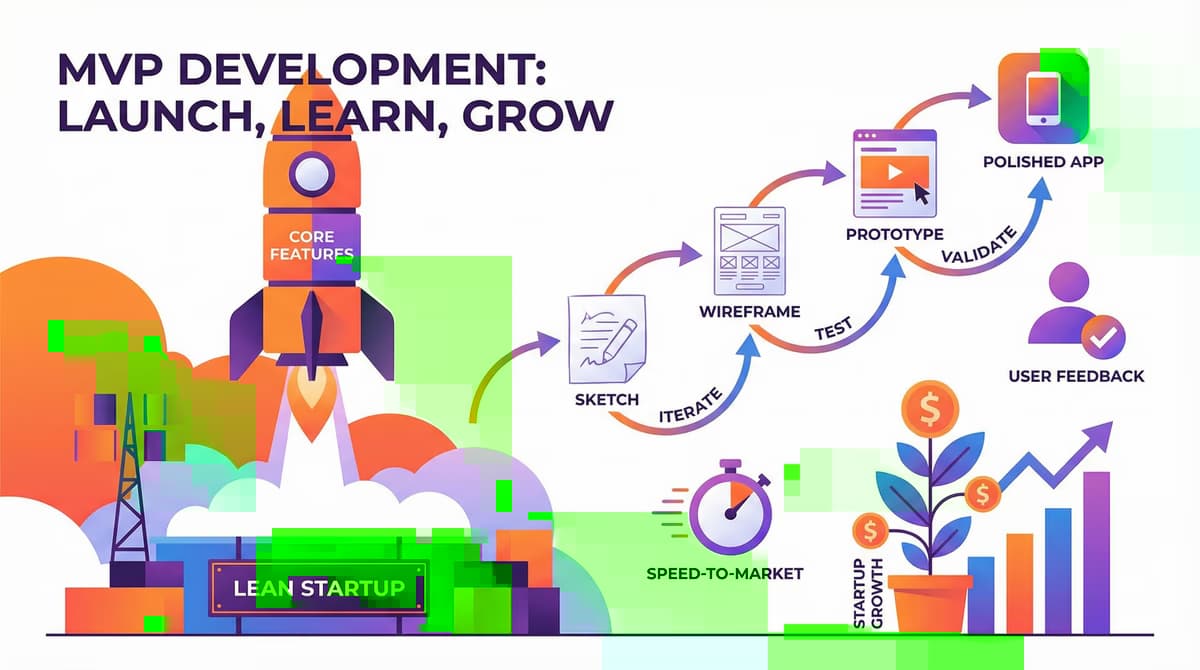
A minimum Viable Product is the first, minimally functional version of a product.
It contains only the core functions needed to provide added value to the first users and to collect valuable feedback.
In contrast to a pure prototype that only serves to test concepts, a MVP is a real, marketable product.
However, it is not a fully built application with all conceivable features.
The main purpose of a MVP is to learn on the market with low risk and manageable budget and to develop the product based on real user feedback.
This approach makes it possible to respond quickly to market changes and to ensure that the final product meets the actual needs of the target group.
The central cost factors for MVP development
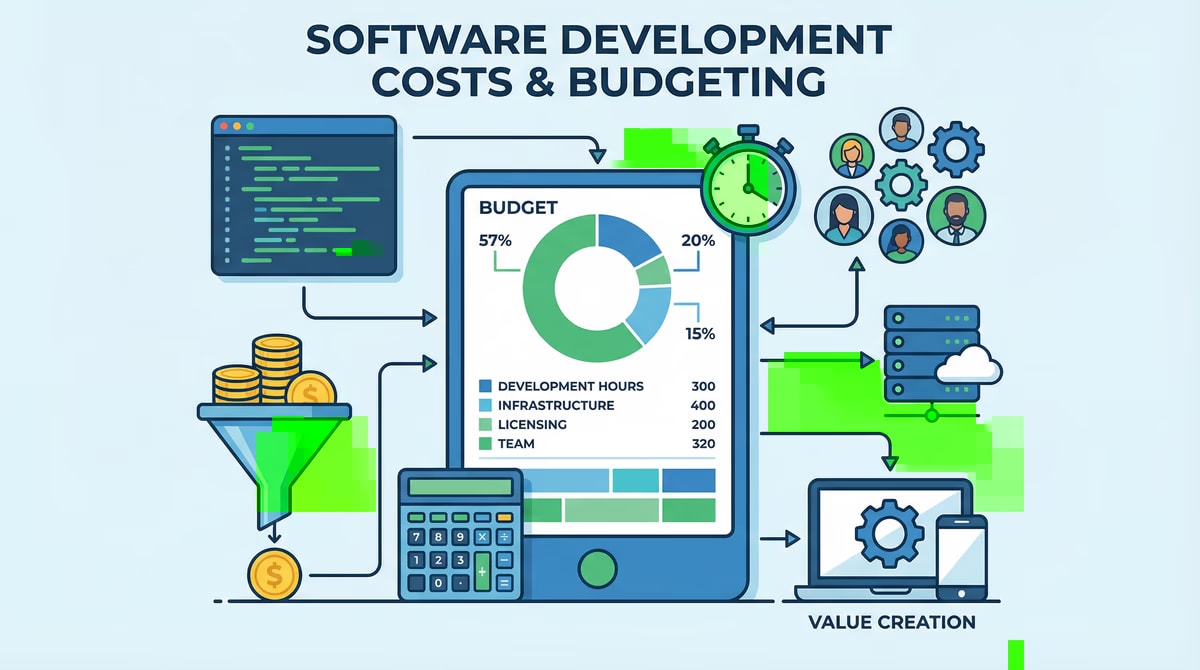
Short: The cost of developing a MVP is composed of different items.
The cost of developing a MVP is composed of different items. Pure programming is only part of the overall budget.
A transparent breakdown of cost factors is crucial for sound budget planning.
| Cost factor | Share in budget (approx.) | Typical margin (varies strongly) |
|---|---|---|
| Development (Backend & Frontend) | 50-60% | 15,000 - 150,000 € |
| UI/UX Design | 15-20% | 5,000 - 30,000 € |
| Project management & design | 10-15% | 3,000 - 20,000 € |
| Quality Assurance & Testing | 8-12% | 2,500 - 15,000 € |
| Infrastructure & licenses | 5-8% | 2,000 - 10,000 € |
Development approaches and their impact on costs
From the idea to the MVP: Realistic cost planning > > The path from a brilliant business idea to a functioning product is exciting and full of challenges.
For What is a MVP and why is it so important? , see Cost Calculator: Software Development und Discover solutions on our website for rollout paths and planning.
In addition to these factors, the development approach chosen also plays a decisive role in total costs. There are two extremes here:
- No code/low code platforms: These tools enable a very fast and cost-effective development, since little to no code has to be written. For very simple MVPs or for rapid validation of an idea, this can be a feasible way. The costs are often only 5,000 € to 25,000 €. However, with increasing complexity and number of users, these platforms quickly reach their limits and lead to a strong dependence on the provider.
- Custom Development: Custom programming offers maximum room to adapt and scalability. It is the right choice for complex projects and.
On the numbers: Survey and market figures without an inline footnote follow common public reports (e.g. Bitkom) and official statistics (Destatis). Practical examples: Groenewold IT internal data, 2026.
References and further reading
The following separate references complement the topics in this article:
- Bitkom – German digital industry association.
- German Federal Office for Information Security (BSI).
- European Commission – Digital strategy.
- MDN Web Docs (Mozilla)
- W3C – World Wide Web Consortium.
"Legacy migration often fails not because of the stack, but because tacit domain knowledge was never captured—budget explicitly for knowledge transfer."
— Björn Groenewold, Managing Director, Groenewold IT Solutions
Frequently Asked Questions (FAQ)
What is this article about: “What is a MVP and why is it so important?”?
This post explores What is a MVP and why is it so important? from the perspective of needs, typical pitfalls. And sensible next steps. In short.
From the idea to the MVP. Realistic cost planning > >. The path from a brilliant business idea to a functioning product is exciting and full of challenges.
Who benefits most from the content described here?
Useful for project leads and product owners in Software development who must choose between standard software, custom development, and integration.
How does this topic fit into an IT or digital strategy?
Technically and organizationally, alignment with experienced partners pays off — from requirements to operations; start with the [services overview](/en/services/software-development). For multi-system landscapes, [IT consulting and architecture](/en/services/it-consulting) helps align vendors and internal teams.
What are sensible next steps if we need support?
A practical next step: book a consultation and clarify which MVP or pilot fits your team and landscape.
About the author

Managing Director of Groenewold IT Solutions GmbH and Hyperspace GmbH
Since 2009 Björn Groenewold has been developing software solutions for the mid-market. He is Managing Director of Groenewold IT Solutions GmbH (founded 2010) and Hyperspace GmbH. As founder of Groenewold IT Solutions he has successfully supported more than 250 projects – from legacy modernisation to AI integration.
Blog recommendations
Related articles
These posts might also interest you.

How to connect your company systems for sustainable success
In today's business world marked by digital transformation, data is the undisputed elixir of life of every company. They are the basis for innovation, efficiency and sound...

Venture Capital for Software Development: Opportunities and Risks
In the dynamic world of software development, access to capital is often the decisive factor that decides on the success or failure of an innovative start-up. One of the famous...
Software funding in the middle class: practical examples and success factors
Digitization poses major challenges to small and medium-sized enterprises (SMEs), but also offers immense opportunities. One of the central hurdles is often Software Financing. How...
Free download
Checklist: 10 questions before software development
Key points before you start: budget, timeline, and requirements.
Get the checklist in a consultationRelevant next steps
Related services & solutions
Based on this article's topic, these pages are often the most useful next steps.
Related services
Related solutions
Cost calculators
Practical next steps after What is a MVP and why is it so important?
What is a MVP and why is it so important? addresses a practical choice for product and IT teams. Start with one clear goal: align software scope, technical risk, and business value before the next investment.
Check the current process, the data involved, and the result users need. Then record the main risks and define a small first step. This keeps the decision easy to review and gives your team a shared basis.
For implementation support, our custom software development connects the article's guidance with architecture, delivery, and stable operations. Engineering and project ownership stay with our team in Leer, Germany.
This post belongs to Software development. Browse the related Software development articles or use the English software blog for other topics.
When budget is the next question, the software cost calculators provide planning ranges. The IT glossary explains key terms, while in-depth technology guides cover wider decisions.
If the topic affects a live project, book a technical consultation or send the context through our project contact form. We usually reply within one working day.