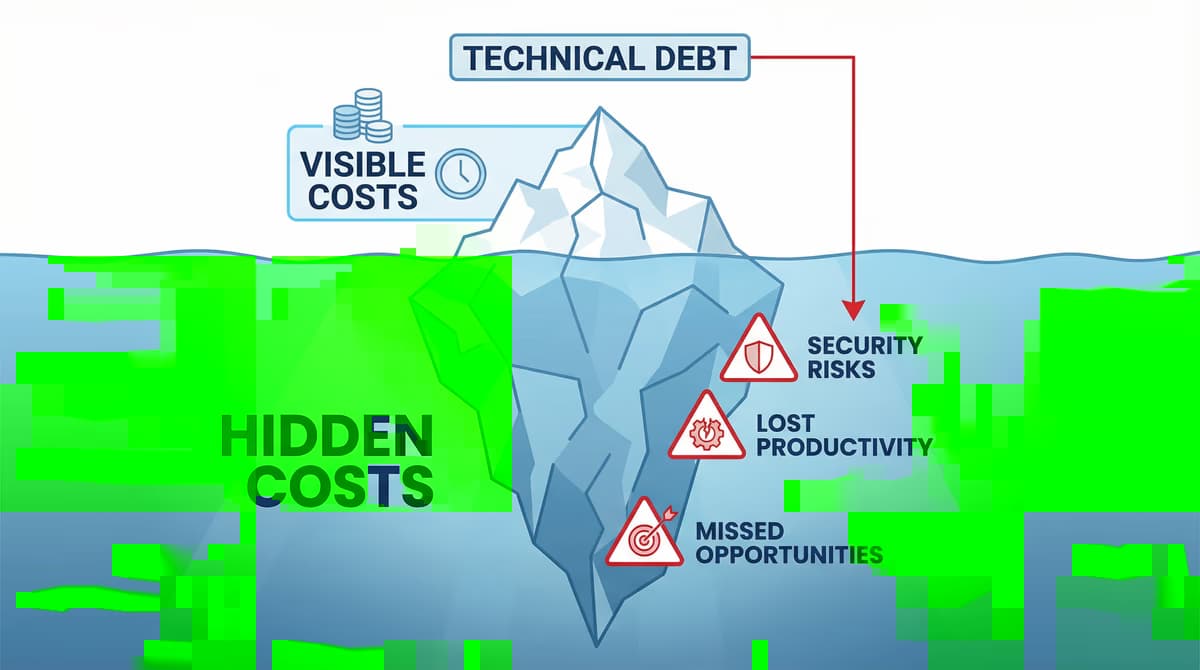
As of: 23 September 2026 · Reading time: 4 min
Key takeaways
- Technical debt – a term that can often be heard in IT departments, but in management can provide questioning views.
- Similar to financial debt, technical debt can also be...
Technical debt – a term that can often be heard in IT departments, but in management can provide questioning views. Similar to financial debt, technical debt can also be...
“Good software is not an accident—it comes from a structured development process with clear quality standards.”
– Björn Groenewold, Managing Director, Groenewold IT Solutions
Technical debt – a term that can often be heard in IT departments. However, in management can provide questioning views.
Similarly to financial debt, technical debt can also burden a company and paralyze its new strength.
But how do you explain to a board who thinks in quarters and ROI the need to invest in the dismantling of invisible waste?
The answer is in proper communication. The aim is to translate technical problems into the language of business and to show the effects for business success.
In this post, we will show you how to convince management of the strategic value of reducing technical debt and why Groenewold IT Solutions is the right partner for this operation.
What are technical debts and why do they arise?
Technical debt – a term that can often be heard in IT departments, but in management can provide questioning views.
For Technical debt communicating: How to convince management, Legacy Modernisation, Solution: Legacy Reduction sowie Software Maintenance help you align rollout, scope and budget before you commit.
Technical debt arises if short-term solutions and fast completion prevail over sustainable quality in software development.
This can happen consciously to adhere to tight deadlines, or unconsciously through lack of experience or inadequate processes.
The result is suboptimal code structures, outdated technologies and missing documentation. This make future adjustments and developments more difficult, slow and expensive.
This is also referred to as the needed but often postponed measure.
Talking about management
Instead of talking ‘code quality’ or ‘refactoring’, you should focus on the impact of technical debt on business goals. Use terms that are understood on the board:
- Innovation capacity instead of “technical debt”: Show how much time and resources need to be spent to remedy mistakes and maintain outdated systems that could actually flow into the development of new, sales-enhancing products.
- “Sales bottlenecks” instead of “old systems”: Explain how outdated systems limit scalability and prevent the company from responding quickly to new market needs.
- “Business Risks” instead of “Safety Vulnerabilities”: See that outdated software can be a cyber-attacking gateway, thus endangering not only IT, but the entire company.
quantify business impact
Short: To underline the urgency, it is helpful to quantify the costs of technical debt.
To underline the urgency, it is helpful to quantify the costs of technical debt. A clear comparison of costs and benefits helps management to set the right priorities.
Here is an example of how you can present the impact on different business areas:
| Business area | Impacts due to technical debt | Benefits due to reduction of technical debt |
|---|---|---|
| Development |
References and further reading
The following separate references complement the topics in this article:
- Bitkom – German digital industry association.
- German Federal Office for Information Security (BSI).
- European Commission – Digital strategy.
- MDN Web Docs (Mozilla)
- W3C – World Wide Web Consortium.
"Mobile apps need clear offline and security models alongside UX—trust collapses without both."
— Björn Groenewold, Managing Director, Groenewold IT Solutions
Frequently Asked Questions (FAQ)
What is this article about: “Technical debt communicating: How to convince management”?
This article sums up practical aspects of Technical debt communicating. How to convince management for leaders and delivery teams.
In short: Technical debt – a term that can often be heard in IT departments. However, in management can provide questioning views.
Who benefits most from the content described here?
It is especially relevant for firms in Software development that need reliable systems, clear interfaces, and predictable delivery — from mid-market teams to expert departments.
How does this topic fit into an IT or digital strategy?
You can map the topic to service building blocks such as custom software and delivery support. Architecture reviews and stepwise rollout reduce risk and rework.
For multi-system landscapes, IT consulting and architecture helps align vendors and internal teams.
What are sensible next steps if we need support?
For architecture, rollout, or a second expert opinion, book a free initial consultation — including timeline and interface alignment.
About the author

Managing Director of Groenewold IT Solutions GmbH and Hyperspace GmbH
Since 2009 Björn Groenewold has been developing software solutions for the mid-market. He is Managing Director of Groenewold IT Solutions GmbH (founded 2010) and Hyperspace GmbH. As founder of Groenewold IT Solutions he has successfully supported more than 250 projects – from legacy modernisation to AI integration.
Blog recommendations
Related articles
These posts might also interest you.

ETL processes: extract and combine data from silos
In today's data-driven business world, information is the life elixir of each company. But too often these valuable data are trapped in isolated systems, so-called...
Resolve data silos in the cloud: How to make your data usable
In today's data-driven business world, access to accurate and timely information is crucial for success. Companies that drive digital transformation and C...
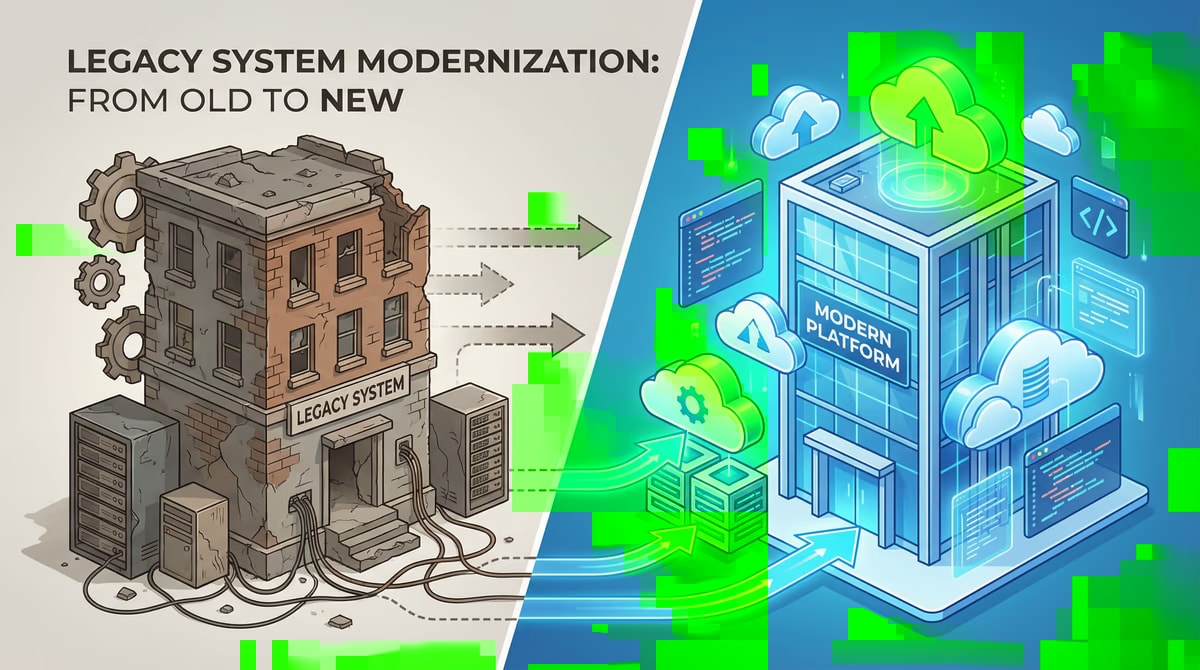
Software Resolution: Planning Data Migration
The decision has been made: A new, modern software system will replace the outdated solution in your company. This step promises more efficiency, better functionality and a ...
Free download
Checklist: 10 questions before software development
Key points before you start: budget, timeline, and requirements.
Get the checklist in a consultationRelevant next steps
Related services & solutions
Based on this article's topic, these pages are often the most useful next steps.
Related services
Related solutions
Practical next steps after Technical debt communicating: How to convince management
Technical debt communicating: How to convince management addresses a practical choice for product and IT teams. Start with one clear goal: align software scope, technical risk, and business value before the next investment.
Check the current process, the data involved, and the result users need. Then record the main risks and define a small first step. This keeps the decision easy to review and gives your team a shared basis.
For implementation support, our custom software development connects the article's guidance with architecture, delivery, and stable operations. Engineering and project ownership stay with our team in Leer, Germany.
This post belongs to Software development. Browse the related Software development articles or use the English software blog for other topics.
When budget is the next question, the software cost calculators provide planning ranges. The IT glossary explains key terms, while in-depth technology guides cover wider decisions.
If the topic affects a live project, book a technical consultation or send the context through our project contact form. We usually reply within one working day.