
As of: 23 September 2026 · Reading time: 8 min
Key takeaways
- CI/CD maturity can be reliably diagnosed in 10 questions.
- 4 maturity levels: manual, automated with gaps, continuous delivery, continuous deployment.
- 70% of mid-level teams are between maturity 1 and 2.
- The jump to maturity 3 is usually possible in 2-4 weeks.
In 10 questions, check whether your CI/CD pipeline maturity is – from "still manual" to "Continuous Deployment". With measures per degree of maturity.
“Digitalization is not an IT project—it is a business strategy.”
– Björn Groenewold, Managing Director, Groenewold IT Solutions
CI/CD maturity check 2026
What This Is About
In 10 questions, check whether your CI/CD pipeline maturity is – from "still manual" to "Continuous Deployment".
As a basis for decision CI/CD maturity check 2026: 10 questions that show where your mid-sized business stands are suitable cost calculator: AI knowledge database and digitalization for mid-sized businesses.
DevOps consulting for mid-sized firms almost always begins with the question: "Where do we actually stand?" These 10 questions give you an honest answer in 5 minutes.
The 10 diagnostic questions
- Will every commit be built automatically? Two. Running automated tests on each build?
- Are test results enforced as a Merge condition?
- Is the deployment process defined in code (IaC)?
- Can you deploy in staging at the push of a button?
- Can you deploy production at the push of a button?
- Is there a rollback in under 10 minutes?
- Are Secrets versioned and rotated (not in repo)?
- Is there monitoring that checks the deploy for malfunction?
- Is the build output reproducible?
The 4 degrees of maturity
ripening degree 1: Manual (0–3 Yes)
Short: Deployments take hours, rollback is random.
Deployments take hours, rollback is random. First pipeline for 1 service, automate build.
ripening degree 2: Automated with gaps (4–6 Yes)
Short: CI runs, CD semi-automatic.
CI runs, CD semi-automatic. First step: Force test gates, IaC for staging.
ripeness 3: Continuous Delivery (7–8 Yes)
Short: Deploy possible at push of a button, but not automatically.
Deploy possible at push of a button, but not automatically. Next step: Canary deployment, automatic smoke tests.
ripeness 4: Continuous Deployment (9–10 Yes)
Short: Every green build goes productive.
Every green build goes productive. To expand Observability, define SLOs.
What we typically see
In German mid-sized firms, 70% of the teams range between maturity 1 and 2. The jump to 3 is usually possible in 2–4 weeks if the team is motivated and the architecture is involved.
Next step
If you want to know which gaps are the fastest – with fixed price options and training of your team – we start with a structured discovery: DevOps Consulting mid-sized businesses.
Measurability and quality assurance
Define Erfolg on measurable criteria – for example reduced processing time, lower escalations or higher conversion – and not only managed via “Go-live”.
For reife, a slim set of automated tests is worth on the most important user journeys plus targeted manual exploratory tests before releases. .Quality is also created by code reviews, architecture decision logs (ADR) and clear handovers to the operation.
Runbooks, escalation paths and recorded border cases. Knowledge remains in the company – regardless of custom persons or service providers.
Practice impulse on the topic
In practice, projects often lose drive if Responsible between specialist, IT and external partners remain unclear.
Name Owner for data, security and operation in writing – and link delivery items with acceptance criteria, not only with milestone data.
Groenewold IT supports architecture, rollout and integration – according to your focus: software maintenance &. Maintenance, individual software development. If you are unsafe.
This entry is the most risky one, start with a short architecture or discovery workshop instead of a maximum microscope.
Integration into your IT landscape
Typical integration points are ERP, CRM, identity providers, payment services and industry software. stable contracts, version policy for APIs and transparent error semantics –.
This means partners and internal teams do not have to guess.
If you need support in technical rollout, we arrange CI/CD maturity check 2026: 10 questions that show where your mid-sized business stands willing to enter your existing architecture – including prioritization and resilient releases.
Matching entry points: software maintenance & maintenance, individual software development.
Typical stumbling stones – and how to bypass them
Short: Scope-Creep arises when needs are re-suspended without new prioritization.
Scope-Creep arises when needs are re-suspended without new prioritization. Antidote: clear product-over roll, visible backlog and recorded “later” list.
Selective test data lead to surprises in production. Invest early in anonymized snapshots or generated records covering edge cases.
Knowledge islands between development and operation cause long incident times.
Common runbooks, common demos and a common glossary on technical terms reduce friction – especially in complex topics such as CI/CD maturity check 2026: 10 questions that show where your mid-sized business stands.
Deepening: Requirements and stakeholders
Projects around reife rarely fail due to missing features – more often due to unclear decision-making and changing priorities.
Document assumptions explicitly (what we know, what we guess) and link them to review appointments. . medium level and stands should not only be addressed ‘sometimes’.
Specify measurable intermediate results that show whether the selected direction is wearing.
This increases internal acceptance and makes external communication more credible – for example towards management, supervisory board or public bodies.
Frequently Asked Questions (FAQ)
What is it about in this article about “CI/CD maturity check 2026: 10 questions that show where your mid-sized business stands”?
This post highlights CI/CD maturity check 2026: 10 questions that show where your mid-sized business stands from the perspective of needs, typical stumbling stones and meaningful next steps.
In the core. In 10 questions, check whether your CI/CD pipeline maturity is – from "but manually". To "Continuous Deployment". With measures per degree of maturity.
For whom are the content described particularly relevant?
Pragmatically usable for project management and Product Owner who need to decide in DevOps between standard software, custom development and integration.
How can the topic be classified into an IT or digital strategy?
Technically and organizationally, it is worthwhile to vote with experienced partners – from request clarification to operation; an entry point is the [performance overview](/en/services/software-development) with related topics. In addition, a coordination with [IT consulting and architecture](/en/services/it-consulting) helps if several systems or suppliers are involved.
What next steps are useful when support is needed?
Pragmatic next step: book appointment and jointly clarify what MVP or pilot variant fits your team and landscape.
What do I know if the scope is too big?
If more than three separate target groups or delivery items are same time “Must-have”, most of the time prioritization is missing.
For CI/CD maturity check 2026: 10 questions that show where your mid-sized business stands helps a clear pilot with a measurable result.
How do I avoid technical dead ends?
With early architecture reviews, prototype critical uncertainties and repeatable deployments. A clean interface strategy pays off at questions.
What role does maintenance play after the launch?
Short: A sustainable solution needs Patch cycles , monitoring and ownership.
A sustainable solution needs Patch cycles, monitoring and ownership. Plan budget for further development – not only for the first release.
Checklist (compact, customizable)
- Staging with realistic data or high-quality synthetic sets.
- Set up cost and license monitoring for cloud/environment.
- Record performance budgets and accessibility in QA.- Track dependencies on third-party providers and API versioning.
- Set goals, KPI and non-scope in writing.
- Plan documentation and short courses for key users.
Technology, interfaces and operation
As soon as more than one system is involved, clear API contracts, comprehensible error objects and idempotent write operations become important.
For topics related to check and show, you should plan staging environments, test data and restart concepts. This also covers features.
Observability belongs to this. Correlation IDs via gateway and services, meaningful log levels and alarms on business KPI – not only on CPU green.
Backups and recovery tests are part of the “Definition of Ready” for productive load, not a later footnote.
Security, Data Protection and Compliance
Depending on the industry and data types, Access concepts, encryption, storage and deletion concepts can quickly become a bottleneck. Check early on whether personal data are processed.
This are legal bases and how affected rights are technically supported.
Supplier and open source components should land in a regular review: licenses, known vulnerabilities, update path. This not only protects against incidents.
However, also accelerates audits and alerts – especially when public authorities or regulated markets are in play.
Conclusion and next steps
CI/CD maturity check 2026: 10 questions that show where your mid-sized business stands can be successfully introduced when technology, organization and measurability match – instead of isolated tool rollouts without process reference.
Use the overview in this article as a basis for discussion on priorities, risks and the first loadable pilot.
Intensify matching topics in category overview Blog category and check operational support via software maintenance & maintenance, custom software development.
Groenewold IT accompanies review, rollout and operation – from the first grouping to scalable releases.
Technical sources and further links
The following separate references complement the grouping on the topics of this Article:
- Bitkom – Digital Economy Association.
- BSI – Federal Office for Information Security.
- European Commission – Digital Strategy.
- MDN Web Docs (Mozilla)
- W3C – World Wide Web Consortium
"Mobile apps need not only UX but also clear offline and security concepts; otherwise, trust and acceptance in the area suffers."
— *Björn Groenewold, Managing Director, Groenewold IT Solutions *
About the author

Managing Director of Groenewold IT Solutions GmbH and Hyperspace GmbH
Since 2009 Björn Groenewold has been developing software solutions for the mid-market. He is Managing Director of Groenewold IT Solutions GmbH (founded 2010) and Hyperspace GmbH. As founder of Groenewold IT Solutions he has successfully supported more than 250 projects – from legacy modernisation to AI integration.
Blog recommendations
Related articles
These posts might also interest you.

DevOps ROI 2026: When does Infrastructure as Code really pay?
IaC is not the same for everyone. We anticipate which team and server size are worth Terraform & Co. – and when not.
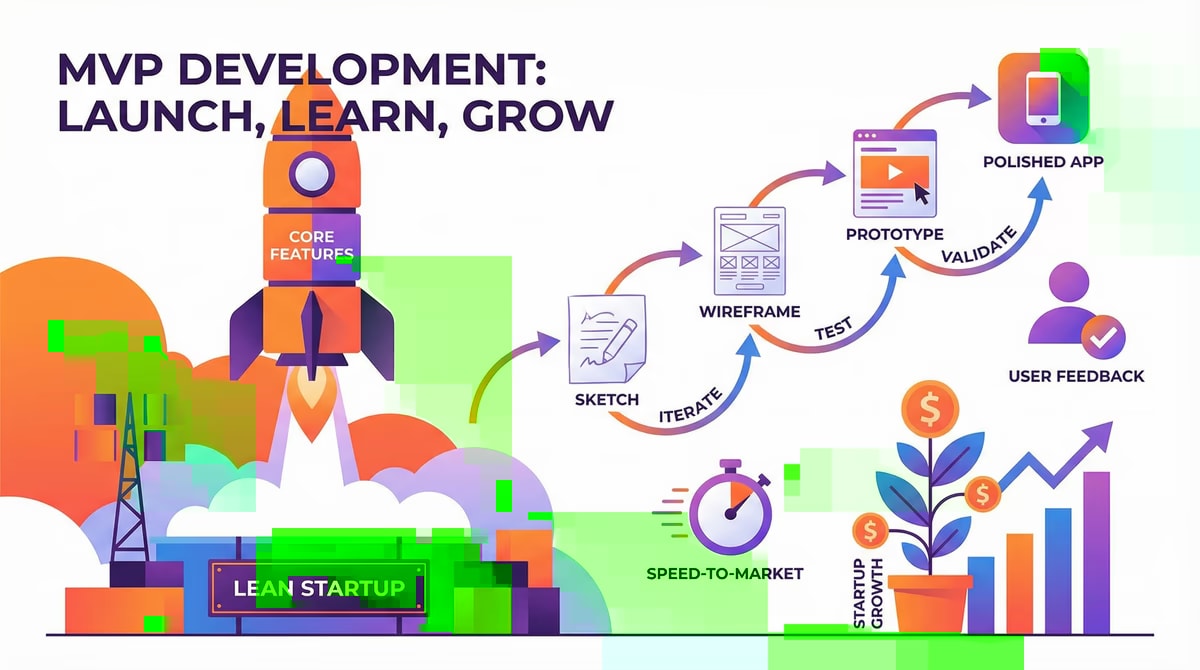
What is a MVP and why is it so important?
♪ From the idea to the MVP: Realistic cost planning > > The path from a brilliant business idea to a functioning product is exciting and full of challenges. One of the first un...

How to connect your company systems for sustainable success
In today's business world marked by digital transformation, data is the undisputed elixir of life of every company. They are the basis for innovation, efficiency and sound...
Free download
Checklist: 10 questions before software development
Key points before you start: budget, timeline, and requirements.
Get the checklist in a consultationRelevant next steps
Related services & solutions
Based on this article's topic, these pages are often the most useful next steps.
Related services
Related solutions
Cost calculators
Practical next steps after CI/CD Maturity Check 2026: 10 Questions That Show Where Your Organization Stands
CI/CD Maturity Check 2026: 10 Questions That Show Where Your Organization Stands addresses a practical choice for product and IT teams. Start with one clear goal: align software scope, technical risk, and business value before the next investment.
Check the current process, the data involved, and the result users need. Then record the main risks and define a small first step. This keeps the decision easy to review and gives your team a shared basis.
For implementation support, our custom software development connects the article's guidance with architecture, delivery, and stable operations. Engineering and project ownership stay with our team in Leer, Germany.
This post belongs to DevOps. Browse the related DevOps articles or use the English software blog for other topics.
When budget is the next question, the software cost calculators provide planning ranges. The IT glossary explains key terms, while in-depth technology guides cover wider decisions.
If the topic affects a live project, book a technical consultation or send the context through our project contact form. We usually reply within one working day.