As of: 23 September 2026 · Reading time: 18 min
Key takeaways
- AI solutions for medium-sized production: use cases, costs & implementation.
- Concrete steps instead of theory – now request project check.
AI solutions for medium-sized production: use cases, costs & implementation. Concrete steps instead of theory – now request project check.
“AI in the mid-market only works when it solves a concrete business problem—not as an end in itself.”
– Björn Groenewold, Managing Director, Groenewold IT Solutions
Why AI solutions for medium-sized production are now crucial
AI solutions for midsize production: Use cases, cost & rollout.
For AI solutions for midsize production: practical guide 2026, Cost Calculator: AI Development and Industry: Manufacturing are practical starting points. Budget and industry context: Discover solutions.
To AI solutions for midsize production: Practical guide 2026 are individual software development and interface & integration projects suitable entrances for planning and rollout.
Manufacturing companies that push digitalization to the long bank pay a silent price.
Rising reject rates, unplanned machine shutdowns and a production planning that is still based on Excel tables. That's not an edge phenomenon.
Many midsize manufacturing companies in Germany still work with systems built for a world without real-time data review.
Artificial Intelligence is not a self-interest. AI solutions for midsize production are valuable when they solve concrete bottlenecks.
Detect quality errors earlier, plan ahead machine maintenance, control supply chains more flexibly.
This is exactly what distinguishes successful AI projects from expensive pilot projects that end up in the drawer after six months.
Competitive pressure not only comes from Asia. European competitors also invest heavily in automation and machine learning.
Those who do not improve the value chain as SMEs lose jobs to companies that produce faster, cheaper and more error-free.
Three structural benefits speak for acting now:
- Technology ripe: Cloud solutions and pre-trained models significantly reduce entry costs.
- Funding landscape: Funding from programs such as "midsize digital" or the BMBF is still available in 2026.
- Data access: Modern manufacturing systems already generate sensor data that can be used for AI applications.
The window for a structured entry is open. It will not remain open indefinitely.
AI Application Examples Production: What really works in everyday production
Most articles about AI Application Examples Production list Buzzwords. This section does the opposite.
It shows what applications in midsize production plants actually have effect and why others fail.
Quality control via computer vision
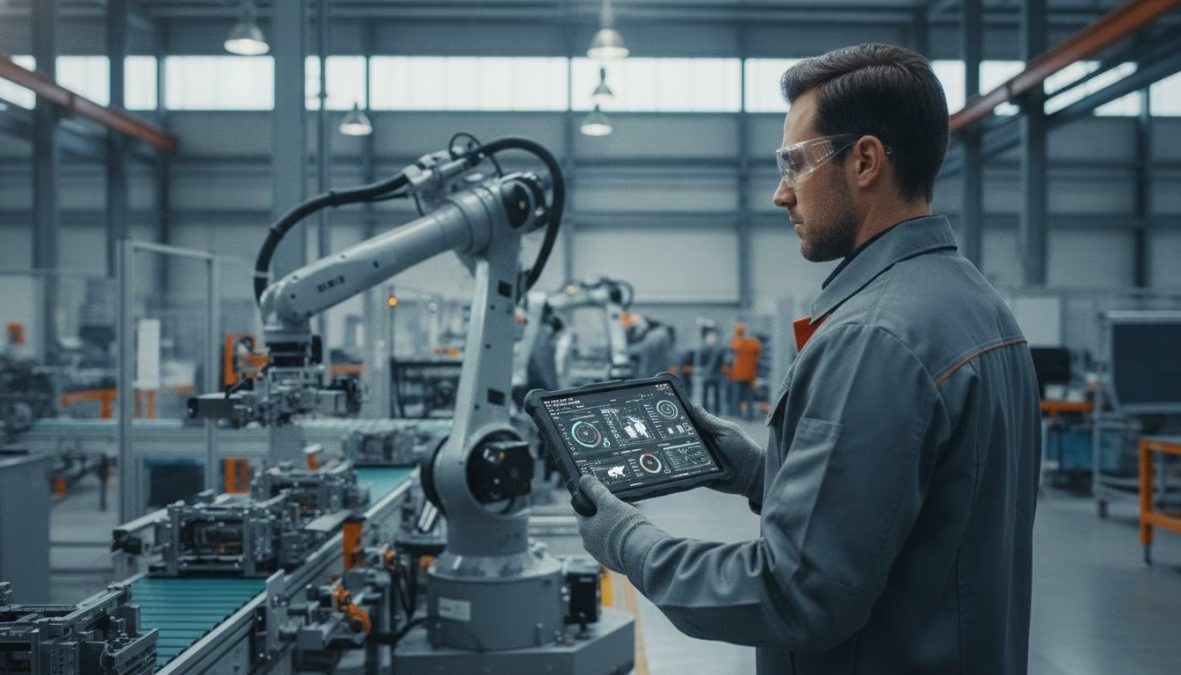
Computer Vision is the fastest scalable AI application area in production.
Camera systems coupled with trained image recognition models detect surface defects, dimensional deviations and assembly errors more reliably and faster than manual visual inspection.
The decisive advantage: Such systems operate 24/7 without fatigue effects.
A camera module with matching evaluation software can be retrofitted to existing production lines without changing the entire infrastructure.
Typical entry scenarios for SMEs:
- Final control of injection molded parts on cracks, burrs or color deviations.
- weld inspection in metal processing.
- Completeness check for assembly processes (all screws set?)
What most guides conceal: The quality of training data decides on success or failure.
A model that has been trained with 200 error images does not provide production-ready detection rate. Realistic projects require several thousand annotated images per error class.
Intelligent production planning and logistics optimization
Production planning based on historical data and AI-based forecasting models reduces setup times and significantly improves machine utilization.
At the same time, algorithms take into account order volumes, material access, machine capacities and delivery time windows.
The same principle applies to logistics. Route optimization, inventory planning and retrieval control benefit from machine learning as soon as sufficient historical transaction data are available.
Many midsize companies underestimate that they already have this data, only unstructured in ERP systems.
The pragmatic entry leads via its own ERP interface.
Anyone who runs SAP, Microsoft Dynamics or a comparable system has a data base on which AI modules can be placed directly.
Predictive maintenance in mid-sized businesses: Preventing failures before they arise
Preliminary maintenance in mid-sized firms is the application case with the clearest ROI argument. Unplanned machine shutdowns cost not only repair costs.
However, mainly production failure, delivery delay and contractual penalties.
The principle is technically manageable. Sensors on critical machine components detect vibration, temperature, current consumption and noise levels.
Anomaly detection algorithms find patterns that indicate imminent failures, typically days or weeks before damage occurs.
There are two realistic ways of entry for SMEs today. Retrofit solution.
IoT sensor modules are mounted on existing machines, data run into a cloud platform (e.g. Azure IoT Hub or AWS IoT Core), a pre-trained anomaly model takes over the evaluation Machine manufacturer solution.
Many suppliers of modern CNC machines or presses already provide integrated modules for predictive maintenance that only need to be activated
A common mistake: Companies start predictive maintenance on uncritical machines to "go safe". The result is a pilot project with low impact and lack of internal acceptance. Better.
Choose the machine with the highest risk of failure and the most expensive effects as starting point.
According to Industry 4.0 Platform of the BMWK, predictive maintenance is one of the most used AI applications in German manufacturing companies.
This is because the cost-benefit ratio is especially transparent compared to other AI projects.
Profi tip: Predictive maintenance provides the most convincing business cases when the initial value is known.
How often is the target machine unplanned per year and what does a failure cost? No serious ROI can be calculated without this base.
AI Tools for Industry: Concrete Software Stack for SMEs
Short: Those looking for AI tools for industry will find hundreds of offers.
Those looking for AI tools for industry will find hundreds of offers. The key question is not which tool has the most functions.
However, which stack can actually be operated for an SME with limited IT staff and existing infrastructure.
Open source vs. commercial solutions: advantages and disadvantages
| Criterion | Open Source (e.g. TensorFlow, PyTorch, MLflow) | Commercial Platforms (e.g. Siemens Industrial Edge, PTC ThingWorx) |
|---|---|---|
| Entry costs | Low (licence free) | Medium to high |
| Rollout effort | High (own know-how required) | Medium (preconfigured modules) |
| Room to adapt | Very high | Limited by Vendor logic |
| Vendor-Lock-in | No means to high | |
| Support | Community + Service Provider | Support including |
| GDPR control | Fully controllable | Depending on hosting model |
For most SMEs, a hybrid approach is recommended: open source frameworks for model development, combined with a middleware platform that integrates into existing MES or ERP systems.
A practice-proven stack for mid-sized firms:
- Data pipeline: Apache Kafka or MQTT for real-time data from production.
- Model training: Python with scikit-learn or PyTorch, hosted on own servers or EU cloud- Model deployment: MLflow for versioning, Docker container for portability.
- Visualization: Grafana for real-time dashboards, directly to machine operators.
Attention: Anyone who chooses a commercial AI provider to contractually secure source code rights and data sovereignty risks a Vendor lock-in that makes later migrations extremely costly.
This point is systematically played down in sales talks.
Groenewold IT Solutions develops AI solutions based on open technologies with complete source code transfer after project completion.
This structurally excludes Vendor-Lock-in and gives SMEs full control of their own infrastructure.
Challenges when introducing AI in mid-sized businesses and how to solve them
[This is followed by a revised section which, instead of general GDPR warnings, offers concrete checklists for the legal department and prioritization matrices for data quality. ]
Change Management and Employee Qualification: The underestimated success factor
Most AI projects fail here - not technology.
A perfectly trained anomaly detection model does nothing if the machine operator ignores the alarm because it does not trust the system.
No one of the competing guides deals with this point with the needed depth. This is the real gap between AI theory and production reality.
Why employees and works council need to be involved early
In midsize manufacturing plants with growing structures, the word "AI" often triggers three concrete fears, which are rarely expressed openly, but are consistently exploited in passive resistance:
Fear of performance monitoring: "The system monitors me and reports errors to the management.". Fear of job loss: “The AI makes my work unnecessary. ".
Distrust against false alarms: “The system is more often wrong than I – why should I listen to it?”
These fears are rational, not irrational. They arise because communication starts too late and because the technical functioning of the AI systems for the workforce remains a blackbox.
Anyone who starts change management at the introductory training has already lost.
The works council is not an obstacle, but a strategic lever. Work councils.
This are integrated into the project definition at an early stage, become internal ambassadors instead of brakes.
This presupposes that the following points are contractually or regulated by an operating agreement before the first pilot project starts:
- What data are collected and which are not?
- Are personal performance data evaluated? (Antwort should read: “No” - and this must be technically detectable)- Who has access to what evaluations?
- Yes. How are misalarms treated without any effects for employees?
The three-roll model for AI qualification in production
Not all employees need the same knowledge. A practical training model differs according to three roles:
Roll 1: Machine operators and shift leaders This group works daily with the AI editions. You don't need data science knowledge, but you need to know three things:
- Yes. Understanding the difference between an AI statement and a binding instruction.
- Knowledge of how they object to the system and document it (human-in-the-loop principle).
- Learning to distinguish false alarms from real anomalies - this is only done by practice, not by training films.
Recommended format: practical training directly at the plant, 2-4 hours, with real production data from your own company. No external trainers who do not know the machine.
Rolle 2: Master, Production Manager and Quality Manager This group interprets KPI dashboards and makes decisions based on AI recommendations. You need:
- Basic understanding of how the model comes to its predictions (no mathematics, but intuition for confidence values and error rates).
- clarity on which decisions they may delegate to the algorithm and which are not.
- Ability to find model drift: "The system has been reporting unusually many false alarms for three weeks - when was it recently retrained?"
Recommended format: workshop series in 3 modules of 3 hours, distributed over the pilot period, not as a block event before the productive start.
Rolle 3: Management and commercial management This group does not need to know any technical details, but it must be able to answer strategic questions:
- Yes. How do we measure the ROI of the AI system and when do we draw the tear line?
- What AI decisions require human release (e.g. in safety-relevant processes)?
- Yes. How do we communicate in-house and externally via AI?
Recommended format: half-day strategy workshop at project start, follow-up review after 6 months.
Phase model: Change Management parallel to implementation
Change management is not a unique event, but a process that runs parallel to the technical rollout:
| Project phase | Change management measure |
|---|---|
| Data inventory | Information event for affected teams: What are we planning, what are we not planning? |
| Conceptual proof | Actively involve pilot team: Employees name vulnerabilities in the system |
| Pilot project | Regular feedback rounds (all 2 weeks), analyze false alarms together |
| Operation | Monthly short-term reviews, pick up improvements from the workforce structured |
A often overlooked point. The employees working with the system daily are the best quality assurance for the AI model.
They first notice when predictions no longer match reality. Those who do not systematically exploit this knowledge give a valuable feedback loop.
The qualification requirement is growing with the degree of maturity
A common mistake: companies invest in training before the productive start and then never again. AI systems continue to develop, models are retrained, new applications are added.
Qualification must be planned as an ongoing investment, not as a single project item.
Practical orientation. For each new AI application, an internal "AI-Pate".
Should be named - a person from the operational field (not from the IT) who understands the system, acts as the first point of contact for colleagues and forwards feedback to the development team.
This role does not cost an extra budget. However, creates a structural bridge between technology and everyday production.
knowledge: Change management is not a soft factor, but a measurable project risk.
AI implementations without structured workforce integration have a significantly higher demolition rate - and even if they run technically, the efficiency gains remain far below the potential because the system is bypassed in everyday life instead of being used.
Costs, ROI calculation and funding opportunities for AI in mid-sized businesses
Short: Concrete figures are missing in most guides on this topic.
Concrete figures are missing in most guides on this topic. This is no coincidence: the bandwidth is large. Still, realistic orientation values can be mentioned.
Typical cost areas for AI projects in midsize production:
- Simplified pilot project for predictive maintenance (a machine, retrofit sensors, cloud connection): 25,000 to 60,000 euros.
- Computer vision quality control (a testing station, camera system, model training): 40,000 to 120,000 euros.
- AI-based production planning (integration into existing ERP, model development, training): 50,000 to 150,000 euros.
These figures are project cost estimates, no product prices. They depend heavily on the data quality, the complexity of integration and the needed adaptation effort.
ROI calculation model: How to calculate your AI project
A simple ROI framework for production AI projects:
Step 1: Entering output costs
- Annual costs of unplanned machine shutdowns (hours × hour rate production failure)- Annual waste costs (piece × material value + rework costs).
- Personnel costs for manual quality testing (hours × wage costs).
Step 2: Expected improvement estimate (conservative)
- Reduction of unplanned silences: many companies report major improvements after 12 months.
- Reduction reject rate: depending on output level and error type.
- Efficiency gain Quality testing: often factor 3-5 compared to manual testing.
Step 3: calculate ROI
ROI (%) = ((Annual Savings - Project Costs) / Project Costs) × 100 Amortization Time (Monate) = Project Cost / (Annual Savings / 12) Example for predictive maintenance:
- Starting situation: 4 unplanned idles/year × 15,000 euros = 60,000 euros annual costs.
- Conservative reduction to 1 standstill/year: saving 45,000 euros/year.
- Project costs: 50,000 euros
- ROI after year 1: -10% (still in minus), after year 2: +80 %.
- Amortization time: about 13 months.
Conveyor programs can significantly shorten the amortization time. Relevant starting points 2026 according to central digital network of the BMWK:
- Central Digital Centres: Free initial advice and pilot projects.
- ZIM (Central Innovation Programme mid-sized firms): Promoting R&D projects up to EUR 380.000.
- Digitalization premiums of countries: Variety depending on the country, often 30-50% grant.
Step-by-step: successfully implementing AI solutions for medium-sized production
A structured rollout approach separates successful AI projects from expensive experiments.
Groenewold IT Solutions recommends a phase-based approach for AI solutions for midsize production, limiting risks and building internal acceptance.
Data inventory (2-4 weeks): What data exist in which quality and accessibility? Priority of applications (1-2 weeks): Which application has the highest ROI and the lowest technical risks?
Concept proof (4-8 weeks). Validate an application with real production data without full integration Pilot project (3-6 months). Complete rollout on an area or machine Evaluation and scaling.
Measure ROI, document findings, plan introduction to further areas
 What most rollout guides do not say: The concept is the most critical phase.
Here it is shown whether the database carries whether the selected model can handle the real production conditions and whether the team understands and accepts the results.
A proof of concept that does not answer these questions clearly should not be escalated for the pilot project.
AI maintenance and life cycle management do not forget
AI models are not software that you once installed and then forget. Production conditions change: new materials, new machines, changed process parameters.
A model that was trained 18 months ago can provide false predictions today without any obvious error being visible.
Life cycle management for AI systems in production includes:
- Model monitoring: Continuous monitoring of prediction accuracy against current production data.
- Drift detection: Automatic alerting if model behavior differs from historical patterns.
- Retraining cycles: Regular new training with current data, at least half a year.
- Version control: Documentation of all model versions with training parameters and performance meters.
According to Fraunhofer Institute of Production Technology IPT, lack of model monitoring is one of the main causes of AI systems losing quality in production after 12-18 months without the operators failing.
A practical minimum: Monthly review of core key figures (recognition rate, false positive rate) by a responsible person in the company. No complex system needed, but clear ownership.
Profi tip: Version control for AI models is just as important as for software code.
Those who do not know which model is currently in production and when it was recently trained cannot systematically debugging in quality problems.
Conclusion: With the right AI strategy for competitive production
AI solutions for midsize production are no longer a topic of the future, they are a present problem for all who have not yet begun.
The technology is mature, the promotion is available, and the applications are tested. What is missing is usually not a budget, but a structured entry.
Companies with 2026 in terms of AI strategy for SMEs are not those with the largest technology budget.
These are those who have started with a clearly defined problem that have carefully examined the data base and have not treated change management as thoughts. .Anyone who starts a pilot project has a measurable competitive advantage in 18 months.
If you wait, you will only find the gap harder because the learning systems of competitors will improve daily.
For an separate assessment of its own digitization stand, the mid-sized firms 4.0 Competence Center offers free first talks.
Midsize manufacturing companies that start AI projects without clear technical support risk expensive misstarts and burnt internal acceptance.
Groenewold IT Solutions accompanies SMEs from data inventory to production-ready rollout, with fixed developers in Germany, complete source code transfer and GDPR-compliant data retention in the EU.
No offshoring, no Vendor-Lock-in, clear contact.
Request a free project review now and get an honest assessment of which AI application case for your production delivers the fastest ROI.
Frequently Asked Questions (FAQ)
How can AI be used in medium-sized production?
AI solutions for midsize production cover a wide range.
From automated quality control via computer vision to predictive maintenance to avoid machine failures to smart production planning and logistics optimization.
It is crucial to start with a clearly defined pilot project that provides measurable benefits before you scale.
This allows to minimize risks and build up acceptance in the team.
What are the challenges with the AI introduction in mid-sized businesses?
The biggest obstacles to the introduction of AI in the middle are lack of data quality, lack of internal AI know-how and uncertainties about GDPR and data protection.
There are also concerns about high investment costs and resistance to changes in the workforce.
Anyone who systematically addresses these challenges - for example through data purification, targeted employee qualification and GDPR-compliant cloud solutions - sets the basis for a successful rollout.
Which AI tools are especially suitable for SMEs?
For SMEs, modular and scalable AI tools are recommended for industry. In the open source area, Python libraries like scikit-learn or TensorFlow offer entry options.
Platforms such as Microsoft Azure AI, AWS SageMaker or expert MES systems with integrated AI modules are relevant for production-related applications.
It is important to choose solutions that can be operated without Vendor lock-in and can be hosted in the EU in accordance with the GDPR.
How high are the cost of AI solutions in mid-sized businesses and what does the state support?
?The cost of AI solutions in mid-sized firms varies greatly. A first pilot project can be introduced from around EUR 15,000-40,000, more complex systems are significantly higher.
Current cloud costs and maintenance are added. State funding is possible through programmes such as the Central Innovation Programme mid-sized firms (ZIM) or funding from the federal states.
A careful ROI calculation before starting helps to realistically estimate the break-even point.
Do you need your own experts in the company for AI solutions in production?
Not necessarily - many SMEs successfully start with an external IT service provider that takes over rollout and advice.
However, it is important that internal employees develop basic skills to operate and monitor AI systems in everyday life.
In the medium term, the training of an internal AI manager is recommended. Thus, the company remains operational and separate of a single provider.
What does predictive maintenance mean and is it worthwhile for mid-sized businesses?
Predictive maintenance refers to predictive maintenance of machines using sensor data and machine learning. Algorithms detect anomalies in machine operation before a failure occurs.
This approach is especially worthwhile for expensive systems with long downtime costs.
First systems can often be integrated into existing industrial 4.0 infrastructure and amortised by reduced downtime and lower maintenance costs frequently within one to two years.
References and further reading
The following separate references complement the topics in this article:
About the author

Managing Director of Groenewold IT Solutions GmbH and Hyperspace GmbH
Since 2009 Björn Groenewold has been developing software solutions for the mid-market. He is Managing Director of Groenewold IT Solutions GmbH (founded 2010) and Hyperspace GmbH. As founder of Groenewold IT Solutions he has successfully supported more than 250 projects – from legacy modernisation to AI integration.
Blog recommendations
Related articles
These posts might also interest you.

Benefits of Local Software Development: Why Germany Matters for Mid-Sized Businesses
The estimated cost advantage due to offshoring is often the most expensive wrong decision that a medium-sized company can make. In a time when the sum of the GDPR fines has already exceeded the brand…

Calculating AI Phone Bot Costs Realistically
Telephone bots costs depend on scope, integration and operation. Companies calculate realistic, GDPR-compliant and predictable.
Mobile App Development in Germany: The Guide for mid-sized businesses 2026
Did you know that over 90 percent of German digital users now organize their everyday life almost exclusively via smartphone applications? for mid-sized businesses, the topic Mobile App Development…
Free download
Checklist: 10 questions before software development
Key points before you start: budget, timeline, and requirements.
Get the checklist in a consultationRelevant next steps
Related services & solutions
Based on this article's topic, these pages are often the most useful next steps.
Related services
Related solutions
Cost calculators
Related industries
Practical next steps after AI solutions for medium-sized production: practical guide 2026
AI solutions for medium-sized production: practical guide 2026 addresses a practical choice for manufacturers. Start with one clear goal: turn a useful AI idea into a governed process with clear data and risk boundaries.
Check the current process, the data involved, and the result users need. Then record the main risks and define a small first step. This keeps the decision easy to review and gives your team a shared basis.
For the EU AI Act timeline, risk classes and GPAI obligations in practice, see our pillar guide EU AI Act for mid-sized companies.
For implementation support, our AI development for business connects the article's guidance with architecture, delivery, and stable operations. Engineering and project ownership stay with our team in Leer, Germany.
This post belongs to Artificial intelligence. Browse the related Artificial intelligence articles or use the English software blog for other topics.
When budget is the next question, the software cost calculators provide planning ranges. The IT glossary explains key terms, while in-depth technology guides cover wider decisions.
If the topic affects a live project, book a technical consultation or send the context through our project contact form. We usually reply within one working day.