As of: 23 September 2026 · Reading time: 17 min
Key takeaways
- AI solutions for medium-sized production: application examples, costs, ROI and Legal pitfalls.
- Request project check now.
AI solutions for medium-sized production: application examples, costs, ROI and Legal pitfalls. Request project check now.
“AI in the mid-market only works when it solves a concrete business problem—not as an end in itself.”
– Björn Groenewold, Managing Director, Groenewold IT Solutions
Why AI solutions for medium-sized production are now crucial
AI solutions for midsize production: application examples, costs, ROI and legal case knitting.
For AI Solutions for Mid-Sized Manufacturing: The Practical Guide, Cost Calculator: AI Development and Industry: Manufacturing are practical starting points. Budget and industry context: Discover solutions.
Artificial Intelligence in Manufacturing is not a luxury for corporations. SMEs.
This are now slowing down with digital transformation, risk their market strength tomorrow to competitors who are already using automated quality assurance, predictive maintenance and smart production planning.
The decisive argument is not technology for its own sake. It is the value chain.
Each step from raw material procurement to delivery contains processes that become faster, more accurate and cost-efficient by algorithms.
According to the Bitkom Guide to AI in mid-sized businesses, manufacturing companies that have completed AI pilot projects see measurable productivity increases, especially in quality assurance and predictive maintenance.
Three structural reasons make 2026 at the right time for midsize manufacturing companies:
computing power has become affordable. Cloud-based AI infrastructure means that SMEs do not have to operate their own data centers. Data access has increased.
Modern sensor technology supplies the training data that AI models need. Regulation creates planning security.
The EU AI Act gives clear guidelines for the use of AI in production.
The actual question is no longer "ob" but "where to start".
AI-solutions for midsize manufacturing have the greatest benefit where repetitive testing tasks, machine data and planning processes come together.
Those starting with a clearly defined pilot project typically see results within three to six months.
AI Examples of Application in Production: What really works in mid-sized businesses
The biggest mistake in practice: AI in production means complete automation.
In fact, the most effective applications of assistance systems that improve human decisions are not replaced. .Manufacturing plants.
This today want to use AI application examples for midsize production, focus on three core areas: automated quality assurance, smart production planning and predictive maintenance.
All three have in common that they can build on existing machine data and be introduced step by step.
Automated quality assurance with Computer Vision
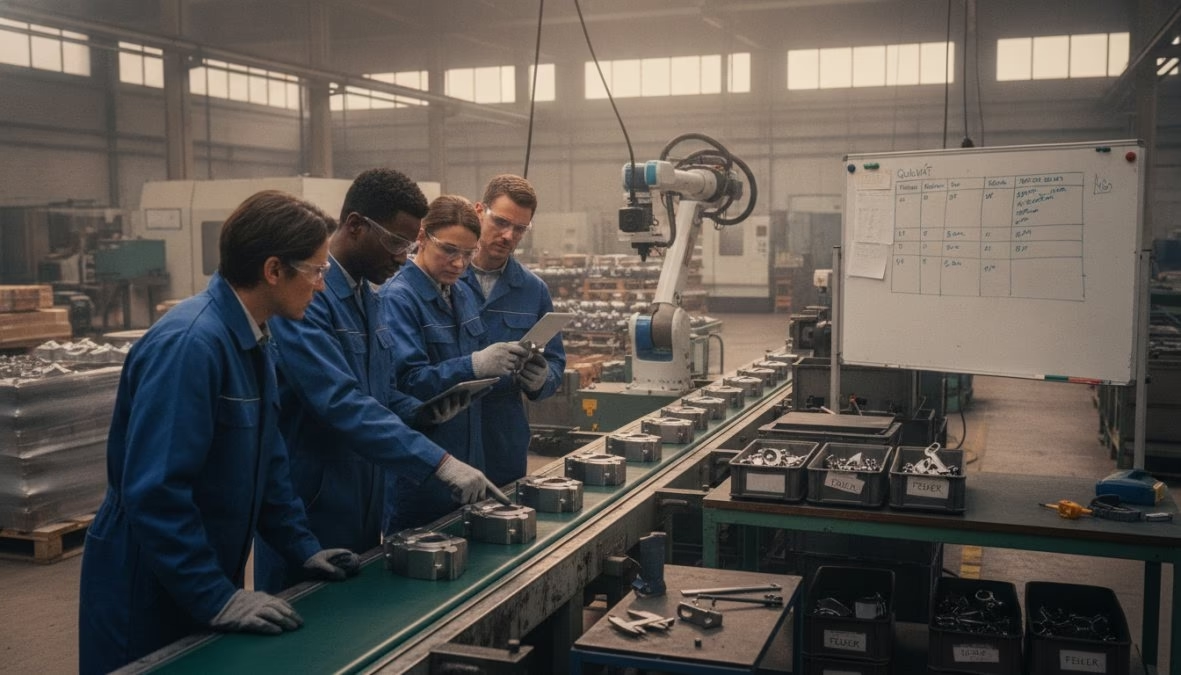
Manual visual checks are slow, expensive and susceptible to errors.
Computer Vision systems scan components with cameras and detect defects in real time before faulty parts reach the next production stage.
36ZERO Vision is an example of a solution built clearly for manufacturing plants without deep AI knowledge.
The software detects errors in pixel accuracy, is compatible with commercially available camera hardware and can be integrated into existing lines without months of setup.
The focus is primarily on visual inspection. This is simultaneously the strength and limit of the system.
Maddox AI goes one step further. The machine vision platform connects AI-based defect detection with real-time process review.
For production lines with high throughput, the intuitive dashboard is a decisive advantage. The hook: The models need initial training data, which requires a certain advance.
ZEISS Industrial Quality Solutions are the benchmark for high-end applications in medical technology or automotive industry.
The combination of AI-assisted porosity review and CT data provides a precision that does not achieve manual testing. The investment costs are correspondingly high.
Attention: A frequent error in the introduction of Computer Vision is the skipping of data quality testing.
Bad lighting, inconsistent camera angles or insufficient reference data lead to AI models producing more pseudo committees than manual testing. It costs time and trust in technology.
Neckar IT offers a transparent alternative for midsize companies that value traceability. AI headmaps show where accurate errors have occurred, and complete archiving significantly helps audits.
The regional orientation is an advantage for some firms, for others a restriction.
Intelligent production planning and process optimization
Production planning based on empirical values and Excel tables is a relic from the pre-industrial 4.0 era.
AI-based systems analyze order situation, machine capacities, material access and supply chain status simultaneously and create plans that would not be accessible manually.
DELMIA by Dassault Systèmes is the most complete digital production planning platform.
Was-wheat-if simulations for supply chains are especially valuable when supply bottlenecks or demand fluctuations require rapid reactions. The disadvantage is the complexity.
DELMIA is difficult to handle for many SMEs without expert personnel or external rollout partners.
Process optimization by AI means, in practice, above all. This reduces resource consumption, shortening throughput times and detecting bottlenecks at an early stage.
Algorithms trained on historical production data can find patterns that remain hidden by human planners.
Predictive Maintenance in mid-sized businesses: Avoid Unplanned Silence
Short: Unplanned machine shutdowns are one of the most expensive cost drivers in manufacturing.
Unplanned machine shutdowns are one of the most expensive cost drivers in manufacturing. Predictive maintenance in the mid-sized firms addresses clearly this problem.
Instead of waiting machines after fixed intervals or only reacting in case of failure, AI steadily analyzes sensor data and reports before a defect occurs.
The principle is simple. The rollout is not always.
Predictive maintenance is defined as predictive maintenance based on real-time machine data and AI algorithms that calculate failure probabilities before a defect becomes visible.
According to Fraunhofer Institute for Production Technology IPT, the prerequisites for successful predictive maintenance projects are, above all, a sufficient sensor density for machines and a clean data base.
Missing these, the best algorithms do not provide reliable predictions.
Recommended tools: From Axians NEO Suite to proALPHA ERP
Axians NEO Suite is the first choice for maintenance departments that want to convert from more reactive to proactive maintenance.
The suite combines real-time condition monitoring with predictive maintenance algorithms and digital twins for maintenance simulations.
What distinguishes the solution: it bundles expert knowledge and makes maintenance decisions comprehensible. The limitation is known.
Without a good data base from sensors, Axians does not deliver miracles. .proALPHA ERP integrates AI functions for predictive maintenance directly into the ERP system.
For manufacturing companies that already use proALPHA, this is the most elegant entry into predictive maintenance because no extra system landscape has to be built.
Early detection of machine failures by AI review and live production data monitoring are the strongest arguments.
The rollout effort is high but justified for companies with holistic process control needs.
| Tool | Core function | Strength | Limitation |
|---|---|---|---|
| Axians NEO Suite | Predictive Maintenance, Condition Monitoring | Digital twins, expert knowledge | Requires good sensor data base |
| proALPHA ERP | ERP + AI maintenance planning | Deep ERP integration | High rollout effort |
| DELMIA | Manufacturing planning, Simulation | Complete ecosystem | Requires expert staff |
Data Quality for AI in Manufacturing: The underestimated basic prerequisite
Short: Most AI projects fail in mid-sized firms.
Most AI projects fail in mid-sized firms. Not technology, not budget, but data base.
Data quality for AI in production is the key requirement before any other investment is sensible. AI models are just as good as the data they train on.
Incomplete machine data, inconsistent sensory or missing historical records produce models that fail in practice.
Typical data problem sources in midsize manufacturing companies:
- Island data: Machines from different makers supply data in different formats that are not automatically merged.
- Selective timestamps: Events without exact time can not be correlated with production phases.
- Incomplete maintenance history: If machine shutdowns were not systematically recorded, the predictive maintenance model lacks the training labels.
- Too low sampling rate: Sensors measuring only once per minute do not detect high-frequency anomalies.
The pragmatic approach: perform a data audit before each AI project. This means that all relevant data sources are inventing, assessing data quality (completeness, consistency, topicality) and gaps.
Who skips this step, invests in an AI project built on sand.
Data management is not a unique project, but a continuous process.
Companies that want to integrate AI into production in a sustainable manner need a data strategy built parallel to the AI strategy.
Artificial Intelligence in Manufacturing: Costs, ROI and Budget Planning for SMEs
Many midsize companies hesitate to invest AI because the costs appear opaque. This is understandable, but detachable.
The cost of artificial intelligence in manufacturing can be divided into three categories. Software licenses or development costs, rollout and integration costs and running operating costs.
For a first pilot project in the field of quality assurance or predictive maintenance, the total cost varies depending on the complexity and chosen provider in an area that can be budgeted for midsize companies if the business case is clearly defined.
Autodesk Fusion is a special case: From approx. 500 euros per year, the platform offers AI support for generative design and production preparation.
For designers and production planners in mid-sized firms, this is a low threshold entry into AI-based processes. The focus is more on design than on pure factory AI.
This is an advantage or restriction depending on the application.
ROI calculation: How to calculate the business case
A specific ROI framework for predictive maintenance in mid-sized firms:
Step 1: quantify standstill costs Average standstill time per event (hours) × hourly rate of the plant (production + personnel) = cost per standstill
Step 2: Frequency determine Number of unplanned shutdowns per year × Cost per standstill = Annual standstill costs
Step 3. Savings potential appreciably show empirical values that predictive maintenance systems can significantly reduce unplanned idle levels.
A conservative approach calculates with a reduction of 30 to 50 percent.
Step 4: Compare investment costs Software costs + rollout costs + training costs = total investment
Step 5: Amortization Period Calculate Total Investment ÷ Annual Saving = Amortization Period in Years
Those who fill this framework with real figures from their own business will receive a resilient basis for decision-making for management.
Profi tip: Often forgotten in ROI calculation: Also soft savings count.
Reduced AI quality assurance, lower guarantee costs and lower auditing effort for auditors add up to major amounts over three years.
The recommended software stack for medium-sized AI solutions
A concrete technology stack for midsize manufacturing companies that works in practice typically looks as follows: Level 1: Data acquisition and infrastructure Industrial IoT sensors (e.g. from Bosch or Siemens) that capture machine data in real time.
For data storage, an EU-based cloud infrastructure is recommended to ensure GDPR compliance.
Level 2: Process control and ERP proALPHA ERP for companies seeking an integrated solution.
For companies with existing ERP system (SAP, Microsoft Dynamics), AI extension modules are available that can be integrated into existing systems.
Level 3: Expert AI modules
- Quality assurance: 36ZERO Vision or Maddox AI.
- Predictive Maintenance: Axians NEO Suite.
- Manufacturing planning: DELMIA for complex value creation networks.
Level 4. Custom AI development For applications that do not cover standard solution, customized software development is the right way.
Groenewold IT Solutions develops AI solutions for mid-sized firms as custom software, with full source code ownership after project completion and without Vendor lock-in.
Permanent developers on site guarantee GDPR-compliant development with data retention in the EU. This is a key criterion for regulated industries such as medical technology or automotive.
Level 5. Research Teamwork With the Smart Quality Platform (IQP), Fraunhofer IPT offers a research-based option for companies who want to develop new tailor-made AI models.
Ideal for pilot projects, no standard software from the bar.
The most common fault in stack construction: introduce too many systems in parallel.
The proven approach is sequential: first secure data base, then pilot an AI module, then scale.
Legal Case Knitting: AI Act, GDPR and Compliance in Manufacturing
The EU AI Act has been in force since 2024 and also affects midsize manufacturing companies directly. What most of the guides on this topic conceal.
The grouping of AI systems by risk classes has concrete implications for documentation duties and conformity assessments.
AI systems used in manufacturing for safety-relevant processes can be classified as high-risk AI.
This means broad technical documentation, human supervision, risk management system and registration in the EU database. Anyone who ignores this risk fines and interruptions in operation.
According to EU AI Act Overview of the European Commission, high-risk AI systems in manufacturing are subject to strict needs for clarity and human control.
Manufacturing companies should check early in which risk class their planned AI applications fall. .In parallel, GDPR compliance remains a continuous task.
Even if machine data frequently do not contain personal data in production, there are limits.
Employee data in shift planning systems, biometric data in access control or video surveillance in production.
Concrete compliance checklist for AI in production:
- Risk grouping of all planned AI systems according to EU AI Act.
- Prepare technical documentation for high-risk AI.
- Conduct data protection impact assessment (DSFA) for relevant systems.
- Check data processing contracts with AI providers (order processing).
- Ensure data retention in the EU (especially in cloud solutions).
- Create internal guidelines for dealing with AI-generated decisions.
- inform employees about AI use (include works council).
Attention: If you use AI solutions from US providers that process data on servers outside the EU, you risk GDPR violations.
Data retention in the EU is not an optional feature, but a legal requirement.
Strategic implementation of AI solutions for medium-sized production
Short: Strategy suggests technology.
Strategy suggests technology. This is nowhere more than the introduction of AI solutions for midsize production. Many projects fail not at the AI itself.
However, at lack of planning, unrealistic goals and lack of internal acceptance.
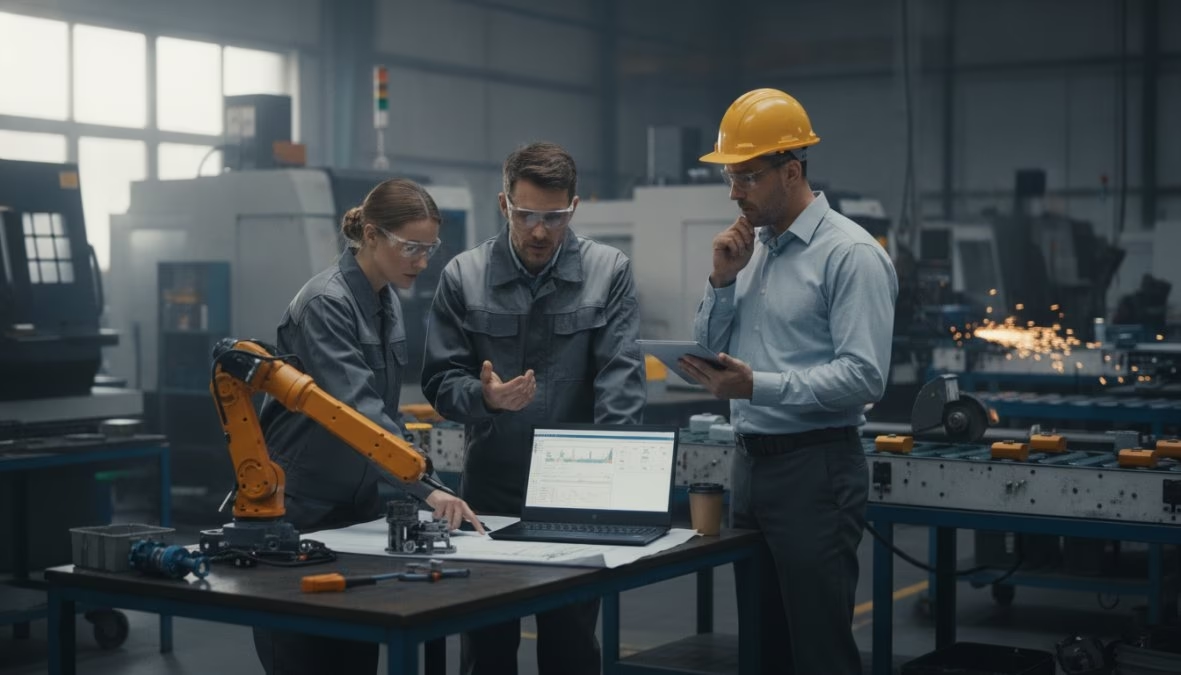
The strategic rollout of AI solutions for midsize production follows a proven three-phase model that plans scalability from the start and accepts the shortage of skilled workers as a reality.
Step 1: Define pilot project and check data base
The pilot project is the most critical step. It must be clearly defined, measurable and lockable in a manageable period.
criteria for a good pilot project:
- Clarer Business Case: The expected benefit is quantifiable (e.g. reduction of committee, avoidance of standstills).
- Outstanding data base: The needed data already exists or can be collected with reasonable effort. The pilot covers a process or a machine, not the entire production.
- Interner Champion: A person in the company is responsible and drives the project forward.
After the pilot definition follows the data audit. Without this step, any further investment is risky. .### Step 2.
Dealing with shortage of skilled workers and building AI competence in-house
The shortage of skilled workers is the biggest structural challenge for AI projects in mid-sized firms. There are not enough AI specialists.
And those that exist are absorbed by large companies and tech companies.
The realistic way for SMEs is not to hire AI experts but to enable existing employees. This means:
- Continuation for production staff: Basic understanding for AI assistance systems, handling dashboards and interpretation of AI recommendations.
- Training for IT staff: Data management, interfaces to AI systems, basic model monitoring.
- External partners for specialist knowledge: For initial rollout and model development, integrate external expertise without building long-term dependencies.
Groenewold IT Solutions is following this approach in AI development for mid-sized firms. No freelancer chains, no offshoring.
However, fixed experts who transfer knowledge and enable companies to operate their systems themselves in the long term.
Step 3: Plan scalability from the start
A pilot project that is not scalable is a dead end. Scalability means technical.
The architecture of the AI system must be able to record further machines, production lines or locations without rebuilding the system.
Practical needs for scalable AI architectures in production:
- Modular design that allows extensions without system interruptions.
- Standard data interfaces (APIs) that can integrate new data sources.
- Clear separation between model training and model reference.
- Recorded source code that is not bound to a single provider.
If you treat scalability as a thought, you pay twice for growth.
Challenges and frequent errors in AI introduction in mid-sized businesses
Short: The theory sounds convincing.
The theory sounds convincing. Practice often looks different.
What most guides do to AI solutions for midsize production: The most common reasons are not technical problems, but organizational problems.
Error 1: AI as IT project handle AI projects that are exclusively responsible for IT department, without integration of production, fail regularly.
The production staff know the processes to be improved.
Without their knowledge and acceptance, the best AI system remains unused. .Error 2: Too big first steps "We implement AI across manufacturing" is a program for frustration.
Companies starting with a clearly defined application consistently report better results than those seeking overall transformation.
Error 3: Missing success measurement Without defined KPIs before project start, success cannot be measured. And without measurable successes, the basis for further investment is lacking.
Baseline metrics should be collected before each pilot project.
Error 4. Vendor lock-in underestimate Many AI providers offer proprietary platforms where the source code remains with the provider.
If you want to change the platform, you lose your entire AI investment.
This is a structural risk that must be taken into account in the selection of suppliers.
Error 5. Data protection as thoughts GDPR compliance and AI-act needs to be retrofitted into a running system is expensive and technically complex.
Privacy by Design saves considerable costs in the long term.
According to VDMA Guide to AI in production the lack of internal data base and usually lack of internal production Both can be done through careful preparation.
Conclusion: The next step for AI-based production
AI solutions for midsize production are not self-propelled.
They require a clean database, a clearly defined business case, the right tool selection and a partner that not only delivers. However, also empowers.
The good news: Whoever is structured sees first results faster than expected.
The pragmatic entry always follows the same pattern.
A demarcated pilot project, measurable KPIs, an internal champion and a technology partner that plans scalability and independence from the beginning.
Midsize manufacturing companies that want to introduce solutions for midsize production are facing the challenge of managing technical complexity, legal needs and limited internal resources at the same time.
Groenewold IT Solutions develops customized AI solutions for mid-sized firms as custom software, with full source code ownership, GDPR-compliant data retention in the EU and without Vendor lock-in.
With over 15 years of experience in IT consulting, the company accompanies manufacturing operations from data audit to scalable AI solution.
Request free project check and take the first concrete step towards AI-based production. .## Frequently Asked Questions (FAQ)
How best to start with AI in medium-sized production?
The most sensible entry is a clearly defined pilot project with a measurable target - for example the automation of the visual inspection at a single production line.
Important. First, check the existing data quality. This is because without clean sensor data, AI models do not provide reliable results.
Start with an area that already generates digital data and only after proven success scale on further processes along the value chain.
Which AI applications are most worthwhile for SMEs in production?
The three application areas with the fastest ROI for AI solutions in midsize production are.
Predictive maintenance (avoidance of unplanned shutdowns), automated quality assurance via Computer Vision (reduction of rejects) and AI-based production planning (optimization of resource consumption and throughput times).
These areas already generate structured data and allow direct success measurement. This makes the investment decision much easier for SMEs.
How high are the cost of AI solutions in mid-sized businesses?
The cost of AI solutions in production varies greatly according to approach. Standard software such as Autodesk Fusion starts from approx. 500 € per year.
At the same time, expert platforms for predictive maintenance or quality assurance are project-based and can include several ten thousand euros depending on the complexity.
Tailored AI custom solutions offer greater room to adapt in the long term, as no Vendor lock-in is created and the source code remains owned by the company.
What are the biggest obstacles in the introduction of AI in production?
The most common obstacles are insufficient data quality, lack of internal AI competence and uncertainty in legal framework conditions such as the EU AI Act and the GDPR.
In addition, the shortage of skilled workers: many SMEs do not have their own data scientists.
A pragmatic solution is the teamwork with an skilled IT partner, who takes over both the technical rollout and also trains employees in handling the new AI solutions.
Do you need your own data experts for AI in manufacturing?
Not necessarily, but internal AI know-how is a clear competitive advantage. A dedicated project manager who works with an external IT service provider often suffices for the start.
In the medium term, targeted competence building is recommended.
Further training in data management and basics of machine learning empowers existing employees to maintain and develop AI solutions independently - without complete dependency on external providers.
About the author

Managing Director of Groenewold IT Solutions GmbH and Hyperspace GmbH
Since 2009 Björn Groenewold has been developing software solutions for the mid-market. He is Managing Director of Groenewold IT Solutions GmbH (founded 2010) and Hyperspace GmbH. As founder of Groenewold IT Solutions he has successfully supported more than 250 projects – from legacy modernisation to AI integration.
Blog recommendations
Related articles
These posts might also interest you.

Benefits of Local Software Development: Why Germany Matters for Mid-Sized Businesses
The estimated cost advantage due to offshoring is often the most expensive wrong decision that a medium-sized company can make. In a time when the sum of the GDPR fines has already exceeded the brand…

Calculating AI Phone Bot Costs Realistically
Telephone bots costs depend on scope, integration and operation. Companies calculate realistic, GDPR-compliant and predictable.
Mobile App Development in Germany: The Guide for mid-sized businesses 2026
Did you know that over 90 percent of German digital users now organize their everyday life almost exclusively via smartphone applications? for mid-sized businesses, the topic Mobile App Development…
Free download
Checklist: 10 questions before software development
Key points before you start: budget, timeline, and requirements.
Get the checklist in a consultationRelevant next steps
Related services & solutions
Based on this article's topic, these pages are often the most useful next steps.
Related services
Related solutions
Cost calculators
Related industries
Practical next steps after AI Solutions for Mid-Sized Manufacturing: The Practical Guide
AI Solutions for Mid-Sized Manufacturing: The Practical Guide addresses a practical choice for manufacturers. Start with one clear goal: turn a useful AI idea into a governed process with clear data and risk boundaries.
Check the current process, the data involved, and the result users need. Then record the main risks and define a small first step. This keeps the decision easy to review and gives your team a shared basis.
For the EU AI Act timeline, risk classes and GPAI obligations in practice, see our pillar guide EU AI Act for mid-sized companies.
For implementation support, our AI development for business connects the article's guidance with architecture, delivery, and stable operations. Engineering and project ownership stay with our team in Leer, Germany.
This post belongs to Artificial intelligence. Browse the related Artificial intelligence articles or use the English software blog for other topics.
When budget is the next question, the software cost calculators provide planning ranges. The IT glossary explains key terms, while in-depth technology guides cover wider decisions.
If the topic affects a live project, book a technical consultation or send the context through our project contact form. We usually reply within one working day.