As of: 3 September 2026 · Reading time: 4 min
Key takeaways
- Why rigid waterfall models have served and how agile methods like Scrum and Kanban make your projects faster and better.
Why rigid waterfall models have served and how agile methods like Scrum and Kanban make your projects faster and better.
“Good software is not an accident—it comes from a structured development process with clear quality standards.”
– Björn Groenewold, Managing Director, Groenewold IT Solutions
DevPartner Home Blog Services Contact Agile Methods
Agile Software development: Methods and best practices by Markus Schmidt 10. March 2026 Why rigid waterfall models have served and how agile methods such as Scrum and Kanban make your projects faster and better.
Short: The needs for software are changing faster than ever.
The needs for software are changing faster than ever. What was specified six months ago can already be outdated today.
Classic approach models like the waterfall model push their limits here. The answer is: Agile software development. ♪ What is Agile Software Development?
Agile software development is not a single tool, but a mindset based on the "Agile Manifesto" published in 2001. The core values are:
- Individuals and interactions are about processes and tools.
- Functional software is based on complete documentation.
- Teamwork with the customer is through contract negotiations.
- React on change is above the follow-up of a plan. ♪ Most popular methods: Scrum and Kanban Scrum.
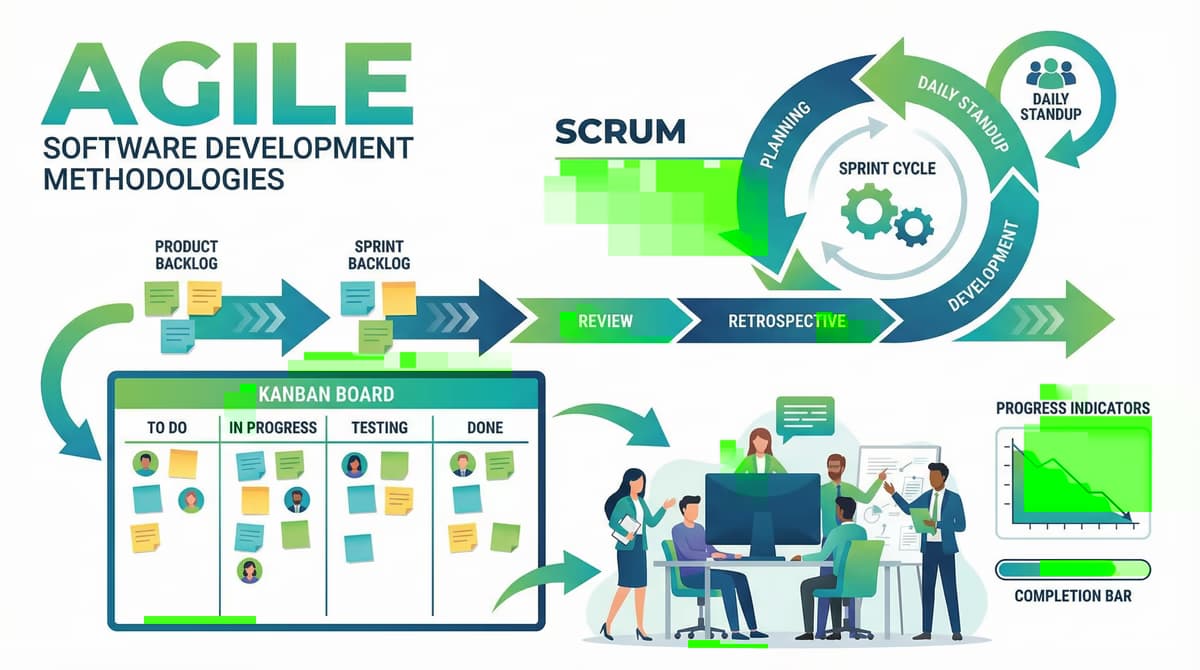
Scrum is the most common agile framework. It structured the development in fixed time intervals, so-called sprints (usually 2-4 weeks).
- Rolling: Product Owner (defined the "What"), Scrum Master (protects the process), Development Team (replaces).
- Artifacts: Product Backlog (list of all needs), Sprint Backlog (tasks for the current sprint), increment (ready software).
- Events: Daily Standup (short adjustment), Sprint Review (presentation of results), Sprint Retrospective (improving the process). = Kanban.
Kanban concentrates on the continuous flow of tasks. There are no fixed sprints. Tasks wander on a board of "To Do" via "In Progress" to "Done".
- Visualization: The work process is made transparent.
- WIP-Limits: The number of parallel tasks (work in progress) is limited to avoid bottlenecks.
- Focus: Ideal for maintenance projects or teams with highly fluctuating needs.
Benefits for companies
Why rigid waterfall models have served and how agile methods like Scrum and Kanban make your projects faster and better.
Leaders exploring Agile Software development: Methods and best practices can use View services, Cost Calculator: Software Development sowie Our Development Process as structured entry points.
Why should you use agile methods?
- Faster Time-to-Market: Regular releases bring functions faster to the user.
- Higher quality: Continuous testing and feedback reduce errors early.
- Room to adapt: Changes can be planned at any time without endangering the entire project.
- Clarity: You can see the current status and progress of the project at any time.
- Risk mitigation: misdevelopments are detected early and corrected before much budget is burned.
Best Practices for Introduction
Agility cannot be "installed". It is a cultural change.
- Start small: start with a pilot project before you rewrite the whole company.
- School your team: Invest in Training and Coaching for Pro.
References and further reading
The following separate references complement the topics in this article:
- Bitkom – German digital industry association.
- German Federal Office for Information Security (BSI).
- European Commission – Digital strategy.
- MDN Web Docs (Mozilla)
- W3C – World Wide Web Consortium.
"APIs are the backbone of modern systems; stabilise contracts early or pay twice in integration work later."
— Björn Groenewold, Managing Director, Groenewold IT Solutions
Frequently Asked Questions (FAQ)
What is this article about: “Agile Software development: Methods and best practices”?
This article sums up practical aspects of Agile Software development. Methods and best practices for leaders and delivery teams. In short.
Why rigid waterfall models have served and how agile methods like Scrum and Kanban make your projects faster and better.
Who benefits most from the content described here?
It is especially relevant for firms in Software development that need reliable systems, clear interfaces, and predictable delivery — from mid-market teams to expert departments.
How does this topic fit into an IT or digital strategy?
You can map the topic to service building blocks such as custom software and delivery support. Architecture reviews and stepwise rollout reduce risk and rework.
For multi-system landscapes, IT consulting and architecture helps align vendors and internal teams.
What are sensible next steps if we need support?
For architecture, rollout, or a second expert opinion, book a free initial consultation — including timeline and interface alignment.
About the author

Managing Director of Groenewold IT Solutions GmbH and Hyperspace GmbH
Since 2009 Björn Groenewold has been developing software solutions for the mid-market. He is Managing Director of Groenewold IT Solutions GmbH (founded 2010) and Hyperspace GmbH. As founder of Groenewold IT Solutions he has successfully supported more than 250 projects – from legacy modernisation to AI integration.
Blog recommendations
Related articles
These posts might also interest you.

Quality assurance in offshore projects: How to ensure the success of your software development
In today's globalised business world, the outsourcing of software development projects to external service providers, known as offshoring, is a strategic emergency for many companies...

Data integration: Strategies against data silos
In today's data-driven business world, information is the life elixir of each company. But too often these valuable data are trapped in isolated systems, so-called...

Digitalise knowledge transfer: tools and platforms for modern workplaces
In today's fast-paced business world, the effective knowledge transfer between employees is a key factor in the company's success. Companies that make it, the Wiss...
Free download
Checklist: 10 questions before software development
Key points before you start: budget, timeline, and requirements.
Get the checklist in a consultationRelevant next steps
Related services & solutions
Based on this article's topic, these pages are often the most useful next steps.
Related services
Related solutions
Cost calculators
Practical next steps after Agile Software development: Methods and best practices
Agile Software development: Methods and best practices addresses a practical choice for product and IT teams. Start with one clear goal: align software scope, technical risk, and business value before the next investment.
Check the current process, the data involved, and the result users need. Then record the main risks and define a small first step. This keeps the decision easy to review and gives your team a shared basis.
For implementation support, our custom software development connects the article's guidance with architecture, delivery, and stable operations. Engineering and project ownership stay with our team in Leer, Germany.
This post belongs to Software development. Browse the related Software development articles or use the English software blog for other topics.
When budget is the next question, the software cost calculators provide planning ranges. The IT glossary explains key terms, while in-depth technology guides cover wider decisions.
If the topic affects a live project, book a technical consultation or send the context through our project contact form. We usually reply within one working day.