As of: 23 September 2026 · Reading time: 14 min
Key takeaways
- Individual software solutions for production increase efficiency and competitiveness.
- Discover advantages, costs and implementation now.
Individual software solutions for production increase efficiency and competitiveness. Discover advantages, costs and implementation now.
“Good software is not an accident—it comes from a structured development process with clear quality standards.”
– Björn Groenewold, Managing Director, Groenewold IT Solutions
Why individual software solutions for production exceed standard software
Short response: Custom software solutions for production increase efficiency and market strength.
For Custom software solutions for production: The Guide, Cost Calculator: Software Development and Industry: Manufacturing are practical starting points. Budget and industry context: Our Development Process.
Those who want to approach Custom software solutions for production: The Guide will find concrete performance paths in individual software development and interface & integration projects.
Tailored production software surpasses standard solutions where manufacturing processes are too complex or too specific to be pressed into generic workflows.
Standard systems cover typical business processes, but production is rarely typical.
Typical weaknesses of ERP and CRM standard solutions in the manufacturing environment
ERP systems such as SAP or Microsoft Dynamics have been built for broad applications. That's her problem in the manufacturing environment.
They force process adaptations to slow down production managers daily.
Typical vulnerabilities:
- Starre data models: Production-specific parameters such as machine states, setup times or batch tracking can only be mapped with costly customizing projects.
- Interface problems: Standard systems communicate badly with machine controls (SPS/SCADA) because the data formats do not fit.
- Scaling license costs with user number: Any extension costs, any adjustment binds external consultants.
- Vendor-Lock-in: The source code belongs to the provider, not the company.
According to Gartner's ERP market analysis many ERP implementations in the manufacturing industry fail not in technology but in the lack of process matching.
When is it worth changing to individual solution?
The change to an custom software is worthwhile if at least two of the following conditions apply:
The company operates proprietary manufacturing processes that do not represent a standard system. The interface connection to machines or legacy systems requires recurring, expensive adjustments.
The licensing costs of the standard system exceed the calculated development costs of an custom solution within five years. competitive benefits depend directly on the speed and quality of process automation.
Data security and GDPR compliance cannot be fully guaranteed with the existing solution.
A common mistake. Companies compare the purchase costs of standard software with the development costs of an custom solution.
But ignore the ongoing licensing, maintenance and adaptation costs over five to ten years. .> Attention: Who only compares initial development costs without computing the Total Cost of Ownership for five years, decides on incorrect data base.
Standard software works cheaper until the first customizing projects begin.
Benefits of customized production software at a glance
Tailored production software is a software solution built clearly for the needs of a single company, which accurately maps production processes, system architecture and data flows.
It is not created by the bar, but by a precise review of the operational reality.
The benefits are shown at several levels simultaneously:
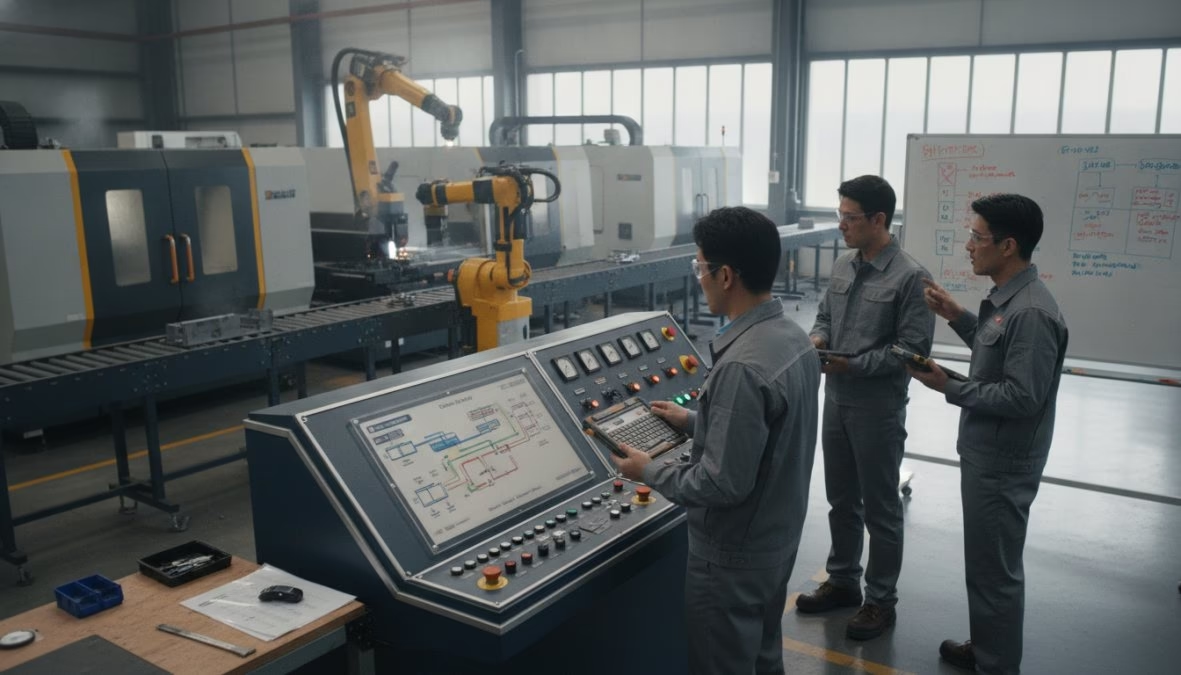
Process fit without compromise: Each mask, each workflow, each interface is built according to actual processes.
No way around generic functions, no training effort for processes that no one needs.
Full data control: For custom software, the source code lies with the client. This means: no dependency on the provider, no forced updates, no vendor lock-in.
Scalability as required: New production lines, extra locations or modified processes can be integrated without having to negotiate a new license model.
Direct efficiency increase: Because the software does exactly what production needs, manual workarounds, double data inputs and media breaks are eliminated.
| Criterion | Standard software | Custom production software |
|---|---|---|
| Process fit | Generic | Exact tailored to operation |
| Interface connection | Limited | Fully configurable |
| Source code property | At provider | At client |
| Scalability | Licensing | Free scalable |
| Long term cost | Rising (licenses, customizing) | Planable and controllable |
| GDPR Conformity | Limited controllable | Fully shapeable |
Many companies underestimate the strategic value of source code ownership. Anyone who owns the code can change, expand or develop in-house at any time. This is operational sovereignty.
knowledge: Tailored production software provides the greatest added value when process matching, interface room to adapt and long-term data control are more important than fast access.
Optimizing production planning with individually developed software
The biggest weakness of most production planning systems is not lacking functions, but lacking topicality.
Those who make decisions based on data that is two hours old are planning to pass the reality.
Real-time data and workflow optimization in production
Custom production software for production planning works with real-time data from machine connections, storage systems and ERP interfaces. This allows planning adjustments that cannot afford standard systems.
Specific applications in practice:
Dynamic machine occupancy. If a machine fails, the system automatically calculates alternative occupancy plans based on current capacity data.
Predictive material planning: real-time storage data automatically trigger ordering processes before bottlenecks arise.
Quality assurance in the process. Deviations of production parameters are reported at once, not only in the final product.
Workflow automation: releases, status messages and escalations run automatically without manual interventions.
Workflow optimization in production is not an end in itself. It reduces lying times, lowers the committee and accelerates the responsiveness to customer requests.
If you integrate real-time data into production planning, make better decisions faster.
Profi tip: The integration of machine control data (OPC-UA, MQTT) directly into the planning software is technically demanding. However, the largest lever for real-time planning.
Many projects fail because this step is planned too late.
Interface connection: Integrate individual production software into existing systems
Interface connection is the most technically critical part of each project for custom software solutions for production.
Not the development of core functions costs most of the time, but the clean integration into the existing IT infrastructure.
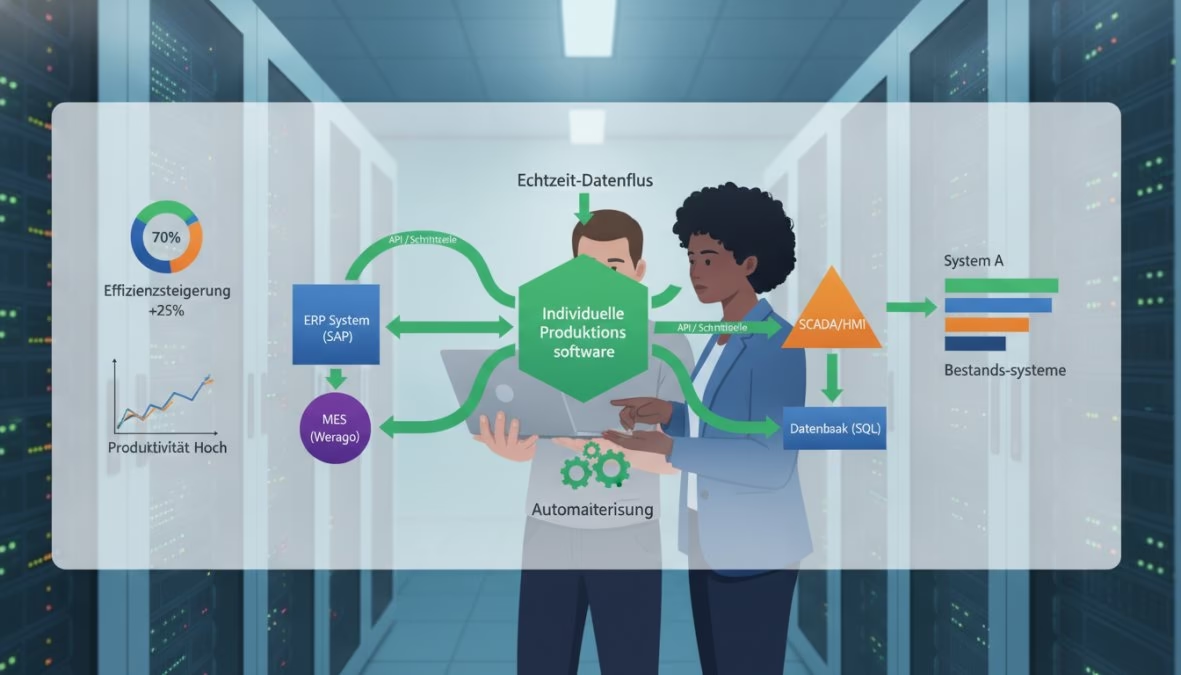
IMAGE.
Two IT professionals in a server room, one pointing at a laptop screen showing system architecture connections, both wearing business casual attire, blue server rack lighting in background | section.
Interface connection. Custom production software integrate into [existing systems]
APIs and middleware as bridge technology for legacy systems
APIs and middleware are the bridge technology between modern production software solutions and grown legacy systems.
Without it, any new application remains an island. .Legacy systems in production are the rule, not the exception.
Many manufacturing companies operate ERP systems that have been in use for 15 or 20 years. They are stable, well played and contain valuable data.
But they don't speak modern protocols.
Here the middleware architecture starts:
- API gateway: Central entry point for all system communication that takes over authentication, logging and rate licensing.
- Message Broker (e.g. RabbitMQ, Apache Kafka): Decoupled systems, buffers data packets and ensures data integrity even at load peaks.
- ETL processes: Extract, transform and load data from legacy formats into modern data structures.
- Webhook integration: Enables event-controlled communication between systems without permanent polling.
What most guides overlook: Interface development is not a single project, but a continuous process. Systems change, data formats continue to develop, new machines are added.
A well-recorded API layer is so not a technical game, but operational need.
According to Fraunhofer Institute for Production Technology, the system compatibility between new software solutions and existing IT infrastructure is one of the most common pillars in digitization projects in mid-sized firms.
Cloud vs. On-Premise: Choose the right system architecture
The decision between cloud and on-premise is not a matter of modernity versus tradition. It is a question of needs, risk profile and control needs.
Cloud integration provides fast scalability, reduces internal IT coverage and allows access to multiple sites.
This is a real advantage for companies with distributed production sites or seasonal load peaks.
On-premise solutions keep the data in your own data center. This is not optional for many manufacturing companies.
However, is prescribed by compliance needs, data protection or security needs.
Hybrid architectures combine both approaches: production-critical data remains local, evaluations and reporting run in the cloud. This is currently the most pragmatic approach to mid-sized firms.
| Architecture | Strengths | Flaws | Suitable for |
|---|---|---|---|
| Cloud | Scalable, low-maintenance | Dependence on the provider | Multi-location operations |
| On-Premise | Full data control | High IT imprint | Compliance-intensive industries |
| Hybrid | Flexible, balanced | Complex architecture | Medium with growth plans |
Costs of individual software development for production realistically estimate
Short: Here is the uncomfortable truth.
Here is the uncomfortable truth. Custom software development for production costs more than buying a standard license.
Anyone who uses this as an argument against custom software thinks too short.
ROI and cost-benefit analysis: What individual software provides in the long term
The cost-benefit review for custom production software must be calculated over a period of at least five years. Short-term comparisons systematically lead to wrong decisions.
Cost drivers for standard software (often underestimated):
- Annual license fees that scale with user number and modules.
- External consultant costs for customizing projects.
- Costs for interface adapters and middleware solutions.
- training effort for processes that do not fit the operation.
- Migration costs for the next version change of the provider.
Cost drivers for custom software (transparent and planable):
- Initial development costs (once)
- Maintenance and further development (as required, internal or external).
- No license fees, no Vendor dependency.
The ROI is derived from several sources at the same time.
Reduced process costs due to automation, less waste due to better quality control, faster responsiveness to market changes and the omission of ongoing licensing costs.
A simple calculation formula for rock estimation:
ROI formula (simplified):
Annual savings (process costs + license costs) x 5 years minus development costs Custom software = net ROI over 5 years
Many companies note that the investment in custom production software is already amortised after two to three years.
Legal framework conditions: EU AI Act, GDPR and data security in production
Legal needs are not a supplement, but a central selection criterion for each software solution in production.
This is especially true since the EU AI Act has introduced binding duties for AI-based systems.
GDPR in production: Production data often contain personal data, such as shift plans, performance data of custom employees or access protocols.
These must be processed, stored and deleted in accordance with the GDPR. For standard software with data keeping outside the EU, this is structurally difficult.
EU AI Act (completely relevant since 2026): Systems using AI models for quality control, production planning or predictive maintenance are covered by the EU AI Act's high risk grouping.
That means:
Documentation needs for AI models and training data Needs for clarity and clarity of AI decisions Obligation for human supervision in critical decisionsRegistration duties in the EU high-risk AI System Database
According to EU AI Act full text and guidelines, companies using AI-based production systems must carry out conformity assessments and hold technical documentation.
Data security: Production data are business secrets. Cloud solutions with data storage in Germany or the EU offer significantly more legal certainty than global providers.
Custom software solutions for production, which are built by German developers and operated on German servers, meet these needs structurally better.
Groenewold IT Solutions develops exclusively with permanent experts in Germany and guarantees GDPR-compliant data retention in the EU. This is not a marketing statement, but a contractual assurance.
Companies that integrate AI functions into their production software without taking into account the EU AI Act risk major fines from 2026 onwards.
The compliance needs should be incorporated into the system architecture from the outset, not then supplemented.
Change Management: Successful introduction of individual software solutions for production
Technology rarely fails in technology.
The most common cause of failed software launches in production is lack of acceptance among employees who are supposed to work with it daily.
Change management is not a soft factor, but a hard condition for success. Without a structured introduction, the best custom software remains unused.
Proven procedure in five steps:
Early integration of key users. Production managers, shift leaders and skilled machine operators should already be involved in the requirement review.
Whoever contributes to development does not sabotage the introduction.
Pilot operation before rollout: introduce new production software first in a production line or area, collect feedback, adjust, then roll out.
Training in the real process: No abstract system training, but training at the actual workflows of the company.
Clear communication of benefit. Employees need to understand why the new software helps their work, not complicate.
Dedicated contact: A firm internal project manager who answers questions and escalates problems.
According to McKinsey's digital transformation study, digital transformation projects often fail not at technical hurdles, but at organizational and cultural factors.
Frequent errors in implementation and how to avoid them
The most expensive mistake is a too tight schedule. Production software implementations need buffers for interface problems, data migration and training. Whoever ignores it forces a forward rollout.
Other typical errors:
- Needs too early: Production processes change during development. Agile development methods with regular reviews are superior here.
- Underestimate data migration: Historical data from legacy systems are often inconsistent, incomplete or in proprietary formats. Data quality must be tested before migration.
- No rollback strategy: What happens when the new system expires on the first day of production? Who has no answer should not go live.
- IT and production do not speak to each other: Software developers do not understand manufacturing processes automatically. Regular joint reviews are mandatory, no guarantee.
Profi tip: A proven approach is the parallel operating phase. Old and new systems run four to six weeks simultaneously.
This costs more effort in the short term, but prevents production failures with undetected errors.
Conclusion: Tailored production software as a strategic competitive advantage
Custom software solutions for production are not a luxury solution for companies.
They are the logical consequence for manufacturing companies whose competitive advantage lies in the precision of their processes.
Standard software cannot protect this advantage because it does not represent it by definition.
The decision for tailor-made production software is an investment in operational sovereignty: full control of data, processes and system architecture, without dependency on license policy or Vendor roadmaps.
Anyone who honestly calculates the Total Cost of Ownership, takes the EU AI Act seriously and understands change management as a success factor will notice.
The change to custom solution is not a risk. He's a strategic decision that pays off.
Frequently Asked Questions (FAQ)
Why are individual software solutions for production often better than standard solutions?
Standard software such as generic ERP systems often covers only general processes and requires costly adjustments.
Custom software solutions for production are clearly tailored to the specific manufacturing processes, machines and data flows of a company.
This reduces unnecessary functions, improves user acceptance and enables direct integration into existing system architectures - without compromising data quality or process automation.
What are the advantages of customized production software for manufacturing companies?
?Tailored production software offers, among other things, a higher efficiency increase through precise workflow optimization, complete control over the source code without vendor lock-in, better scalability with growing needs and a GDPR-compliant data storage.
In addition, interfaces to existing ERP systems, CRM or DMS can be built clearly. This significantly simplifies data integration and makes real-time data usable in production planning.
What does the development of an individual software cost for production?
The costs for custom software development in production vary greatly depending on the project scope, complexity of the interface connection and selected system architecture.
Simple modules often start in the five-digit range, complete solutions with AI integration or complex API connection can be significantly higher.
The long-term cost-benefit review is crucial: falling royalties, reduced error rates and process automation typically amortize the investment within a few years.
How can individual software be integrated into existing ERP systems?
The integration usually takes place via defined interfaces and APIs that act as bridge technology between the new custom software and existing legacy systems such as ERP or CRM.
An AI layer as a middleware can harmonize data formats and control data flows.
Important is a careful review of the existing IT infrastructure and the decision between cloud and on-premise integration to ensure system compatibility and data security.
How does the development of an individual production software typically work?
The development process begins with a detailed requirement review of the specific manufacturing processes.
This is followed by conception, architecture decision (e.g. Cloud vs. On-Premise) and stepwise development in Sprints.
Interface connections to ERP or other host systems are planned early.
At the same time, change management should be taken into account to ensure acceptance in the team. Finally, tests, commissioning and ongoing further development follow.
Manufacturing companies that really want to digitize their processes are bound by standard software sooner or later.
Groenewold IT Solutions develops tailor-made software solutions for production with proven experts from Germany, complete source code transfer and guaranteed GDPR compliance without Vendor lock-in.
Request a free project check now and learn what solution suits your processes and budget.
References and further reading
The following separate references complement the topics in this article:
About the author

Managing Director of Groenewold IT Solutions GmbH and Hyperspace GmbH
Since 2009 Björn Groenewold has been developing software solutions for the mid-market. He is Managing Director of Groenewold IT Solutions GmbH (founded 2010) and Hyperspace GmbH. As founder of Groenewold IT Solutions he has successfully supported more than 250 projects – from legacy modernisation to AI integration.
Blog recommendations
Related articles
These posts might also interest you.

How to connect your company systems for sustainable success
In today's business world marked by digital transformation, data is the undisputed elixir of life of every company. They are the basis for innovation, efficiency and sound...

Venture Capital for Software Development: Opportunities and Risks
In the dynamic world of software development, access to capital is often the decisive factor that decides on the success or failure of an innovative start-up. One of the famous...
Software funding in the middle class: practical examples and success factors
Digitization poses major challenges to small and medium-sized enterprises (SMEs), but also offers immense opportunities. One of the central hurdles is often Software Financing. How...
Free download
Checklist: 10 questions before software development
Key points before you start: budget, timeline, and requirements.
Get the checklist in a consultationRelevant next steps
Related services & solutions
Based on this article's topic, these pages are often the most useful next steps.
Related services
Related solutions
Cost calculators
Related industries
Practical next steps after Individual software solutions for production: The Guide
Individual software solutions for production: The Guide addresses a practical choice for manufacturers. Start with one clear goal: align software scope, technical risk, and business value before the next investment.
Check the current process, the data involved, and the result users need. Then record the main risks and define a small first step. This keeps the decision easy to review and gives your team a shared basis.
For implementation support, our custom software development connects the article's guidance with architecture, delivery, and stable operations. Engineering and project ownership stay with our team in Leer, Germany.
This post belongs to Software development. Browse the related Software development articles or use the English software blog for other topics.
When budget is the next question, the software cost calculators provide planning ranges. The IT glossary explains key terms, while in-depth technology guides cover wider decisions.
If the topic affects a live project, book a technical consultation or send the context through our project contact form. We usually reply within one working day.