Software development
Digitization in the middle class: How to measure your success
Digitization is no longer a trend for medium-sized enterprises, but a need to remain competitive. But how to measure the success of Digitalisie...

Cost transparency · AI chatbot · B2B
What does an enterprise AI chatbot really cost? We break down knowledge-base work, integrations and monthly operating spend — Made in Germany (Leer, East Frisia).
In brief
The investment range for an AI chatbot is EUR 10,500 – 105,000 excl. VAT. FAQ, mid-market and enterprise scale the scope inside that span.
A use-case review comes before the effort estimate. Book a consultation · AI chatbot development
Mid-sized companies use chatbots to relieve support teams, improve internal knowledge access or automate customer conversations, without relying on generic cloud tools that may conflict with data policies.
Pricing is driven by data sources, integrations and privacy requirements. From a lightweight FAQ bot to an enterprise assistant with CRM coupling, both one-off build costs and monthly operating costs vary significantly. The sections below explain the main factors in plain language.
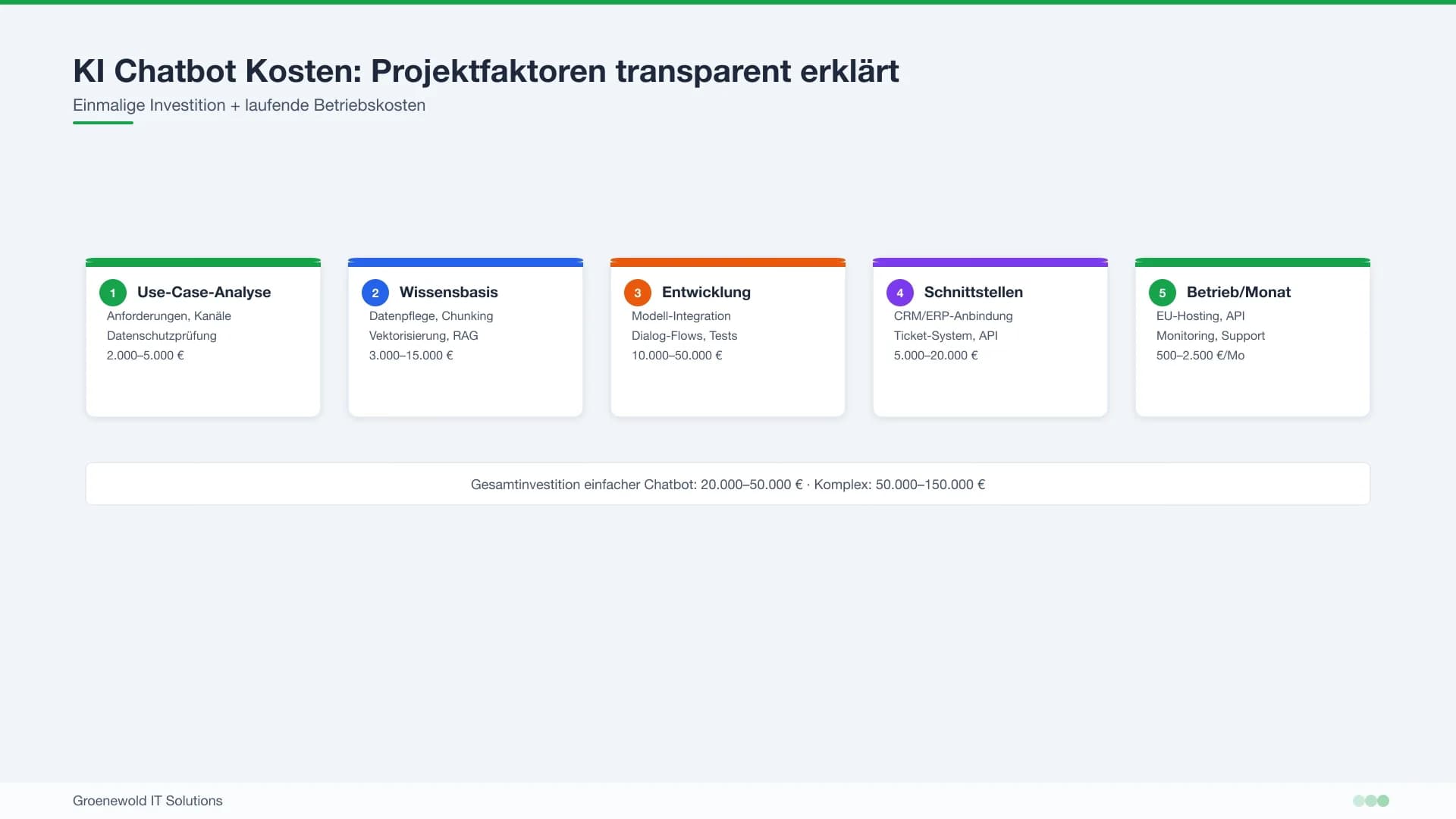
One-off costs split into clear phases. The sharper the use-case boundary, the more predictable the estimate.
Requirements capture, process analysis, technical concept, privacy review.
Structuring and cleansing documents, FAQs, manuals, and process knowledge.
Chatbot build, CRM/ERP coupling, escalation logic, channel integration (web, Teams, etc.).
Data protection impact assessment, DPA, access controls, logging and deletion concept.
After go-live, budget for hosting, LLM usage and quality assurance — these items belong in the total cost of ownership.
EU data centre, vector database, application hosting. On-premise: higher capex, often lower opex.
Depends on traffic and model choice. Open-source models can lower API fees. That is not a second project total.
Answer quality assurance, knowledge base updates, monitoring dashboards, error analysis and tuning.
We avoid naming one fixed AI chatbot price without a use-case review. Effort comes from knowledge-base breadth and quality, depth of CRM/ERP/ticketing integrations, privacy needs (DPA, DPIA, on-premise), model usage, monitoring of answer quality and long-term support. Planning these together keeps both capex and opex predictable.
A structured build covers discovery and use-case definition, knowledge preparation, dialogue and escalation logic, integration into existing systems, testing and handover to operations. Per phase we align responsibilities on your side and ours — data delivery, approvals, test cases and acceptance criteria — so hidden effort stays visible.
LLM chatbot costs combine model usage (managed APIs or self-hosted open models), application and vector-database hosting in EU regions, security controls (roles, logging, encryption) and continuous quality checks. Early alignment on usage, hosting and monitoring prevents surprises after launch. More on delivery: AI chatbot development.
AI chatbot prices are not one-size-fits-all: data complexity, channels, integrations and compliance shape the estimate. The clearer these dimensions are up front, the tighter the range.
Structured, well-maintained sources reduce preparation effort. Scattered PDFs and wikis increase it.
Each additional system (CRM, ERP, ticketing) adds build and test effort — but often unlocks the core business value.
GDPR requirements, on-premise operation or formal DPIAs can materially increase total effort.
Cloud (lower capex, API usage) vs on-premise (higher capex, different opex profile) changes the overall picture.
You need a use-case review for a binding quote. As orientation: simple FAQ bots with a static knowledge base often start around €10,500 – 21,000 excl. VAT. Mid-size solutions with two to three integrations and a dynamic knowledge layer frequently land around €21,000 – 42,000 excl. VAT. Enterprise bots with multi-channel delivery, CRM/ERP integration and on-premise operations can reach €42,000 – 105,000 excl. VAT.
Add monthly hosting, LLM API usage and monitoring on top of build costs. A proof of concept before full rollout helps validate ROI and effort.
These dimensions move the AI chatbot budget the most:
| Cost driver | Lower effort | Higher effort |
|---|---|---|
| Number of data sources | 1–2 structured sources | 5+ unstructured sources (PDFs, wikis, ERP) |
| Channels | One channel (e.g. website) | 3+ channels (web, Teams, WhatsApp, phone) |
| Integrations | None / simple REST | CRM + ERP + ticketing + SSO |
| Compliance | Lower risk, straightforward privacy | On-premise, DPIA, sensitive personal data |
| Dialogue complexity | FAQ, mostly static | Multi-step flows, transactions, escalation |
| Escalation logic | None / simple email handoff | Smart routing to agents, ticketing integration, priorities |
| Training / fine-tuning | No fine-tuning (RAG on knowledge base) | Model fine-tuning or adapters on company data |
| Monitoring & maintenance | Basic logging, quarterly review | Continuous quality monitoring, monthly KB updates, alerting |
| Privacy (GDPR) | Standard DPA, no sensitive categories | DPIA, on-premise, deletion concepts, roles, sensitive data |
| Languages | English only | Multilingual (EN/DE/FR/…) |
Frequently asked questions
The investment range for an AI chatbot is EUR 10,500 – 105,000 excl.
VAT. Data sources, integrations and privacy set the scope inside that span. Hosting and API usage are operations, not a second project total.
The main drivers are: (1) number and quality of data sources — more unstructured sources mean more preparation work, (2) number of system integrations (CRM, ERP, ticketing), (3) number of channels (web, Teams, WhatsApp), (4) privacy requirements — on-premise or formal DPIAs increase effort, (5) dialogue complexity — multi-step flows and escalation logic cost more than simple FAQ answering, (6) operating model — cloud hosting vs on-premise affects both capex and opex.
Every project differs in data quality and structure, IT landscape, privacy posture and use cases (public website bot vs internal knowledge assistant with CRM access).
That is why flat-rate chatbot prices are rarely meaningful — a scoped estimate after a use-case workshop is the more serious baseline.
Simple FAQ chatbots sit at EUR 10,500 – 21,000 excl.
VAT. Mid-size solutions at EUR 21,000 – 42,000 excl. VAT. Enterprise with CRM, ERP and on-premise at EUR 42,000 – 105,000 excl. VAT. That is the same table, not a second range.

Request a cost estimate
In an intro call we clarify use case, knowledge base and integrations for a transparent effort estimate.
A build covers analysis, knowledge preparation, development and GDPR setup.
The total sits in the investment range EUR 10,500 – 105,000 excl. VAT. Work packages are not added as a second total.
A simple FAQ bot with a static knowledge base and one channel is much cheaper than a complex bot with dynamic knowledge, several integrations (CRM, ERP, ticketing), multilingual support and intelligent escalation routing.
Integration complexity — not the language model alone — is usually the largest cost driver.
Hosting, LLM API usage and monitoring are operations after go-live.
They are not the investment range EUR 10,500 – 105,000 excl. VAT and not a saving.
Yes: tight use-case scoping prevents scope creep, open-source models can cut API spend, and a clean knowledge base reduces preparation effort.
We often recommend a proof of concept before full build-out to validate ROI and effort.
Key cost drivers for AI chatbot projects include: number of data sources (1–2 structured sources vs 5+ unstructured sources such as PDFs, wikis, ERP), number of channels (one website channel vs 3+ channels such as web, Teams, WhatsApp, phone), integrations (none / simple REST vs CRM + ERP + ticketing + SSO), compliance (low risk vs on-premise with DPIA and sensitive personal data), dialogue complexity (FAQ vs multi-step transactions and escalation), escalation logic, training/fine-tuning, monitoring & maintenance, GDPR posture and languages (German only vs multilingual).
These factors have the greatest impact on budget.
The investment range is EUR 10,500 – 105,000 excl.
VAT. FAQ, mid-market and enterprise scale the scope. Data sources, channels and privacy set the position inside that span.
In a free intro call we review your use case and provide a transparent effort estimate — no hidden line items.
Book a consultationThe calculation follows six visible stages. All figures remain planning values until scope and assumptions have been reviewed.
1. Capture inputs
The calculator records the visible project, volume, complexity and operating parameters selected on this page.
2. Add fixed components
Fixed base modules and selected add-ons are added without mixing them with recurring charges.
3. Apply multipliers
Quantity, complexity and scope factors multiply only the cost components identified for them in the calculator model.
4. Create the range
The calculator applies its documented lower and upper uncertainty factors to the base result; ROI views keep investment and savings visible separately.
5. Round and calibrate
Monetary result fields are rounded to the nearest whole euro. Public project-cost components are calibrated with the centrally maintained display factor.
6. Classify the result
The result is shown as non-binding guidance. A binding quote requires scope, data, integrations, risks and acceptance criteria to be reviewed.
Efficiency or discount factor: A central display factor of 0.7 is applied to public project-cost components to keep all calculators aligned with the currently reviewed pricing basis. It is not a customer-specific discount; customer-entered wages, revenues and existing operating costs are not reduced.
Why this is not a binding quote: The calculator cannot verify complete requirements, third-party dependencies, data quality, legal constraints or acceptance criteria.
Concrete project profiles with assumptions and indicative budgets—useful for internal alignment alongside the calculator.
Software leasing spreads this investment range over 72 months. Terms are on the software financing page.
Use case, knowledge integration, model cost, and care—so you see the real TCO of your bot.
1. Use case and success metrics
We define the use case and metrics (containment, escalation) with you. That determines effort and risk.
2. Knowledge integration
FAQs, documents, CRM integration—each source costs in integration and care. We estimate cleanly per source.
3. Model and inference cost
We pick GPT, Claude, open source, or hybrid and calculate token costs realistically over 12 months.
4. Training and continuous improvement
We calculate testing, prompt tuning, re-indexing, and reviews. Bots get better over time—that has a price.
| Model | When it fits | Budget & flexibility | Typical risks |
|---|---|---|---|
| Fixed price (fixed scope) | Clearly defined scope, stable requirements, repeatable delivery. | Predictable total cost; little room for change without a change order. | Scope creep leads to change orders or quality trade-offs. |
| Time & Material | Discovery, legacy, evolving requirements, or close collaboration. | Maximum flexibility; budget transparent via hourly or daily rates. | Without prioritisation, effort can grow—backlog and reviews matter. |
| Retainer / maintenance package | Ongoing operations, updates, small features, and support. | Agreed capacity per month; predictable follow-on cost. | Large changes may still need a separate estimate. |
| Hybrid (milestone + T&M) | MVP or phased releases with clear go-lives, then iterate. | Core delivery fixed price; extensions on a time-and-materials basis. | Define contractually what is in scope vs. extra work. |
Calculators on this page provide indicative ranges; we choose the right model with you based on risk, scope, and planning horizon.
The ranges shown are indicative. For a binding quote we discuss scope, priorities and funding options in a free intro call. Many digitalization projects qualify for grants – try our funding calculator.
Browse all cost calculators, explore services and typical solutions. Questions about AI chatbot? Contact us.
After using the AI chatbot calculator, validate assumptions in a short intro call.
Browse all cost calculators in the costs overview.
Calculator overall range
EUR 14,000–168,000 excl. VAT, depending on data and integrations
The overall range is derived from the valid parameters of the relevant cost calculator.
Typical duration
2–10 months
Main risk drivers
Non-binding indication
This result is only a non-binding indication based on typical assumptions. Effort and price must be calculated individually for your project.
Blog posts that put budget, effort and typical project paths for this calculator in context.
Digitization in the middle class: How to measure your success
Digitization is no longer a trend for medium-sized enterprises, but a need to remain competitive. But how to measure the success of Digitalisie...
Digital Transformation: Leadership and Change Management as key to success
Digital transformation is more than just the introduction of new technologies. It is a profound change process that affects companies of all sizes. Especially for small and...
Digital Transformation: The Power of Partnerships and Ecosystems
Digital transformation is no longer an option for small and medium-sized enterprises (SMEs), but a need to remain competitive. But the way to the digital future...