Agency delivery included
AI chatbot agency service from discovery to operations
Companies that want an AI chatbot built receive more than an embedded chat widget. We define the use case, prepare approved knowledge, develop escalation paths, connect CRM or ticketing and train the team that owns the service after launch. The result is a scoped delivery with a test set, operating rules and measurable answer-quality targets.
Website and support chatbot
Product FAQs, service questions and ticket triage are answered around the clock, with full context handed to staff when confidence, subject or customer request requires a human.
Internal knowledge assistant
Manuals, wikis and process documents become searchable through role-aware RAG. Source references and approval states help employees distinguish verified guidance from missing knowledge.
Service handover and SLA readiness
Runbooks, monitoring, known-error guidance and ownership for knowledge updates are agreed before go-live. This prevents the chatbot from becoming an unowned experiment after the first release.
Specialised agency or generic chatbot tool?
A generic tool may be sufficient for a static FAQ. A specialised chatbot agency is needed when answers must respect permissions, cite approved sources, update from business systems and hand cases to people without losing context. We define these controls before selecting a model or widget.
Business chatbot use cases
Website FAQ
Answer recurring product and service questions with human handover.
Internal knowledge
Search manuals, policies and process documentation with source citations.
HR and onboarding
Guide employees through approved policies, forms and first-week processes.
IT helpdesk
Triage standard requests and route unresolved incidents with full context.
Product guidance
Support configuration and selection using catalogue, CRM or commerce data.
Customer service
Combine consistent answers, ticket creation and measurable escalation quality.
Implementation in four controlled stages
1. Use-case analysis
Channels, question volume, human escalation and measurable success criteria.
2. Knowledge base
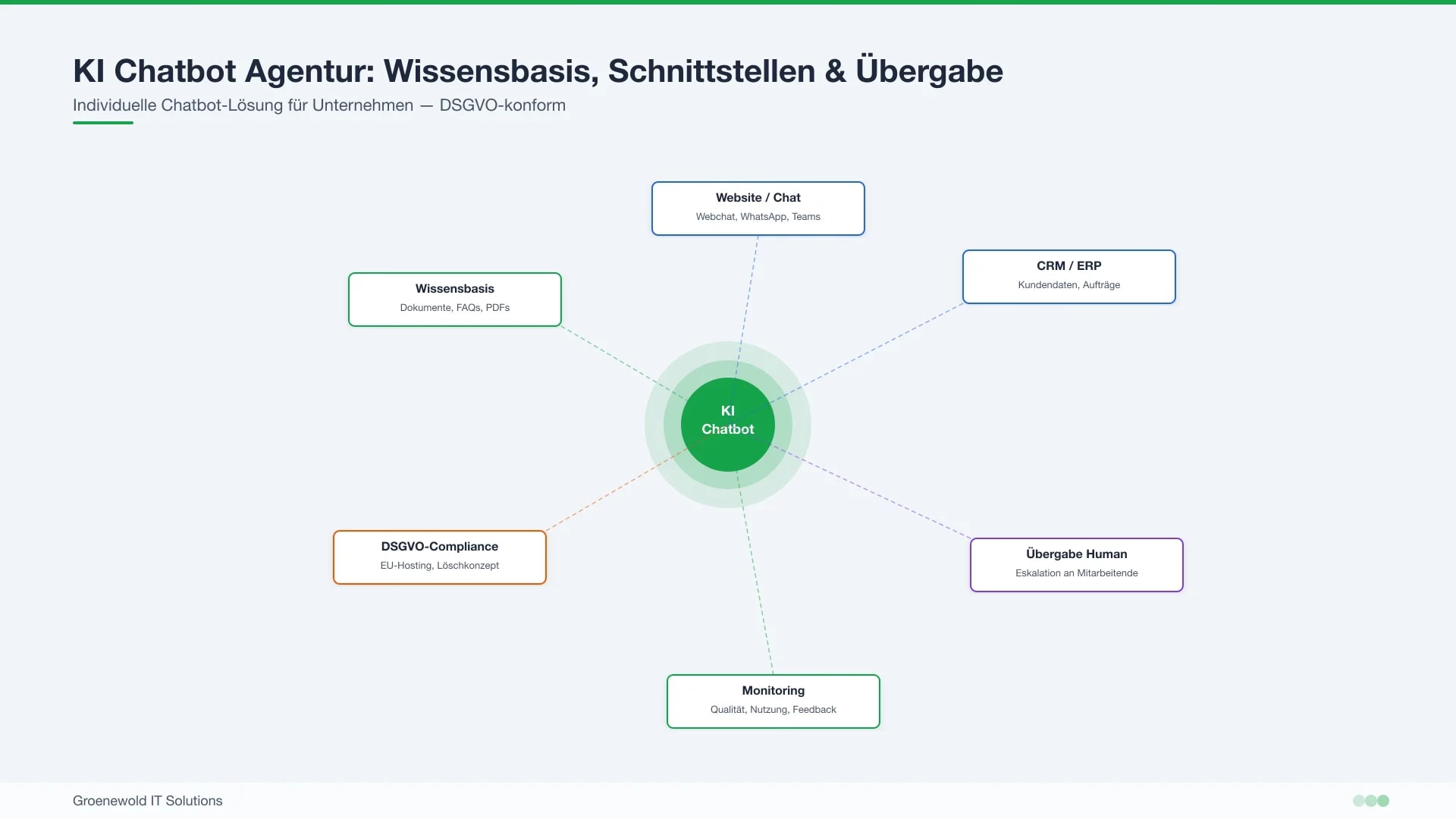
Approved documents, websites and system data with refresh and ownership rules.
3. Build and integration
RAG, website widget, CRM, ERP or ticketing plus permission checks.
4. Test and operate
Acceptance set, team enablement, monitoring and answer-quality reviews.
Website integration, customer service and privacy
Website chatbots can run as a widget or native frontend while the same backend serves Teams, Slack or a service portal. CRM and ticketing integrations pass identity, intent and conversation context into the existing process. Personal data is minimised, retention and deletion are documented and EU hosting or on-premise operation is evaluated for the specific scenario.
A GDPR-aligned design still requires an individual legal assessment. We provide the technical controls, processing documentation and data-flow transparency needed for that assessment.
A rule-based bot follows fixed decision trees; a RAG chatbot answers from approved business sources; an AI agent for autonomous workflows can plan and execute multi-step actions. We select the smallest reliable architecture and expose realistic budget factors in the AI chatbot cost guide.