
As of: 3 September 2026 · Reading time: 8 min
Key takeaways
- Automation in mid-sized businesses reduces costs and errors.
- Learn what processes are worthwhile and how the implementation can be planned.
Automation in mid-sized businesses reduces costs and errors. Learn what processes are worthwhile and how the implementation can be planned.
“An ERP system is only as good as its fit to your actual business processes.”
– Björn Groenewold, Managing Director, Groenewold IT Solutions
Anyone who only digitally maps processes has nothing automated yet. Right here many companies lose time, money and nerves.
Forms are filled online, but in-house forwarded as before by house mail. Data are in several systems, releases depend on custom persons.
And recurring tasks bind professionals who should actually work on more important topics. Automatization not only creates efficiency but above all reliability.
For many leaders, the topic is attractive, but at the same time involves risks. Which processes are even suitable? Where does custom development pay instead of standard tools?
And how to prevent new dependencies, shadow processes or data protection problems arising? If you want to clean up automation, you don't need Buzzwords.
However, clear goals, resilient architectural decisions and a realistic project path.
What automation really means in companies
Central automation reduces costs and errors.
For Implementing Automation in Mid-Sized Firms the Right Way, Cost Calculator. API Development and Solution. Integration Chaos are practical starting points.
Budget and industry context: RPA vs. API Integration.
Apply correctly to Automatization in mid-sized firms are interface & integration projects and system integration suitable entrances for planning and rollout.
In the company context, automation does not simply mean removing manual work completely.
The aim is to design recurring, rule-based or data-driven processes in such a way that they run reliably, comprehensible and as far as possible without media breakage.
This can start small, for example with automatic notifications, data comparisons or release processes.
However, it may also concern business-critical processes, for example the processing of orders, invoices, service cases or master data.
The key point: Good automation is not based on tools, but on business processes.
A company does not benefit because it has introduced a workflow engine or an RPA product.
It benefits when transit times decrease, error rates decrease measurably and teams are significantly relieved.
Especially in mid-sized firms, this is relevant because processes have often grown over years.
Excel files, ERP system, email mailboxes, specialist applications and custom interim solutions exist in parallel.
This does not result in a clean end-to-end process, but a sequence of transfers. Automation starts exactly where these transfers cost time or generate errors.
Which processes are suitable for automation
Short: Not every process should be automated at once.
Not every process should be automated at once. In practice, processes that frequently occur follow clear rules and produce noticeable friction in their present state are especially worthwhile.
Typical candidates are supply creation, invoice processing, ticket forwarding, approval procedures, data transfer between systems, reporting, terminology or onboarding processes.
Also interesting are processes which, although not technically complex, cause high secondary costs. Manually maintained data collection can involve double collection, incorrect evaluations or queries in customer service.
Such effects often remain invisible until the business volume rises or key persons fail.
Processes which are still unexplained or permanently produce exceptions are less suitable.
If it is unclear who decides which data are binding or which rules are relevant at all, you will otherwise only digitize chaos.
Then first the process should be clarified professionally. Automation is not a substitute for missing responsibilities.
Automation needs measurable goals
Short: Many projects start with the desire to become more efficient.
Many projects start with the desire to become more efficient. This is understandable, but as a project goal too inaccurate. Better is a clear economic and operational definition.
Should the processing time decrease by 40 percent? Should input errors be halved? Should specialist departments access the same data without media break?
Or should a process be scalable without building extra staff?
This clarity is crucial because it influences architecture, prioritization and project scope. If you only look at speed, you may build a fast.
However, difficult to maintain single solution. Those who only rely on technical elegance lose sight of the business benefits.
Good projects combine both: a clear scope and measurable results.
This is especially important for risk-sensitive organisations. Automation often intervenes in growing core processes.
So, from the outset, it should be proven which key figures are collected before and after rollout. Without baseline, the benefits are often subjective at the end.
Standard Software, Low Code or Individual Solution?
Short: This question decides on costs, room to adapt and subsequent ease of upkeep.
This question decides on costs, room to adapt and subsequent ease of upkeep. Standard software makes sense if processes are largely industry-typical and can be reproduced without major compromises.
This applies, for example, to certain approval procedures, ticketing structures or basic workflows. The advantage is quickly available. The disadvantage.
As soon as special logic, existing interfaces or special authorization models come into play, it becomes quickly unclear. .Low-code platforms have an attractive effect at first glance.
This is because specialist areas can build faster prototypes. This can work well for clearly outlined applications. It becomes critical when the prototype becomes a business-critical system.
Without architecture discipline, there are difficult traceable dependencies, limited expandability and operational risks.
Custom development is usually the better choice when processes are competitive, multiple systems have to be integrated or long-term control is important.
This applies especially to companies that do not want standard software from the bar. However, pass-precise solutions with clean roll logic, GDPR-compliant data processing and clear maintenance strategy.
Here, an rollout pays off from a single source because conception, development, integration and operation are thought together.
Why interfaces are often more important than workflow itself
Short: In many projects, the actual problem lies not in the form or in the user interface.
In many projects, the actual problem lies not in the form or in the user interface. However, in missing or unstable connections between systems.
Automation rarely fails on the idea, but on data breaks.
If ERP, CRM, DMS, technical application and e-mail system do not play together reliably, each process remains only partially automated.
So, you should check early where data arises. This system is leading and how changes are propagated. This is not only about technical access via API.
However, also about responsibilities, data quality and error handling. What happens when an import fails? How are duplicates detected?
What information can be transferred at all for data protection reasons?
Here, quick tool introduction of resilient company solution separates. If you look at interfaces only by the way, then high operating expenses will be involved.
Anyone who plans them clean from the start creates the basis for stable automation.
This is how a load-bearing implementation starts
Short: A good automation project does not begin with development, but with structure.
A good automation project does not begin with development, but with structure. First, the actual process is started, then the target architecture is described and professionally prioritized.
Exemptions, releases, security needs and integration points should already be visible in this phase. This will reduce the subsequent disadvantages and discussions.
A clearly defined scope of rollout follows. Especially in midsize organisations, it is often useful not to automate the entire process space at once.
However, to start with a measurable core process.
Thus, a resilient productive operation is created more quickly without the project grading through too many special cases. .It is also important to remember operation and maintenance early.
Automation is not a one-time project. Rules change, source systems are adjusted, responsibilities shift. A solution must so be expandable and comprehensible.
Solid contact persons, transparent documentation and full control of the source code are not incidentals. However, central components of investment security.
Typical errors in automation
Many projects are losing effect because they start technical and end organisational. Then a workflow is built.
However, no one has decided cleanly who maintains rules, releases exceptions or is responsible for data quality. This leads to questions, circumvention solutions and decreasing acceptance.
Another common mistake is the automation of a bad process.
If unnecessary testing steps, double detection or historically grown special routes remain, the process becomes more digital but not better. Automation should always be process cleaning.
The lack of clarity in costs and scope is also critical. Especially in business-critical projects, leaders need planning.
A clearly defined approach, comprehensible priorities and realistic effort estimates are so more important than technical promises. Companies such as Groenewold IT Solutions are doing exactly here.
With structured design, measurable results and rollout in Germany.
What decision-makers should clarify before project start
Short: Before an automation project starts, three questions should be answered.
Before an automation project starts, three questions should be answered. Firstly, what specific business process is today causing measurable friction? Secondly, what systems and data sources are involved?
Thirdly, what is success measured objectively after the Go-Live?
If these questions are answered clearly, a diffuse digitalization project will be a controllable project.
Then it is also possible to decide cleanly whether standard software is sufficient, an integration has to be expanded or an custom solution is more economical.
Automation is not an end in itself. It is valuable when it reduces complexity, makes ownership clearer and improves operational performance measurably.
For companies with growing system landscapes and high demands on data protection, ease of upkeep and reliability, this is often the difference between another IT project and a real productivity step.
Technical sources and further links
The following separate references complement the grouping on the topics of this Article:
- Bitkom – Digital Economy Association- BSI – Federal Office for Information Security.
- European Commission – Digital Strategy.
- MDN Web Docs (Mozilla)
- W3C – World Wide Web Consortium.
"ERP projects rarely fail at the software list, but at unclear process boundaries and lack of expertise in the project."
— *Björn Groenewold, Managing Director, Groenewold IT Solutions *
About the author

Managing Director of Groenewold IT Solutions GmbH and Hyperspace GmbH
Since 2009 Björn Groenewold has been developing software solutions for the mid-market. He is Managing Director of Groenewold IT Solutions GmbH (founded 2010) and Hyperspace GmbH. As founder of Groenewold IT Solutions he has successfully supported more than 250 projects – from legacy modernisation to AI integration.
Blog recommendations
Related articles
These posts might also interest you.

Hosting and operation of web applications
Hosting and operation of web applications: What companies should pay attention to in terms of security, scaling, GDPR, support and responsibility in everyday life.
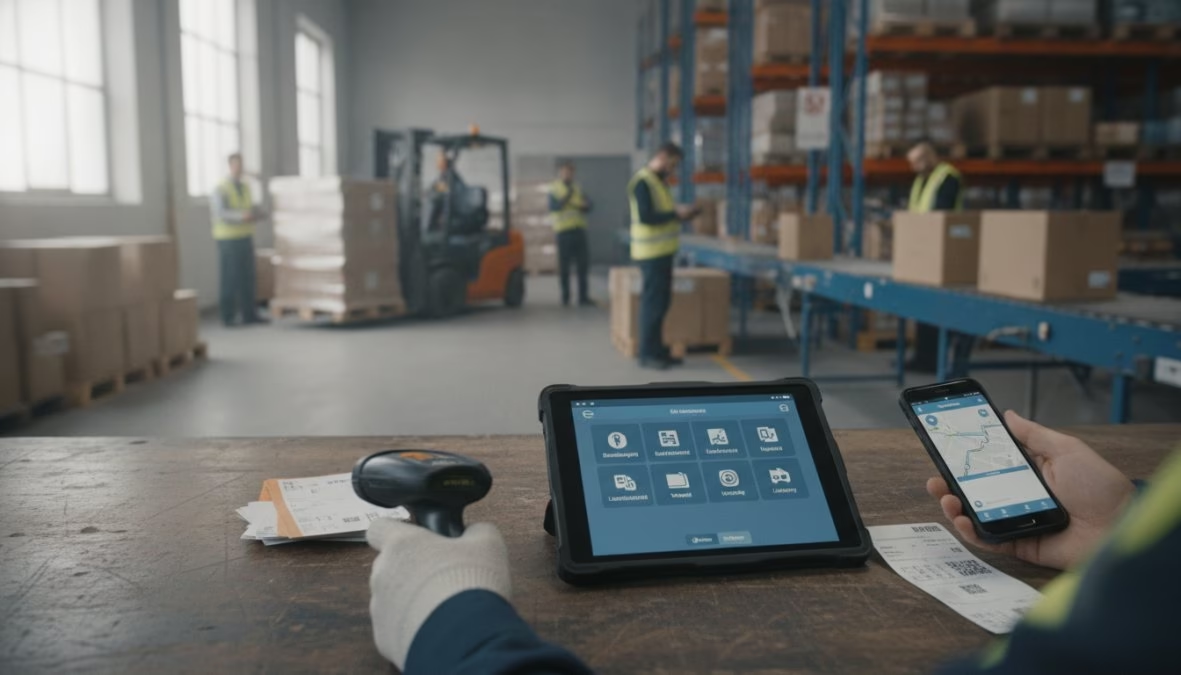
Mobile Applications for Logistics Processes: The Practice Guide
Mobile applications for logistics processes optimize storage, transport and supply chain. Advantages, features and selection at a glance – now discover.

Create mobile app for companies
Create mobile app for companies: How to plan goals, functions, interfaces, GDPR and operation for measurable results.
Free download
Checklist: 10 questions before software development
Key points before you start: budget, timeline, and requirements.
Get the checklist in a consultationRelevant next steps
Related services & solutions
Based on this article's topic, these pages are often the most useful next steps.
Related solutions
Related comparison
Cost calculators
Practical next steps after Implementing Automation in Mid-Sized Businesses the Right Way
Implementing Automation in Mid-Sized Businesses the Right Way addresses a practical choice for product and IT teams. Start with one clear goal: align software scope, technical risk, and business value before the next investment.
Check the current process, the data involved, and the result users need. Then record the main risks and define a small first step. This keeps the decision easy to review and gives your team a shared basis.
For implementation support, our custom software development connects the article's guidance with architecture, delivery, and stable operations. Engineering and project ownership stay with our team in Leer, Germany.
This post belongs to ERP & CRM. Browse the related ERP & CRM articles or use the English software blog for other topics.
When budget is the next question, the software cost calculators provide planning ranges. The IT glossary explains key terms, while in-depth technology guides cover wider decisions.
If the topic affects a live project, book a technical consultation or send the context through our project contact form. We usually reply within one working day.