As of: 4 September 2026 · Reading time: 5 min
Key takeaways
- The logistics and transport industry is the backbone of the global economy.
- However, it faces immense challenges: increasing competitive pressure, complex international regulations, the need for sustainability and demand...
The logistics and transport industry is the backbone of the global economy. However, it faces immense challenges: increasing competitive pressure, complex international regulations, the need for sustainability and demand...
“An ERP system is only as good as its fit to your actual business processes.”
– Björn Groenewold, Managing Director, Groenewold IT Solutions
Odoo ERP & CRM for Logistics & Transport: The All-in-One Solution for a Connected Supply Chain
Author: Björn Groenewold | Published: 2 February 2026 | Updated: 4 May 2026
"An ERP system is only as good as its fit to your actual business processes." — Björn Groenewold, Managing Director, Groenewold IT Solutions
Why Logistics Companies Need Integrated ERP
The logistics and transport industry is the backbone of the global economy.
For Odoo ERP & CRM for Logistics & Transport. The All-in-One Solution for…, API & Integration Projects, Cost Calculator. API Development, [Solution.
Integration Chaos](/en/solutions/integration-chaos) sowie RPA vs. API Integration help you align rollout, scope and budget before you commit.
Modern logistics operations are complex. Shipments cross borders, involve multiple partners, and require real-time visibility at every stage.
Many logistics companies manage this complexity with a collection of separate tools.
A spreadsheet for route planning, a standalone WMS, a separate CRM. And an ERP that does not talk to any of them.
This fragmentation creates errors, delays, and unnecessary cost.
An integrated ERP and CRM platform eliminates these gaps. All data flows through one system. Every team sees the same information.
Three Core Challenges in Logistics IT
Challenge 1: Fragmented Information Across Multiple Systems
Information scattered across disconnected systems creates concrete operational problems:
- Delivery errors caused by outdated address data in one system not reflected in another.
- Billing errors from invoice data that does not match the shipment record.
- Partner communication delays when status information must be manually transferred between tools.
- No single view of the customer — order history, complaints, and contract data live in different places.
Each manual data transfer between systems is a point of failure. The more systems, the more transfers. The more transfers, the more errors.
Challenge 2: Cost Pressure from Inefficient Operations
Short: Logistics margins are tight.
Logistics margins are tight. Inefficient route planning, suboptimal warehouse utilisation, and unnecessary fuel consumption directly reduce profitability.
Separate systems make optimisation difficult because the data needed for decisions is spread across tools:
- Route optimisation requires real-time load data, vehicle access, and delivery windows together.
- Warehouse slotting requires inventory data, pick frequency, and order patterns together.
- Invoice reconciliation requires shipment records, partner rates, and fuel surcharges together.
An integrated system makes all of this data available in one place, enabling optimisation that separate tools cannot support.
Challenge 3: Transparency Gaps for Customers
Short: B2B logistics customers expect shipment visibility comparable to consumer parcel tracking.
B2B logistics customers expect shipment visibility comparable to consumer parcel tracking. They want to know where their goods are, when they will arrive.
And who to contact if something changes.
Meeting this expectation requires end-to-end data visibility — from pickup through every transit point to final delivery.
Systems that do not exchange data in real time cannot provide this.
How Odoo Addresses Logistics Requirements
Short: Odoo consolidates the core logistics functions into one platform.
Odoo consolidates the core logistics functions into one platform. The relevant modules for logistics and transport include:
- Inventory management: Real-time stock levels, lot and serial number tracking, multi-warehouse support.
- Purchase and vendor management: Supplier orders, lead times, and costs in one view.
- Sales and CRM: Customer orders, contracts, and communication history linked to shipment records.
- Accounting: Invoices generated directly from shipment data, eliminating manual reconciliation.
- Reporting: Real-time dashboards for delivery performance, cost per shipment, and customer satisfaction.
Industry-specific needs — customs documentation, hazardous goods grouping, temperature-controlled shipment tracking — are handled through Odoo's module system and custom configurations.
The Integration Advantage
When sales, operations, and accounting share one platform, the operational benefits are immediate:
- A customer order in CRM automatically creates a shipment task in the WMS.
- A completed delivery automatically triggers invoice generation in accounting.
- A customer complaint in CRM is linked to the shipment record, enabling fast root cause review.
- Management sees real-time performance data without waiting for reports to be compiled manually.
Implementation for Logistics Companies
A logistics ERP rollout follows a defined process:
- Process mapping: Current workflows — order-to-delivery, warehouse operations, invoicing — are recorded.
- Gap review: Needs not covered by standard Odoo modules are identified and addressed through configuration or custom development.
- Integration: Connections to carrier APIs, customs systems, and partner platforms are built and tested.
- Data migration: Historical shipment and customer data is migrated with full validation.
- Go-live and support: Phased rollout with training and dedicated support during the transition period.
References and Further Reading
- Bitkom — German digital industry association.
- German Federal Office for Information Security (BSI).
- European Commission — Digital strategy.
About the Author: Björn Groenewold (Dipl.-Inf.) is Managing Director of Groenewold IT Solutions GmbH. Since 2012, he has supported over 250 IT projects for German Mittelstand companies.
Frequently Asked Questions (FAQ)
What is this article about: “Odoo ERP & CRM for Logistics & Transport: The All-in-One Solution for a Connected Suppl…”?
Here we cover Odoo ERP &. CRM for Logistics &. Transport. The All-in-One Solution for a Connected Suppl… — focused on architecture, process, and business outcomes.
In short: The logistics and transport industry is the backbone of the global economy. However, it faces immense challenges.
This increases competitive pressure, complex international regulations, the need for sustainability and demand...
Who benefits most from the content described here?
Typical readers are business and IT leaders in ERP & CRM who want to secure quality, security, and ease of upkeep over the long term.
How does this topic fit into an IT or digital strategy?
In a digital strategy, prioritize stable core processes first, then extensions. See also professional software development and consulting.
For multi-system landscapes, IT consulting and architecture helps align vendors and internal teams.
What are sensible next steps if we need support?
If you need support with design, delivery, or modernization: schedule an appointment or outline your project via contact.
The following separate references complement the topics in this article:
About the author

Managing Director of Groenewold IT Solutions GmbH and Hyperspace GmbH
Since 2009 Björn Groenewold has been developing software solutions for the mid-market. He is Managing Director of Groenewold IT Solutions GmbH (founded 2010) and Hyperspace GmbH. As founder of Groenewold IT Solutions he has successfully supported more than 250 projects – from legacy modernisation to AI integration.
Blog recommendations
Related articles
These posts might also interest you.

Hosting and operation of web applications
Hosting and operation of web applications: What companies should pay attention to in terms of security, scaling, GDPR, support and responsibility in everyday life.
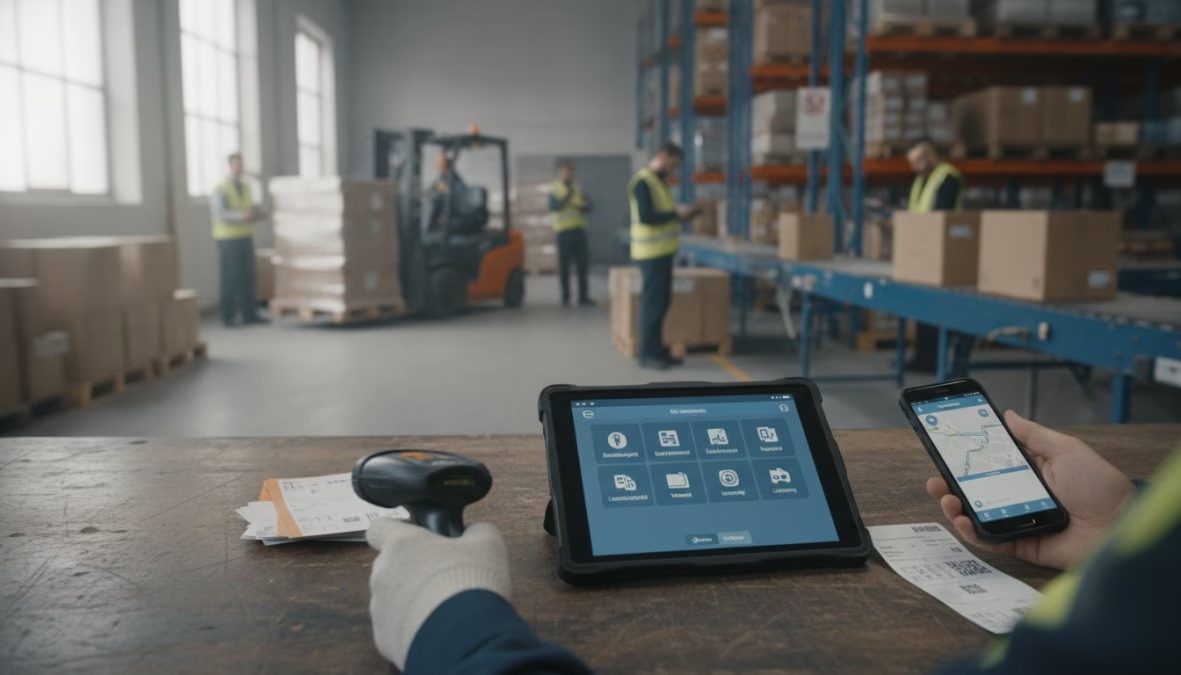
Mobile Applications for Logistics Processes: The Practice Guide
Mobile applications for logistics processes optimize storage, transport and supply chain. Advantages, features and selection at a glance – now discover.

Create mobile app for companies
Create mobile app for companies: How to plan goals, functions, interfaces, GDPR and operation for measurable results.
Free download
Checklist: 10 questions before software development
Key points before you start: budget, timeline, and requirements.
Get the checklist in a consultationRelevant next steps
Related services & solutions
Based on this article's topic, these pages are often the most useful next steps.
Related solutions
Related comparison
Cost calculators
Related industries
Practical next steps after Odoo ERP & CRM for Logistics & Transport: The All-in-One Solution for a Connected Supply Chain
Odoo ERP & CRM for Logistics & Transport: The All-in-One Solution for a Connected Supply Chain addresses a practical choice for energy providers. Start with one clear goal: select and adapt an ERP setup around real workflows instead of generic feature lists.
Check the current process, the data involved, and the result users need. Then record the main risks and define a small first step. This keeps the decision easy to review and gives your team a shared basis.
For implementation support, our Odoo ERP consulting and development connects the article's guidance with architecture, delivery, and stable operations. Engineering and project ownership stay with our team in Leer, Germany.
This post belongs to ERP & CRM. Browse the related ERP & CRM articles or use the English software blog for other topics.
When budget is the next question, the software cost calculators provide planning ranges. The IT glossary explains key terms, while in-depth technology guides cover wider decisions.
If the topic affects a live project, book a technical consultation or send the context through our project contact form. We usually reply within one working day.