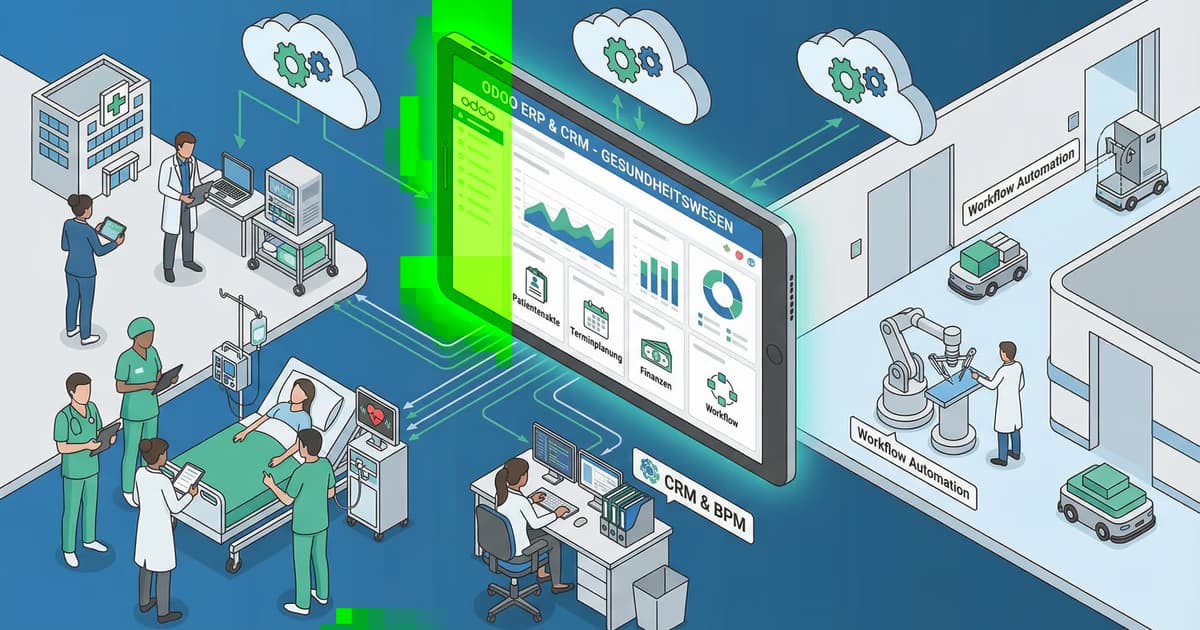
As of: 5 September 2026 · Reading time: 5 min
Key takeaways
- The energy and supply industry is facing a profound change.
- The energy transition, volatile procurement markets, an ever stricter regulatory system and the increasing expectations of customers in digital services provide traditional services...
The energy and supply industry is facing a profound change. The energy transition, volatile procurement markets, an ever stricter regulatory system and the increasing expectations of customers in digital services provide traditional services...
“An ERP system is only as good as its fit to your actual business processes.”
– Björn Groenewold, Managing Director, Groenewold IT Solutions
Odoo ERP & CRM: The Digital Control Center for Energy and Supply Companies
The IT Challenge in the Energy Sector
The energy and supply industry is facing a profound change.
When planning Odoo ERP & CRM. The Digital Control Center for Energy and Supply… from idea to delivery, API & Integration Projects, Cost Calculator. API Development, [Solution.
Integration Chaos](/en/solutions/integration-chaos) sowie RPA vs. API Integration offer practical next steps on our site.
The energy and supply sector is under pressure from many directions. The energy transition has changed how electricity is produced and distributed. Procurement markets are volatile.
Regulatory demands keep rising.
Customers expect digital self-service as a baseline.
Legacy IT infrastructure was built for simpler, more stable energy markets. It struggles with today's complexity.
The core problem is fragmentation: disconnected systems prevent a clear view of operations and customer relationships.
Odoo addresses this with an integrated, modular ERP and CRM platform built for complex industry needs.
Three Specific Challenges in Energy and Supply IT
Challenge 1: Regulatory Compliance and Audit-Ready Documentation
Short: Energy companies operate under strict regulatory frameworks.
Energy companies operate under strict regulatory frameworks. The Energy Economics Act (EnWG) and related regulations require continuous process adaptation. Systems must produce audit-ready documentation automatically.
Violations trigger regulatory effects and financial penalties. Manual documentation and fragmented systems make compliance expensive and fragile.
An integrated platform generates audit documentation as part of normal operations:
- Contract changes are logged automatically.
- Tariff adjustments are recorded with timestamps and user identifiers.
- Customer data changes require no extra manual effort to document.
Challenge 2: Asset Management and Predictive Maintenance
Energy providers manage infrastructure spread across wide geographic areas:
- Electrical grids with thousands of components.
- Gas pipelines and pressure reduction stations.
- Water facilities and treatment systems.
- Smart meter gateways and metering equipment.
Reacting to failures after they occur is expensive. It also creates supply vulnerabilities. Modern asset management focuses on predictive maintenance instead.
Sensor data from field equipment feeds into the central ERP system. Maintenance is then scheduled based on actual equipment condition — not fixed intervals.
This reduces emergency costs and extends equipment life.
Odoo supports IoT integration directly. Sensor readings flow into the maintenance module. Work orders are created automatically when threshold values are breached.
Challenge 3: Digital Customer Relationship Management
Today's energy customers expect:
- Real-time access to their consumption data.
- Automated meter reading processes
- Fast digital responses on tariff changes and contract questions.
- Self-service portals for account management.
Meeting these goals requires a CRM system connected to operational data. When a customer calls about their bill, the service rep should see:
- Meter reading history
- Relevant tariffs across billing periods.
- Previous communications
All of this in one view — without manual investigation.
Disconnected systems make that impossible.
How Odoo Functions as the Central Control Platform
Odoo brings the main functions of energy and supply companies into one integrated system:
- Contract management: Tariff arrangements, customer agreements, and billing schedules in one place.
- Meter data management: Smart meter integration for automated reading handling.
- Asset management: Infrastructure records, maintenance scheduling, and work order tracking.
- CRM: Full customer view — agreements, interactions, complaints, and payments — in unified profiles.
- Accounting: Invoice generation, payment handling, and financial reporting linked to contract and meter data.
- Compliance documentation: All process changes logged automatically with full audit trails.
- Regulatory reporting: Pre-configured reports aligned with EnWG and other regulatory needs.
The Integration Advantage for Energy Companies
When contract data, meter readings, maintenance tasks, and CRM share one database, operations improve at once:
- Meter readings trigger invoice creation automatically — no manual step needed.
- Maintenance events on network infrastructure link automatically to affected customer contracts.
- Customer complaints connect to related assets, maintenance records, and contract data in one view.
- Management sees live performance data — active contracts, payment status, asset health — without waiting for reports.
Implementation Approach for Energy and Supply Companies
A structured rollout reduces risk and speeds up time to value:
- Process review: Billing processes, tariff structures, maintenance schedules, and customer workflows are recorded in detail.
- Regulatory configuration: Compliance and audit needs are built into the system from the start.
- Integration: Smart meter systems, field service tools, and regulatory reporting interfaces are connected.
- Data migration: Customer, contract, and asset data transfers with thorough validation.
- Training and deployment: Rollout starts with the highest-priority processes for immediate operational benefit.
References and Further Reading
- Bitkom — German digital industry association.
- German Federal Office for Information Security (BSI).
- European Commission — Digital strategy.
About the Author
Short: Björn Groenewold (Dipl.-Inf.) manages Groenewold IT Solutions GmbH.
Björn Groenewold (Dipl.-Inf.) manages Groenewold IT Solutions GmbH. Since 2012, he has led more than 250 IT projects — including ERP deployments in regulated industries and critical infrastructure.
Frequently Asked Questions (FAQ)
What is this article about: “Odoo ERP & CRM: The Digital Control Center for Energy and Supply Companies”?
Here we cover Odoo ERP & CRM. The Digital Control Center for Energy and Supply Companies — focused on architecture, process. And business outcomes.
The energy and supply industry is facing a profound change.
The energy transition, volatile procurement markets, an ever stricter regulatory system and the increasing goals of customers in digital services provide traditional services...
Who benefits most from the content described here?
Typical readers are business and IT leaders in ERP & CRM who want to secure quality, security, and ease of upkeep over the long term.
How does this topic fit into an IT or digital strategy?
In a digital strategy, prioritize stable core processes first, then extensions. See also professional software development and consulting.
For multi-system landscapes, IT consulting and architecture helps align vendors and internal teams.
What are sensible next steps if we need support?
If you need support with design, delivery, or modernization: schedule an appointment or outline your project via contact.
The following separate references complement the topics in this article:
- Bitkom – German digital industry association.
- German Federal Office for Information Security (BSI).
- European Commission – Digital strategy.
- MDN Web Docs (Mozilla)
- W3C – World Wide Web Consortium.
> "ERP programmes rarely fail on software selection; they fail on unclear process ownership."
— Björn Groenewold, Managing Director, Groenewold IT Solutions
About the author

Managing Director of Groenewold IT Solutions GmbH and Hyperspace GmbH
Since 2009 Björn Groenewold has been developing software solutions for the mid-market. He is Managing Director of Groenewold IT Solutions GmbH (founded 2010) and Hyperspace GmbH. As founder of Groenewold IT Solutions he has successfully supported more than 250 projects – from legacy modernisation to AI integration.
Blog recommendations
Related articles
These posts might also interest you.

Hosting and operation of web applications
Hosting and operation of web applications: What companies should pay attention to in terms of security, scaling, GDPR, support and responsibility in everyday life.
Mobile Applications for Logistics Processes: The Practice Guide
Mobile applications for logistics processes optimize storage, transport and supply chain. Advantages, features and selection at a glance – now discover.
Create mobile app for companies
Create mobile app for companies: How to plan goals, functions, interfaces, GDPR and operation for measurable results.
Free download
Checklist: 10 questions before software development
Key points before you start: budget, timeline, and requirements.
Get the checklist in a consultationRelevant next steps
Related services & solutions
Based on this article's topic, these pages are often the most useful next steps.
Related services
Related solutions
Related comparison
Cost calculators
Related industries
Practical next steps after Odoo ERP & CRM: The Digital Control Center for Energy and Supply Companies
Odoo ERP & CRM: The Digital Control Center for Energy and Supply Companies addresses a practical choice for energy providers. Start with one clear goal: select and adapt an ERP setup around real workflows instead of generic feature lists.
Check the current process, the data involved, and the result users need. Then record the main risks and define a small first step. This keeps the decision easy to review and gives your team a shared basis.
For implementation support, our Odoo ERP consulting and development connects the article's guidance with architecture, delivery, and stable operations. Engineering and project ownership stay with our team in Leer, Germany.
This post belongs to ERP & CRM. Browse the related ERP & CRM articles or use the English software blog for other topics.
When budget is the next question, the software cost calculators provide planning ranges. The IT glossary explains key terms, while in-depth technology guides cover wider decisions.
If the topic affects a live project, book a technical consultation or send the context through our project contact form. We usually reply within one working day.