
As of: 23 September 2026 · Reading time: 14 min
Key takeaways
- Advantages of proprietary software at a glance: Build vs.
- Buy, TCO, Security & more.
- Now make informed decision and project check.
Advantages of proprietary software at a glance: Build vs. Buy, TCO, Security & more. Now make informed decision and project check.
“Good software is not an accident—it comes from a structured development process with clear quality standards.”
– Björn Groenewold, Managing Director, Groenewold IT Solutions
Advantages of proprietary software at a glance
Benefits of proprietary software at a glance: Build vs.
For Benefits of proprietary software: The ultimate guide, Custom Software Development outlines how we support rollout and delivery.
To Benefits of proprietary software: The ultimate guide provides a practical entry for the next steps.
The benefits of proprietary software are the decisive lever for many midsize companies to permanently stand out from competition. Standard solutions rarely match custom business processes.
And the compromises that are discussed here cost more than the saved license costs in the long term.
Groenewold IT Solutions has been accommodating companies with this decision for over 15 years and knows the legal pitfalls on both sides.
This guide provides a sound decision-making aid. This includes TCO review, security aspects and Vendor Lock-in. This simply ignore most of the comparisons.
What is individual software? Definition and demarcation
Custom Software is a software solution built clearly for the needs of an custom company or a defined user group, instead of appearing as a prefabricated product for the mass market.
The motto is Standard Software (also COTS, Commercial Off-The-Shelf), i.e. products such as SAP, Microsoft 365 or Salesforce.
This are designed for a broad audience and are adapted to custom needs by configuration.
Custom software, on the other hand, is created on the basis of a specification that reflects the specific business processes of the client.
The limitation is more important than it sounds. Whoever buys standard software adapts its processes to the software.
If you want to develop custom software, the software adapts to its processes. This difference determines who really controls the digital transformation.
Tailored solutions instead of compromises
Tailored software exactly forms business processes without teams having to develop workarounds or bend processes. That sounds trivial, but it's not.
Many companies underestimate how much productivity is lost due to daily friction losses with unmatched tools.
The practical effects of a customized solution:
- No superfluous range of functions that confused users and worsens the user experience.
- Interfaces are built exactly where they are needed.
- Yes. The technology stack is chosen according to technical needs, not according to manufacturer specifications- User orientation is part of the design from the start, not a subsequent optimization project.
Individual Software vs. Standard Software: A Direct Comparison
Short: Two options, but none the same.
Two options, but none the same. The decision between custom software and standard software depends on factors that go far beyond the pure purchase price.
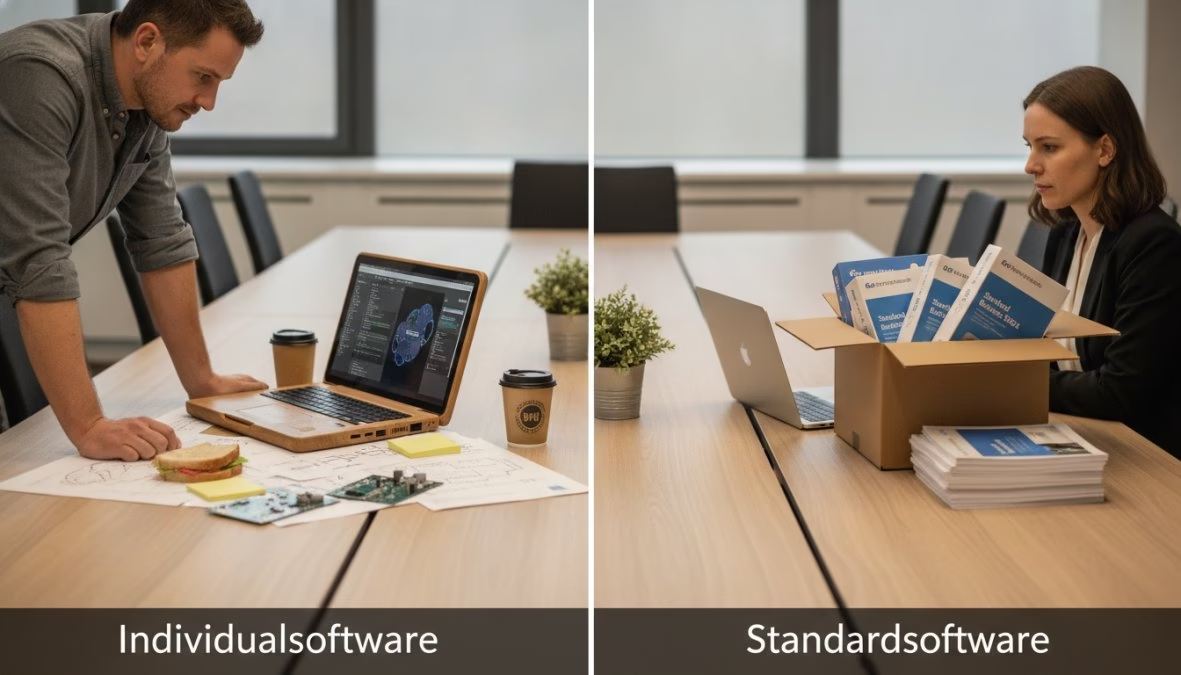
Comparison table: Individual development vs. COTS solutions
| Criterion | Custom Software | Standard Software (COTS) |
|---|---|---|
| Adaptation | Fully customized | Limited by configuration |
| Initial costs | Higher | Low |
| Licence costs | No running license costs | Current subscriptions |
| Vendor Lock-in | No lock-in at source code possession | Frequently strong |
| Integration ability | Freely configured | Depending on provider APIs |
| Scalability | Individually planable | Depending on the provider roadmap |
| Security & GDPR | Full control | Depending on the provider |
| Time-to-Market | Longer initial | Faster initial |
| Competitive differentiation | High | Low (all use the same) |
When is standard software the better choice?
Standard software is then the right choice when a process is industry-wide, does not offer differentiation potential and the needs are well covered with the existing range of functions.
Concrete scenarios where COTS solutions are useful:
- Accounting and wage billing according to legal standards.
- Standard e-mail communication and collaboration tools.
- Industrial CRM processes without special needs.
- Quick entry with limited budget and short time horizon.
The decisive test. If a competitor uses the same software and thus achieves the same results, this software does not create a competitive advantage.
Then standard software is sufficient.
Build vs. Buy: Making the strategic decision right
Short: The build-vs.-buy decision is not a technical question, but a strategic one.
The build-vs.-buy decision is not a technical question, but a strategic one. Those who only meet them under cost points usually regret it. .The core problem.
Many companies compare the development costs of an custom solution with the annual subscription of a standard software. And opt for the cheaper one.
What is missing is the question of ROI over five to ten years, after process optimization, after competitive differentiation and after the real total cost of ownership.
According to an review by Gartner on Software Investment Decisions, companies systematically underestimate the long-term costs of standard software because license increases, adaptation costs and migration expenses rarely fall into initial costing.
Attention: A frequent error. Companies choose standard software because it works cheaper. And then invest major resources in workarounds, manual data transfers and non-matching processes over years.
These hidden costs do not appear in any license bill.
competitive advantage and competitive differentiation through own software
Built software is most valuable when it maps a process that no competitor performs as well.
This process is not only more efficient but also more difficult to copy.
Typical areas with high differentiation potential:
- Customized Configurators and Order Processes.
- Automated quality control according to internal standards.
- Proprietary calculation or evaluation logics.
- Industry-specific compliance workflows
Competitive differentiation by software is not created by technology alone. However, by the combination of technology and deep process knowledge.
This is clearly why companies that make their software themselves develop this advantage seriously.
Scalability, flexibility and integration capability
Custom software scales as the company grows, not as the provider allows. This is a core difference.
Standard software scales according to the price model of the manufacturer. More users, more costs, more restrictions. proprietary software scales according to the software architecture.
This was designed from the outset for its own needs. Agile development allows to add incremental functions without rebuilding the entire system.
Integration capability is another point where standard software is often disappointed. Interfaces to third-party systems depend on the APIs provided by the provider and on its roadmap.
Custom software can build interfaces exactly where they are needed, regardless of manufacturer decisions.
Costs for software development calculate: TCO and ROI realistically rate
The most common misuse in cost-benefit review: development costs are compared with licensing costs as if these were the only relevant figures.
Unique development costs vs. running license costs
Custom software causes higher initial costs. This is a fact that no one should talk nicely.
There are no running license costs for this, and the company has the source code completely.
Standard software works cheaper because entry costs are low.
Cumulative licensing costs over five to ten years, combined with costs for adjustments, training and process adjustments, often give a different picture.
According to Bitkom-Studien zur Digitisation im mid-sized businesses, midsize companies issue a major part of their IT budget for licenses that are only partially used.
knowledge: The break-even between custom software and standard software is in many scenarios three to five years.
If you plan longer, you often drive cheaper with your own development.
Long-term maintenance costs and Total Cost of Ownership (TCO)
Total Cost of Ownership (TCO) is the honest measure for a software decision. TCO covers all costs over the entire life cycle.
Development or license, rollout, training, adaptations, maintenance, support and migration.
For custom software, maintenance costs are predictable because the company fully understands the software and the source code is accessible.
Maintenance and care of custom software can be secured in-house or by an external partner without a provider being able to change the conditions unilaterally.
Standard software often hides maintenance costs: version updates that make adjustments unusable; price increases for renewal; Dependence on the manufacturer's support offer. These costs rarely appear in the initial TCO calculation.
A realistic TCO calculation should include:
- Initial development or license costs.
- Rollout and integration effort
- Training costs for users
- Annual maintenance and development costs.
- Costs for process adaptation to the software.
- Migration costs when changing (exit costs).
- Opportunity costs due to missing functions.
Safety aspects and Vendor Lock-in in development
Short: Security is the topic that is most often underestimated in build vs.-buy discussions.
Security is the topic that is most often underestimated in build vs.-buy discussions. And Vendor Lock-in is the risk that can be most expensive.
Full control of source code and data storage
Who owns the source code controls the security. This sounds simple, but has far-reaching effects for GDPR compliance, data retention and auditability.
For standard software, the source code lies with the provider. Vulnerabilities are closed according to the provider's schedule, not according to the company.
Data management takes place on the provider's infrastructure, often outside the EU. This is a regulatory problem for many industries, which will be overlooked in the purchase decision.
proprietary software allows full control of data storage, encryption, access rights and audit logs.
For companies with sensitive customer data or strict compliance needs, this is not a Nice-to-have. However, a duty.
The GDPR requirements of the Data Protection Conference show that companies must show and control the processing of personal data completely.
Technology choice, software architecture and independence
Vendor Lock-in is created not only by license agreements. However, by dependence on proprietary technologies, data formats and interfaces.
Anyone who has invested deeply in an ecosystem pays a considerable price when changing.
Own development with open source technologies such as react for the front end or standard backend frameworks eliminates this dependence in principle.
The choice of technology remains with the company, not with the provider.
This means changing the development partner without data loss, portability to other infrastructures and no forced upgrades by manufacturer decisions.
Profi tip: When: choosing the technology stack, companies should explicitly insist on widespread open source technologies.
Proprietary frameworks of the development partner create a new lock-in that is as problematic as that of the software provider.
Software Development Inhouse or Outsourcing: What fits your company?
The decision between in-house development and outsourcing is often more important than the build-vs.-buy question itself.

In-house teams provide maximum control and deep process knowledge. However, require considerable investment in recruiting, salaries and training.
This is simply not scalable for many midsize companies. .Outsourcing to a expert partner is often the more pragmatic solution for mid-sized firms.
It is crucial to what quality signals are respected. Fixed developers instead of freelancer chains, development in Germany instead of offshoring.
And complete source code ownership after project completion. Groenewold IT Solutions works exclusively with fixed experts on site and guarantees GDPR-compliant development with data retention in the EU.
This is an essential factor for midsize companies with regulatory needs.
Change management and user orientation in the introduction
New software rarely fails in technology. It fails at the introduction.
Change management in the introduction of custom software means. Integrate users early, integrate feedback into development and build training concepts parallel to development.
Agile development helps this because users can already work with early versions during the development and can incorporate adjustments into running sprints.
User orientation is not a soft-skill theme, but a direct efficiency factor. Software that intuitively use users reduces error rates and support effort.
This is a measurable advantage that should not be missing in any ROI calculation.
Ensure maintenance and care of individual software in the long term
Maintenance and maintenance of custom software is the phase most often underestimated in project planning. It decides on the long-term value of the investment.
Without structured maintenance, software outdated technologically, accumulates technical debt and becomes the maintenance load instead of the competitive advantage.
According to IEEE studies on software maintenance, a major proportion of the total software costs is eliminated from the maintenance phase, not from initial development.
Important aspects of a sustainable maintenance strategy:
- Clear control of source code ownership from day one.
- Documentation of the software architecture for later developers.
- Defined process for security updates and dependency management.
- Regular code reviews for quality assurance.
- Clear SLAs for reaction times with critical errors.
Agile development and continuous development
Agile development is not only a methodology for initial development, but the foundation for continuous development.
Software that is not built loses its competitive advantage. .The principle is simple. Needs change, markets change, technologies change.
Custom software can go along with these changes because the company maintains complete control over roadmap and prioritization.
No provider decides which features will come in the next release. The company decides on its own market observations and customer feedback.
Efficiency increase through continuous development is not a one-off effect, but a cumulative advantage. Any iteration that improves a process builds on the previous one.
Over years, this is a technical advance that competitors with standard software cannot structurally catch up.
Use the advantages of proprietary software specifically: Conclusion and next steps
The benefits of proprietary software do not automatically unfold.
They are created by a sound decision, an skilled development partner and a long-term perspective on TCO, scalability and competition differentiation.
The main findings at a glance:
Custom Software vs. Standard Software is not a cost.
However, a strategy question Build vs. Buy decides on TCO over five to ten years, not at the entry price Vendor Lock-in is the underestimated risk of COTS solutions Source code ownership is the prerequisite for real independence and GDPR conformity Agile development ensures long-term development as a competitive advantage Change management decides on acceptance and thus on the real ROI
If you want to strategically use the benefits of your own software, you need a partner that not only develops. However, advises.
A partner who understands the processes before writing the first line code.
Many midsize companies face the challenge of finding the right software strategy without getting into expensive dependencies.
Groenewold IT Solutions offers tailor-made software development through fixed experts in Germany, with full source code ownership after project completion and guaranteed GDPR compliance without offshoring. The result.
No Vendor lock-in risks, clear contact persons and software that really fits your own processes.
Request a free project check at Groenewold IT Solutions now and clarify which solution for your company creates the largest long-term added value.
Frequently Asked Questions (FAQ)
What are the biggest advantages of proprietary software compared to standard solutions?
?Proprietary software adapts exactly to your business processes, instead of having to adapt your processes to a standard solution.
The most important benefits are full control of the source code, no running license costs, maximum integration capability in existing systems, independence from providers.
And a real competitive advantage through tailored functions that competitors cannot simply copy.
When is the development of software worthwhile for a company?
Custom software is worthwhile if your business processes are unique and no standard software (COTS) reproduces them completely if you want to save license costs in the long term if data protection and GDPR compliance are critical or if you want a measurable competitive advantage through digital differentiation.
Even with high demands on scalability and interfaces to existing systems, self-development is often the better choice.
Is proprietary software cheaper than standard software in the long term?
This depends on the Total Cost of Ownership (TCO). Own development has higher initial investment. However, saves ongoing licensing costs and avoids expensive adjustments to rigid standard solutions.
In the long term - often from three to five years - custom software is often cheaper, especially when maintenance and care are clearly regulated and the ROI can be measured by process optimization and efficiency enhancement.
What risks are there in the development of software?
Typical risks include higher initial costs, longer market entry times and development risks with unclear specifications. In addition, dependencies on the chosen technology stack.
This also covers effort for maintenance and further development.
These risks can be significantly reduced by agile development, a detailed specifications, clear responsibilities and an skilled development partner with detectable expertise.
How does individual software influence the business processes of a company?
Custom software is built directly on the basis of your existing business processes and can significantly improve it through automation, improved interfaces and user-oriented user experience.
Instead of adapting processes to a software, the software improves your processes - which leads to measurable efficiency increase, fewer sources of errors and higher acceptance among employees.
What is the difference between in-house development and outsourcing in individual software?
?During in-house development, you employ your own developers. This offers full control. However, causes high personnel costs.
When outsourcing a expert partner like Groenewold IT Solutions, you use external know-how without having to build up your own development capacities.
It is important to pay attention to permanent developers without freelancer chains and to GDPR-compliant data retention in the EU to ensure quality and legal certainty.
References and further reading
The following separate references complement the topics in this article:
About the author

Managing Director of Groenewold IT Solutions GmbH and Hyperspace GmbH
Since 2009 Björn Groenewold has been developing software solutions for the mid-market. He is Managing Director of Groenewold IT Solutions GmbH (founded 2010) and Hyperspace GmbH. As founder of Groenewold IT Solutions he has successfully supported more than 250 projects – from legacy modernisation to AI integration.
Blog recommendations
Related articles
These posts might also interest you.

How to connect your company systems for sustainable success
In today's business world marked by digital transformation, data is the undisputed elixir of life of every company. They are the basis for innovation, efficiency and sound...

Venture Capital for Software Development: Opportunities and Risks
In the dynamic world of software development, access to capital is often the decisive factor that decides on the success or failure of an innovative start-up. One of the famous...
Software funding in the middle class: practical examples and success factors
Digitization poses major challenges to small and medium-sized enterprises (SMEs), but also offers immense opportunities. One of the central hurdles is often Software Financing. How...
Free download
Checklist: 10 questions before software development
Key points before you start: budget, timeline, and requirements.
Get the checklist in a consultationRelevant next steps
Related services & solutions
Based on this article's topic, these pages are often the most useful next steps.
Related services
Related solutions
Practical next steps after Advantages of proprietary software: The ultimate guide
Advantages of proprietary software: The ultimate guide addresses a practical choice for product and IT teams. Start with one clear goal: align software scope, technical risk, and business value before the next investment.
Check the current process, the data involved, and the result users need. Then record the main risks and define a small first step. This keeps the decision easy to review and gives your team a shared basis.
For implementation support, our custom software development connects the article's guidance with architecture, delivery, and stable operations. Engineering and project ownership stay with our team in Leer, Germany.
This post belongs to Software development. Browse the related Software development articles or use the English software blog for other topics.
When budget is the next question, the software cost calculators provide planning ranges. The IT glossary explains key terms, while in-depth technology guides cover wider decisions.
If the topic affects a live project, book a technical consultation or send the context through our project contact form. We usually reply within one working day.