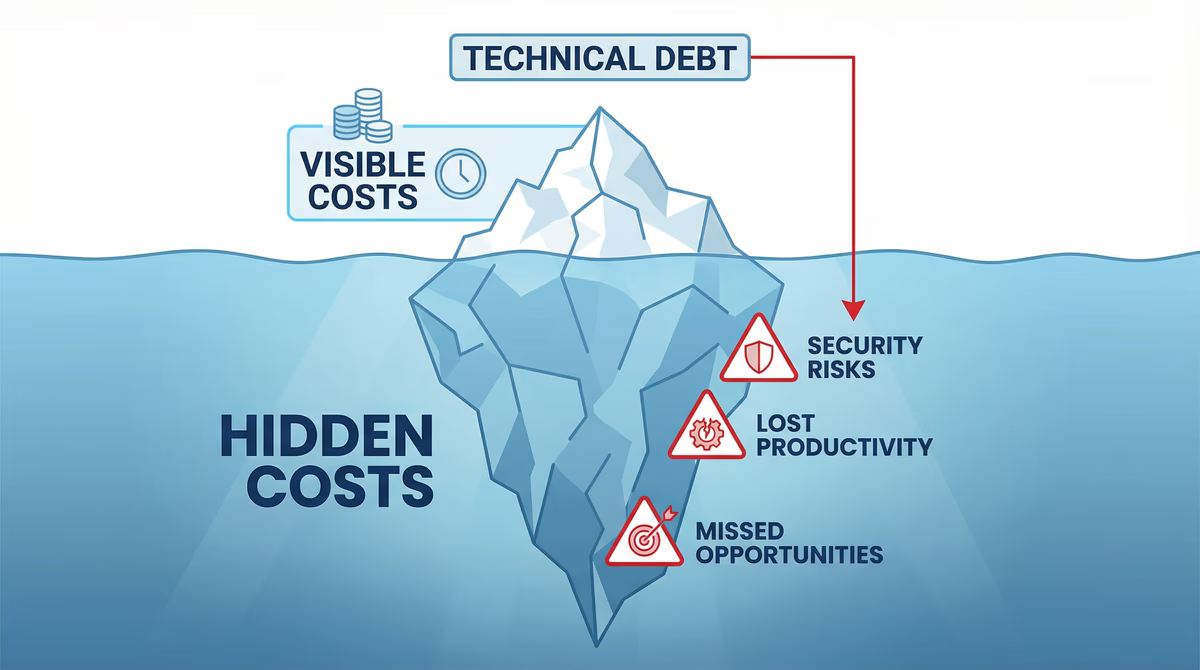
Technical debt communicating: How to convince management
**Technical debt** – a term that can often be heard in IT departments, but in management can provide questioning views. Similar to financial debt, technical debt can also be...

Estimate the investment for your CRM project – from system selection and data migration to team training.
In brief
The investment frame for a CRM implementation is EUR 4,760 – 122,719 excl. VAT. Data migration, telephony and ERP coupling move the project inside that band.
The upfront cost can be spread over 72 months. Terms are on the software financing page.
Related: B2B CRM.
The calculation follows six visible stages. All figures remain planning values until scope and assumptions have been reviewed.
1. Capture inputs
The calculator records the visible project, volume, complexity and operating parameters selected on this page.
2. Add fixed components
Fixed base modules and selected add-ons are added without mixing them with recurring charges.
3. Apply multipliers
Quantity, complexity and scope factors multiply only the cost components identified for them in the calculator model.
4. Create the range
The calculator applies its documented lower and upper uncertainty factors to the base result; ROI views keep investment and savings visible separately.
5. Round and calibrate
Monetary result fields are rounded to the nearest whole euro. Public project-cost components are calibrated with the centrally maintained display factor.
6. Classify the result
The result is shown as non-binding guidance. A binding quote requires scope, data, integrations, risks and acceptance criteria to be reviewed.
Efficiency or discount factor: A central display factor of 0.7 is applied to public project-cost components to keep all calculators aligned with the currently reviewed pricing basis. It is not a customer-specific discount; customer-entered wages, revenues and existing operating costs are not reduced.
Why this is not a binding quote: The calculator cannot verify complete requirements, third-party dependencies, data quality, legal constraints or acceptance criteria.

Concrete project profiles with assumptions and indicative budgets—useful for internal alignment alongside the calculator.
FAQ
A standard CRM for a small sales team is live EUR 4,760 – 122,719 excl.
VAT including configuration and training. Odoo CRM with ERP coupling or custom solutions with migration from a legacy system typically stay in the same investment frame. User count and data migration drive the budget.
HubSpot or Pipedrive win on speed for straightforward sales processes.
Odoo CRM pays off when ERP, invoicing and inventory should live in one system. Custom CRM is worth it for industry-specific processes that standard tools force into workarounds.
Excel lists with clean structure migrate cheaply.
Legacy CRMs with activity history, documents and custom fields need mapping, deduplication and test runs – often 20–30% of the project budget. Budget it explicitly, not as an afterthought.

Choose the right CRM
We compare standard, Odoo and custom options against your sales process – free initial consultation.
Standard CRMs are productive in 2–6 weeks.
Odoo with ERP coupling or custom solutions typically need 2–4 months including migration and training. The critical path is usually data quality, not software.
Configure around the existing sales process instead of forcing a new one, migrate history so reps find their accounts, automate data entry where possible (email sync, telephony) and train per role.
Adoption failures are process failures, rarely tool failures.
| Model | When it fits | Budget & flexibility | Typical risks |
|---|---|---|---|
| Fixed price (fixed scope) | Clearly defined scope, stable requirements, repeatable delivery. | Predictable total cost; little room for change without a change order. | Scope creep leads to change orders or quality trade-offs. |
| Time & Material | Discovery, legacy, evolving requirements, or close collaboration. | Maximum flexibility; budget transparent via hourly or daily rates. | Without prioritisation, effort can grow—backlog and reviews matter. |
| Retainer / maintenance package | Ongoing operations, updates, small features, and support. | Agreed capacity per month; predictable follow-on cost. | Large changes may still need a separate estimate. |
| Hybrid (milestone + T&M) | MVP or phased releases with clear go-lives, then iterate. | Core delivery fixed price; extensions on a time-and-materials basis. | Define contractually what is in scope vs. extra work. |
Calculators on this page provide indicative ranges; we choose the right model with you based on risk, scope, and planning horizon.
The ranges shown are indicative. For a binding quote we discuss scope, priorities and funding options in a free intro call. Many digitalization projects qualify for grants – try our funding calculator.
Browse all cost calculators, explore services and typical solutions. Questions about CRM implementation? Contact us.
After using the CRM implementation calculator, validate assumptions in a short intro call.
Browse all cost calculators in the costs overview.
What does your CRM project cost?
Interactive estimate based on your inputs.
Non-binding project range from the software cost calculator: EUR 10,332 – 372,623 excl. VAT.
Methodology: The estimates are based on historical project data, complexity drivers and standard implementation assumptions. Results are a non-binding indication only; effort and price must be calculated individually.
If you are still deciding
If you are ready to implement
Calculator overall range
EUR 19,600–224,000 excl. VAT, depending on systems and migration
The overall range is derived from the valid parameters of the relevant cost calculator.
Typical duration
3–15 months
Main risk drivers
Non-binding indication
This result is only a non-binding indication based on typical assumptions. Effort and price must be calculated individually for your project.
A transparent four-step process for validating the CRM Implementation indication with concrete requirements.
1. Confirm scope and target outcome
We clarify the business outcome, user groups, and boundaries relevant to CRM Implementation.
2. Review data, interfaces, and risks
We validate integrations, data quality, security, compliance, and operational dependencies.
3. Check the calculator assumptions
We compare the selected parameters with the real system landscape and document deviations.
4. Prepare the precise quote
You receive a scoped proposal with milestones, exclusions, price model, and next decision point.
Blog posts that put budget, effort and typical project paths for this calculator in context.

Technical debt communicating: How to convince management
**Technical debt** – a term that can often be heard in IT departments, but in management can provide questioning views. Similar to financial debt, technical debt can also be...

ETL processes: extract and combine data from silos
In today's data-driven business world, information is the life elixir of each company. But too often these valuable data are trapped in isolated systems, so-called...

Resolve data silos in the cloud: How to make your data usable
In today's data-driven business world, access to accurate and timely information is crucial for success. Companies that drive digital transformation and C...