
Odoo
Odoo vs. SAP: A closer look at total cost of ownership (TCO)
In today's business world, characterized by digital transformation, a powerful enterprise resource planning (ERP) system for optimizing business processes is the increase in...
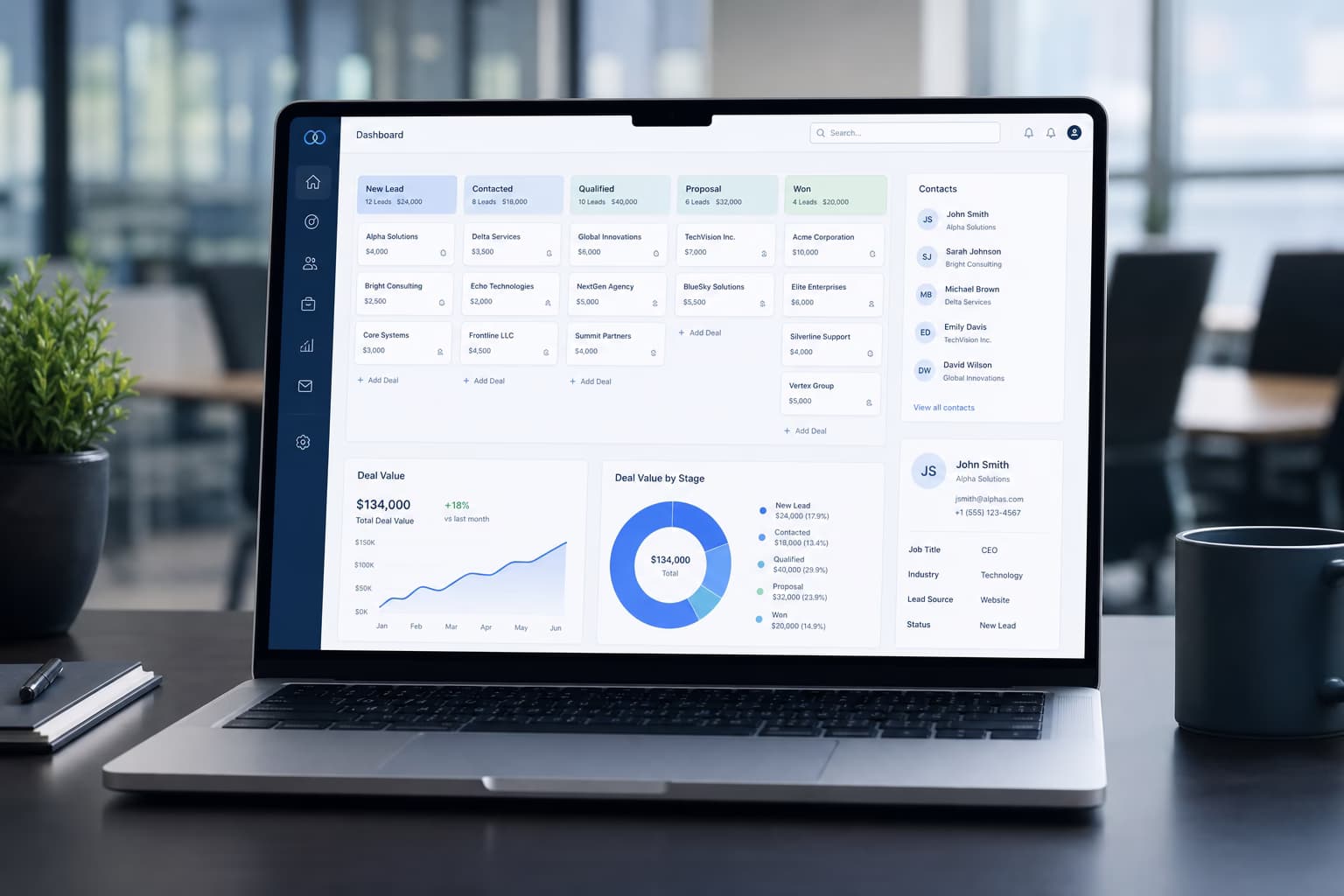
CRM software for B2B sales: leads, pipeline and ERP integration instead of generic seat licenses—delivered Made in Germany from Leer, East Frisia.
CRM Software for Integrated Business Processes
CRM software structures customer relationships, sales pipeline and service – in B2B with accounts, long cycles and ERP coupling. Standard CRM software like HubSpot, Salesforce or Pipedrive is often optimized for B2C – short sales cycles, simple products, mass marketing with large contact lists. For a neutral vendor overview, see our CRM systems comparison. B2B sales is fundamentally different: sales cycles take weeks or months, multiple stakeholders need to be convinced, proposals are complex and individual, prices are negotiated, and the customer relationship is long-term.
A custom B2B CRM maps your sales processes exactly:Account-based selling with multiple contacts, decision-maker mapping, and relationship history. Opportunity management for complex deals with defined phases and milestones. Proposal logic with product configurator, customer-specific prices, and discount rules. And the ERP integrationthat connects your sales data with orders, deliveries, and invoices.
Additionally: with Salesforce, you pay from 75 EUR/user/month for the Professional edition – features like forecasting or workflows cost extra. With 20 sales reps, that's 18,000 EUR/year, trending upward. A custom solution often pays for itself in 2-3 years – see our page on a custom Salesforce alternative.
“B2B CRM does not fail for lack of a forecast widget—it fails on inconsistent account ownership; hygiene before reporting.”
Björn Groenewold, CEO, Groenewold IT Solutions
Review your ERP and CRM process
In a structured first call we clarify whether custom CRM software, Odoo or a Salesforce migration fits—documented and without sales pressure.
Prioritise CRM software when forecasts are unreliable, proposals live in email and spreadsheets, or sales and finance maintain different customer records. Typical triggers: field sales growth, ERP change or rising seat-license costs. See also our ERP system and CRM system hub, Odoo ERP & CRM and enterprise integration.
Capture, qualify, score leads and guide them automatically through the sales funnel.
Visualize the sales pipeline, create forecasts, prioritize deals, win/loss analysis.
Create proposals from the CRM, manage price lists, track versions, electronic signature.
Multiple contacts per company, decision-maker mapping, org charts, relationship history.
Appointments, tasks, follow-ups, reminders – nothing gets lost, everything is documented.
Pipeline value, conversion rates, sales rep performance, forecast accuracy – all KPIs.
Customer master data, orders, invoices, payments – seamlessly connected with SAP, Odoo, or your ERP.
Outlook/Gmail sync, email tracking, templates, sequences for automated outreach.
A CRM designed for B2C won't meet your B2B requirements.
| B2B Sales | B2C Sales |
|---|---|
| Long sales cycles (weeks to months) | Short decisions (minutes to days) |
| Multiple contacts and decision-makers per account | One customer = one contact |
| Complex proposals with configuration and negotiation | Standard products with fixed prices |
| Negotiations, discounts, framework agreements, SLAs | Fixed prices, at most coupons |
| Recurring business, up-/cross-selling | Often one-time transactions |
Complex projects with long cycles, technical consulting, configuration
Managed services, project business, framework agreements, license sales
Customer-specific prices, framework agreements, field sales management
Key account management, forecast planning, EDI integration
A CRM project is more than software – it changes how your sales team works.
Capture your sales processes, phases, qualification criteria, and integrations.
Accounts, contacts, opportunities, activities – define the structure together.
Build CRM, integrate interfaces, migrate existing data.
Train sales team, pilot phase, incorporate feedback, full rollout.
Costs depend on feature set and integration depth into your system landscape.
Salesforce Sales Cloud costs from 75 EUR/user/month (Professional). With 15 users, that's 13,500 EUR/year. A custom solution for 55,000 EUR pays for itself in about 4 years – after that, you save permanently.
For many B2B requirements, Odoo CRM is a cost-effective foundation. Open source, no license costs, and we customize it to your processes. Often 30-50% cheaper than a complete custom development.
Custom CRM or Salesforce license?
Compare ongoing CRM license costs with a custom development – break-even over 5 years.
B2B sales cycles often run for weeks or months, involve several decision-makers and need individually priced proposals. Standard CRM platforms such as Salesforce or HubSpot are optimised for fast B2C pipelines and only partly reflect that complexity. Fields for decision-maker mapping, multi-step approvals or customer-specific price lists are missing or only available through expensive add-ons. A custom B2B CRM models your sales process exactly – from lead qualification with your own scoring model through proposal creation with a product configurator to automated forecasting and pipeline reporting.
ERP integration is especially critical. Orders, invoices, delivery status and payments must sync bidirectionally so sales staff see the full customer picture without switching systems. Leadership needs reliable KPIs: pipeline value by region, conversion rate per stage, average deal duration and win/loss reasons. A tailored solution delivers all of this without compromise and feeds data-driven sales decisions.
We build CRM systems that fit your sales model – from technical delivery via our software development service to seamless connection with ERP, email and telephony through our system integration practice. Terms around CRM, lead scoring and pipeline management are explained in our IT glossary.
FAQ
CRM software consolidates customer, sales and service data—from leads and opportunities through to aftercare.
In B2B, the focus is account structures, long cycles and reliable forecasts rather than mass marketing. Solid CRM software connects sales with ERP, email and telephony so duplicate data entry disappears and stakeholders stay visible.
CRM software pays off when pipeline, proposals or service processes live in spreadsheets, inboxes or isolated tools—or when Salesforce-style seat licenses grow faster than value.
For SMEs, custom development or Odoo-based CRM often wins when processes are clearly scoped and ERP integration is business-critical.
We start with sales analysis and a data model, deliver an MVP iteratively (leads, accounts, pipeline) and integrate ERP and email step by step.
Key users sign off early; migration from legacy CRM uses mapping and deduplication. That keeps go-live and adoption predictable—without a big bang.
Costs depend on scope, integration depth and migration—not only build effort but training and operations.
Risks sit in unclear processes, poor data quality and missing ERP coupling. We structure scope, milestones and test cases early so budget and benefit stay traceable.
Via documented REST APIs, events or connectors we link ERP, identity, email and telephony.
Permissions, logging and GDPR-aligned storage are agreed with IT and privacy teams. Typical targets: SAP Business One, Odoo, Microsoft Dynamics or DATEV—without undocumented silo hacks.
We build migration scripts for Excel, Salesforce, HubSpot, Pipedrive and other systems.
Contacts, accounts, opportunities and activities are transferred – including duplicate cleansing.
Yes – we integrate Microsoft 365, Google Workspace or IMAP/SMTP.
Emails are matched to contacts automatically; you can send from the CRM and track open rates.

Discuss B2B CRM
Let us talk through your sales processes – free and without obligation.
Let us review your CRM software requirements—free and non-binding. We show the right path between custom build, Odoo and legacy CRM migration.
Four checks: accounts, pipeline, ERP and data from the old system.
1. Accounts, not contacts
An account holds several people and a long cycle. A flat contact list does not.
2. Fix the pipeline
Stages and the required fields per stage come from sales, not a default template.
3. Link the ERP
Quote and order read the same master data. Maintaining items twice stays out.
4. Clean old data
Duplicates are removed before the move. Activities travel only if they are still needed.
A B2B CRM puts accounts, opportunities and follow-up in one place when the pipeline lives in inboxes and spreadsheets. Approval for B2B CRM should therefore depend on a measurable baseline, an accountable business owner, and a clear target. The HowTo block on this page describes delivery; this section is only for the project decision.
Browse all solutions by use case, industry, and application type. For our service portfolio, see Services; for in-depth topic articles, see Topics.
Key terms are explained in our IT Glossary. For a non-binding discussion about B2B CRM or a proposal, please contact us.
Articles that complement this solution.
Odoo vs. SAP: A closer look at total cost of ownership (TCO)
In today's business world, characterized by digital transformation, a powerful enterprise resource planning (ERP) system for optimizing business processes is the increase in...
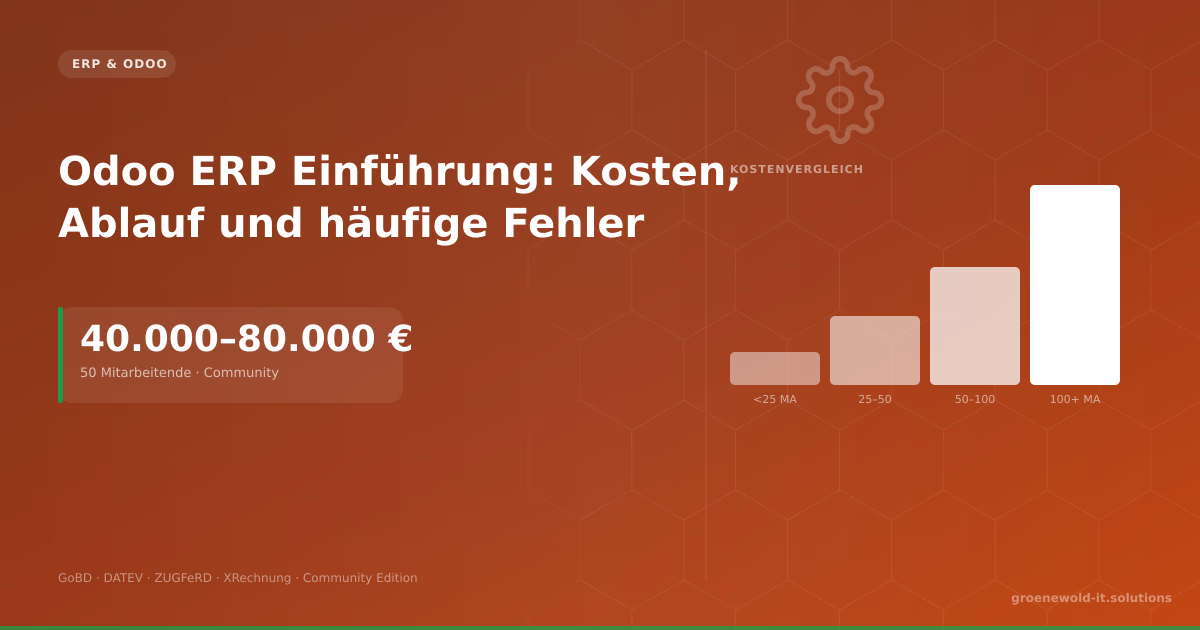
Odoo ERP Introduction: Cost, execution and frequent errors
An Odoo-ERP entry costs typically €40,000-80,000 for 50 employees. This article gives clear figures on Community vs. Enterprise, GoBD requirements, module issues and the five most common project errors.
Odoo vs. SAP: Which ERP solution fits the middle class?
In today's digital landscape, medium-sized companies face the crucial question of which ERP system (Enterprise Resource Planning) best supports their business processes...