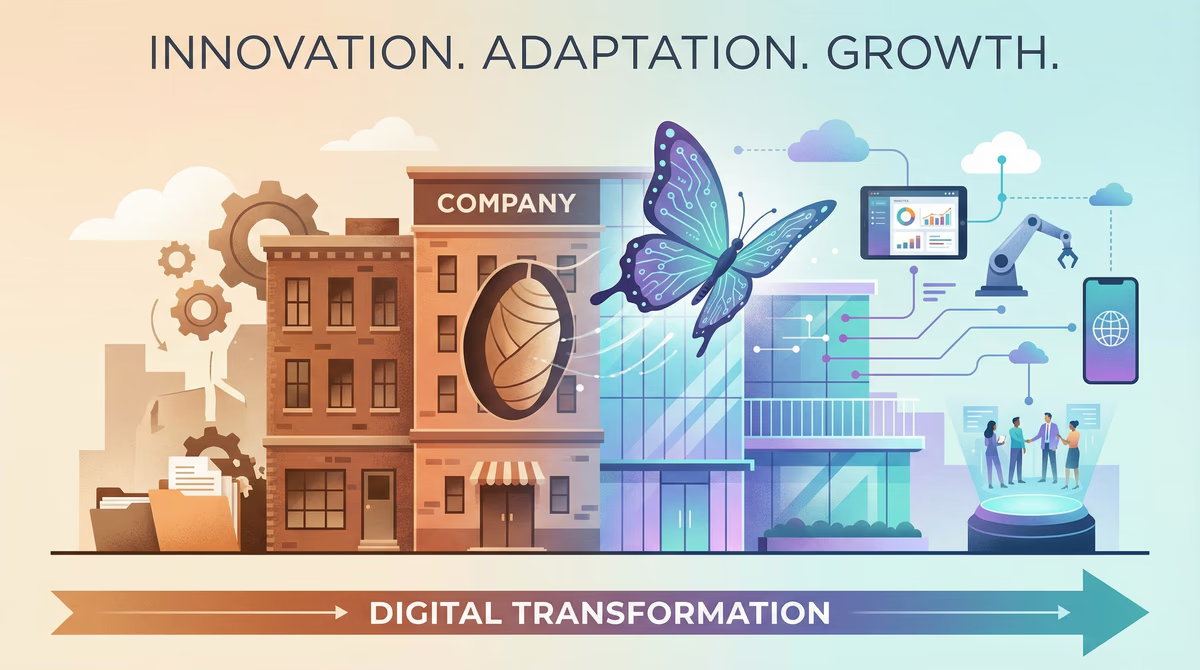
Software development
Digitization in the middle class: How to measure your success
Digitization is no longer a trend for medium-sized enterprises, but a need to remain competitive. But how to measure the success of Digitalisie...
What time tracking software costs: custom development and integration with payroll or project management.
In brief
Digital time tracking typically pays back in 3 to 6 months. The count is less manual entry, payroll work and rework.
Is digital time tracking worth it?
Calculate your savings potential
How many employees track working hours?
The calculation follows six visible stages. All figures remain planning values until scope and assumptions have been reviewed.
1. Capture inputs
The calculator records the visible project, volume, complexity and operating parameters selected on this page.
2. Add fixed components
Fixed base modules and selected add-ons are added without mixing them with recurring charges.
3. Apply multipliers
Quantity, complexity and scope factors multiply only the cost components identified for them in the calculator model.
4. Create the range
The calculator applies its documented lower and upper uncertainty factors to the base result; ROI views keep investment and savings visible separately.
5. Round and calibrate
Monetary result fields are rounded to the nearest whole euro. Public project-cost components are calibrated with the centrally maintained display factor.
6. Classify the result
The result is shown as non-binding guidance. A binding quote requires scope, data, integrations, risks and acceptance criteria to be reviewed.
Efficiency or discount factor: A central display factor of 0.7 is applied to public project-cost components to keep all calculators aligned with the currently reviewed pricing basis. It is not a customer-specific discount; customer-entered wages, revenues and existing operating costs are not reduced.
Why this is not a binding quote: The calculator cannot verify complete requirements, third-party dependencies, data quality, legal constraints or acceptance criteria.
Concrete project profiles with assumptions and indicative budgets—useful for internal alignment alongside the calculator.
Time Tracking Software Costs depend on whether you choose licensing (SaaS) or custom development. Standard solutions cost from a few euros per user per month. Custom development is worthwhile when you need deep integration with payroll, project accounting or ERP, or when you have specific approval workflows and reporting needs. A custom time tracking module or app typically ranges from EUR 10,500 – 35,000 excl. VAT depending on scope and integrations. Digital time tracking typically pays back in 3 to 6 months. We help you decide between standard and custom and outline a transparent project.
Off-the-shelf time tracking works well for simple recording and basic reporting. Custom solutions make sense when you need integration with existing payroll, ERP or project accounting systems, when approval workflows must match your company rules or when you require specific reports for billing, capacity planning or compliance. We build web and mobile time tracking that fits your processes and connects to your backend – so data flows automatically and manual re-entry is eliminated. Typical deliverables include recording interfaces, approval flows, reporting and integration with your systems.
Costs depend on the number of integrations, complexity of workflows and whether you need mobile apps, offline capability or multi-site support. We scope the project in a short workshop and provide a fixed or capped quote. Use the calculator below to estimate ROI from time tracking; for a tailored quote for custom time tracking or integration get in touch – we outline options and typical cost ranges without obligation.
Request a quoteFAQ
Building a bespoke module or app usually lands between EUR 10,500 – 35,000 excl.
VAT, in line with a tailored app rather than an enterprise rollout. Digital time tracking typically pays back in 3 to 6 months. In a first call we weigh a ready-made tool against a tailored build and sketch a clear project plan.
Custom solutions make sense when you need integration with payroll, ERP or project accounting, when approval workflows must match your company rules, or when you need specific reports for billing, capacity planning or compliance.
Digital time tracking typically pays back in 3 to 6 months.
Typical deliverables: recording interfaces, approval flows, reporting and integration with your systems.
Data flows automatically and manual re-entry is eliminated. A brief requirements session lets us commit to a fixed or capped price.
Off-the-shelf time tracking works for simple recording and basic reporting.
For deep integration and custom workflows, custom development is often the better fit. We outline both options without obligation.

Four checks: headcount, minutes per entry, payroll admin, and the investment frame of the app.
1. Set the headcount
More people recording time pulls the month toward the short end of the 3 to 6 month band.
2. Measure minutes per entry
Recording and correction on the timesheet, not a flat quarter hour.
3. Add payroll admin
The hours spent on payroll belong in the status quo.
4. Use the app price only as a frame
The catalog price is the investment, not the monthly saving.
| Model | When it fits | Budget & flexibility | Typical risks |
|---|---|---|---|
| Fixed price (fixed scope) | Clearly defined scope, stable requirements, repeatable delivery. | Predictable total cost; little room for change without a change order. | Scope creep leads to change orders or quality trade-offs. |
| Time & Material | Discovery, legacy, evolving requirements, or close collaboration. | Maximum flexibility; budget transparent via hourly or daily rates. | Without prioritisation, effort can grow—backlog and reviews matter. |
| Retainer / maintenance package | Ongoing operations, updates, small features, and support. | Agreed capacity per month; predictable follow-on cost. | Large changes may still need a separate estimate. |
| Hybrid (milestone + T&M) | MVP or phased releases with clear go-lives, then iterate. | Core delivery fixed price; extensions on a time-and-materials basis. | Define contractually what is in scope vs. extra work. |
Calculators on this page provide indicative ranges; we choose the right model with you based on risk, scope, and planning horizon.
The ranges shown are indicative. For a binding quote we discuss scope, priorities and funding options in a free intro call. Many digitalization projects qualify for grants – try our funding calculator.
Browse all cost calculators, explore services and typical solutions. Questions about Time Tracking? Contact us.
After using the Time Tracking calculator, validate assumptions in a short intro call.
Browse all cost calculators in the costs overview.
Calculator overall range
EUR 16,800–196,000 excl. VAT, depending on product scope
The overall range is derived from the valid parameters of the relevant cost calculator.
Typical duration
2–12 months
Main risk drivers
Non-binding indication
This result is only a non-binding indication based on typical assumptions. Effort and price must be calculated individually for your project.
Blog posts that put budget, effort and typical project paths for this calculator in context.
Digitization in the middle class: How to measure your success
Digitization is no longer a trend for medium-sized enterprises, but a need to remain competitive. But how to measure the success of Digitalisie...
Digital Transformation: Leadership and Change Management as key to success
Digital transformation is more than just the introduction of new technologies. It is a profound change process that affects companies of all sizes. Especially for small and...
Digital Transformation: The Power of Partnerships and Ecosystems
Digital transformation is no longer an option for small and medium-sized enterprises (SMEs), but a need to remain competitive. But the way to the digital future...