As of: 23 September 2026 · Reading time: 14 min
Key takeaways
- Mobile applications for logistics processes optimize storage, transport and supply chain.
- Advantages, features and selection at a glance – now discover.
Mobile applications for logistics processes optimize storage, transport and supply chain. Advantages, features and selection at a glance – now discover.
“An ERP system is only as good as its fit to your actual business processes.”
– Björn Groenewold, Managing Director, Groenewold IT Solutions
What are mobile applications for logistics processes?
Short response: Mobile applications for logistics processes improve storage, transport and supply chain.
For Mobile Applications for Logistics Processes: The Practice Guide, API & Integration Projects and Cost Calculator: API Development are practical starting points. Budget and industry context: Industry: Logistics.
To Mobile applications for logistics processes: The Practice Guide are Data Analysis & Business Intelligence and App Development appropriate entrances for planning and rollout.
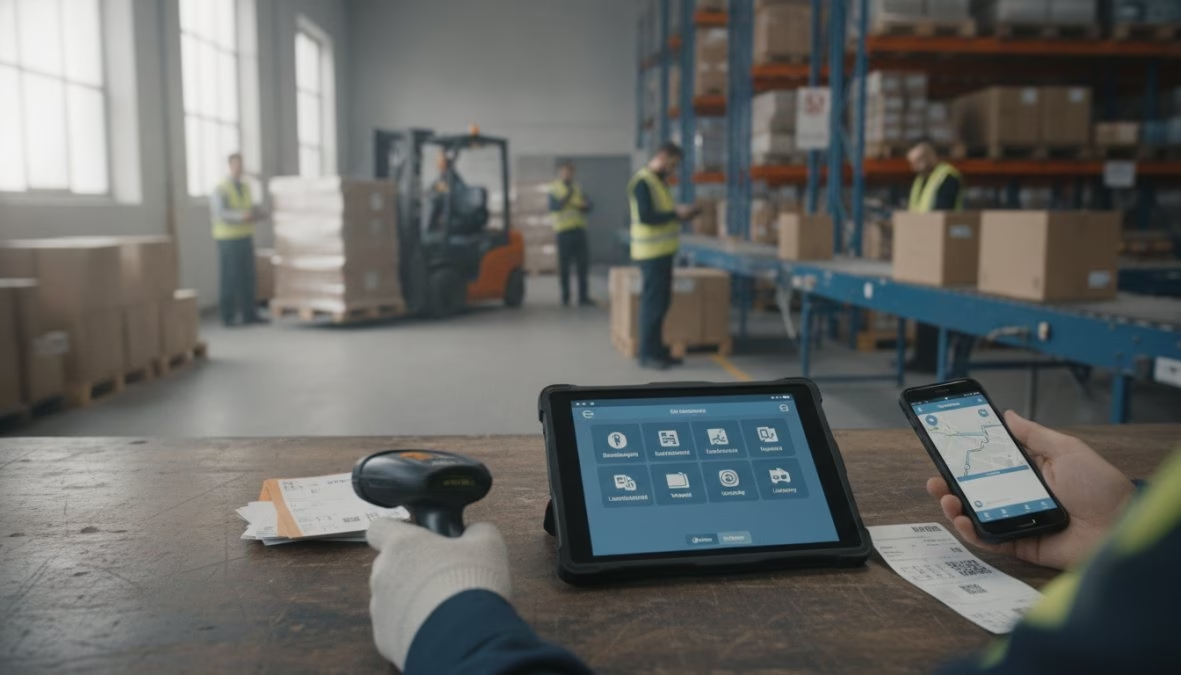
Mobile applications for logistics processes are software-based solutions for smartphones, tablets and MDE devices (mobile data collection).
This digitally map and control operational processes in storage, transport and supply chain management.
The term includes a broad spectrum.
From simple barcode scanner apps for picking up to fully integrated platforms that are seamlessly integrated into ERP systems such as SAP S/4HANA.
The connection between the terminal is crucial in the hands of the employee and the company's central IT systems.
What many companies underestimate. Mobile Logistics apps are not an add-on that is then glued to existing processes. They are an intervention in the process architecture.
An app that reproduces goods flows in real time changes how dispatchers decide how to prioritize warehouse managers and how to detect errors.
Those who treat this as a pure IT project fail regularly.
Typical application fields at a glance:
- Intralogistics: Incoming goods, Deposit, Commissioning, Inventory.
- Transport management: Order transfer, digital delivery certificates (POD), GPS tracking.
- Resource management: Real-time storage movements, minimum inventory warnings.
- Quality backup: Checklists, photo documentation, deviation messages.
Digitization of these processes is not an end in itself. It is the prerequisite for Industry 4.0 and for automation, which decides on market strength in the coming years.
Logistics app Benefits: What companies win
Short: Theory knows everyone.
Theory knows everyone. The question is: What actually happens when a company converts to mobile logistics apps?
Error reduction and process speed
Manual data input is the most common source of error in storage processes. Manual shipping document processes, double bookings, lost documents.
Each of these errors costs time for correction and generates interface losses between departments.
Mobile data acquisition via barcode scan or RFID structurally eliminates these sources of error because the data are captured directly at the location of the movement of goods and transferred at once to the system. .In practice, this means.
Picking errors are rarer because the app leads the employee step by step through the process and signals incorrect scans at once.
Commodity receipts are booked more quickly because no paper form has to be filled out and then tapped.
Profi tip: A frequently overlooked source of efficiency. Mobile apps can reduce running distances in the warehouse through improved order sequences.
This does not save seconds, but hours per shift.
Real-time transparency along the supply chain
Real-time data is the backbone of modern supply chain management decisions.
If a disponent knows where a shipment is just how much stock is actually available and whether a delivery has delays, he can act proactively instead of reacting reactively.
Solutions like EURO-LOG Mobile Track deliver GPS tracking and ETA calculations in real time directly to dispatchers and customers.
The Logistiqo Driver App transfers orders live to drivers and records digital delivery documents with photo and signature.
This is not a game: it reduces queries, accelerates billing and increases customer satisfaction measurable.
Clarity along the supply chain also means recognizing bottlenecks earlier. Anyone who brings real-time data from warehouse and transport together sees problems before they escalate.
Mobile data acquisition in logistics: From MDE to smartphone
Mobile data acquisition (MDE) is the technical core of any mobile logistics solution.
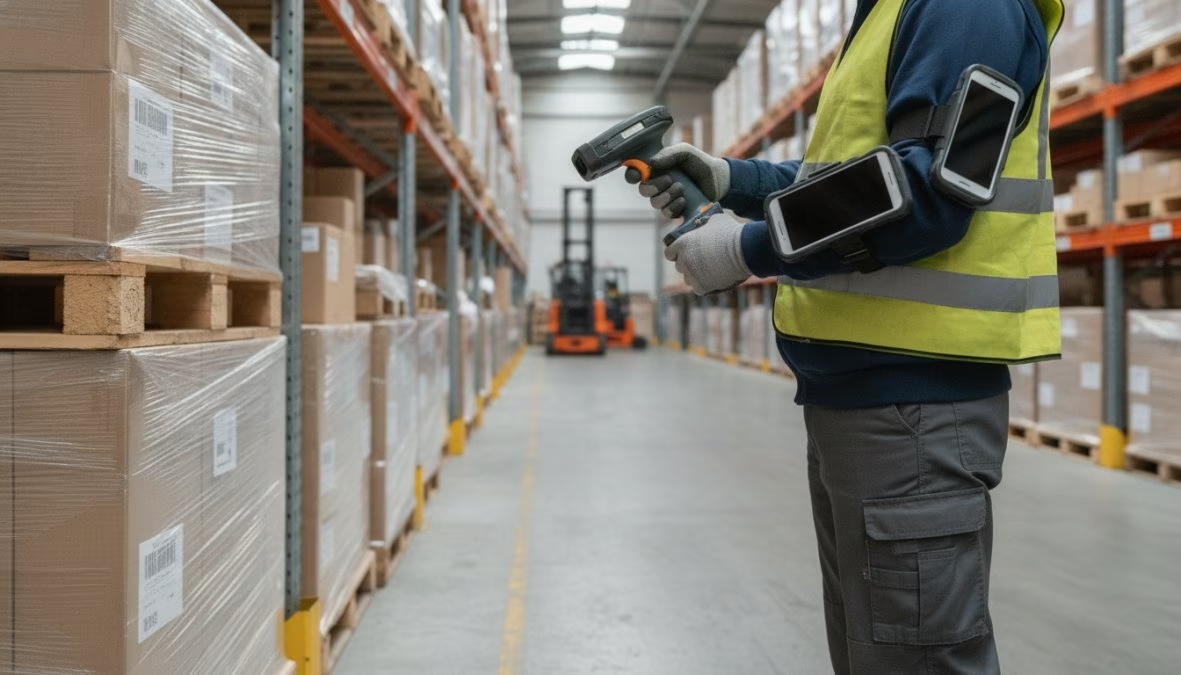
MDE refers to the detection of data directly at the point of origin, i.e. in the warehouse, at the goods entrance or on the loading ramp, via a mobile terminal with integrated scanner or camera.
Choosing the right terminal is not an incident. It significantly affects acceptance, reliability and overall costs.
Hardware compatibility and BYOD in everyday storage
Here is one of the blind spots of many providers. Most logistics app providers present their solution for a specific device segment and ignore reality in midsize companies.
A heterogeneous device landscape made of solid MDE terminals, Android tablets and sometimes private smartphones of employees. .SmartWarehouse from ACVENTIS is improved, for example, on Android MDE devices with integrated scanner.
This is ideal for warehouse operations with high scan volumes. If you are looking for a more flexible solution.
This also runs on commercial smartphones, you have to compare it deeper.
BYOD (Bring Your Own Device) is a two-edged sword in logistics:
- Advantage: No device investment, employees know their device.
- Proportion: Security risks, lack of robustness, compliance issues.
- Recommendation: BYOD only for auxiliary processes (checklists, status queries), not for booking-relevant core processes.
A cleanly built app must run on all relevant terminals.
If you do not write this into the needs from the beginning, you will pay it later by post-development.
Attention: Apps certified only on a device manufacturer produce hardware lock-in. If the device manufacturer adjusts the model or increases the prices, you will notice.
Clear compatibility before purchase.
Offline capability and data synchronization
This is the aspect that almost no provider communicates prominently but can decide on the success or failure of a mobile logistics solution.
Warehouses are rarely equipped with complete Wi-Fi. Freezers, outer bearings, basement: Everywhere there the connection breaks off.
An app that does not work without a network is worthless in these areas.
Off-line solutions such as SmartWarehouse (ACVENTIS) or the SIRUM app store transactions locally and synchronize them as soon as the connection is restored.
What happens when two employees have moved the same range offline? How to prioritize bookings?
Quality criteria for offline synchronization:
- Local data keeping without data loss in connection termination.
- Automatic synchronization with reconnection
- Clear conflict resolution in parallel offline bookings.
- Transparent logging of all synchronized processes.
SAP Fiori Logistics apps: Mobile processes in the S/4HANA environment
For companies that rely on SAP S/4HANA, SAP Fiori is the strategic standard for mobile logistics apps.
SAP Fiori is the design and development framework of SAP for modern, mobile user interfaces provided via the SAP Business Technology Platform (BTP).
Practice looks more differentiated. SAP Fiori offers a major number of prefabricated apps for Warehouse Management (WM), Materials Management (MM) and Production Planning (PP).
Companies such as prismat also develop custom-tailored SAP Fiori apps that integrate smartphone functions such as camera and GPS and are configured process-clearly. .What most of the guides here conceal.
The rollout effort for custom SAP Fiori apps is considerable. Standard apps are quickly activated.
However, as soon as processes deviate from the standard, complexity and costs increase significantly.
As an alternative, ORBIS offers finished mobile apps with seamless integration in SAP EWM, WM and MM.
This are ready to use out-of-the-box and thus deliver faster ROI than fully custom Fiori developments.
The decision between standard Fiori apps, configured solutions and custom development depends on three factors: process standardization, existing SAP licenses and internal SAP know-how.
| Solution | Rollout effort | Room to adapt | Suitable for |
|---|---|---|---|
| SAP Fiori Standard apps | Low | Low | Standard processes in S/4HANA |
| ORBIS Logistics Apps | Medium | SAP environments, faster ROI | |
| Custom Fiori apps (e.g. prismat) | High | Very high | Large companies, special processes |
| Manufacturer-neutral apps (e.g. SmartWarehouse) | Medium | High | Non-SAP or Multi-ERP environments |
Integration, Security and Cloud: Embed Mobile Applications for Logistics Processes
A mobile logistics app that works isolated is no progress. She's just another silo.
ERP and WMS interfaces without interface losses
Integration into existing ERP systems (SAP, weclapp, Microsoft Dynamics) and warehouse management systems (WMS).
This also covers transport management systems (TMS) is the basic technical requirement for real added value.
Interface losses occur if data between app and backend system are not transmitted completely, not in real time or not error-free.
According to Gartner's report on supply chain technology, integration quality is the most common reason for failed digitalization projects in logistics. Technically relevant interfaces include:
- RFC/BAPI: Classic SAP interfaces for deep system integration.
- REST/OData: Modern API standards that are also suitable for cloud solutions.
- IDOC: For document exchange and shipping document processes in SAP environments.
Cloud computing plays a growing role in this.
Cloud-based logistics apps like weclapp Lager-App or smapOne can be operated without local server infrastructure and scale flexibly with the company. Scalability is a real advantage.
If you equip 10 warehouse workers with the app today and 50 in two years, you pay only what it uses.
Security aspects and GDPR compliance
Security in mobile logistics apps is not a topic for completing a presentation. It is a design principle that must be installed from the beginning.
Relevant safety aspects for mobile logistics applications:
- Data encryption: Transport encryption (TLS) and encryption of locally stored data on the terminal.
- Authentication: Single Sign-On (SSO) or multi-factor authentication for access to sensitive logistics data.
- Device management: Mobile Device Management (MDM) for remote deletion of device loss.
- GDPR compliance: EU data retention, clear contract processing contracts, uncontrolled data transfer to third countries.
If you use logistics apps from providers outside the EU, you must actively check the General Data Protection Regulation.
Especially GPS tracking data of drivers and employee movement data in the warehouse are personal data within the meaning of the GDPR.
knowledge: GDPR conformity is not a bonus feature. With GPS tracking and employee data, it is legal duty. Clear data location and order processing agreement before rollout.
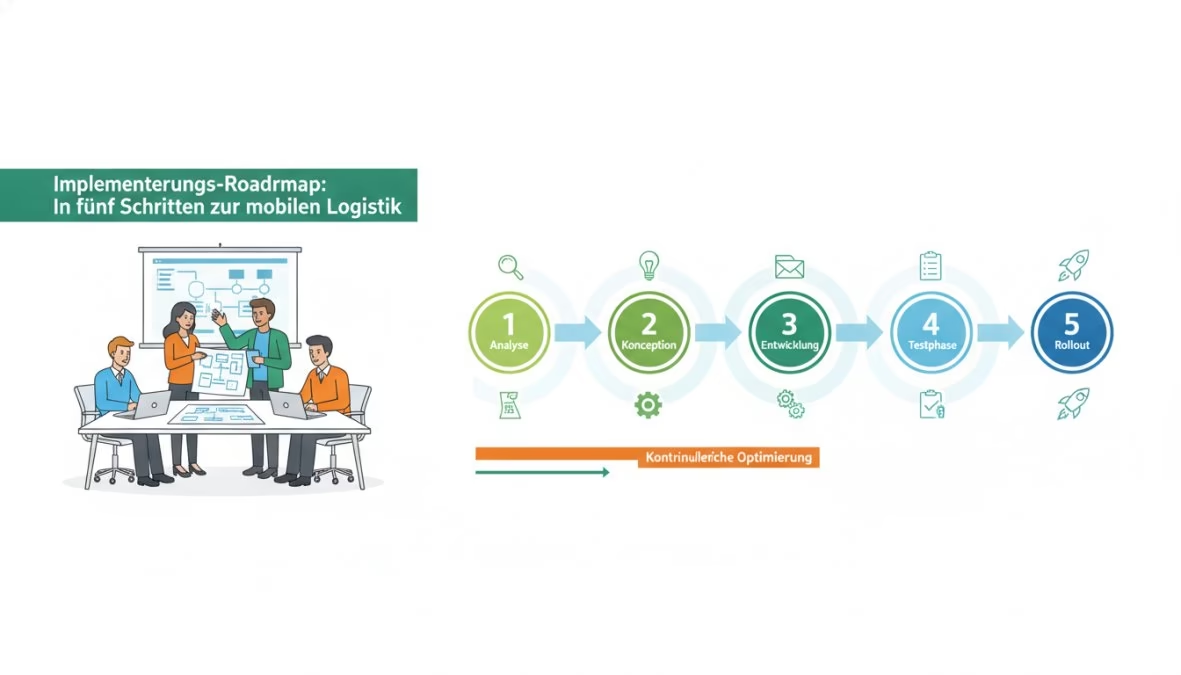
Implementation Roadmap: In five steps to mobile logistics
Short: Most implementations do not fail in technology.
Most implementations do not fail in technology. They fail in lack of preparation and unrealistic goals. This roadmap is based on the experience of real projects.
Step 1. Process review and requirement definition [Time: 2-4 weeks] Document your current storage processes in detail. What processes do most errors create?
Where are the biggest losses of time? Define measurable targets (e.g. ordering time by 20%, error rate below 0.5%).
Step 2. Define hardware decision and pilot area [Time: 1-2 weeks] Select devices based on your process needs, not using marketing material.
Define a pilot area with 5-10 users that is representative of your main processes.
Step 3. System integration and data migration [Time: 4-8 weeks] Integration into ERP/WMS is the most technically complex step. Plan buffers for unexpected interface problems.
Test data synchronization and offline behavior explicitly.
Step 4: Pilot operation and user training [Time: 2-4 weeks] Usability decides about acceptance. An app that employees cannot intuitively operate is bypassed.
Invest in training and systematically collect feedback from the pilot operation.
Step 5: Rollout and continuous optimization [Time: running] Roll out gradually. Measure KPIs against your exit targets. Improve workflows based on real usage data.
.
Profi tip: Forget most project plans: plan a "fall level" for pilot operations.
If the app has critical problems in the first week, employees must be able to return to the old process without stopping the operation.
According to Fraunhofer Institute for Material Flow and Logistics, insufficient process review and lack of user involvement are the most common causes of failed digitization projects in intralogistics.
AI in Logistics 2026: How intelligent apps change the industry
Short: AI in logistics is no longer a future scenario in 2026.
AI in logistics is no longer a future scenario in 2026. It has arrived in concrete applications that are already being used in operational logistics processes today.
The most relevant AI applications in mobile logistics apps today:
Predictive analytics for inventory management: AI models analyze historical goods movements, seasonality and external factors to predict inventory bottlenecks before they occur.
This changes how disponents work with inventory data.
Image-based quality check: Smartphone cameras become a quality tool.
Apps detect damaged goods by computer vision when entering goods and document damage automatically with time stamp and GPS coordinate.
Smart route optimization: TMS apps use AI to adjust delivery routes in real time when traffic conditions, delivery windows or order volumes change.
EURO-LOG Mobile Track is an example of this category.
Language-controlled picking: Voice picking systems based on language models enable hands-free picking. The error rate drops because employees no longer have to look at a screen.
It is crucial. AI functions in logistics apps are just as good as the data quality on which they are based.
Anyone who is investing in clean mobile data collection today sets the basis for AI-based process optimization tomorrow. This is not a marketing argument, but a technical causality.
According to the McKinsey Global Institute for Digitization of Supply Chain, companies that integrate AI-based analyses into their supply chain can significantly reduce storage costs and improve delivery reliability.
Conclusion: Find the right way to the mobile logistics app
Short: The market for mobile applications for logistics processes is unclear.
The market for mobile applications for logistics processes is unclear. SAP-focused solutions, cloud platforms, no-code building boxes, expert MDE apps.
Everyone has their permission, and none fits for everyone.
What counts is the fit between your process reality, your IT landscape and the provider's solution approach.
A company with SAP S/4HANA and standardised warehouse processes works well with ORBIS or SAP Fiori.
A midsize operation without SAP that wants to digitize quickly finds a more pragmatic entry in weclapp or smapOne.
Anyone who has custom processes that do not represent a standard needs custom development.
The two critical questions before each decision: Does the app run offline? What hardware? Anyone who clears these two points before signing it will save expensive rework later.
Many companies are committed to selecting and implementing mobile logistics solutions because standard software does not reflect their specific processes.
Groenewold IT Solutions has been developing customized mobile applications for mid-sized firms for over 15 years.
GDPR-compliant, with full source code property after payment, without offshoring and without Vendor lock-in.
Request your free project check now and learn what solution fits your processes and budget.
Frequently Asked Questions (FAQ)
What advantages do mobile applications offer in logistics?
Mobile applications for logistics processes reduce errors by digital data acquisition, replace paper-based processes and deliver real-time data on goods flows and inventory quantities.
Staff in picking, goods receipt and transport can book, scan and acknowledge directly at the terminal.
This reduces the administrative effort, accelerates storage processes and creates clarity that requires modern supply chain management.
How does mobile data acquisition improve warehouse logistics?
Mobile data acquisition (MDE) in the logistics enables goods movements, inventory and shipping document processes to be digitally recorded directly on the shelf or incoming goods.
Instead of handwritten lists or downstream PC inputs, data flow into the WMS or ERP system in real time.
This minimizes interface losses, increases inventory accuracy and gives warehouse managers current key figures for process optimization at any time.
What is the difference between native apps and web apps in logistics?
?Native logistics apps run directly on the operating system (Android or iOS) and can completely use hardware functions such as scanner, camera or GPS - even offline. Web apps are browser-based, platform-independent and simpler to wait, but encounter borders with offline capability and hardware access. For demanding intralogistics with MDE devices, native or hybrid solutions are recommended; Web apps are often enough for simple checklists and dashboards.
How does AI change mobile applications in logistics by 2026?
AI in the 2026 logistics enables predictive inventory planning, automatic route optimization and smart anomaly detection directly in the mobile app.
Instead of only displaying actual data, AI-assisted applications provide recommendations for action - for example in the case of imminent bottlenecks or different delivery times.
First AI functions are already accessible to mid-sized firms via cloud platforms without complex own development.
What functions are indispensable in a logistics app?
Real-time synchronization with ERP or WMS systems, barcode and RFID scanning, offline capability for seamless operation without WLAN, intuitive usability for quick installation and digital documentation (e.g. delivery notes, delivery certificates).
In addition, the app should run on common terminals - from solid MDE terminals to smartphones - and meet security needs such as GDPR-compliant data retention.
When is it worth individual development instead of a standard solution?
Customised mobile application for logistics processes is worthwhile if standard solutions do not fit into existing ERP landscapes, specific workflows must be mapped or Vendor lock-in should be avoided.
Companies get full source code ownership, no license dependency and an app that fits exactly with their warehouse processes - especially relevant for midsize companies with grown IT structures.
Technical sources and further links
The following separate references complement the grouping on the topics of this Article:
About the author

Managing Director of Groenewold IT Solutions GmbH and Hyperspace GmbH
Since 2009 Björn Groenewold has been developing software solutions for the mid-market. He is Managing Director of Groenewold IT Solutions GmbH (founded 2010) and Hyperspace GmbH. As founder of Groenewold IT Solutions he has successfully supported more than 250 projects – from legacy modernisation to AI integration.
Blog recommendations
Related articles
These posts might also interest you.

Hosting and operation of web applications
Hosting and operation of web applications: What companies should pay attention to in terms of security, scaling, GDPR, support and responsibility in everyday life.

Create mobile app for companies
Create mobile app for companies: How to plan goals, functions, interfaces, GDPR and operation for measurable results.

Implementing Automation in Mid-Sized Businesses the Right Way
Automation in mid-sized businesses reduces costs and errors. Learn what processes are worthwhile and how the implementation can be planned.
Free download
Checklist: 10 questions before software development
Key points before you start: budget, timeline, and requirements.
Get the checklist in a consultationRelevant next steps
Related services & solutions
Based on this article's topic, these pages are often the most useful next steps.
Related solutions
Related comparison
Cost calculators
Related industries
Practical next steps after Mobile Applications for Logistics Processes: The Practice Guide
Mobile Applications for Logistics Processes: The Practice Guide addresses a practical choice for logistics teams. Start with one clear goal: choose an app approach that stays secure, testable, and useful after launch.
Check the current process, the data involved, and the result users need. Then record the main risks and define a small first step. This keeps the decision easy to review and gives your team a shared basis.
For implementation support, our business app development connects the article's guidance with architecture, delivery, and stable operations. Engineering and project ownership stay with our team in Leer, Germany.
This post belongs to ERP & CRM. Browse the related ERP & CRM articles or use the English software blog for other topics.
When budget is the next question, the software cost calculators provide planning ranges. The IT glossary explains key terms, while in-depth technology guides cover wider decisions.
If the topic affects a live project, book a technical consultation or send the context through our project contact form. We usually reply within one working day.