As of: 23 September 2026 · Reading time: 7 min
Key takeaways
- B2B online shops have different requirements than B2C.
- Customer groups, net ad, ERP integration and approval workflows – what mid-sized businesses need to know.
B2B online shops have different requirements than B2C. Customer groups, net ad, ERP integration and approval workflows – what mid-sized businesses need to know.
“Digitalization is not an IT project—it is a business strategy.”
– Björn Groenewold, Managing Director, Groenewold IT Solutions
B2B-Onlineshop: What sets them apart from B2C and what matters
B2B-Onlineshop: Why a normal online shop is not enough
B2B online shops have different needs than B2C.
To B2B onlineshop: What distinguishes it from B2C and what it is important arrange CMS & E-commerce platforms, cost calculator: onlineshop, solution: commerce & e-commerce and Comparison: Shopware vs. Magento Services, solutions and planning bases.
Many midsize companies start with a standard online shop that was originally designed for B2C – and quickly reach borders.
Net prices are displayed incorrectly, quantity discounts do not attack automatically. And regular customers must ask by e-mail because the shop does not know any special conditional logic.
B2B e-commerce is not a subset of B2C. It is an separate application case with other processes, other users and other technical needs.
The main differences B2B vs. B2C
| Dimension | B2C | B2B |
|---|---|---|
| Price logic | Uniform | Customer-group specific |
| Display format | Gross | Net (§ 14a UStG) |
| Order process | Checkout → Payment | Request → Offer → Order |
| Payment methods | Credit card, PayPal | Invoice, advance payment, credit line |
| User | anonym | authenticated, company account |
| Minimum order | rare | frequent (MOQ) |
| Product access | public | partially blocked (closed catalogues) |
| Integration | rarely needed | ERP, CRM, merchandise industry |
Core functions of a professional B2B online shop
1. Customer groups and individual price lists
Different customers have different purchase prices. A B2B shop must:
- Define customer groups (e.g. retailers, wholesalers, direct customers).
- Set price lists per customer group.
- Seasonal prices (Longe 1–10: 50 €, 11–50: 45 €, > 50: 40 €).
- enable special conditions for custom customers.
Standard shop systems such as Shopware 6 offer this function in the business or professional edition. WooCommerce needs paid plugins.
2. Net representation and tax correctness
B2B customers buy net. The shop must:
- Show prices net once a B2B account is detected.
- Validate USt ID No (EU-wide purchase, §4 No 1b UStG).
- Ensure correct accounting (net amount, tax rate, gross amount).
- Find intra-Community delivery correctly
Errors here are not only commercially unpleasant – they are tax-relevant.
3. Ordering workflows and approval processes
In many companies, not every employee can order unlimited. A B2B shop required:
- roles in the customer account (purchaser, author, admin).
- Order limits per user
- Approval workflow: Order → Review → Release → Shipping.
- Enquiry mode: Cart is not ordered directly but sent as request.
Especially relevant for midsize purchasing departments that have to map internal control processes.
4. ERP integration as a central topic
Short: A B2B shop without ERP connection is an island solution.
A B2B shop without ERP connection is an island solution. Master data, stocks and prices must be automatically synchronized.
Typical integration needs:
| Data flow | direction | frequency |
|---|---|---|
| Product master data | ERP → Shop | daily / change |
| Stock | ERP → Shop | hourly / real time |
| Price lists | ERP → Shop | daily |
| Orders | Shop → ERP | at once |
| Shipping status | ERP → Shop | hourly |
| customer base | bidirectional | at plant |
Depending on the ERP system (SAP, Microsoft Dynamics, Sage, Datev), there are standard connectors or custom interfaces. We develop both variants at Groenewold IT Solutions.
→ More about ERP integration: System integration and interfaces
5. Closed catalogues and access control
Some products are not visible to all customers. B2B shops need:
- Password-protected catalog or login
- Product visibility per customer group.
- price display only after authentication.
- Exclusive ranges for specific partners.
6. Recurring orders and fast ordering
B2B customers often order the same products regularly. Important features:
- Order lists / stored goods baskets.
- CSV upload for mass orders (Article number + quantity).
- Quick order by item number.
- Order history with reorder button.
These features significantly reduce the effort for regular customers – and reduce the demand rate during sales.
Technical platform selection for B2B
| Request | WooCommerce | Shopware 6 | Own development |
|---|---|---|---|
| Customer groups + price lists | Plugin | nativ | complete |
| Approval workflows | very elaborate | B2B Suite | complete |
| ERP integration | restrictions | good | complete |
| scalability (> 10k products) | limits | good | complete |
| Closed catalog | Plugin | nativ | complete |
For companies with complex B2B processes, we recommend either Shopware 6 Professional/Enterprise or an custom portal solution that accurately maps their own processes. .→ Our services: B2B-Onlineshop Development
Typical project phases of a B2B-Shop project
- Customization (2–4 weeks): Process review, interface detection, system architecture.
- Concepting phase (1–2 weeks): Wireframes, database model, API design.
- Base rollout (4–8 weeks): Product catalog, Customer account management, Checkout.
- ERP integration (3–8 weeks): interfaces, data migration, tests.
- B2B specific features (2–6 weeks): workflows, price logic, roles.
- Test phase and Go-live (2–4 weeks).
Total duration: typically 4–9 months for a fully integrated B2B shop.
FAQ: B2B-Onlineshop
Short: Can our field service also order via the B2B shop?
Can our field service also order via the B2B shop? Yes. In professional B2B portals, the field service can order on behalf of customers or create offers.
This "sales agent" function can be introduced in Shopware 6 and in custom solutions.
How do we deal with customers without VAT ID No? Customers without valid VAT ID No. are treated as B2C customers and pay gross prices.
The validation of the USt ID number can be automated against the EU’s VIES system.
Can B2B customers request offers? Yes.
Many B2B shops offer a “request basket” instead of a direct checkout – the customer places articles in the shopping cart and sends an offer request.
The distribution then creates an custom offer.
How do we protect our price lists from competitors? Login-Pflicht before price display, IP spins. And a technically clean access control system.
We will be happy to advise you on the right measures.
→ Free first call: Contact → More about integration: interfaces and ERP coupling
Measurability and quality assurance
Define Erfolg on measurable criteria – for example reduced processing time, lower escalations or higher conversion – and not only managed via “Go-live”.
For b2b, a slim set of automated tests is worth on the most important user journeys plus targeted manual exploratory tests before releases.
Quality is also created by code reviews, architecture decision logs (ADR) and clear handovers to the operation. Runbooks, escalation paths and recorded border cases.
Knowledge remains in the company – regardless of custom persons or service providers.
Frequently Asked Questions (FAQ)
What is this article about “B2B-Onlineshop: What sets them apart from B2C and what matters”?This article highlights B2B online shop: What distinguishes it from B2C and what it needs from the perspective of requirements, typical stumbling stones and meaningful next steps. In the core: B2B online shops have different requirements than B2C. Customer groups, net ad, ERP integration and approval workflows – what mid-sized businesses need to know.
For whom are the content described particularly relevant?
Pragmatically usable for project management and Product Owner who need to decide in E-Commerce between standard software, custom development and integration.
How can the topic be classified into an IT or digital strategy?
Technically and organizationally, it is worthwhile to vote with experienced partners – from request clarification to operation; an entry point is the [performance overview](/en/services/software-development) with related topics. In addition, a coordination with [IT consulting and architecture](/en/services/it-consulting) helps if several systems or suppliers are involved.
What next steps are useful when support is needed?
Pragmatic next step: book appointment and jointly clarify what MVP or pilot variant fits your team and landscape.
Conclusion and next steps
B2B online shop: What distinguishes it from B2C and what it is important can then be successfully introduced if technology, organization and measurability match – instead of insulated tool rollouts without process reference.
Use the overview in this article as a basis for discussion on priorities, risks and the first loadable pilot.
Intensify matching topics in category overview Blog category and check operational support via web development, onlineshop creation.
Groenewold IT accompanies review, rollout and operation – from the first grouping to scalable releases.
Technical sources and further links
The following separate references complement the grouping on the topics of this Article:
- Bitkom – Digital Economy Association.
- BSI – Federal Office for Information Security.
- European Commission – Digital Strategy.
- MDN Web Docs (Mozilla)
- W3C – World Wide Web Consortium.
"APIs are the backbone of modern software: If you stabilize interfaces late, you will pay with double integration work."
— *Björn Groenewold, Managing Director, Groenewold IT Solutions *
About the author

Managing Director of Groenewold IT Solutions GmbH and Hyperspace GmbH
Since 2009 Björn Groenewold has been developing software solutions for the mid-market. He is Managing Director of Groenewold IT Solutions GmbH (founded 2010) and Hyperspace GmbH. As founder of Groenewold IT Solutions he has successfully supported more than 250 projects – from legacy modernisation to AI integration.
Blog recommendations
Related articles
These posts might also interest you.
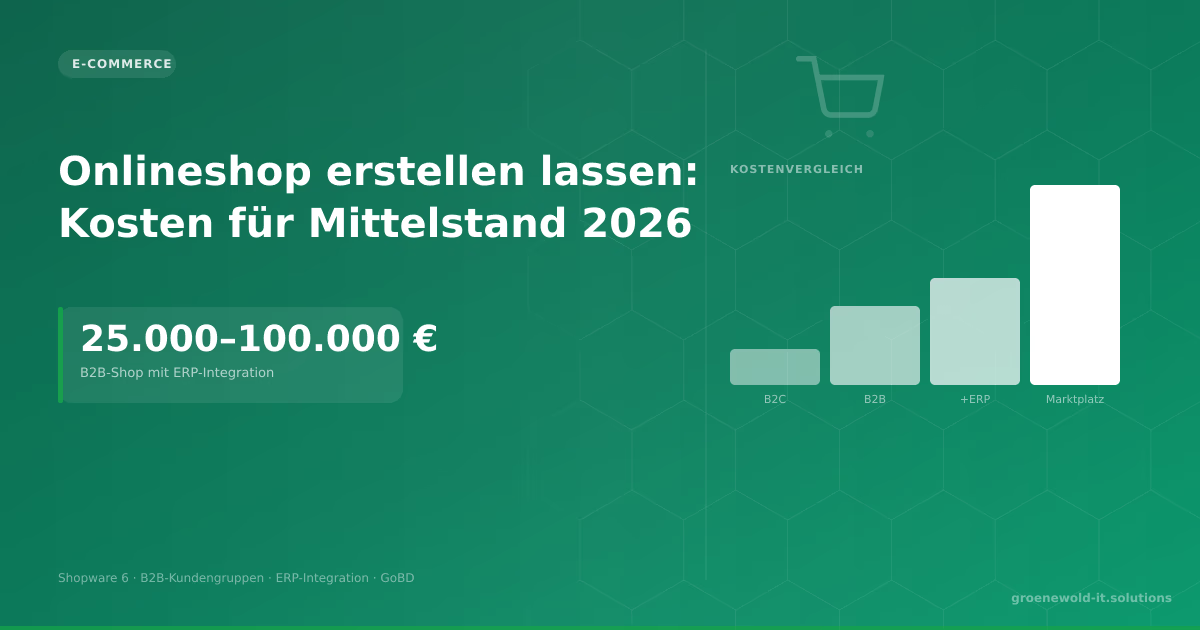
Creating an Online Shop: Costs for Mid-Sized Businesses in 2026
Create an online shop costs €25,000 to €100,000 in mid-sized businesses. This article explains the difference B2C vs. B2B-Shop, ERP integration, Shopware vs. WooCommerce and running costs after the…

Having an Online Shop Developed: What Does It Really Cost?
Onlineshop development: costs, runtimes and decision-making aid between standard shop system and individual solution for mid-sized businesses.

Shopware vs. WooCommerce: Which System Fits Mid-Sized Businesses?
Shopware 6 or WooCommerce – an honest system comparison for medium-sized companies with focus on B2B, ERP integration and scalability.
Free download
Checklist: 10 questions before software development
Key points before you start: budget, timeline, and requirements.
Get the checklist in a consultationRelevant next steps
Related services & solutions
Based on this article's topic, these pages are often the most useful next steps.
Related solutions
Related comparison
Related industries
Practical next steps after B2B Online Shops: What Sets Them Apart from B2C and What Matters
B2B Online Shops: What Sets Them Apart from B2C and What Matters addresses a practical choice for product and IT teams. Start with one clear goal: align software scope, technical risk, and business value before the next investment.
Check the current process, the data involved, and the result users need. Then record the main risks and define a small first step. This keeps the decision easy to review and gives your team a shared basis.
For implementation support, our custom software development connects the article's guidance with architecture, delivery, and stable operations. Engineering and project ownership stay with our team in Leer, Germany.
This post belongs to E-Commerce. Browse the related E-Commerce articles or use the English software blog for other topics.
When budget is the next question, the software cost calculators provide planning ranges. The IT glossary explains key terms, while in-depth technology guides cover wider decisions.
If the topic affects a live project, book a technical consultation or send the context through our project contact form. We usually reply within one working day.