




Odoo
Odoo vs. SAP: A closer look at total cost of ownership (TCO)
In today's business world, characterized by digital transformation, a powerful enterprise resource planning (ERP) system for optimizing business processes is the increase in...

Create an online shop with conversion-focused checkout, ERP integration and measurable tracking—including Shopify, WooCommerce and Shopware. Platform and ecommerce architecture are bundled in our ecommerce and CMS platform overview, Made in Germany.

Fast time-to-market as a SaaS store: checkout, apps and hosting in one stack – with disciplined app governance and ERP/fulfillment connections. We map Shopify in our ecommerce and Shopify platform overview.
Professional online shops on Shopware – Rule Builder, B2B suite and custom plugins by priority.
Flexible for content-led sites – online shop development with clear plugin discipline and a performance budget. Strategy, ERP and CMS integration for WooCommerce live on our CMS and WooCommerce platform overview.
For large catalogues and multi-store – B2B e-commerce with complex roles and internationalisation.
Secure integration of PayPal, Stripe, Klarna and other PSPs with reconciliation logic.
Inventory, orders and customer status synchronised with your merchandise management system.
Compare Shopify, WooCommerce and Shopware in context: ecommerce and CMS platforms.
Project references
Documented examples with transparent evidence types — browse matching references or open the full case study.
A successful online shop is far more than a product catalog with a checkout button. It requires carefully orchestrated user journeys that guide visitors from discovery through consideration to purchase with minimal friction. We design e-commerce experiences based on conversion research and real user behavior data, optimizing everything from product page layouts and filtering systems to cart recovery flows and post-purchase communication sequences that drive repeat business.
Our e-commerce implementations go deep into backend integration because the shop frontend is only the tip of the iceberg. We connect your online store directly to ERP systems for real-time inventory synchronization, automate order routing to fulfillment centers, and integrate accounting software so invoices generate automatically. Payment providers like Stripe, PayPal, and Klarna are configured with proper fraud detection and PSD2 compliance, ensuring secure transactions across all European markets.
Performance can affect product discovery and checkout completion, but its commercial impact varies by audience, device, catalogue and campaign. We define measurable budgets for loading, interaction and transferred data, then test them with realistic catalogue and third-party scripts. Server rendering, optimised image delivery and deliberate caching reduce avoidable work without promising a universal sub-second result. Mobile and desktop results are documented with their test conditions before go-live.
Launching a shop is just the beginning of the e-commerce journey. We provide ongoing optimization services including A/B testing of checkout flows, SEO improvements for product pages, and analytics dashboards that reveal which marketing channels actually drive profitable orders. Our maintenance contracts cover security patches, platform updates, and performance monitoring so you can focus on growing your product range and customer base while we keep the technical infrastructure running flawlessly.
Sustainable revenue growth comes from systematic A/B testing at critical touchpoints: product pages, checkout flows, cart dialogs, and calls-to-action. We complement this with push notifications to recover abandoned carts and re-engage existing customers with offers. Combined with a well-executed SEO strategy, these measures ensure not only more visitors find your shop, but a larger share of them actually convert into paying customers.
Black Friday, seasonal spikes, or viral campaigns – your online shop must handle sudden traffic surges without sacrificing performance or availability. We architect shop infrastructure with load balancing, intelligent caching, and global CDN deployment. Through an API gateway, we orchestrate microservices and headless commerce architectures that scale independently – keeping checkout fast even when thousands of customers browse your shop simultaneously.
Selling internationally requires more than translated text. Professional internationalization (i18n) encompasses currency conversion, country-specific tax rates, local payment methods, and legally compliant processes. With Progressive Web Apps, we deliver an app-like shopping experience – offline-capable, fast, and installable – without the detour through an app store. Combined with consistent responsive design, you reach your audiences worldwide on every device.
ERP & payment integration for your online shop
Web & Mobile Development →Frontend development for optimal user experience
Ecommerce & CMS platforms →Compare Shopify, WooCommerce and Shopware
Shopware development →Custom Shopware plugins and modules
Magento Development →Adobe Commerce for large catalogues and B2B
Online shop development starts with choosing the platform. The matrix maps the common options by ideal use, strength and effort. Estimate budgets via online shop costs.
| Platform | Ideal for | Strength | Effort (indication) |
|---|---|---|---|
| Shopify | Fast B2C start, brands with a standard checkout | SaaS hosting, app ecosystem, time-to-market | low–medium |
| Shopware | B2B and ambitious B2C shops | Rule Builder, B2B suite, ERP integration | medium–high |
| WooCommerce | Smaller, content-driven shops | WordPress integration, quick start | low–medium |
| Magento / Adobe Commerce | Large catalogs, international shops | Scaling, multi-language, multistore | high |
| Headless / custom | Special processes, custom frontends | Maximum flexibility, API-first | project-dependent |
FAQ
It depends on product count, integration depth and budget.
We advise technology-neutral and recommend the platform with the best cost-benefit ratio.
We connect Stripe, Mollie, PayPal and other PSPs – including PCI-DSS-compliant tokenisation and reconciliation logic.
Yes.
We implement multi-currency, multilingual stores and country-specific tax logic from day one.
Through optimised checkout flows, fast load times, trust signals and data-driven A/B tests on the pages that matter most.
Cost depends on catalogue size, B2B rules, design, migration and integrations.
A lean B2C store with standard checkout has a different scope from a B2B store with tenants, price lists, approvals and ERP connectivity. Hosting, payment fees, maintenance and content migration are shown separately.
We structure the proposal into storefront, checkout, payments, integrations, testing and go-live. Assumptions about data quality, variants, tax rules, shipping zones and legal-content ownership are documented before implementation. Critical integrations can be tested as a focused proof of concept.
Acceptance uses realistic product, customer and order data so the budget is tied to concrete deliverables rather than a generic platform demo.
B2B e-commerce needs clear role models: who sees which prices, who triggers approvals, how are framework agreements and tiers mapped?
Without these rules the shop becomes a CRM duplicate and maintenance splits across ERP and shop. Customer accounts with multiple buyers, quote/order history, CSV/EDI interfaces and credit limits often matter – that distinguishes B2B from a classic B2C catalogue.
The e-commerce platform must deliver reliable APIs and webhooks or synchronisation breaks under peak load. Online shop development then covers not only the theme but cart rules and payment methods.
We prioritise integration paths and measurable checkout steps before the layout is final-polished.
A Shopware agency delivers traceable releases: concept, UX, theme or plugin development, tests and documented handovers – not only buying a theme and hoping.
Credible references in a similar industry, clear SLAs for operations and security patches, and explicit ownership of integrations matter. As a Shopware agency we use staging systems, automated regression tests for checkout and alignment with ERP test tenants.
Ask about monitoring and incident processes – that separates professional online shop development from one-off deliveries. B2B e-commerce on Shopware benefits from Rule Builder and commercial data models when master data is clean before launch.
In short: deliverables and acceptance in writing, then the chosen e-commerce platform can grow with you.
Implementation includes configured product and category structures, storefront, cart, checkout, payment and shipping rules, tax logic, roles and agreed ERP or PIM integrations.
Data migration, test cases, staging, monitoring, go-live planning and operations documentation are also explicit deliverables. Returns, split shipments, failed payments and stock conflicts are tested because these exceptions shape daily operations.
Access and ownership for payments, hosting, domains and transactional email are recorded for handover. In a headless setup, commerce backend and frontend are accepted separately.
This page focuses on building the shop; the earlier choice between CMS and commerce platforms is covered by our platform comparison service.
Shopware fits the DACH region and B2B features well; WooCommerce when website and shop are tightly coupled with WordPress and the catalogue stays manageable; Magento for very large catalogues, multi-store and international role scenarios.
The decision depends on integration depth, team skills and licence cost – not the logo alone. Building an online shop should start with a proof of concept for critical integration paths.
B2B e-commerce on Shopware often benefits from standard B2B packages; WooCommerce needs tighter plugin discipline. Check roadmaps: which e-commerce platform receives security updates for how long? Online shop development is planable when the platform fits strategically – not only short-term lowest price.
Depends on your requirements: Shopware for professional German B2B/B2C, WooCommerce for smaller shops with WordPress integration, Magento for international enterprise.
We advise neutrally.
Yes, that is our specialty.
We connect shops to SAP, Navision, Odoo, or custom warehouse systems. Real-time stock sync, automatic order transfer and invoice synchronisation.
A professional shop with custom design, payment integration and basic functions starts at around 15,000 €.
Complex B2B shops with configurators or multi-channel correspondingly higher. Clear offer after requirements analysis.
The go-live window depends on catalogue readiness, design approval, migration, payment onboarding and integration tests.
A standardised store can fit a multi-week plan, while complex B2B and ERP projects need additional discovery. We confirm dates after dependencies and acceptance data are available, then use sprint demos to keep progress and risks visible.

Plan an e-commerce project?
We analyse your requirements and develop a realistic roadmap and quote—Thorsten Frieling, project management.
All common ones: PayPal, credit card (Stripe, Adyen), direct debit, invoice, Klarna, Amazon Pay.
We advise which providers make sense for your target audience and are cost-efficient.
Through SSL encryption, secure hosting in Germany, regular updates and proper cookie consent.
We work with specialised lawyers for legal texts and advise on legally compliant shop operation.
Yes, we offer managed hosting and maintenance packages.
Regular updates, backups, security monitoring and support with questions—so you can focus on your business.
Yes, we also take over existing shops.
After an audit we identify optimisation potential and develop your shop further—whether feature extensions, performance or relaunch.
Questions about e-commerce?
We advise honestly on shop systems, costs and strategy—without sales pressure (Björn Groenewold, CEO).
Having an online shop created pays off when checkout, payment route, and ERP connectivity are planned together—not when only a theme goes live without master data ownership.
| Use case | Benefit | Differentiation | Outcome | Next step |
|---|---|---|---|---|
| B2B shop with price lists and approvals | Shopware/WooCommerce with ERP logic | Not pure B2C template shop | Conversion-strong checkout | Shopware development |
| Relaunch with SEO and performance risk | Migration, redirects, and monitoring | Not CMS hub without shop focus | Stable relaunch without ranking drop | Online shop costs |
| Payment and shipping unclear | Payment and fulfilment route from one team | Not frontend design only | Measurable checkout without drop-offs | E-commerce solutions |
Online shop creation is the transactional page for shop projects. Platform choice first: CMS & e-commerce platforms.
Costs: online shop cost calculator.
Service overview: Software & platforms (overview)

Use our funding calculator to see which government grants may apply to your project.
Björn Groenewold – Managing Director
Related topics
Complementary services from other areas
These services are frequently requested together with Online Shop Development or complement it thematically.
Integration & interfaces: find the right entry point
Data & analytics: analysis, BI or database engineering?
On the scheduling page, pick a free slot for a 30-minute intro call about Online Shop Creation – straightforward next steps.
Free & non-binding · 30-minute intro call
Book next available slot
Use our interactive calculator for a first budget indication—free and non-binding.
Thorsten Frieling – Projektmanagement
Recent articles from our blog that match this service.
Odoo vs. SAP: A closer look at total cost of ownership (TCO)
In today's business world, characterized by digital transformation, a powerful enterprise resource planning (ERP) system for optimizing business processes is the increase in...
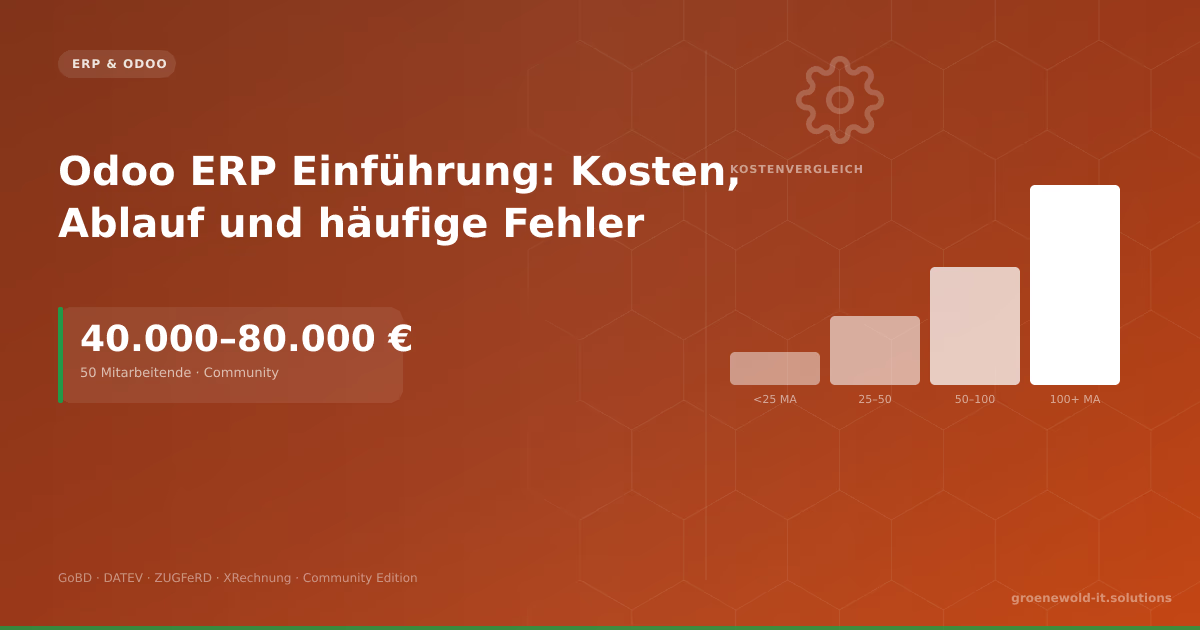
Odoo ERP Introduction: Cost, execution and frequent errors
An Odoo-ERP entry costs typically €40,000-80,000 for 50 employees. This article gives clear figures on Community vs. Enterprise, GoBD requirements, module issues and the five most common project errors.

Accessibility in the Web: Why Accessibility 2026 is mandatory
Accessibility is no longer a 'Nice-to-have'. With the European Accessibility Act (EAA), it becomes a legal obligation. We show how to make your website accessible to everyone.