
Odoo
Odoo vs. SAP: A closer look at total cost of ownership (TCO)
In today's business world, characterized by digital transformation, a powerful enterprise resource planning (ERP) system for optimizing business processes is the increase in...

Your shop needs to scale, but conversion stagnates and systems are too tightly coupled? We build the tech for it – e-commerce platforms that scale without breaking under every peak.
30 min. initial consultation – 100% free & non-binding
Typical Challenges
Despite traffic, too few visitors buy
During peaks, the shop slows down or crashes
Product data in PIM, ERP, shop not in sync
Abandonments in checkout, payment errors
Core Web Vitals in the red zone
Inventory data is wrong, return process manual
Concrete Solution Paths
| Your Problem | Our Approach | Your Result |
|---|---|---|
| Slow pages, poor Web Vitals | Performance audit + caching + CDN | Load time under 2 sec, better ranking |
| Checkout abandonments | Funnel analysis + UX optimization | Conversion rate increases measurably |
| Product data not in sync | PIM/ERP integration with data contracts | One truth for all channels |
| Shop buckles under peaks | Load balancing + autoscaling | Stable even during campaigns |
| New features take forever | Headless/composable architecture | Teams deliver independently |
Proven Architecture
Headless/Composable: CMS for content, commerce engine for transactions. Teams deliver independently.
Product data is harmonized. Data contracts prevent errors in prices and availability.
Caching, CDN, image strategy, and checkout latencies are defined as budgets and monitored.
Payment/PCI, role models, audit logs – so campaigns run securely.
Own shop or marketplace?
Calculate when your own online shop pays off compared to marketplace commissions.

“Retail and e-commerce platforms live on clean master data and stable interfaces to ERP and logistics – the slick storefront is only the tip of the iceberg.”
In 30 minutes we discuss your requirements around shop platform & PIM, ERP & logistics interfaces and performance under campaign load – and show you how we take your e-commerce to the next level.
Already thinking in numbers? Use our online shop cost calculator or the ROI calculator shop vs. marketplace. See delivered projects in our references.
The e-commerce market continues to grow, yet many shops don't reach their potential because the technical foundation can't keep up. Slow page load times, a confusing checkout process, faulty product data, or unstable interfaces to ERP and shipping providers lead to abandoned carts and dissatisfied customers. At the same time, expectations rise: customers expect personalized experiences, real-time availability, and seamless cross-channel experiences across desktop, mobile, and app.
Choosing the right e-commerce platform is one of the most consequential architecture decisions. Whether Shopware, Magento, WooCommerce, or a headless solution with a custom frontend – each platform has its strengths and limitations. We advise you technology-neutrally and recommend the setup that matches your business model, product complexity, and growth plans. We look beyond the shop itself at the entire commerce architecture: PIM for product data management, ERP integration for inventory and invoicing, CRM for customer retention, and marketing automation for personalized campaigns.
A central topic for growing online shops is performance under peak loads. Black Friday, seasonal business, or successful ad campaigns can multiply visitor traffic within minutes. If the shop slows down or crashes in exactly these moments, not only revenue is lost but also customer trust. We plan load capacity from the start: auto-scaling, content delivery networks, intelligent caching, and load tests before every campaign ensure your shop performs reliably even under pressure.
The integration between shop and inventory management is another critical success factor. When stock levels aren't synchronized in real-time, overselling occurs and customers are disappointed. When orders need to be manually transferred between systems, errors and delays arise. We implement robust integrations that automatically synchronize inventory, price, and customer data, and self-heal on disruptions instead of silently losing data.
Checkout optimization is also one of our core competencies in e-commerce. Every unnecessary click, every superfluous form field, and every delay loading payment options costs conversion. We analyze the entire purchase process, identify drop-off points, and systematically optimize the checkout: express checkout options, one-click orders for returning customers, local payment methods, and trust-building elements in the right places.
For companies in B2B e-commerce, additional requirements apply. Customer-specific prices, complex discount structures, order approval processes, quota management, and EDI system integration require a thoughtful architecture that goes beyond standard shop functionality. We have experience with B2B commerce projects across various industries and know which features are truly needed and where standard solutions suffice.
Our goal is to deliver an e-commerce platform that doesn't just work today but grows with your business. That means: a clean, modular architecture that's extensible, automated tests that prevent regressions, and documentation that enables your team to develop the shop independently. Because the best e-commerce solutions are those that can flexibly adapt to changing market requirements without needing to rebuild the foundation every time.
FAQ
That depends on your processes and growth plans.
We evaluate requirements (B2B/B2C, variants, integration depth) and recommend a setup that fits technically and economically.
Through load tests, caching, CDN, clear observability and runbooks.
Peak load is planned as its own use case – not as a surprise.
Often quickly: performance improvements, checkout optimization and clean product data have direct effects on the funnel.
We link measures to measurable KPIs.
The online shop cost calculator gives EUR 5,950 – 99,645 excl.
VAT as its non-binding overall range. Theme, ERP integration, marketing automation, B2B workflows, headless architecture and multi-store requirements determine the result.

Discuss e-commerce
We recommend an iterative approach with clear milestones (Thorsten Frieling, project management).
From product and inventory logic to checkout and fulfillment.
1. Assortment & price logic
Variants, tiers, B2B roles, and tax/multi-currency are modeled.
2. Shop & performance
Frontend, caching, Core Web Vitals, and search-friendly structures.
3. ERP, payment, shipping
Real-time or deferred syncs, payment providers, shippers, and return flows.
4. Go-live & growth
Monitoring, A/B-ready extensions, and roadmap for internationalization or new channels.
In retail the question is whether the shop reads stock, prices and shipping from one transaction. Approval for retail and e-commerce should therefore depend on a measurable baseline, an accountable business owner, and a clear target. The HowTo block on this page describes delivery; this section is only for the project decision.
Browse all solutions by use case, industry, and application type. For our service portfolio, see Services; for in-depth topic articles, see Topics.
Key terms are explained in our IT Glossary. For a non-binding discussion about retail and e-commerce or a proposal, please contact us.
Articles that complement this solution.
Odoo vs. SAP: A closer look at total cost of ownership (TCO)
In today's business world, characterized by digital transformation, a powerful enterprise resource planning (ERP) system for optimizing business processes is the increase in...
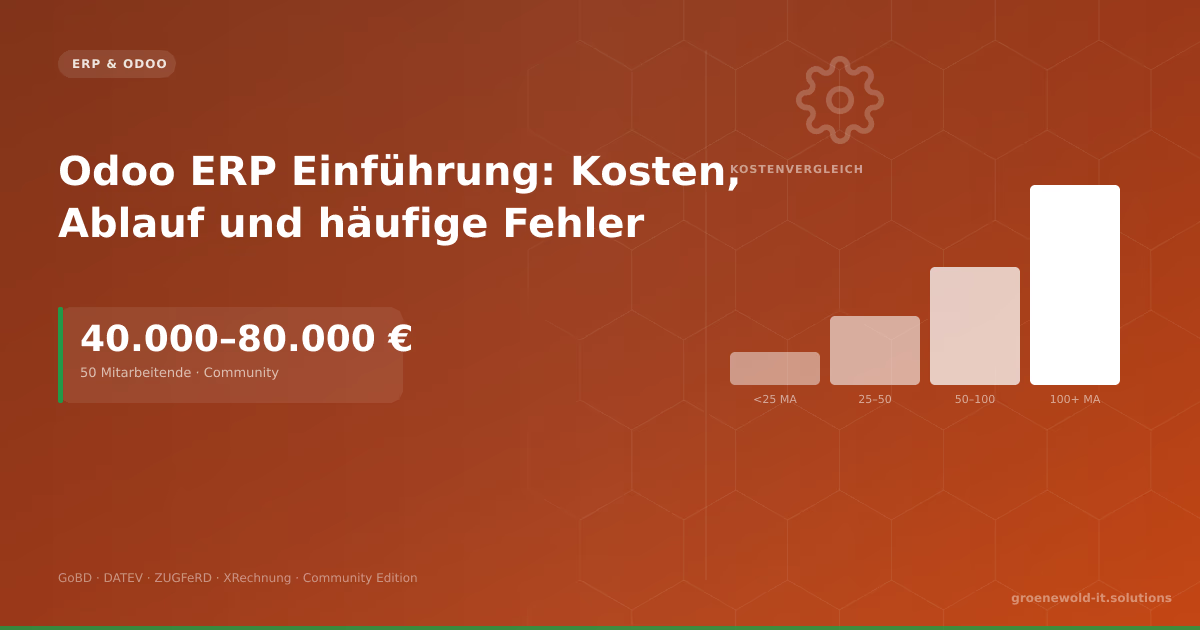
Odoo ERP Introduction: Cost, execution and frequent errors
An Odoo-ERP entry costs typically €40,000-80,000 for 50 employees. This article gives clear figures on Community vs. Enterprise, GoBD requirements, module issues and the five most common project errors.

Accessibility in the Web: Why Accessibility 2026 is mandatory
Accessibility is no longer a 'Nice-to-have'. With the European Accessibility Act (EAA), it becomes a legal obligation. We show how to make your website accessible to everyone.