
As of: 3 September 2026 · Reading time: 8 min
Key takeaways
- Web development cost realistically estimate: factors, price frames, risks and what companies should pay attention to in scope, operation and maintenance.
Web development cost realistically estimate: factors, price frames, risks and what companies should pay attention to in scope, operation and maintenance.
“Digitalization is not an IT project—it is a business strategy.”
– Björn Groenewold, Managing Director, Groenewold IT Solutions
If you only ask for an end price in a new digital project, you often get a number - but you don't have a valid basis for decision.
This is where budget gaps, time shifts and unnecessary supplements are created later. When it comes to web development, it counts not only what is programmed.
However, how clear needs, interfaces, responsibilities and operating models are defined.
This is not a detail for companies.
A website with contact form, an internal employee portal, a customer platform or a business-critical web app are economically completely different projects.
Anyone who places these projects in the same price category usually calculates by demand.
What does web development cost actually determine?
Web development cost realistically estimate: factors, price frames, risks and what companies should pay attention to in scope, operation and maintenance.
For Calculating Web Development Costs Realistically, Cost Calculator: Legacy Modernisation and Solution: Legacy Reduction are practical starting points. Budget and industry context: Monolith vs. Microservices.
The biggest misconception is: costs arise primarily through code. In practice, a major part of the budget is influenced by design, planning, architecture, quality assurance and introduction.
The actual cost drivers are often not the visible surfaces, but processes in the background.
A simple example: a sales portal with login looks over at the first glance.
However, as soon as role rights, CRM connection, document generation, release processes and auditability are added, the effort changes significantly. The result is not only "a web solution".
However, a central working system with high demands on stability, data protection and ease of upkeep.
In addition, the question is whether standard modules are sufficient or whether custom development is needed. A modular system is cheaper at short notice.
However, quickly reaches limits when processes are special, interfaces are complex or compliance needs are high. Custom development costs more at the beginning.
However, can be more economical in the long term if media breaks, manual work and subsequent relocations are eliminated.
Typical price frames for web development costs
Short: Flat-rate numbers without context rarely help.
Flat-rate numbers without context rarely help. Still, each management needs orientation values.
Realistically, web development costs in very different areas depending on the project type. .A simple company website with a clear structure, few custom modules and manageable content is often located in the lower four-digit to medium five-digit range.
As soon as custom functions, user areas or connections to third-party systems are required, the frame shifts significantly.
For professional web portals and web apps with role logic, data processing, interfaces and administrative functions, the effort often starts in the middle five-digit range.
Complex platforms with multiple user groups, custom workflows, ERP or CRM integration, reporting, client capability or increased security needs are quickly within the high five-digit to six-digit range.
This is not a sign of overprice, but an expression of the actual scope of performance.
For example, if you want to develop a system that permanently accelerates operating processes or replaces manual material processing, you do not invest in design.
However, in productivity, data quality and future security.
Why offers vary greatly for the same project
If three service providers call very different prices for a similar project, this is rarely the margin. Different assumptions were usually made.
One calculates only the development, the other already project management, testing, deployment and documentation.
Another deliberately plans with low quality assurance or with external resources that are no longer available later.
This is clearly critical for clients.
A cheaper entry price can prove to be the most expensive option if needs were incompletely included or later changes trigger new discussions each time.
Also problematic are unsharp performance descriptions. If the offer is only "custom web development", the basis for real comparability is missing.
This is why it is worth not only looking at the total amount. However, on the average of the offer. Are workshops included? Is there a technical concept?
How are interfaces evaluated? Is the acceptance regulated? What are the benefits of the Go-Live? And who bears ownership when problems occur during operation?
The scope is the largest lever
In many projects, not false daily rates are the problem, but an unclean defined scope.
If needs are released too early or too late, the effort and the need for planning are almost inevitably increasing.
This especially concerns projects where departments, IT and external systems come together. .A clean scope does not mean to prescribe any detail.
It means defining the target image clearly enough to be able to complicate effort, risks and priorities. What user groups are there? What processes are critical?
What functions are mandatory for starting, which can be moved to a second stage of expansion? Where are dependencies on old systems?
With limited budgets, this prioritization is crucial.
Not every idea must be included in Release 1. It is often more economical to start with a clearly defined core system and to implement extensions step by step.
This creates faster results and reduces project and investment risks.
Hidden costs often arise after the launch
Short: Many calculations only consider the development phase.
Many calculations only consider the development phase. For companies, however, the entire life cycle counts.
Hosting, monitoring, support, maintenance, security updates, further development and training are economically part of the project.
This is especially relevant for business-critical applications. If employees, customers or partners rely on a system every day, it is not enough that the software goes technically live.
It must be able to be operated, recorded and quickly adjusted as needed.
If you do not think of these services early, you will only shift costs to a later stage - usually under higher time pressure.
Interfaces also cause follow-up costs. If a ERP, CRM or payment provider changes its API, the web application must be adapted.
The same applies to legal needs, role models or new safety standards.
A good calculation so takes into account not only the initial development but also the long-term operational capability.
fixed price or agil - what is more economical?
Short: This question is often asked too easy.
This question is often asked too easy. A fixed price creates planability if goals, functions and framework conditions are sufficiently clear.
It is especially suitable for projects with definable scope, clear decreases and manageable dependencies.
Agile procedures are economical if needs are clear in terms of target and benefit. However, are still in need of development in detail.
This is the case with new digital products, process innovations or complex integration projects. Then it is not about turning away uncertainty.
However, controlling it structuredly. .The decisive factor is less the label than the project maturity. A badly prepared fixed price often leads to conflicts about change requests.
An unclearly controlled agile project can make budgets fray. A hybrid model is often useful.
First a clean review and concept phase with clear results, then a resilient rollout in defined expansion stages.
What companies should consider when choosing the provider
Web development costs are always also a question of the delivery model.
Anyone who works with offshoring, changing freelancers or unclear subcontractor structures can be cheaper on the paper.
However, new risks often arise for clients - in the case of communication, access, documentation, data protection and long-term maintenance.
For many organisations, especially with sensitive data or complex specialist processes, a reliable setup is more important than the lowest initial price.
Solid contact persons, German-speaking communications, GDPR-compliant rollout, transparent responsibilities and complete source code transfer create control.
These factors reduce the project risk and thus indirectly also the total costs.
Groenewold IT Solutions so focuses on custom development from a single source, with fixed developers in Germany and clear project structure.
For leaders, this is not a marketing detail, but an economic advantage. Less friction, more resilient planning and long-term manageable systems.
How to get a realistic cost estimate
A serious estimate does not begin with the question "What costs a web app?". However, with a structured project image.
These include target, user groups, core processes, system landscape, integrations, security needs and the desired operating framework.
Only when these points are tangible is a loadable calculation from a rough number.
An early grouping in must, target and can needs is helpful. Thus, economically sensible expansion stages can be defined.
The technical pre-examination is equally important: what existing systems remain? What data do you need to migrate? Are there any dependencies on third parties?
What performance and access goals apply?
Companies prefering this clarification rarely save only in the offer phase.
They shorten decisions, reduce yields and create a significantly better basis for appointments, budget and decrease. .Anyone who wants to realistically evaluate web development costs should not look for the cheapest entry.
However, for the model with the best ratio of planability, quality and long-term benefits. Good software is not a theoretical investment.
It shows its value where processes run faster, data flow more cleanly and teams can finally focus on work instead of reroutes.
Technical sources and further links
The following separate references complement the grouping on the topics of this Article:
- Bitkom – Digital Economy Association.
- BSI – Federal Office for Information Security.
- European Commission – Digital Strategy.
- MDN Web Docs (Mozilla)
- W3C – World Wide Web Consortium.
"APIs are the backbone of modern software: If you stabilize interfaces late, you will pay with double integration work."
— *Björn Groenewold, Managing Director, Groenewold IT Solutions *
About the author

Managing Director of Groenewold IT Solutions GmbH and Hyperspace GmbH
Since 2009 Björn Groenewold has been developing software solutions for the mid-market. He is Managing Director of Groenewold IT Solutions GmbH (founded 2010) and Hyperspace GmbH. As founder of Groenewold IT Solutions he has successfully supported more than 250 projects – from legacy modernisation to AI integration.
Blog recommendations
Related articles
These posts might also interest you.
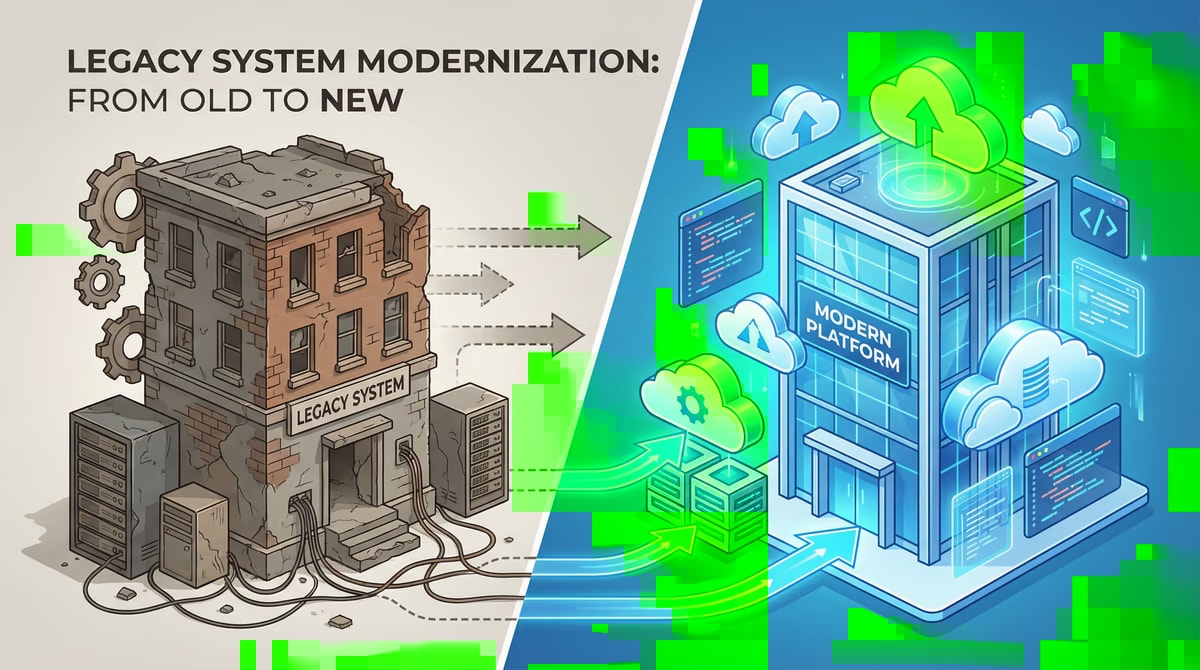
Technical debt in legacy systems: A ticking time bomb?
In the fast-paced world of software development, time and budget are often the driving forces. In order to adhere to deadlines and keep projects within the framework, compromises are often made at...
Replace legacy software: strategies and common pitfalls
In today's fast-paced digital world, outdated software systems, often referred to as legacy software, are one of the biggest challenges for companies. You can find innovations frombrem...
Legacy Migration: Strategies for a smooth transition
In today's rapidly changing digital landscape, outdated IT systems, often referred to as legacy systems, represent a considerable challenge for many companies. Although she...
Free download
Checklist: 10 questions before software development
Key points before you start: budget, timeline, and requirements.
Get the checklist in a consultationRelevant next steps
Related services & solutions
Based on this article's topic, these pages are often the most useful next steps.
Related services
Related solutions
Related comparison
Cost calculators
Practical next steps after Calculating Web Development Costs Realistically
Calculating Web Development Costs Realistically addresses a practical choice for product and IT teams. Start with one clear goal: align software scope, technical risk, and business value before the next investment.
Check the current process, the data involved, and the result users need. Then record the main risks and define a small first step. This keeps the decision easy to review and gives your team a shared basis.
For implementation support, our custom software development connects the article's guidance with architecture, delivery, and stable operations. Engineering and project ownership stay with our team in Leer, Germany.
This post belongs to Legacymodernization. Browse the related Legacymodernization articles or use the English software blog for other topics.
When budget is the next question, the software cost calculators provide planning ranges. The IT glossary explains key terms, while in-depth technology guides cover wider decisions.
If the topic affects a live project, book a technical consultation or send the context through our project contact form. We usually reply within one working day.