
As of: 3 September 2026 · Reading time: 8 min
Key takeaways
- What mobile app can develop depends on scope, platform, UX and interfaces.
- So companies plan budget and risks clean.
What mobile app can develop depends on scope, platform, UX and interfaces. So companies plan budget and risks clean.
“Digitalization is not an IT project—it is a business strategy.”
– Björn Groenewold, Managing Director, Groenewold IT Solutions
Anyone who wants to budget an app knows the problem. The first question is almost always after the price, although the actual cost driver question is still open.
That’s why “mobile app development costs” cannot be answered seriously with a lump sum. For companies, not the cheapest estimate.
However, a resilient costing that cleanly reflects scope, risks, operation and long-term viability.
In business apps, the price is rarely just a question of screens and functions.
It is often about processes, roles, releases, interfaces, data protection, offline capability or client logic.
An app for internal service teams has different needs than a customer portal, a booking app or a digital companion for sales and field service.
Those who clarify these differences early will save money, time and voting.
What mobile app develop costs really depend on
Short response: What mobile app can develop depends on scope, platform, UX and interfaces.
For Planning Mobile App Development Costs Realistically, Cost Calculator: Legacy Modernisation and Solution: Legacy Reduction are practical starting points. Budget and industry context: Monolith vs. Microservices.
The largest lever is the range of functions.
A slim app with login, user profile, simple forms and push messages is in a different order of magnitude than a solution with custom business logic, card functions, media uploads, role rights, reporting and multiple third-party systems.
The more processes are digitally mapped, the more conception, development, test and project control are increasing.
The second factor is the system landscape. Many companies do not need an isolated app.
However, an application that speaks with ERP, CRM, PIM, document management or specialist procedures. These interfaces often decide on effort and project risk. An app is built quickly.
An app that is reliably integrated into existing processes, cleanly handles data and remains expandable later requires significantly more architectural work.
The target platform also influences the budget. Should the app be available only for iOS or Android, or for both platforms?
Are there any cross-platform development, or are native components needed, for example for special hardware use, high performance or complex offline scenarios?
The right decision is not a dogma. However, a balance between time-to-market, budget and technical claim. .UX and design are also often underestimated.
A functional interface sometimes suffices for internal apps. For customer-oriented applications, the user management is directly business-critical.
If the app is to create acceptance, accelerate processes or lower service costs, good UX design is not an addition. However, part of the business case.
Typical price frames for business apps
If you are looking for directional values, you need honest tensions instead of lock prices.
A simple mobile business app with clearly limited scope, few roles and manageable backend connection often starts in the range from about $25,000 to 45,000.
This applies especially when needs are well prepared and no complex special logic is added.
In the range from 45,000 to 90,000 US dollars, many custom mid-sized projects are moving.
Here we often talk about multiple core functions, clean rights management, interfaces, notifications, reporting, a professional UX concept and a loadable test process.
For many companies, this is the realistic corridor if the app should be more than one MVP.
Complex platforms, external service solutions, B2B portals with app components or apps with broad integration, offline synchronization, custom security logic and demanding operating needs are quickly from $90,000 to $180,000 or more.
From this point on, it is no longer a purely app. However, a digital product with its own architecture, operating concept and clear roadmap.
These figures are deliberately broad. They do not replace a loadable cost estimate. But they help to avoid unrealistic goals.
If offers are far below this framework, there is often something essential - for example clean design, documentation, testing, GDPR-compliant rollout or later operation.
Why cheap offers often become more expensive
A low entry price is attractive, especially when internal pressure is on budget and timing.
In practice, extra costs usually arise where too little has been structured at the beginning.
Unclear needs, lack of technical pre-examination, unconsidered interfaces or excessive MVP confession almost inevitably lead to yields.
There is a second point: ease of upkeep. If an app is quickly compiled. However, architecture, code quality and test coverage are neglected, later costs increase disproportionately.
Then every extension becomes expensive, releases become risky and the operation depends on custom persons. For companies, this is not an IT detail.
However, an economic risk. .Planability is more important than an artificially small entry price.
A transparent fixed price offer with clearly defined scope is often the better basis than a vague cheap estimate that ends later in change requests.
This creates internal security against management, department and IT.
Mobile app develop costs after project phase
Those who want to calculate clean should think the project in phases. The first phase is the conception.
Here, goals, user groups, processes, interfaces, security needs and success criteria are clarified. This phase is often underestimated, although it reduces a large proportion of later cost risks.
It follows the rollout with architecture, UI development, backend connection, testing and project management. The clearer the preparatory work, the more precise this phase can be calculated.
Companies benefit here from a partner that not only develops. However, translates needs in a structured manner and ensures technical decisions in a comprehensible manner.
The third phase is the operation. These include hosting, monitoring, updates, app store management, security patches, support and further development.
Those who only consider the initial development underestimate the total costs. An app is not a one-time project. However, a system that needs to be operated and maintained.
These cost drivers are often overlooked
Short: A common point is the right and role logic.
A common point is the right and role logic. As soon as different user groups see different content, releases or functions, the effort increases significantly.
This also applies to audit trails, logging and traceability. This are often vital in regulated environments or in the public sector.
Data quality and old systems are also relevant. If master data are inconsistent or existing interfaces have been recorded incompletely, effort is shifted in review and stabilization.
Not the app interface, but the reality of the existing landscape is the actual cost driver.
App releases, security and data protection are also part of the initial calculation. GDPR-compliant processes, clean consents, deletion concepts, secure authentication and encrypted communication are not optional extras.
Those who only address them shortly before Go-Live produce delays and extra costs.
How companies plan a realistic budget
The best start is not the question “What does an app cost?” but “What problem should the app solve measurably?”.
If the target is clear, must-haves can be separated from Nice-to-haves. This is clearly the result of a scope that can be budgeted with ease.
It is useful to first establish a technical and economically viable core.
Not every idea must be included in Release 1. It is often wiser to first implement the process with the highest lever and to expand further functions using real use.
This reduces project risk without artificially reducing the solution.
Equally important is an early technical audit. What systems must be connected? Are there any APIs? How to run authentication?
What data can be processed on a mobile basis? If these questions are answered before the offer is made, the cost security increases significantly.
For companies that value quality, data protection and long-term control, it is also worth taking a closer look at the delivery model.
Solid contact persons, development in Germany, clear responsibilities and full source code transfer are not marketing details. However, factors for taxability and future security.
Groenewold IT Solutions starts right here: transparent project paths instead of blackbox development.
When an individual app calculates economically
Short: Not every requirement needs custom development.
Not every requirement needs custom development. If standard software covers the core process cleanly, an introduction can be more economical.
An custom app is worthwhile where processes, data flows or user experiences are business-critical and imposes too many compromises on standard solutions.
Typical cases are mobile sales processes, service and maintenance operations, releases on the go, customer portals with specific logic or digital offers with direct differentiation in the market.
Then the app is not an IT cost block. However, a tool for speed, service quality and lower process costs.
Important is the perspective beyond the first release. A good app saves time, reduces errors, avoids media breaks and improves data quality.
If these effects are measurable, the investment volume can be represented significantly better in-house.
Anyone who wants to plan realistically the costs of a mobile app does not need a number of fantasies.
However, a clear scope, clean technical preparatory work and a partner who takes ownership. It is clearly then that a cost-discussion will make a resilient investment decision.
Technical sources and further links
The following separate references complement the grouping on the topics of this Article:
- Bitkom – Digital Economy Association- BSI – Federal Office for Information Security.
- European Commission – Digital Strategy.
- MDN Web Docs (Mozilla)
- W3C – World Wide Web Consortium.
"The migration of legacy systems fails in many projects not on the technology alone.
However, on the lack of documentation of implicit expertise – that is why Knowledge Transfer is firmly on the budget."
— *Björn Groenewold, Managing Director, Groenewold IT Solutions *
About the author

Managing Director of Groenewold IT Solutions GmbH and Hyperspace GmbH
Since 2009 Björn Groenewold has been developing software solutions for the mid-market. He is Managing Director of Groenewold IT Solutions GmbH (founded 2010) and Hyperspace GmbH. As founder of Groenewold IT Solutions he has successfully supported more than 250 projects – from legacy modernisation to AI integration.
Blog recommendations
Related articles
These posts might also interest you.
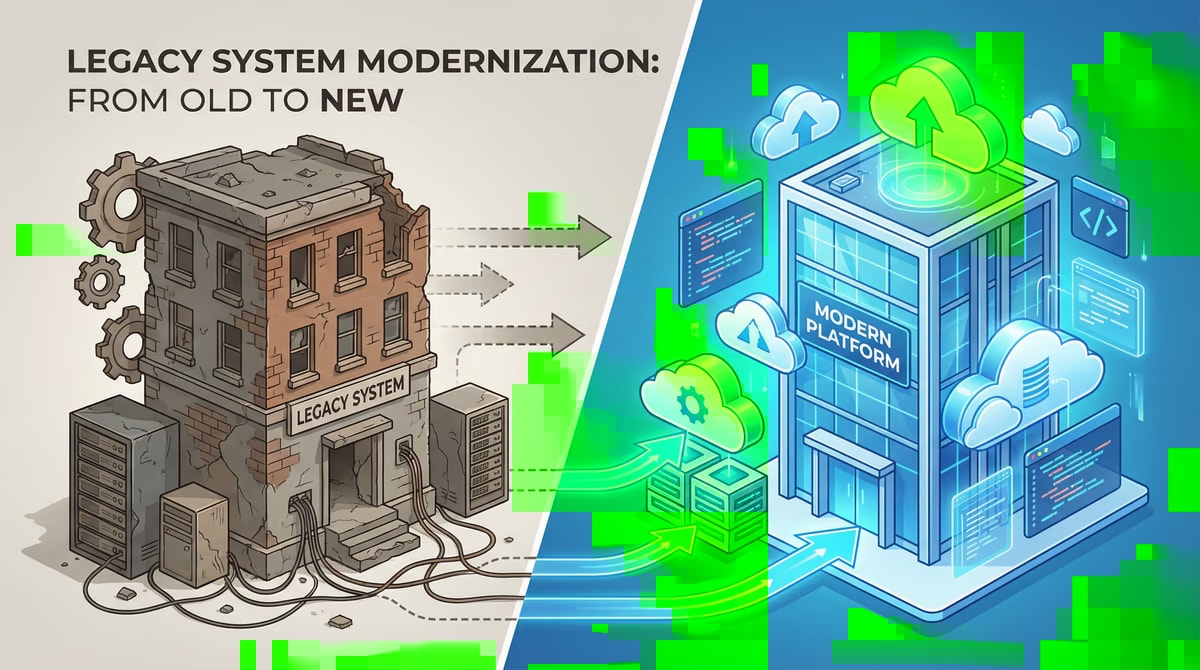
Technical debt in legacy systems: A ticking time bomb?
In the fast-paced world of software development, time and budget are often the driving forces. In order to adhere to deadlines and keep projects within the framework, compromises are often made at...
Replace legacy software: strategies and common pitfalls
In today's fast-paced digital world, outdated software systems, often referred to as legacy software, are one of the biggest challenges for companies. You can find innovations frombrem...
Legacy Migration: Strategies for a smooth transition
In today's rapidly changing digital landscape, outdated IT systems, often referred to as legacy systems, represent a considerable challenge for many companies. Although she...
Free download
Checklist: 10 questions before software development
Key points before you start: budget, timeline, and requirements.
Get the checklist in a consultationRelevant next steps
Related services & solutions
Based on this article's topic, these pages are often the most useful next steps.
Related services
Related solutions
Related comparison
Practical next steps after Planning Mobile App Development Costs Realistically
Planning Mobile App Development Costs Realistically addresses a practical choice for product and IT teams. Start with one clear goal: choose an app approach that stays secure, testable, and useful after launch.
Check the current process, the data involved, and the result users need. Then record the main risks and define a small first step. This keeps the decision easy to review and gives your team a shared basis.
For implementation support, our business app development connects the article's guidance with architecture, delivery, and stable operations. Engineering and project ownership stay with our team in Leer, Germany.
This post belongs to Legacymodernization. Browse the related Legacymodernization articles or use the English software blog for other topics.
When budget is the next question, the software cost calculators provide planning ranges. The IT glossary explains key terms, while in-depth technology guides cover wider decisions.
If the topic affects a live project, book a technical consultation or send the context through our project contact form. We usually reply within one working day.