
As of: 4 September 2026 · Reading time: 4 min
Key takeaways
- Learn how to gradually transfer your monolithic legacy application to a modern microservice architecture.
- A practical guide with the Strangler-FIG-Pattern.
Learn how to gradually transfer your monolithic legacy application to a modern microservice architecture. A practical guide with the Strangler-FIG-Pattern.
“Digitalization is not an IT project—it is a business strategy.”
– Björn Groenewold, Managing Director, Groenewold IT Solutions
Opened at: 21. January 2026
1. Introduction: The evolutionary step for your IT architecture
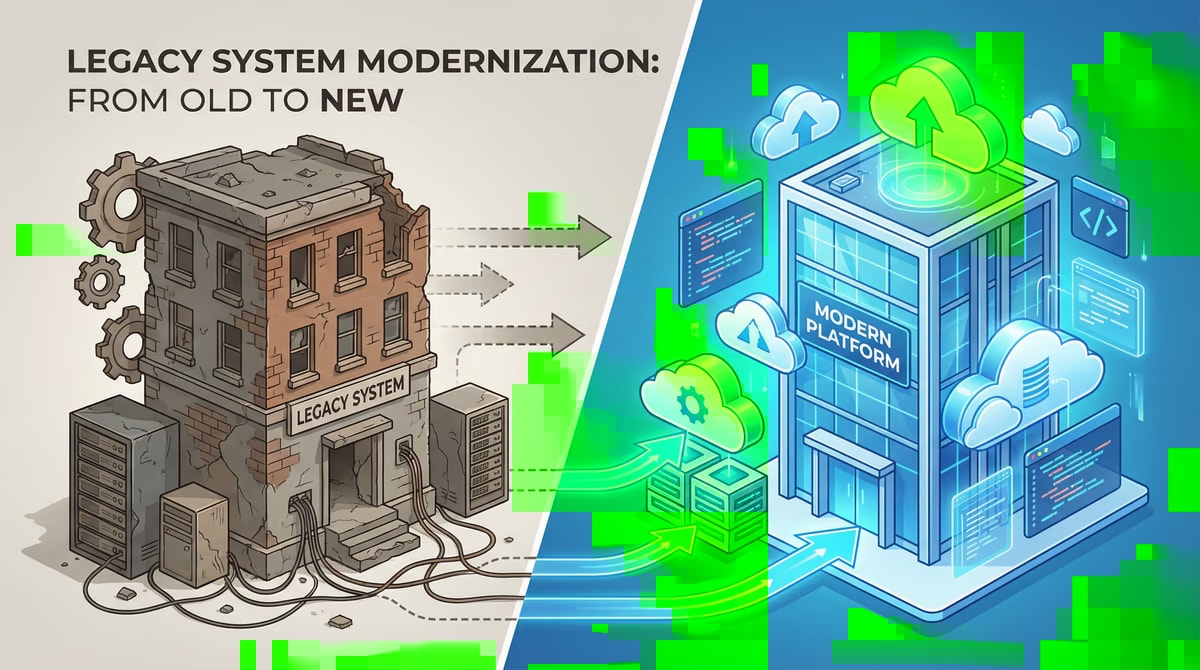
Learn how to gradually transfer your monolithic legacy application to a modern microservice architecture.
Leaders exploring From Monolith to Microservices: One can use Legacy Modernisation, Cost Calculator: Legacy Modernisation, Solution: Legacy Reduction sowie Monolith vs. Microservices as structured entry points.
Many years of growing [legacy](/services/legacy modernization) systems are designed as monolith: a single, huge application in which all functionalities are inseparably interwoven.
While this approach worked in the past, it becomes more often a brake pad in today's fast-paced digital world.
Changes are risky, scaling is difficult and the introduction of new technologies becomes torment.
The transition to a microservice architecture is the logical next step for many companies.
The monolithic application is disassembled into small, separate services which are each responsible for a specific business function.
This guide gradually leads you through the process of [migration](/services/legacy modernization) from a monolith to a flexible and future-proof Microservices landscape.
2. Monolith vs. Microservices: An architecture comparison
Characteristics Monolithic architecture Microservices architecture
Structure * * A single large code base and a single executable file. Many small, separate services with own code bases.
**development * * The entire team is working on a single code base. Small, autonomous teams are responsible for one or more services.
**Deployment * * The entire application must be re-provided for each change. Each service can be provided independently of the others.
**Scaling * * Only the entire application can be scaled even if only a small part has more load. Each service can be individually scaled, saving resources.
** Technology* * The entire application is set to a single technology stack. Each service can be built in the most suitable technology for it.
3. Advantages of Microservice Architecture
Agility and speed: Smaller, separate teams can develop and deploy faster.
Scalability: Critical services can be scaled in a targeted manner without compromising the entire application.
Technical freedom: For each service the best technology can be chosen.
Resilience: The failure of a single service does not lead to failure of the entire application.
Simplified maintenance: Smaller code bases are easier to understand and wait.
The step-by-step migration: The Strangler-FIG-Pattern
A "Big Bang" migration, where the monolith is replaced by microservices on one stroke, is extremely risky and often fails.
A proven approach is the Strangler-Fig-Pattern, named after the wortfeige, which slowly wraps around a tree and finally replaces it.
In this pattern, the monolith is progressively "strangulated" by new microservices
References and further reading
The following separate references complement the topics in this article:
- Bitkom – German digital industry association.
- German Federal Office for Information Security (BSI).
- European Commission – Digital strategy.
- MDN Web Docs (Mozilla)
- W3C – World Wide Web Consortium.
"Cloud-native only pays off when operations, security, and cost model match the architecture—otherwise you ship complexity faster."
— Björn Groenewold, Managing Director, Groenewold IT Solutions
Frequently Asked Questions (FAQ)
What is this article about: “From Monolith to Microservices: One”?
This post explores From Monolith to Microservices. One from the perspective of needs, typical pitfalls, and sensible next steps.
In short: Learn how to gradually transfer your monolithic legacy application to a modern microservice architecture. A practical guide with the Strangler-FIG-Pattern.
Who benefits most from the content described here?
Useful for project leads and product owners in Legacymodernization who must choose between standard software, custom development, and integration.
How does this topic fit into an IT or digital strategy?
Technically and organizationally, alignment with experienced partners pays off — from requirements to operations; start with the [services overview](/en/services/software-development). For multi-system landscapes, [IT consulting and architecture](/en/services/it-consulting) helps align vendors and internal teams.
What are sensible next steps if we need support?
A practical next step: book a consultation and clarify which MVP or pilot fits your team and landscape.
About the author

Managing Director of Groenewold IT Solutions GmbH and Hyperspace GmbH
Since 2009 Björn Groenewold has been developing software solutions for the mid-market. He is Managing Director of Groenewold IT Solutions GmbH (founded 2010) and Hyperspace GmbH. As founder of Groenewold IT Solutions he has successfully supported more than 250 projects – from legacy modernisation to AI integration.
Blog recommendations
Related articles
These posts might also interest you.
Technical debt in legacy systems: A ticking time bomb?
In the fast-paced world of software development, time and budget are often the driving forces. In order to adhere to deadlines and keep projects within the framework, compromises are often made at...
Replace legacy software: strategies and common pitfalls
In today's fast-paced digital world, outdated software systems, often referred to as legacy software, are one of the biggest challenges for companies. You can find innovations frombrem...
Legacy Migration: Strategies for a smooth transition
In today's rapidly changing digital landscape, outdated IT systems, often referred to as legacy systems, represent a considerable challenge for many companies. Although she...
Free download
Checklist: 10 questions before software development
Key points before you start: budget, timeline, and requirements.
Get the checklist in a consultationRelevant next steps
Related services & solutions
Based on this article's topic, these pages are often the most useful next steps.
Related services
Related solutions
Related comparison
Cost calculators
Practical next steps after From Monolith to Microservices: One
From Monolith to Microservices: One addresses a practical choice for craft and service firms. Start with one clear goal: reduce legacy risk in controlled steps while daily work and key data remain available.
Check the current process, the data involved, and the result users need. Then record the main risks and define a small first step. This keeps the decision easy to review and gives your team a shared basis.
For implementation support, our legacy software modernization connects the article's guidance with architecture, delivery, and stable operations. Engineering and project ownership stay with our team in Leer, Germany.
This post belongs to Legacymodernization. Browse the related Legacymodernization articles or use the English software blog for other topics.
When budget is the next question, the software cost calculators provide planning ranges. The IT glossary explains key terms, while in-depth technology guides cover wider decisions.
If the topic affects a live project, book a technical consultation or send the context through our project contact form. We usually reply within one working day.