As of: 23 June 2026 · Reading time: 17 min
Key takeaways
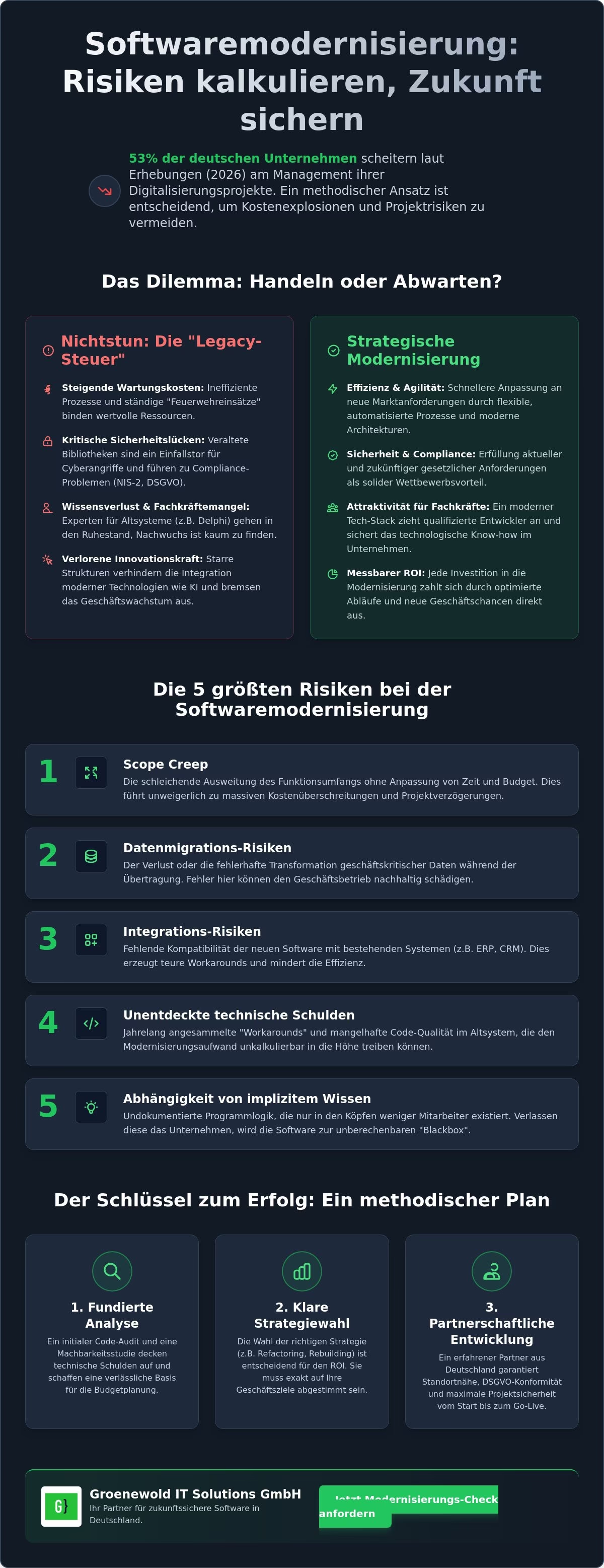
- Did you know that according to current surveys from 2026, 53 percent of German companies already indicate that they fail to manage their digitalization projects?
- This figure shows that the risks of software modernization are often severely underestimated while the pressure is..
Did you know that according to current surveys from 2026, 53 percent of German companies already indicate that they fail to manage their digitalization projects? This figure shows that the risks of software modernization are often severely underestimated while the pressure is..
“Digitalization is not an IT project—it is a business strategy.”
– Björn Groenewold, Managing Director, Groenewold IT Solutions
Did you know that according to current surveys from 2026, 53 percent of German companies already indicate that they fail to manage their digitalization projects?
This figure shows that the risks of software modernisation are often underestimated massively.
At the same time, pressure is steadily increasing through new regulations such as the NIS-2 directive or the EU AI Act.
It is understandable that leaders in mid-sized firms hesitate when unpredictable cost increases and the dependence on outdated knowledge, for example in the case of grown Delphi structures, act like an uncalculable venture.
We share your conviction that modernisation must not be a leap into uncertainty. However, must be on a solid commercial and technical basis.
In this article you will learn how to accurately calculate the hidden costs and risks of software modernization and how to achieve your project methodically.
We will show you how to create a valid modernization plan, minimise technical hazards through targeted code audits and set up your software without technical legacy loads to ensure a measurable value contribution.
Key findings
Did you know that according to current surveys from 2026, 53 percent of German companies already indicate that they fail to manage their digitalization projects?
For Software Modernisation: Costs, Risks and ROI Strategies for SMEs (2026), Legacy Modernisation and Legacy Code Analysis in 5 Days are practical starting points on our site.
Who plans Software Modernization: Costs, Risks and ROI Strategies for the... from idea to rollout, will find Legacy-Modernization, Cost calculator: Legacy-Modernization, Solution: Abbau vs. Microservices](/compare/monolith-vs-microservices) suitable entry on our website.
- Understand why maintaining outdated legacy systems through maintenance storage and security vulnerabilities is significantly more expensive than strategic modernisation.
- Find the critical risks of software modernization such as Scope Creep and data loss to proactively avoid financial misplanning.
- Get a thorough comparison of strategies such as refactoring or rebuilding to choose the technical path with the best ROI for your company.
- Learn how to ensure reliable budget planning and eliminate technical uncertainties through initial code audits and feasibility studies.- Discover the benefits of a partnership development in Germany, which guarantees maximum project security through proximity to the site and GDPR compliance.
table of contents
- Why software modernization costs causing – and why doing nothing is more expensive.
- Yes. The 5 biggest risks in software modernisation and its financial effects.
- Cost-Check: Modernization strategies in direct comparison.
- Risk management: How to safely calculate the budget for legacy projects.
- Software moderation without offshoring: Maximum security with Groenewold IT Solutions.
Why software modernization causes costs and why doing nothing is more expensive
Short: Software modernization is not a technical purpose.
Software modernization is not a technical purpose. It is a strategic decision to secure your company's long-term future.
Many middle-level leaders shy the initial expenses, but the risk of downtime often weighs harder. Those who rely on outdated systems pay a daily "legacy tax".
This is expressed in slow processes, high maintenance costs and a declining agility. Software Modernization aims to solve these fetters and make the way for real innovations free.
The hidden costs of legacy systems are manifold. It is not just about direct expenditure on the holding. The shortage of skilled workers plays a central role.
Experts who master old Delphi systems or complex database structures from the early 2000s are more often retiring.
Qualified young people prefer modern tech stacks. Risks in software modernization increase exponentially, the longer you delay the transition, as internal knowledge disappears over the grown program logic.
At some point of no return, the system becomes a danger to business operations.
In addition, outdated software causes considerable opportunity costs. While competitors increase their efficiency through AI integration or automated workflows, users of old systems struggle with rigid structures.
Any adaptation to new market needs takes months instead of days. This lost time can hardly be recovered later.
Technical debt as price driver
Technical debts describe the extra effort that arises when one has advanced rapid corrections of a clean architecture over years.
In many midsize companies, these debts have accumulated so much that they halve the development speed. Every new function requires laborious relocations to unstable code areas.
Another risk is the lack of documentation. If knowledge providers leave the company without leaving their know-how structured, the software becomes an unpredictable blackbox.
The Risks in software modernization can only be mastered by a thorough inventory in advance.
Security risks and compliance costs
Security is a critical management task in 2026.
With the entry into force of the NIS 2 rollout in December 2025 and the strict rules of the EU AI Act as from August 2026, companies are legally under force.
Outdated libraries in legacy systems are often an open gateway for cyber attacks. A single security incident causes not only high costs due to operating shutdown.
However, also involves sensitive fines if the data is not kept in compliance with the GDPR. Modern software compliance is so not an annoying evil.
However, a hand-held competitive advantage that underlines the reliability of your company towards customers and partners.
The 5 biggest risks in software modernization and its financial consequences
While the cost of doing nothing is rising, the dangers of an active change often suddenly arise.
A faulty planning leads to projects not only running out of the row over time. However, also to massively exceed the planned budget.
According to current data from 2026, 53 percent of German companies report difficulties in managing their digitalization projects.
This quota shows that the risks in software modernization are not theoretical constructs. However, are real threats to economic efficiency.
Five central risk fields determine the success or failure:
- Scope Creep: The sluggish expansion of the range of functions without adjustment of time and budget.
- Data migration risks: The loss or incorrect transformation of business-critical information.
- Integration risks: Unforeseen incompatibility with existing third-party systems or partner interfaces.
- Accession risks: A lack of integration of end-users leads to the rejection of the new solution in everyday work.- Technology risks: Choosing a stack that works modern, but in a few years offers no more ease of upkeep or specialist base.
In order to systematically exclude these financial uncertainties from the start, a well-founded review of the existing systems is crucial, as it ensures Groenewold IT Solutions as part of a professional legacy modernization.
Data migration: The heart of risk
The transformation of growing data structures is often more complex than the programming of the new surface.
Old systems, in specific those based on older relational databases, frequently contain inconsistencies or "hidden". Logics in the data records.
If these are migrated without prior cleaning, threaten system crashes or faulty business processes in the new environment.
A thorough data purification before the actual transfer saves major costs here, as elaborate corrections after the go-live are avoided. Ensuring data integrity must so have top priority.
Scope Creep and Requirement Management
Unclear specifications are the main reason for exploding project costs. When needs are constantly redefined during development, this often doubles the effort.
We use agile milestones to maintain cost control and focus on core functions.
One essential factor is the avoidance of "gold plating", i.e. the addition of functions that are technically attractive. However, do not bring direct business benefits.
A disciplined requirement management is the most effective remedy for financial Risks in software modernization.
Cost-Check: Modernization strategies in direct comparison
The decision for a modernization method decisively determines whether your budget will be enough or blown at the end. There is not one right way for every company.
Rather, the state of your source code and your long-term business goals decide on the chosen approach.
We mainly distinguish between four strategies that each have a different investment profile and risk level.
Rehost (Lift & Shift): The software is moved into a modern cloud environment without any changes. This is cost-effective and fast, but does not solve any technical debt.
- Refactor: The code is improved without changing external features. This improves the ease of upkeep at moderate costs.
- Rearchitect: Architecture is fundamentally changed, for example by moving to microservices. This requires higher investment, but offers maximum scalability.- Rebuild: The application is redeveloped from scratch. This is often the most expensive option, but eliminates all old loads completely.
In rebuild, Risks are the highest in software modernization because the system is completely redesigned and all needs must be clearly defined.
Refactoring, on the other hand, often offers a faster ROI, as existing logics are used further.
The choice often depends on whether the current software architecture is even expandable or whether it already meets its physical limits.
Refactoring vs. Rebuilding
A software refactoring service is useful when the core of the application is stable. However, the development speed is reduced by unclean code.
Here, step-by-step optimizations can reduce maintenance costs without jeopardizing operation. However, a complete new building is vital when the technical base is outdated.
This often affects systems written in languages like Delphi, for which it becomes more often difficult to find qualified experts.
In the long term, the maintenance costs of a modern web application are significantly lower than the maintenance of a technologically isolated legacy software.
Special case: Delphi Software modernize
Delphi's migration to modern web technologies poses special challenges for midsize companies.
The Risks in software modernization are mainly due to the loss of domain-specific knowledge buried deep in the old code.
Since the average hourly rate for software developers is around 103 euros in 2026, the search for expert Delphi developers is becoming more expensive.
We often recommend a step-by-step detachment of custom modules. The system remains operational across the entire modernization phase.
At the same time, business-critical functions are gradually transferred to a future-proof architecture.
Risk Management: How to safely calculate the budget for legacy projects
A valid modernisation plan does not begin with the first line code. However, with a thorough inventory.
If you start without a precise review, your project quickly turns into a financial barrel without soil.
To control the Risks in software modernization from the outset, we rely on a two-stage procedure. The professional code audit and the feasibility study based on it.
This methodological approach ensures that all assumptions are based on facts and not on vague estimates. .Intermediate experience shows that a budget buffer of at least 20 percent should be considered as standard.
Old systems often have unpredictable dependencies that only occur during rollout. When choosing the contract model, companies usually face the decision between fixed price and time &. Material.
While a fixed price suggests alleged safety, it requires an extremely detailed specification. In agile modernization projects, the Time &.
Material model often offers more room to adapt, provided it is combined with transparent milestones and a tight controlling.
The code audit as insurance for your budget
A code audit is the needed inventory of your digital values.
We investigate the existing architecture for its future capability, check compliance with current security standards and evaluate the ease of upkeep of the source code.
There are often hidden technical debts, which would have remained hidden in superficial review. For management, this audit provides an objective basis of decision.
Is a step-by-step optimization possible or is the risk of a system failure already so high that only a new building guarantees operational safety?
Software review: If the project is already stuck
It happens that modernization projects are being stepped up despite the best intentions.
Warning signals are constantly shifted deadlines, a high error rate after each update or a complete standstill in development.
In such cases, rapid action is needed to avoid the total loss of the previous investment.
Our experts for software maintenance analyze the current status quo, stabilize critical functions and convert the project into a controlled further development.
Often, a professional refurbishment is more economical than a complete demolition, provided the core logic of the software is still valuable.
The cost of saving depends heavily on the degree of technical confusion. Still, the sooner the tear line is pulled, the more the original budget can be saved.
We support you in breaking up tight structures and bringing your project back on track.
Software Modernization without Offshoring: Maximum Security with Groenewold IT Solutions
Choosing the right partner decides whether the calculated Risks in software modernization remain in practice or lead to insoluble problems.
In German mid-sized firms, reliability is the most important currency.
Many companies have skilled painfully that supposed cost savings due to offshoring are often absorbed by massive friction losses in communication and poor code quality.
We so deliberately put on another way: quality and value added directly from the region.
A modern software architecture today forms the foundation for the use of artificial intelligence.
While, according to current surveys from 2026, 43 percent of mid-sized firms do not pursue a specific AI strategy, we are already integrating these technologies into modernised systems.
We not only make your software viable, but make it smart.
Whether automated workflows or machine learning for process optimization, we ensure that your legacymodernisation becomes a stepping stone for future competitive benefits.
Development exclusively in Germany
When we talk about location proximity, we mean not only the spatial distance. It is about the common understanding of business processes and legal frameworks.
Since the entry into force of the NIS 2 rollout in December 2025 and the new needs of the EU AI Act in August 2026, compliance with the highest safety standards is no longer an option but a legal obligation for management.
Through our work exclusively with fixed teams in Germany, we guarantee GDPR-compliant development and data security at the highest level.
Your data does not leave the secured legal area of the Federal Republic at any time. This reduces the legal risks in software modernization to a minimum.
Avoid the typical planning problems of global service chains.
The same language, the same time zone and an identical working culture in project management ensure that needs are clearly understood and introduced without errors.
This efficiency is reflected directly in the project duration and thus in your budget.
Your partner for digital mid-sized businesses
Groenewold IT Solutions is a reliable partner that takes personal ownership for the success of your project. We specialize in modernising complex legacy systems.
This includes grown Delphi structures, where many anonymous agencies are frightened.
We develop tailor-made solutions that not only work today but create a lasting value for your company due to its ease of upkeep and longevity.
Before making far-reaching investment decisions, you need clarity on the actual state of your systems. Review your software objectively – Request Code-Audit now.
Together, we find the needed steps to secure your IT landscape without unnecessary waste.
Apply your software modernization strategically and securely
Successful software modernization is not a random product, but the result of a methodical planning. As we have seen, the typical **risks in software modernization** can be mastered by early code audits and a clear strategy choice. Whether you gradually optimize or rebuild a system completely; The focus is on long-term viability and compliance with current compliance standards such as NIS-2. Anyone who invests in clean structures today secures the necessary flexibility for future innovations such as AI integrations.
Trust in Hanseatic reliability and craft precision. With over 15 years of experience in the development of custom software and a expert expertise for legacy modernization.
This also covers software maintenance, we are at your side. Our development is 100% in Germany; that guarantees you short communication channels and highest data security.
We ensure that your growing IT structures are no longer a brake. However, a real competitive advantage for your company.
Are you ready for the next step? Consult non-binding IT strategy advice for your modernization.
Together, we will certainly lead your project to success and make your software future-proof.
Frequently Asked Questions About Software Modernization
What are the most common risks in software modernization?
?The primary risks of software modernization are the scope creep, i.e. the uncontrolled expansion of the scope of the project. And incorrect data migrations.
In addition, companies often underestimate the dependency of custom knowledge providers who have supervised the old system for years.
A systematic approach with code audits and clearly defined milestones is essential to neutralize these financial and technical hazards at an early stage.
How high are the typical cost of software modernization in mid-sized businesses?
The investment amount varies greatly depending on the technical fault, the number of interfaces and the chosen modernisation path.
Rehosting is significantly cheaper than a complete new building, but does not solve structural problems.
Since the average hourly rates for software developers are around 103 euros in 2026, a precise cost estimate before the start of the project is the most effective remedy for budget excesses.
When is a software refactoring worth compared to a complete new building?
Refactoring is always useful when the core logic of the software is stable and the architecture allows gradual optimization.
This saves costs and saves resources as existing values remain.
On the other hand, a new building is recommended if the technical base is so outdated that safety needs can no longer be met or no specialists are available for maintenance.
What role does data migration play in project costs?
Data migration is often the largest cost block and can take up to 50 percent of the total effort.
Exalted data structures must be cleaned and transformed before transfer. The aim is to ensure integrity in the new system.
Those who save here risk expensive downtimes and correction loops after the go-live. This can greatly increase the overall costs of the project.
How long does an average modernization project last?
Modernisation projects in mid-sized firms usually take a period of six to eighteen months.
While smaller optimizations provide measurable results within a few months, complete architectural changes require a longer planning and testing phase.
The duration depends significantly on how well the existing software is recorded and how agile project management can respond to unforeseen challenges.
Why do many software modernizations fail and how to prevent it?
?The failure is usually due to insufficient review of the initial situation and unrealistic goals of the budget.
This is prevented by a professional code audit that reveals hidden technical debt before the first line code is written. A transparent communication between management and IT partners.
This also covers the integration of end users also ensure the long-term acceptance of the new solution.
Can Delphi software be upgraded safely today?
Yes, Delphi systems can be safely transferred to modern web environments through a modular strategy.
We often recommend a gradual detachment of custom functional areas to avoid the risk of total loss.
This ensures ongoing business operations and allows to successively port valuable business logic into a future-proof language for which more developers are available on the market in the long term.
What advantages does software development Made in Germany offer for risk mitigation?
Software development in Germany provides maximum legal certainty through compliance with the GDPR and current compliance needs such as the NIS-2 Directive.
The same language and working culture in project management prevent communication losses that often lead to expensive misdevelopments in offshoring models.
Close to the location also means a long-term partnership with fixed contact persons. This guarantees the viability and security of your software permanently.
Technical sources and further links
The following separate references complement the grouping on the topics of this Article:
- Bitkom – Digital Economy Association.
- BSI – Federal Office for Information Security.
- European Commission – Digital Strategy.
- MDN Web Docs (Mozilla)
- W3C – World Wide Web Consortium.
"ERP projects rarely fail at the software list, but at unclear process boundaries and lack of expertise in the project."
— *Björn Groenewold, Managing Director, Groenewold IT Solutions *
About the author
Managing Director of Groenewold IT Solutions GmbH and Hyperspace GmbH
Since 2009 Björn Groenewold has been developing software solutions for the mid-market. He is Managing Director of Groenewold IT Solutions GmbH (founded 2010) and Hyperspace GmbH. As founder of Groenewold IT Solutions he has successfully supported more than 250 projects – from legacy modernisation to AI integration.
Blog recommendations
Related articles
These posts might also interest you.
Technical debt in legacy systems: A ticking time bomb?
In the fast-paced world of software development, time and budget are often the driving forces. In order to adhere to deadlines and keep projects within the framework, compromises are often made at...
Replace legacy software: strategies and common pitfalls
In today's fast-paced digital world, outdated software systems, often referred to as legacy software, are one of the biggest challenges for companies. You can find innovations frombrem...
Legacy Migration: Strategies for a smooth transition
In today's rapidly changing digital landscape, outdated IT systems, often referred to as legacy systems, represent a considerable challenge for many companies. Although she...
Free download
Checklist: 10 questions before software development
Key points before you start: budget, timeline, and requirements.
Get the checklist in a consultationRelevant next steps
Related services & solutions
Based on this article's topic, these pages are often the most useful next steps.
Related solutions
Related comparison
Practical next steps after Software Modernisation: Costs, Risks and ROI Strategies for SMEs (2026)
Software Modernisation: Costs, Risks and ROI Strategies for SMEs (2026) addresses a practical choice for product and IT teams. Start with one clear goal: align software scope, technical risk, and business value before the next investment.
Check the current process, the data involved, and the result users need. Then record the main risks and define a small first step. This keeps the decision easy to review and gives your team a shared basis.
For implementation support, our custom software development connects the article's guidance with architecture, delivery, and stable operations. Engineering and project ownership stay with our team in Leer, Germany.
This post belongs to Legacymodernization. Browse the related Legacymodernization articles or use the English software blog for other topics.
When budget is the next question, the software cost calculators provide planning ranges. The IT glossary explains key terms, while in-depth technology guides cover wider decisions.
If the topic affects a live project, book a technical consultation or send the context through our project contact form. We usually reply within one working day.