As of: 23 September 2026 · Reading time: 4 min
Key takeaways
- Time and resources are often scarce in the fast-paced world of software development.
- To comply with deadlines and bring new features to the market quickly, compromise...
Time and resources are often scarce in the fast-paced world of software development. To comply with deadlines and bring new features to the market quickly, compromise...
“Good software is not an accident—it comes from a structured development process with clear quality standards.”
– Björn Groenewold, Managing Director, Groenewold IT Solutions
Technical debt: Recognizing, evaluating and strategically degrading
In the fast-paced world of software development time and resources are often scarce goods.
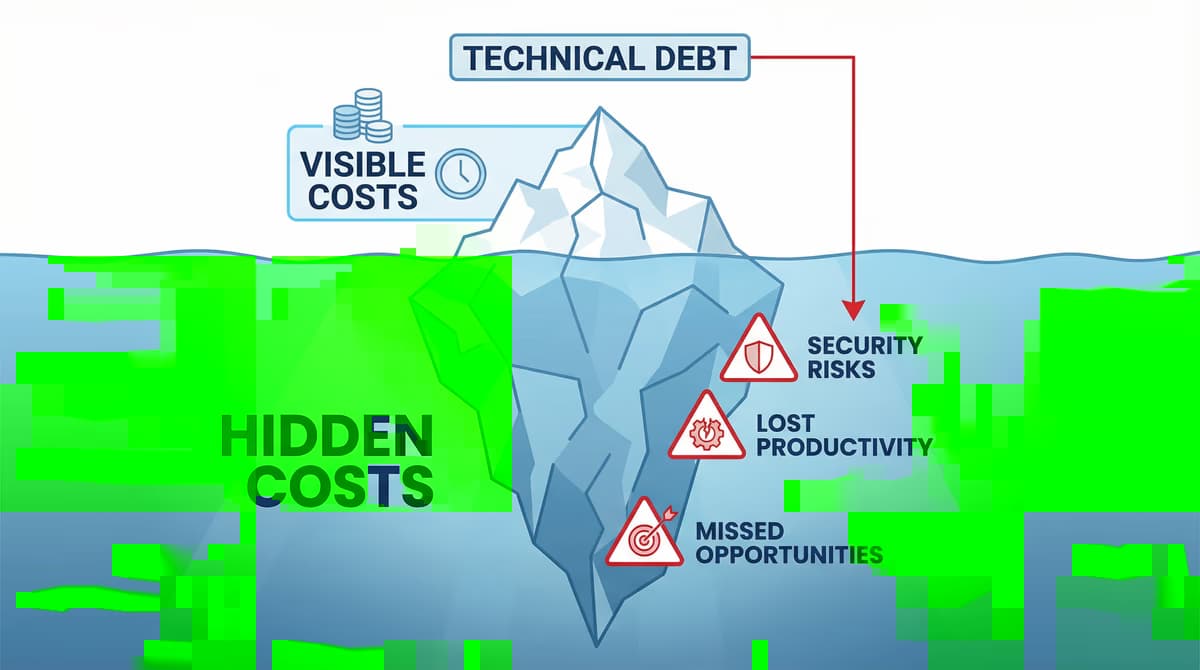
In order to comply with deadlines and bring new features to the market quickly, compromises in code quality are sometimes made. These compromises are known as technical debt.
But what exactly hides behind this concept. And how can companies learn to manage these debts not only. However, also strategically reduce them?
This article highlights the causes and effects of technical debt and shows practical strategies to successfully manage them.
What are technical debts?
The term "technical debt" was coined by software developer Ward Cunningham.
It describes the implicit costs arising from reworking on a software because one has opted for a simple but suboptimal solution instead of implementing a better but more complex solution.
You borrow time from the future by taking a shortcut today. However, this "yellow time".
Must later be repaid with interest, in the form of more elaborate maintenance and further development work.
A simple analogy is the construction of a house. One could initially dispense with a solid foundation to get ready faster.
The house is standing, but cracks and instabilities appear at the first major load.
The subsequent correction of these deficiencies is much more expensive and more complicated than to establish a stable foundation from the outset.
How does technical debt arise?
Time and resources are often scarce in the fast-paced world of software development.
When planning Technical Debt: Detection, Assessment and Strategic Debt from idea to delivery, Legacy Modernisation, Solution: Legacy Reduction sowie Software Maintenance offer practical next steps on our site.
Technical debt can arise for different reasons. Often it is conscious decisions to achieve short-term goals. Sometimes they also arise unconsciously through lack of experience or inadequate processes.
The following table gives an overview of the most common causes:
| Cause | Description |
|---|---|
| Time Print | Enge Deadlines force developer teams to fast solutions that are not always the most sustainable. |
| Long documentation | Unreasonable or outdated documentation makes the code understand more difficult and leads to errors in changes. |
| Fealing Tests | Unreachable Test Cover means that errors remain undetected and adhere to the code. |
| Old technologies The use of outdated technologies and libraries can make maintenance more difficult and risk security. | |
| During experience | Unexperienced developers may tend to suboptimal solutions that lead to problems in the long term. |
| Unclear needs | If the needs for the software are unclear or contradictory, this can lead to incorrect code. |
The consequences of technical debt
The impact of technical debts is manifold and can negatively affect the entire sub
References and further reading
The following separate references complement the topics in this article:
- Bitkom – German digital industry association.
- German Federal Office for Information Security (BSI).
- European Commission – Digital strategy.
- MDN Web Docs (Mozilla)
- W3C – World Wide Web Consortium.
"Legacy migration often fails not because of the stack, but because tacit domain knowledge was never captured—budget explicitly for knowledge transfer."
— Björn Groenewold, Managing Director, Groenewold IT Solutions
Frequently Asked Questions (FAQ)
What is this article about: “Technical Debt: Detection, Assessment and Strategic Debt”?
This post explores Technical Debt. Detection, Assessment and Strategic Debt from the perspective of needs, typical pitfalls, and sensible next steps.
In short: Time and resources are often scarce in the fast-paced world of software development.
Who benefits most from the content described here?
Useful for project leads and product owners in Software development who must choose between standard software, custom development, and integration.
How does this topic fit into an IT or digital strategy?
Technically and organizationally, alignment with experienced partners pays off — from requirements to operations; start with the [services overview](/en/services/software-development). For multi-system landscapes, [IT consulting and architecture](/en/services/it-consulting) helps align vendors and internal teams.
What are sensible next steps if we need support?
A practical next step: book a consultation and clarify which MVP or pilot fits your team and landscape.
About the author

Managing Director of Groenewold IT Solutions GmbH and Hyperspace GmbH
Since 2009 Björn Groenewold has been developing software solutions for the mid-market. He is Managing Director of Groenewold IT Solutions GmbH (founded 2010) and Hyperspace GmbH. As founder of Groenewold IT Solutions he has successfully supported more than 250 projects – from legacy modernisation to AI integration.
Blog recommendations
Related articles
These posts might also interest you.

Open Source ERP: How safe are open commodity management systems really?
In the world of corporate software, Open Source ERP has long since established itself as a flexible and cost-efficient alternative to proprietary systems. Still, stubbornly a foreclosure...
Open source ERP: successfully organize support and maintenance
The implementation of an open source ERP system is a strategic step for many companies towards greater flexibility, control and cost efficiency. But with the introduction of softw...
ERP introduction: Customizing vs. standard processes – What is the right way for the middle class?
The decision for a new Enterprise Resource Planning System (ERP) is one of the strategically important points for a company. It influences efficiency, scalability and...
Free download
Checklist: 10 questions before software development
Key points before you start: budget, timeline, and requirements.
Get the checklist in a consultationRelevant next steps
Related services & solutions
Based on this article's topic, these pages are often the most useful next steps.
Related services
Related solutions
Practical next steps after Technical Debt: Detection, Assessment and Strategic Debt
Technical Debt: Detection, Assessment and Strategic Debt addresses a practical choice for product and IT teams. Start with one clear goal: align software scope, technical risk, and business value before the next investment.
Check the current process, the data involved, and the result users need. Then record the main risks and define a small first step. This keeps the decision easy to review and gives your team a shared basis.
For implementation support, our custom software development connects the article's guidance with architecture, delivery, and stable operations. Engineering and project ownership stay with our team in Leer, Germany.
This post belongs to Software development. Browse the related Software development articles or use the English software blog for other topics.
When budget is the next question, the software cost calculators provide planning ranges. The IT glossary explains key terms, while in-depth technology guides cover wider decisions.
If the topic affects a live project, book a technical consultation or send the context through our project contact form. We usually reply within one working day.