
As of: 4 September 2026 · Reading time: 8 min
Key takeaways
- Software maintenance ensures operation, safety and planning.
- Companies evaluate effort, risks, SLAs and meaningful maintenance models.
Software maintenance ensures operation, safety and planning. Companies evaluate effort, risks, SLAs and meaningful maintenance models.
“Digitalization is not an IT project—it is a business strategy.”
– Björn Groenewold, Managing Director, Groenewold IT Solutions
If a business-critical application fails, the actual error is rarely the biggest problem. Expenditure usually becomes the lack of preparation.
This is where software maintenance is only seen as a cost block or as an integral part of a reliable operating model.
For companies using custom software, this is not a technical incident, but a management issue with direct impact on access, security and budget.
Many leaders invest cleanly in conception, development and go-live - and treat the phase afterwards too casual. The demanding part often begins only during operation.
Needs change, interfaces are adjusted, vulnerabilities appear, operating systems and browsers are developing further, and in-house switch contact persons.
Without clear responsibilities and defined maintenance processes, a good solution with time becomes a risk.
What software maintenance really means in everyday business
Short response: Software maintenance ensures operation, safety and planability.
For Planning and securing software maintenance, Cost Calculator: Legacy Modernisation and Solution: Legacy Reduction are practical starting points. Budget and industry context: Monolith vs. Microservices.
Plan and secure for Software maintenance Legacy code analysis in 5 days and software maintenance & maintenance are suitable entrances for planning and rollout.
Software maintenance is more than bug fixing. In the context of the company, it includes all measures that make an application functional, secure, compatible and economically viable.
These include bug fixes, security updates, technical adjustments to third-party systems, monitoring, performance optimization, minor developments and maintenance of operating documentation.
Especially in custom software, maintenance needs are not a sign of poor quality.
On the contrary, a professionally built solution forms real business processes - and these processes change.
New legal needs, changed role models, extra locations or new data sources directly affect the software.
Anyone who ignores this change pressure saves short notice and pays twice later.
A simple distinction is so helpful for leaders. There are measures to secure the stable operation and measures to develop the system professionally.
Both can be regulated in the same contract, but should not be calculated mixed. Only in this way, effort, reaction times and budgets remain transparent.
Why missing software maintenance becomes expensive
The effects of insufficient software maintenance rarely appear at once. It often starts with small frictions.
An import runs slower, a browser update generates display errors, an API delivers other data formats, a server patch changes dependencies.
Such points are harmless until they merge at a critical moment.
Then typical business damages arise. Employees work with workarounds, specialist departments lose confidence in the system, store customer processes, and internal IT resources are unplanned.
It becomes especially critical if knowledge is only in minds instead of in documentation and clean source code.
Then any adjustment becomes more expensive, any disruption more risky and any decision slower.
There is also the security aspect. Not serviced software is a gateway - not only because of known vulnerabilities.
However, also because of outdated libraries, missing protocol adjustments or unclear authorization concepts.
For companies with sensitive data, GDPR-relevant processes or public contractors, this is not a theoretical risk but a real risk of liability and reputation.
Which types of software maintenance are useful
Short: Not every system needs the same maintenance model.
Not every system needs the same maintenance model. An internal application with few users is handled differently than a customer-oriented platform with high access needs.
It is crucial how critical the system for operation is, how often changes are expected and how complex the technical landscape is.
Correct software maintenance
This is about eliminating errors that have already occurred. This is the classic support case. It is important that fault classes are defined.
A display problem in reporting is different from a complete failure of an ordering process.
Without clear grouping, the basis for loadable reaction times is lacking.
Preventive software maintenance
This form is often underestimated, although it is most useful in business.
Measures that prevent problems are meant before they become visible: updates of frameworks, exchange of outdated components, tests after infrastructure changes or technical cleaning of old loads.
Preventive maintenance causes predictable costs and reduces unplanned downtime.
Adaptive software maintenance
Once the environment changes, the application must adapt. This concerns new operating system versions, modified APIs, security standards, cloud environments or regulatory needs.
Adaptive maintenance is not a special case in interface projects, but is an ongoing reality.
Perfect software maintenance
These include minor improvements in performance, usability or processes. These measures are not always urgent but often economically sensible.
If a frequently used process saves several hours of manual reworking every week, maintenance is quickly a productivity lever.
Software maintenance contractually clean
Short: Many problems are not caused by technology, but by unclear goals.
Many problems are not caused by technology, but by unclear goals. So, software maintenance should always be defined with a clear performance image.
A usable maintenance contract describes not only hourly quotas, but above all responsibilities, service times, reaction periods, escalation routes and the handling of changes.
The separation between operation, maintenance and further development is important.
Operation means that infrastructure, deployments, backups and monitoring are regulated.
Maintenance includes ensuring features and compatibility.
Further development concerns new features or technical extensions. If these areas remain unsharp, discussions arise exactly when speed is required.
SLAs should also be realistically defined. A reaction time of two hours sounds good, but can only be stressed when priorities, communication paths and technical approaches are cleared.
Equally relevant is the question of who releases decisions.
Many disturbances are not solved more slowly because the problem is complex, but because there is no clear release logic in-house.
Clarity is crucial for midsize companies. Planable packages for defined services are often more sensible than purely open accounting.
At the same time, enough room to adapt should remain for unplanned adjustments.
There is no unit solution - but there are good and bad control models.
When a maintenance contract is worth - and when not
A maintenance contract is especially useful when the software is business-critical, serves several interfaces, personal data must be processed or regularly adjusted.
The higher the dependency on the system, the more worthwhile is a regulated model with fixed contacts and recorded processes.
An broad contract for applications that are only rarely used is less sensible, is clearly defined and are not technically subject to any changes.
However, there should also be at least one ordered operating documentation, current source code and a defined contact person.
Anyone who dispenses with a contract should not abandon structure. .Another point is the access of the partner.
Software maintenance works only reliably if knowledge does not depend on individuals.
Fixed teams, recorded transfers and clear responsibilities are so more important than the lowest daily rate.
In the B2B environment, reliability and continuity are more than short-term savings.
The typical vulnerabilities in existing systems
Short: In practice, the same patterns are always shown in maintenance projects.
In practice, the same patterns are always shown in maintenance projects. Often a current technical documentation is missing.
The system is productive, but no one can cleanly explain which services depend on each other. Or there is source code, but no test strategy.
Changes become slow and risky.
Another weak point is increased interfaces.
If ERP, CRM, third-party systems and manual exports have been extended over years, every change on the margin becomes a problem at the core.
This is clearly why software maintenance should not only respond to the visible error, but should consider the system landscape as a whole.
Legacy shares also deserve an honest assessment. Not every old application needs to be modernized at once.
But every company should know which components are critical, outdated or inadequately secured by personnel.
Without this clarity, no loadable maintenance plan can be set up.
How companies evaluate their real maintenance needs
Short: A meaningful starting point is not a tool discussion, but a sober inventory.
A meaningful starting point is not a tool discussion, but a sober inventory. What applications are business-critical? Which of them have recorded dependencies, current accesses and clear leaders?
Where are known technical debts and which external systems impose regular adjustments?
The economic grouping follows. Not every application needs maximum service levels. But every business-relevant solution needs a suitable safety and maintenance level. Anyone who prioritizes here wins planability.
Whoever treats everything the same, usually distributes budget in the wrong place.
In many cases, a stepped model makes sense: stable basic maintenance for operation, defined response times for disturbances and a separate budget for targeted further development.
This approach creates clarity between duty and improvement.
Companies such as Groenewold IT Solutions so rely on structured handovers, transparent performance images and maintenance concepts that combine technical reality and technical ownership. .Software maintenance is not a mandatory program for IT at the end.
But a leading decision on risk, access and ability to act.
Anyone who cleanses them early does not simply buy support - but secures the investment in their own digitalization in the long term.
Technical sources and further links
The following separate references complement the grouping on the topics of this Article:
- Bitkom – Digital Economy Association.
- BSI – Federal Office for Information Security.
- European Commission – Digital Strategy.
- MDN Web Docs (Mozilla)
- W3C – World Wide Web Consortium.
"Privacy by Design is not a subsequent checkbox, but an architectural question – especially for personal master data."
— *Björn Groenewold, Managing Director, Groenewold IT Solutions *
About the author

Managing Director of Groenewold IT Solutions GmbH and Hyperspace GmbH
Since 2009 Björn Groenewold has been developing software solutions for the mid-market. He is Managing Director of Groenewold IT Solutions GmbH (founded 2010) and Hyperspace GmbH. As founder of Groenewold IT Solutions he has successfully supported more than 250 projects – from legacy modernisation to AI integration.
Blog recommendations
Related articles
These posts might also interest you.
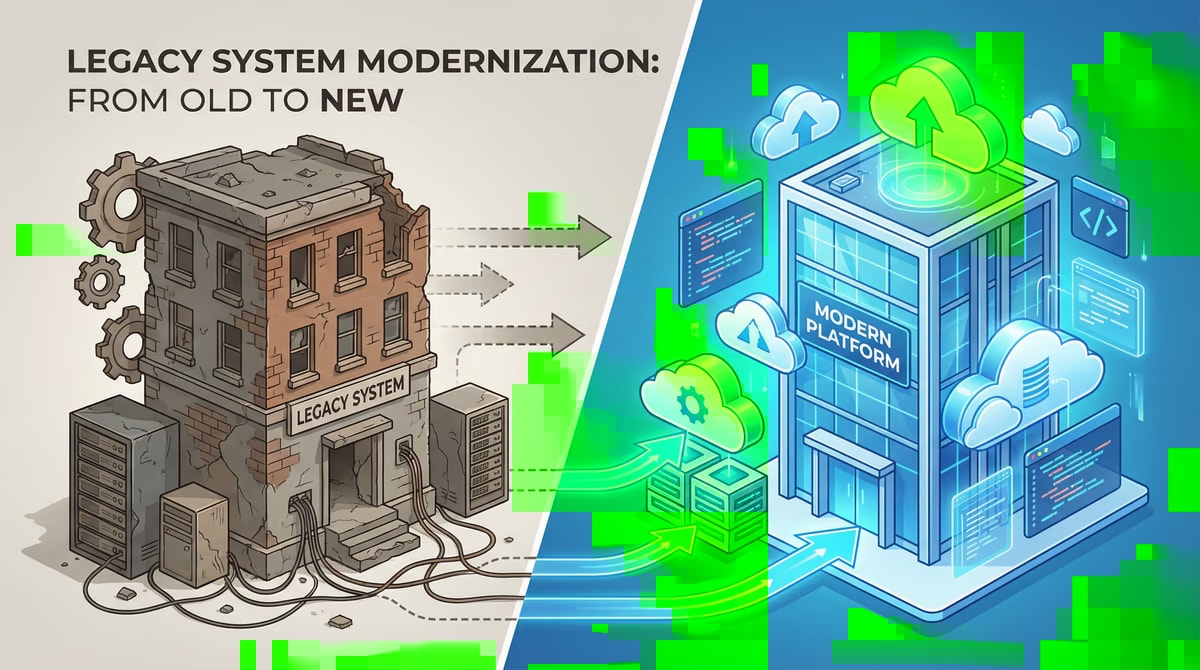
Technical debt in legacy systems: A ticking time bomb?
In the fast-paced world of software development, time and budget are often the driving forces. In order to adhere to deadlines and keep projects within the framework, compromises are often made at...
Replace legacy software: strategies and common pitfalls
In today's fast-paced digital world, outdated software systems, often referred to as legacy software, are one of the biggest challenges for companies. You can find innovations frombrem...
Legacy Migration: Strategies for a smooth transition
In today's rapidly changing digital landscape, outdated IT systems, often referred to as legacy systems, represent a considerable challenge for many companies. Although she...
Free download
Checklist: 10 questions before software development
Key points before you start: budget, timeline, and requirements.
Get the checklist in a consultationRelevant next steps
Related services & solutions
Based on this article's topic, these pages are often the most useful next steps.
Related solutions
Related comparison
Practical next steps after Planning and securing software maintenance
Planning and securing software maintenance addresses a practical choice for product and IT teams. Start with one clear goal: protect stable operations while fixes, updates, and future releases stay predictable.
Check the current process, the data involved, and the result users need. Then record the main risks and define a small first step. This keeps the decision easy to review and gives your team a shared basis.
For implementation support, our software maintenance and support connects the article's guidance with architecture, delivery, and stable operations. Engineering and project ownership stay with our team in Leer, Germany.
This post belongs to Legacymodernization. Browse the related Legacymodernization articles or use the English software blog for other topics.
When budget is the next question, the software cost calculators provide planning ranges. The IT glossary explains key terms, while in-depth technology guides cover wider decisions.
If the topic affects a live project, book a technical consultation or send the context through our project contact form. We usually reply within one working day.