



Software-Wartung
Agile Software Maintenance: How Scrum & Kanban Your Processes
Agile methods can revolutionize software maintenance. Learn how Scrum and Kanban make your processes more flexible and transparent.

Remote support resolves many incidents without travel—help desk, monitoring and on-site service when needed, with fast response times and clear SLAs. We keep your systems running.
When IT fails, every minute costs money and annoys your team. You need support that reacts fast, finds the cause and fixes it. We offer that – professional help for your software and infrastructure.
We offer flexible support. From ad-hoc help to full SLAs with fixed response times. We fit support to your needs and budget. Our team knows the tech we use, so we often fix things faster than generalist providers.
We do more than fix breakages. We monitor so we spot issues before they hit you. We do health checks and keep software up to date and secure. That cuts how often things go wrong and how bad they get.
We support our own apps and systems built by others. Web apps, mobile, databases, integrations – we can help. We also train your staff so they can handle routine issues and escalate the rest to us.

„Support quality shows in mean time to restore and repeat incidents—without runbooks and monitoring, every ticket feels "urgent".“
Project references
Documented examples with transparent evidence types — browse matching references or open the full case study.
Help Desk
First-level support for your users.
Fast Response Times
Quick response to critical issues.
Proactive Monitoring
Identify and resolve issues before they occur.

„SLAs only work when severity definitions and backup contacts exist—otherwise "priority" becomes a calendar negotiation.“
We are happy to advise you on our support services. Contact us for a non-binding initial consultation.

Reactive support waits for something to break, then fixes it – often under pressure. Proactive support uses monitoring, health checks and trends to spot problems before they become incidents. We track performance, errors, server load and response times and get alerted as soon as something is off.
SLAs are central. Each agreement sets clear response and fix times by severity. Critical issues get immediate attention; lower priority waits in line. We report on SLA compliance so you see if we keep our promises. You choose the level that fits your risk – from business hours to 24/7 for critical systems.
We treat support as strategic, not just cost. Regular reviews find repeating issues and suggest fixes – e.g. refactoring a weak integration, updating a dependency or tuning a slow query. That reduces tickets over time and keeps systems in good shape as you grow.
Remote support resolves most tickets without travel: through secured remote sessions we access workstations and servers, fix issues directly and log every action. For distributed sites and home offices this is often faster than an on-site visit – while escalation to on-site service stays available.
Remote sessions run over approved, logged tools with explicit user consent – not random remote apps. Response and resolution times follow the same priority matrix as the rest of support. Hardware defects and cabling are handled on site; software and configuration work mostly remote.
Read more in our cluster article on remote support and remote maintenance, define service hours in support levels and SLAs, explore DevOps consulting and platform engineering, and run it continuously as part of managed IT services with a fixed service desk.
Measurable IT support for companies maps every incident to a priority tier with a response and resolution target. The matrix shows typical values; binding SLAs are agreed to fit your business hours and critical systems—as part of managed IT services.
| Priority | Business impact | Response time | Resolution target | Typical example |
|---|---|---|---|---|
| P1 – critical | Production outage | 1–2 hours | 4–8 hours | Server or network outage |
| P2 – high | Major restriction | 4 hours | 1 business day | Application partly impaired |
| P3 – medium | Minor restriction | 1 business day | 2–3 business days | Single-workstation issue |
| P4 – service request | No outage, request | 1 business day | as agreed | Setup, permission, question |
This service handles user requests and incidents within the agreed service window: ticket intake, impact-based priority, first response, escalation and documented closure. It is not proactive full operations or application-code maintenance. Use managed IT services for continuous operations and software maintenance for source-code changes.
FAQ
IT support covers helpdesk intake, prioritisation and incident handling during the agreed service window.
Proactive full operations are managed IT services; application source-code changes are software maintenance.
Reactive support fixes issues after they occur.
Proactive support uses monitoring and health checks to spot problems before they become incidents. We recommend a mix that fits your risk and budget.
Each agreement defines response and fix times by severity.
Critical issues get immediate attention; we report on SLA compliance so you see we keep our promises.
Yes.
We use regular reviews to find recurring issues and suggest improvements – e.g. refactoring weak integrations or updating dependencies – so ticket volume drops and systems stay healthy.
We support the technologies we develop: web apps, APIs, cloud and on-premise systems.
We clarify scope and tools in advance.

IT support for business relieves workstations and incidents—when SLAs, escalation, and documentation are clear.
| Use case | Benefit | Differentiation | Outcome | Next step |
|---|---|---|---|---|
| Help desk tickets pile up, outages drag on | Remote support, SLAs, and structured handovers | Not full managed IT operations | Faster first-time resolution | Align support model |
| Patches and updates are forgotten | Proactive monitoring and patch cadence | No new software development | Predictable availability | Software maintenance |
| Project is down—acute recovery needed | Escalation to software rescue | Not routine support | Stabilization with fix plan | Software rescue |
Focus here: IT support, help desk and reactive incident handling – not packaged managed IT on managed IT services. Long-term application care: software maintenance.
Software maintenance costs, overview: Operations, support & stabilisation.
Service overview: Operations, support & stabilisation (overview)
Quick context: A compact summary of this service – aligned with your project.
Definition: IT support and incident resolution with clear SLAs for mid-market operations.
When it applies: When systems are critical after go-live, legacy must stay stable or an emergency team must recover existing code.
Audience: Companies with or without in-house IT that prioritise availability, performance and fast incident response.
Outcome: Depending on the need, the result is a help desk process, a managed IT operating model or a maintenance plan. Acute or structural issues lead to software rescue or an assessed modernisation path.
Approach: Onboarding and SLA definition, monitoring and ticketing, releases and patches, incident escalation – optional modernisation review.
Prerequisites and limits: Prerequisites and limits: existing systems, access and agreed SLAs/escalation. Limits: not large greenfield products—see Software & platforms or Integration.
Differentiation: Greenfield product build → Software & platforms; integration projects → Integration; funding → Financing & grants. This page (IT Support & Operations) is the main service page – the overview lists all related services.
Trust: Support and rescue including third-party code; Made in Germany, mid-market operations experience since 2010.
Sensible next step: Sensible next step for IT Support & Operations: define SLA, systems and escalation in an intro support call.

Use our funding calculator to see which government grants may apply to your project.
Björn Groenewold – Managing Director
Service cluster
Related services for Operations & support: help desk, managed IT or maintenance?
Maintenance, support, and project rescue – stable operations, clear SLAs, and fast response times.
Related topics
Complementary services from other areas
These services are frequently requested together with IT Support & Operations or complement it thematically.
IT consulting strategy: roadmaps & digitalisation
Integration & interfaces: find the right entry point

Use our interactive calculator for a first budget indication—free and non-binding.
Thorsten Frieling – Projektmanagement
On the scheduling page, pick a free slot for a 30-minute intro call about It Support – straightforward next steps.
Free & non-binding · 30-minute intro call
Book next available slotOur topic overview links related articles and entry points alongside this service page.
Recent articles from our blog that match this service.
Agile Software Maintenance: How Scrum & Kanban Your Processes
Agile methods can revolutionize software maintenance. Learn how Scrum and Kanban make your processes more flexible and transparent.
Code review: Detecting quality problems early
Learn how code reviews reveal quality problems early. Best practices, checklists and tools for effective code reviews.
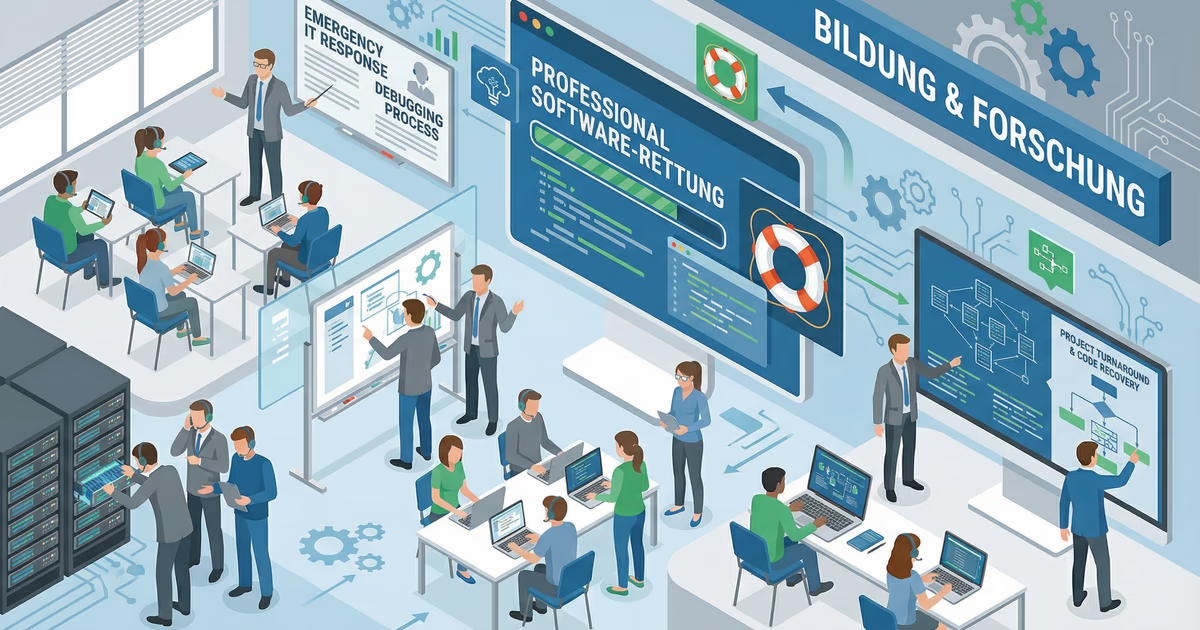
Software Rescue: How to bring back failed IT projects
Not every software project runs according to plan. Budget surpasses, missed deadlines or technical dead endes can meet any company. The good news: Most projects can still be saved. This guide will show you...