Software Rescue – Project Recovery
250+ projects · 5.0 on Google · 100% in Germany

Software rescue with fast diagnosis, documented fixes and clean handover

For mid-sized companies: when production wobbles—we stabilise and document – delivery and project ownership from Germany (Leer/East Frisia), named contacts, no offshore guesswork.

  • 250+ delivered projects
  • 5.0 stars on Google
  • 100% engineering in Germany

Your IT project is at risk? We take over, analyse, and get it back on track. We specialise in software rescue and failed-project takeover. Emergency support is available. Initial analysis typically costs €3,000–8,000. Typical rescue projects run €20,000–80,000.

Fast analysis·Project takeover·Stabilisation·Go-live focusEmergency support possible

30-minute intro call: Software Rescue

Book a 30-minute, no-obligation intro call about Software Rescue – straightforward next steps.

Loading calendar…

Our Rescue Services

Analysis of Failed Projects

Full analysis to find root causes and define a rescue plan.

  • Root cause analysis
  • Risk assessment

Code Refactoring

Restructuring and optimisation of existing code.

  • Code quality improvement
  • Technical debt reduction

Takeover & Renovation

Structured takeover and renovation of troubled projects.

  • Project takeover
  • System migration

Knowledge & answers

Frequently asked questions about software rescue

Basics & diagnosis

When is a project really in trouble?

Watch for these warning signs:

  • Repeated missed deadlines
  • Rising bug counts
  • Budget overruns
  • High team turnover
  • More problems appear than get solved

Often several of these factors combine.

Do you really take on failed projects?

Yes — that is our speciality. We focus on stuck situations, both technical and organisational. We assess the situation fairly, identify the blockers, and create a realistic rescue plan.

Is the existing code worthless?

Rarely. In most cases, a lot can be saved. We analyse what works and refactor only what truly blocks progress. The goal is to protect as much of your investment as possible.

Can every project be rescued?

Most — but not all. After our initial analysis, we give an honest recommendation: rescue or rebuild? We only recommend rescue when we are confident it can succeed.

Björn Groenewold – Managing Director Groenewold IT Solutions

Project off track?

We analyse the situation and outline realistic options.

Björn Groenewold – CEO

Request emergency support

Process & approach

How quickly can you start?

In a crisis, we can start immediately. We put together task-force teams at short notice. Initial analysis often begins within a few days of your first contact.

How does collaboration work?

We communicate openly with weekly progress reports. You always know where things stand. We work in short iterations so you see continuous improvement from the start.

What happens to our existing team?

We work with your team, not against it. We transfer knowledge and provide coaching to strengthen your team. The goal: after the rescue, your team can continue independently.

Thorsten Frieling – Project Manager Groenewold IT Solutions

Effort estimate for your project?

After initial analysis we provide a transparent rescue plan.

Thorsten Frieling – Project management

Contact us

Costs & timeline

What does software rescue cost?

Costs depend on scope and complexity. Initial analysis is typically €3,000–8,000. Rescue projects usually fall between €20,000 and €80,000. This is almost always cheaper than a full rebuild — and you protect what has already been built.

How long does a rescue take?

Analysis phase: 1–2 weeks. Stabilisation: 2–8 weeks. Full recovery: several months, depending on the project. We deliver continuously. You usually see the first quick wins after 2–3 weeks.

Do you guarantee success?

We guarantee full transparency and professional work. In 95% of cases, we bring projects to a successful conclusion. If we see no realistic path to success after analysis, we say so honestly.

Technical measures

What are typical technical problems?

Common issues include:

  • Wrong architecture for the use case
  • Accumulated technical debt
  • Missing or insufficient tests
  • Performance problems
  • Security gaps
  • Outdated dependencies
  • Missing documentation

What does refactoring mean?

Refactoring improves the structure of code without changing what it does. The goal is better readability, easier maintenance, and simpler extension. We remove weak patterns and apply proven ones.

How do you handle technical debt?

We prioritise. Critical debt that blocks development comes first. Then we work through the rest step by step. Not everything has to be perfect at once — but the biggest risks are addressed first.

After the rescue

How do we stop the problem from coming back?

Through solid quality practices: automated tests, CI/CD pipelines, code reviews, regular architecture reviews, and early-warning systems with metrics and monitoring. We train your team to maintain these standards.

Do you offer support after the rescue?

Yes. We offer maintenance contracts with regular updates, proactive monitoring, and fast response when issues arise. Long-term development is also possible.

Can we work independently afterwards?

Yes — that is our goal. We document everything, train your team, and hand over cleanly. We remain available for questions, but you are not dependent on us.

Björn Groenewold – Managing Director Groenewold IT Solutions

Project in distress? We can help.

Let us analyse the situation and build a rescue plan.

Björn Groenewold – CEO

Request emergency support

Software rescue: recovering stalled or failed projects

A failed software project means more than wasted budget. It holds business knowledge that would cost a great deal to recreate from scratch. Our software rescue practice starts from the assumption that most troubled projects contain salvageable value. We triage systematically: what works, what needs repair, and what should be rebuilt. Then we execute a recovery plan that protects your existing investment.

The root causes are consistent across industries: unclear requirements, architecture that cannot scale, technical debt that makes change risky, or communication breakdowns. Every engagement starts with an honest review of those causes. Sustainable recovery means fixing what led to failure — not just the symptoms.

Emergency stabilisation usually delivers visible improvements within the first two weeks. We triage critical bugs, address obvious security gaps, and set up basic monitoring. That buys time for deeper work: refactoring, automated tests, and deployment pipelines that make future changes predictable.

Taking over from another provider needs more than good coding. It requires a structured handover, even when documentation is missing or the previous team has left. Through reverse engineering and stakeholder interviews, we rebuild system knowledge so you can move forward with confidence. Many of our long-term client relationships began as rescue projects.

Software rescue: decision matrix by finding

Whether software rescue, partial rebuild or full rebuild is the right path depends on the finding from the initial analysis. The matrix maps typical situations to the recommendation, rationale, result and an effort indication. The fact-based entry point is the legacy code analysis.

Situation / findingRecommendationRationaleResultEffort (indication)
Core functions stabilisable, code rights availableSoftware rescue (stabilisation)Protect investment, ship fastShippable, stable systemanalysis from 1–2 weeks
Some parts block, the rest is viablePartial rebuild of critical componentsTargeted instead of full rebuildStabilised hybrid systemmedium
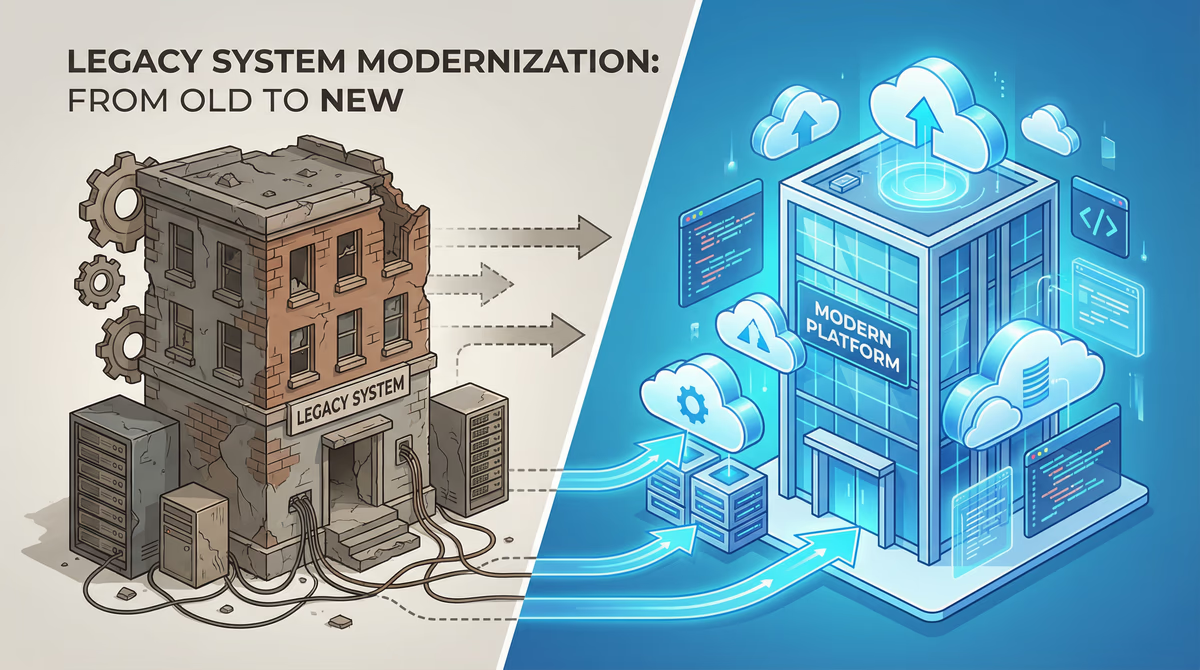
Architecture dead-end, high technical debtControlled rebuild / legacy modernizationCheaper long-term than patchworkFuture-proof foundationhigh
Provider gone, little documentationTakeover with reverse engineeringSecure knowledge, end dependencyDocumented, handed-over stateproject-dependent
Project off track for organisational reasonsProcess and governance recoveryCauses rarely lie in code alonePredictable delivery with milestones4-week plan

Scope: Software rescue vs. maintenance and legacy modernization

Software rescue, stabilisation and takeover of third-party code when projects stall or quality drops. Planned care: software maintenance; strategic legacy reduction: legacy modernization.

Software rescue costs, overview: Operations, support & stabilisation.

Related paths and adjacent topics

Service overview: Operations, support & stabilisation (overview)

More operations & stabilisation services

Adjacent service categories

Software rescue: emergency check to stable solution

Björn Groenewold

Up to 50% of your investment via BAFA/KfW

Use our funding calculator to see which government grants may apply to your project.

Björn GroenewoldManaging Director

Service cluster

Related services for Operations, Support & Stabilization

Maintenance, support, and project rescue – stable operations, clear SLAs, and fast response times.

Related topics

Complementary services from other areas

These services are frequently requested together with Software Rescue or complement it thematically.

Consulting & Strategy

Integration & interfaces: overview