
As of: 23 September 2026 · Reading time: 8 min
Key takeaways
- Software development without offshoring creates more control, clear communication and GDPR security - especially for complex B2B projects.
Software development without offshoring creates more control, clear communication and GDPR security - especially for complex B2B projects.
“Digitalization is not an IT project—it is a business strategy.”
– Björn Groenewold, Managing Director, Groenewold IT Solutions
Anyone who had to save a software project with distributed external teams knows the pattern.
Needs were apparently understood, the result still does not fit the process, queries last too long, ownership runs in circles.
This is clearly where software development without offshoring for many companies is not for preference, but for business-economically sensible decision.
Especially in the middle, in public environment and in project-driven organisations, it is not just whether software is being built.
The decisive factor is whether it fits professionally, is recorded in a revision-proof manner, remains durable in the long term and can be transferred cleanly into operation.
If business processes, data protection, interfaces and internal processes are closely interlinked, the price of misunderstandings rapidly increases significantly more than the supposed cost advantage of favorable development resources.
Why software development without offshoring is more predictable for companies
Software development without offshoring creates more control, clear communication and GDPR security - especially for complex B2B projects.
For Software development without offshoring, Cost Calculator: Legacy Modernisation and Solution: Legacy Reduction are practical starting points. Budget and industry context: Monolith vs. Microservices.
For Software development without offshoring, legacy modemization and legacy code analysis in 5 days are suitable entrances for planning and rollout.
Offshoring is often based on scaling and cost efficiency. This can work in clearly defined, standard tasks.
For custom business applications, ERP-related extensions, integrations, AI solutions or legacy-modernization, the situation usually looks different.
Such projects live by close planning between discipline, IT and development. Needs change in the course.
This is because new dependencies become visible in the workshop or because the test shows that a process in reality is different than in the original documentation.
Those who then work with fixed German-speaking contacts and a well-proven team in Germany reduce friction at a location that often decides on success or standstill in projects.
Planability not only arises through gantt charts or sprint boards.
It arises where questions are quickly resolved, architectural decisions are made comprehensible and the same people bear ownership from the conception to the Go level.
This is one of the practical benefits of developing without offshore chains.
The actual risks of offshoring are often too late visible
Short: Many problems do not appear in the offer, but only in the current project.
Many problems do not appear in the offer, but only in the current project. At the beginning, the daily rate acts attractive.
Later, there will be new issues of planning, extra quality assurance, reworking and internal binding of key persons. Then a cheaper approach becomes quickly expensive.
A typical point is context loss. External distributed teams often see tickets, but not the scope of custom needs in business operations.
A small adjustment in the release process may be crucial for compliance, billing or delivery.
If this grouping is lacking, solutions are created which are technically viable but do not carry surgically.
In addition, there is ownership. Who develops, who reviews, who documents, who is responsible for faults in the company, who takes on stabilization after the Go level?
The more subcontractors and freelancer levels are involved, the more difficult a clear control becomes.
For leaders, this is a risk because project ownership cannot be properly assigned.
Made in Germany is more than a label of origin
Software development without offshoring is not about symbolism. It's about taxability.
Permanent developers in Germany usually mean more consistent communication, stable teams and a common understanding of quality standards, document and data protection.
The rollout framework is crucial especially for GDPR-relevant applications, internal specialist systems, sensitive customer data or regulatory needs.
Data protection is not solved by contracts only at the end. It begins with architecture, role models, logging, interfaces and hosting decisions.
If development, project management and technical ownership take place in a clear German legal and quality framework, the risk falls noticeably.
For many companies, the topic of source code ownership is also central. Anyone who finances an custom solution wants to remain operational in the long term.
This means: complete handover, clean documentation and no dependency on opaque supply chains. Only then will there be real investment security.
When software development without offshoring is particularly useful
Short: Not every project needs the same approach.
Not every project needs the same approach. A simple landing page or an isolated standard module can arise under conditions other than a business-critical core application.
The difference lies in the risk and depth of integration. .A model without offshoring is especially useful if several systems have to be connected to one another, such as ERP, CRM, third-party interfaces and internal specialist logic.
Also in Legacy modernization, closeness to the specialist area is crucial because old processes are rarely fully recorded. Much knowledge is in minds, Excel files and grown exceptions.
This cannot be efficiently reconstructed over long communication chains.
The same applies to digital products with long-term operation. Anyone who wants to develop.
However, also operate, expand, train and stabilize needs a partner who understands the solution over the entire life cycle.
Then continuity is more important than a short-term low purchase price.
What decision-makers win
The greatest advantage is not just better communication. It's better decision-making.
If needs, effort, risks and technical options are discussed transparently, management, IT leadership and expertise can be emphasised.
This creates measurable effects. Amendment requests are recognized earlier. Missing developments are corrected more quickly. Releases are based on comprehensible results instead of assumptions.
And the operation starts more stable because knowledge is not lost between changing service providers.
Internal expenditure also often falls significantly. Many companies underestimate how much management capacity binds a fragmented delivery model.
When a partner is designed, built, integrated and commissioned from a single source, the internal team is appreciably relieved.
The own organization then does not have to permanently play translators between discipline, project management and several external converters.
The cost point: more expensive in purchasing, cheaper in the result?
Short: This question is justified.
This question is justified. Software development without offshoring is often not the cheapest option in pure hours comparison.
For leaders, however, the more relevant question is what the project actually costs at the end - including control costs, improvements, time loss, quality risks and later maintenance.
If a project is closely related to core processes, delay itself is a cost factor.
Non-digitalized processes remain, manual workarounds continue to run, error rates remain high, data must be maintained twice.
A presumably cheaper start price loses importance when the Go level shifts or the result has to be reassembled after a few months. .This is why it is worth looking at Total Cost of Ownership.
Clean architecture, clear responsibilities, recorded code and predictable systems initially cost more discipline. However, pay off in operation.
Anyone who thinks in years instead of in sprints evaluates differently.
What you can recognize a reliable partner
Not every provider who promotes German development works automatically transparent. It is crucial how projects are managed.
Good partners talk about scope, risks, dependencies and realistic priorities early on. They do not promise everything, but make clear what is meaningful in what phase.
Pay attention to fixed contact persons, comprehensible supply structures, recorded transfers and a clear way from the initial call to the operation.
It is also important whether the provider actually masters architecture, development, testing, deployment and support or only coordinates it.
Especially in custom solutions, problems often arise at the transitions.
Another test point is how to deal with changes. In good projects, changes are not an incident, but part of a controlled procedure.
It will be transparent when effects on time, budget and priorities are openly identified.
For whom Offshoring can still be questioned
Short: A differentiated view belongs to this.
A differentiated view belongs to this. Offshoring is not per se wrong.
With clearly standard activities, very large teams with their own governance or uncritical subtasks, it can work.
Companies with strong internal IT control and proven quality mechanisms can successfully lead such models.
However, for many midsize organisations, something else applies. They do not need a supplier pool but a responsible rollout partner.
When internal resources are scarce, processes are complex and needs closely associated with the business, a slim, local model usually brings more security than a globally distributed setup.
For this reason, companies such as Groenewold IT Solutions rely on fixed developers in Germany, clear project paths, GDPR-compliant rollout and complete source code transfer.
This is not a marketing formula, but a conscious response to typical project risks.
In the end, software development without offshoring is primarily a decision for control, liability and long-term ease of upkeep. Whoever sees software not as a short-term procurement object.
However, as a leading part of their own value added, often drives significantly more secure with this approach.
Technical sources and further links
The following separate references complement the grouping on the topics of this Article:
- Bitkom – Digital Economy Association.
- BSI – Federal Office for Information Security.
- European Commission – Digital Strategy.
- MDN Web Docs (Mozilla)
- W3C – World Wide Web Consortium.
"ERP projects rarely fail at the software list, but at unclear process boundaries and lack of expertise in the project."
— *Björn Groenewold, Managing Director, Groenewold IT Solutions *
About the author

Managing Director of Groenewold IT Solutions GmbH and Hyperspace GmbH
Since 2009 Björn Groenewold has been developing software solutions for the mid-market. He is Managing Director of Groenewold IT Solutions GmbH (founded 2010) and Hyperspace GmbH. As founder of Groenewold IT Solutions he has successfully supported more than 250 projects – from legacy modernisation to AI integration.
Blog recommendations
Related articles
These posts might also interest you.
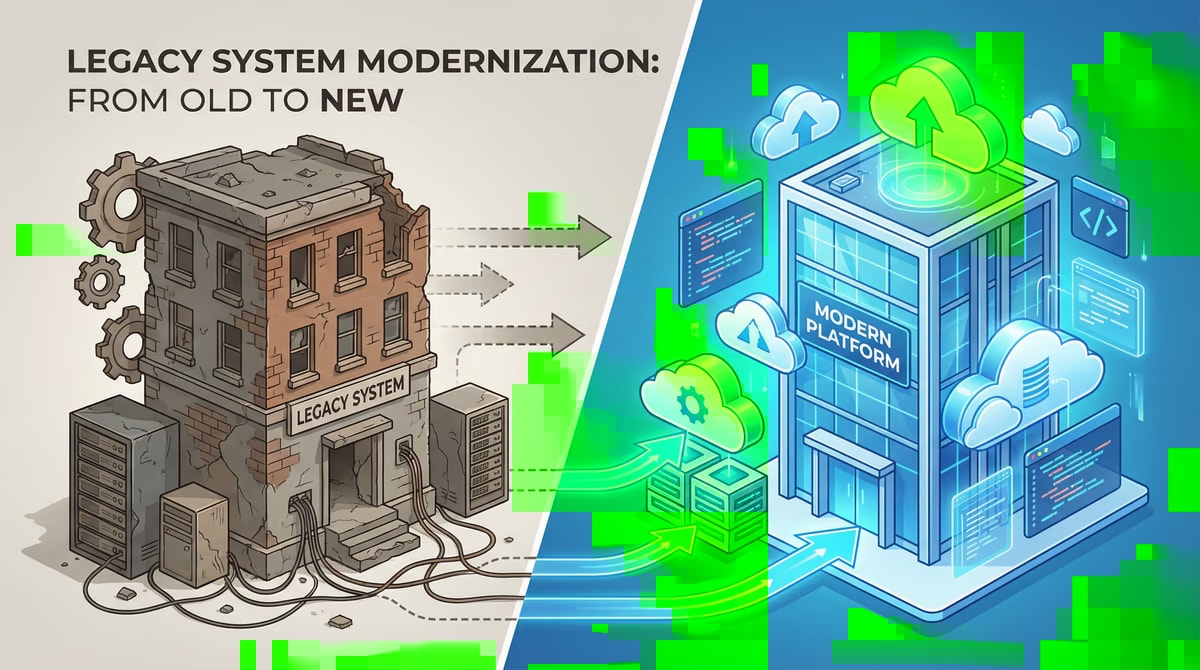
Technical debt in legacy systems: A ticking time bomb?
In the fast-paced world of software development, time and budget are often the driving forces. In order to adhere to deadlines and keep projects within the framework, compromises are often made at...
Replace legacy software: strategies and common pitfalls
In today's fast-paced digital world, outdated software systems, often referred to as legacy software, are one of the biggest challenges for companies. You can find innovations frombrem...
Legacy Migration: Strategies for a smooth transition
In today's rapidly changing digital landscape, outdated IT systems, often referred to as legacy systems, represent a considerable challenge for many companies. Although she...
Free download
Checklist: 10 questions before software development
Key points before you start: budget, timeline, and requirements.
Get the checklist in a consultationRelevant next steps
Related services & solutions
Based on this article's topic, these pages are often the most useful next steps.
Related solutions
Related comparison
Practical next steps after Software development without offshoring
Software development without offshoring addresses a practical choice for product and IT teams. Start with one clear goal: align software scope, technical risk, and business value before the next investment.
Check the current process, the data involved, and the result users need. Then record the main risks and define a small first step. This keeps the decision easy to review and gives your team a shared basis.
For implementation support, our custom software development connects the article's guidance with architecture, delivery, and stable operations. Engineering and project ownership stay with our team in Leer, Germany.
This post belongs to Legacymodernization. Browse the related Legacymodernization articles or use the English software blog for other topics.
When budget is the next question, the software cost calculators provide planning ranges. The IT glossary explains key terms, while in-depth technology guides cover wider decisions.
If the topic affects a live project, book a technical consultation or send the context through our project contact form. We usually reply within one working day.