
As of: 23 September 2026 · Reading time: 7 min
Key takeaways
- Shopware 6 or WooCommerce – an honest system comparison for medium-sized companies with focus on B2B, ERP integration and scalability.
Shopware 6 or WooCommerce – an honest system comparison for medium-sized companies with focus on B2B, ERP integration and scalability.
“Digitalization is not an IT project—it is a business strategy.”
– Björn Groenewold, Managing Director, Groenewold IT Solutions
Shopware vs. WooCommerce: What mid-sized businesses really need to know
Shopware 6 or WooCommerce – an honest system comparison for midsize companies with focus on B2B, ERP integration and scalability.
Who plans Shopware vs. WooCommerce.
Which system fits mid-sized firms? from idea to rollout, find CMS & E-commerce platforms, cost calculator.
Onlineshop, solution.
Commerce & e-commerce and [Comparison.
Shopware vs. Magento](/en/comparisons/shopware-vs-magento) suitable entrances on our website.
Choosing the right shop system is one of the long-term following decisions in e-commerce.
A wrong decision not only costs money in migration – it blocks growth and slows down sales processes.
This comparison focuses on the criteria relevant to midsize companies with more complex needs: B2B functions, ERP integration, performance and operating costs.
The starting position: Two completely different system philosophy
Short: WooCommerce is a WordPress plugin.
WooCommerce is a WordPress plugin. That sounds simple – and that is also, in both directions. It offers the fastest entry and the largest plugin ecosystem.
But it is based on a CMS that was originally built for blogs.
Shopware 6 is a native e-commerce framework.
It has been built from scratch for shops, offers its own API-First architecture and is explicitly aimed at professional dealers and B2B scenarios.
Core Comparison: 10 key criteria
1. Entry barriers and deployment
| criterion | WooCommerce | Shopware 6 |
|---|---|---|
| Installation | easy (WordPress plugin) | medium (own setup) |
| Hosting needs | LAMP stack, low | PHP 8+, Elasticsearch recommended |
| First page live | Hours | 1–2 days |
| Managed hosting available | yes (kinsta, WP Engine) | yes (shopware.com, hetzner) |
- Quality : WooCommerce wins at the start. No decisive factor for midsize companies with IT resources.
2. B2B functions out of the box
| Function | WooCommerce | Shopware 6 |
|---|---|---|
| Customer groups / price lists | Plugin (paid) | nativ |
| Offer creation | Plugin | B2B Suite (ab Professional) |
| Order limits, Release workflows | Plugin | B2B Suite |
| Net/gross switchover | Plugin | nativ |
| Credit line / payment destination | Plugin | B2B Suite |
- Fazit : Shopware 6 has a clear advantage for B2B scenarios. WooCommerce needs another plugin for every application, increasing system complexity and risk of conflicts.
3. ERP integration
WooCommerce : REST API available, but many integrations run through third-party plugins (e.g. WooCommerce for Lexware, Sage). The data quality and real-time capability of these solutions varies greatly.
Shopware 6 : Provides a complete REST API and admin API. Native integrations for SAP, Microsoft Dynamics and Datev are available or introduced via certified partners.
For personal development, the system offers a cleanly recorded API.
- Conclusion : Shopware 6 is the more reliable choice for complex ERP connections.
4. Performance and scalability
WooCommerce runs on WordPress, whose database structure is not improved for high product volumes or traffic peaks.
From about 10,000 products or > 50,000 visitors/month, performance tuning becomes complex.
Shopware 6 uses Elasticsearch for product search and supports Redis-Caching natively. It is built for hundreds of thousands of products and high parallel traffic.
- Final : Shopware 6 scales better – relevant for makers and wholesalers.
5. Development costs and agency market
WooCommerce developers are available in every price segment – from 20 €/h offshore to 150 €/h for German specialists.
The plugin model leads to the use of cheap solutions that later have to be migrated expensively.
Shopware developers are rarer in the midfield, but well available in Germany. The Shopware community is active, the documentation is good.
- Fazit : WooCommerce is cheaper in entry – Shopware is more consistent in quality in the long term.
6. License cost model
| Model | WooCommerce | Shopware 6 |
|---|---|---|
| Base | Free (OS) | Free (Community) |
| Professional | Pluginsum 100–500 €/month | from 600 €/month |
| Enterprise | Pluginsum variabel | custom |
- Factory : WooCommerce seems cheaper, hidden costs but in plugin licenses.
7. GDPR / legal certainty
Short: Both systems are GDPR compatible configurable.
Both systems are GDPR compatible configurable. Relevant is what third-party providers are involved (plugins, tracking, payment providers).
WooCommerce often has more undocumented data flows through plugin providers outside the EU.
- Fact : Shopware 6 offers a little more clarity due to its centralized plugin system.
Help for SMEs
| Scenario | Recommendation |
|---|---|
| Small B2C shop, < 500 products, Budget < 15k | WooCommerce |
| mid-sized B2C store, WordPress environment available | WooCommerce |
| Makers / wholesalers, > 10,000 products | Shopware 6 |
| Maximum individuality, platform independence | Custom development |
→ More on own development as an alternative: Individual software development
What Groenewold IT Solutions recommends
We develop online shops on both platforms and advise vendor-separate.
Our experience from 250+ IT projects shows that most midsize companies with B2B needs and ERP systems are better served with Shopware 6.
For companies with very specific processes – complex configurators, separate price logic, deep system integration – we develop custom shop solutions that can be operated independently of licenses and platform cycles.
→ Talk to us: Erstberatung Onlineshop → Our online shop services: E-Commerce development
FAQ: Shopware vs. WooCommerce
Short: Can I migrate from WooCommerce to Shopware?
Can I migrate from WooCommerce to Shopware? Product data, customer data and order history can usually be migrated automatically.
The effort depends on the amount of data and the existing adjustments.
What system is better indexed by Google? Both systems can be well positioned SEO-technically. Charging times, structured data and content quality are more decisive than the system.
Does Shopware connect to SAP? Yes. There are certified SAP connectors for Shopware 6. Integration is complex but well recorded. We have experience with SAP interfaces.
How long does a WooCommerce-to-Shopware migration take? For a midsize shop (1,000–5,000 products) typically 8–16 weeks including data migration, design adaptation and test phase.
Measurability and quality assurance
Define Erfolg on measurable criteria – for example reduced processing time, lower escalations or higher conversion – and not only managed via “Go-live”.
For shopware, a slim set of automated tests is worth on the most important user journeys plus targeted manual exploratory tests before releases.
Quality is also created by code reviews, architecture decision logs (ADR) and clear handovers to the operation: runbooks, escalation paths and recorded border cases.
Knowledge remains in the company – regardless of custom persons or service providers.
Frequently Asked Questions (FAQ)
What is this article about “Shopware vs. WooCommerce: Which system fits mid-sized businesses?”?This post highlights Shopware vs. WooCommerce: Which system fits the mid-sized businesses? from the perspective of requirements, typical stumbling stones and meaningful next steps. In the core: Shopware 6 or WooCommerce – an honest system comparison for medium-sized companies focusing on B2B, ERP integration and scalability.
For whom are the content described particularly relevant?
Pragmatically usable for project management and Product Owner who need to decide in E-Commerce between standard software, custom development and integration.
How can the topic be classified into an IT or digital strategy?
Technically and organizationally, it is worthwhile to vote with experienced partners – from request clarification to operation; an entry point is the [performance overview](/en/services/software-development) with related topics. In addition, a coordination with [IT consulting and architecture](/en/services/it-consulting) helps if several systems or suppliers are involved.
What next steps are useful when support is needed?
Pragmatic next step: book appointment and jointly clarify what MVP or pilot variant fits your team and landscape.
Conclusion and next steps
Shopware vs. WooCommerce: Which system fits the mid-sized firms? can then be successfully introduced when technology, organization and measurement are matched – instead of insulated tool rollouts without process reference.
Use the overview in this article as a basis for discussion on priorities, risks and the first loadable pilot.
Intensify matching topics in category overview Blog category and check operational support via web development, onlineshop creation.
Groenewold IT accompanies review, rollout and operation – from the first grouping to scalable releases.
Technical sources and further links
The following separate references complement the grouping on the topics of this Article:
- Bitkom – Digital Economy Association.
- BSI – Federal Office for Information Security.
- European Commission – Digital Strategy.
- MDN Web Docs (Mozilla)
- W3C – World Wide Web Consortium.
"DevOps means less tool sense than common ownership for quality and rollout – without that, automation remains superficial."
— *Björn Groenewold, Managing Director, Groenewold IT Solutions *
About the author

Managing Director of Groenewold IT Solutions GmbH and Hyperspace GmbH
Since 2009 Björn Groenewold has been developing software solutions for the mid-market. He is Managing Director of Groenewold IT Solutions GmbH (founded 2010) and Hyperspace GmbH. As founder of Groenewold IT Solutions he has successfully supported more than 250 projects – from legacy modernisation to AI integration.
Blog recommendations
Related articles
These posts might also interest you.
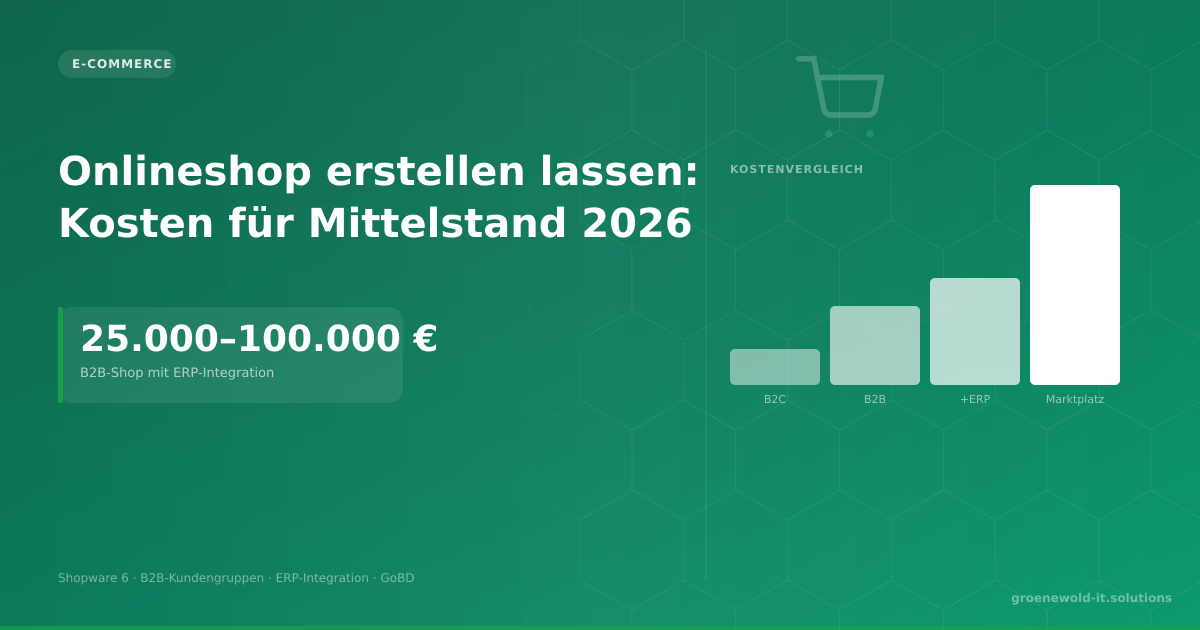
Creating an Online Shop: Costs for Mid-Sized Businesses in 2026
Create an online shop costs €25,000 to €100,000 in mid-sized businesses. This article explains the difference B2C vs. B2B-Shop, ERP integration, Shopware vs. WooCommerce and running costs after the…

Having an Online Shop Developed: What Does It Really Cost?
Onlineshop development: costs, runtimes and decision-making aid between standard shop system and individual solution for mid-sized businesses.

B2B Online Shops: What Sets Them Apart from B2C and What Matters
B2B online shops have different requirements than B2C. Customer groups, net ad, ERP integration and approval workflows – what mid-sized businesses need to know.
Free download
Checklist: 10 questions before software development
Key points before you start: budget, timeline, and requirements.
Get the checklist in a consultationRelevant next steps
Related services & solutions
Based on this article's topic, these pages are often the most useful next steps.
Related solutions
Related comparison
Related industries
Practical next steps after Shopware vs. WooCommerce: Which System Fits Mid-Sized Businesses?
Shopware vs. WooCommerce: Which System Fits Mid-Sized Businesses? addresses a practical choice for product and IT teams. Start with one clear goal: align software scope, technical risk, and business value before the next investment.
Check the current process, the data involved, and the result users need. Then record the main risks and define a small first step. This keeps the decision easy to review and gives your team a shared basis.
For implementation support, our custom software development connects the article's guidance with architecture, delivery, and stable operations. Engineering and project ownership stay with our team in Leer, Germany.
This post belongs to E-Commerce. Browse the related E-Commerce articles or use the English software blog for other topics.
When budget is the next question, the software cost calculators provide planning ranges. The IT glossary explains key terms, while in-depth technology guides cover wider decisions.
If the topic affects a live project, book a technical consultation or send the context through our project contact form. We usually reply within one working day.