
Golang development: performant APIs and microservices with Go
Go development for low-latency APIs, microservices and workers – lean binaries, high concurrency and cloud-native operations Made in Germany from Leer/East Frisia.
For mid-sized companies: low-latency services, workers and infrastructure tools – statically typed, container-friendly and maintainable – delivery and project ownership from Germany (Leer/East Frisia), named contacts, no offshore guesswork.
- 250+ delivered projects
- 5.0 stars on Google
- 100% engineering in Germany
Go (Golang) delivers fast binaries and strong concurrency – ideal when Node or Python hit limits without rewriting your entire system.
Go – when performance and simplicity matter
Go delivers fast binaries, low memory footprint and strong concurrency – ideal for APIs, sync jobs and infrastructure services alongside larger monoliths. We use Go where latency, parallelism or container size matter: pragmatic polyglot architectures instead of big-bang rewrites.
Technology overview: Go (Golang); related API integration, DevOps consulting and Performance & scaling.
Project references
Selected case studies from our project work
Documented examples with transparent evidence types — browse matching references or open the full case study.
Our Go services
Microservices, CLI tools and integration – focused, testable and production-ready.
HTTP/gRPC services
Lean APIs with middleware, timeouts, circuit breakers and structured logging.
Workers & batch
ETL, file processing, ERP sync – idempotent, observable and retry-safe.
Polyglot integration
Go services next to PHP, .NET or Node – clear contracts and contract tests.
DevOps-friendly
Small container images, health endpoints, Prometheus metrics and graceful shutdown.
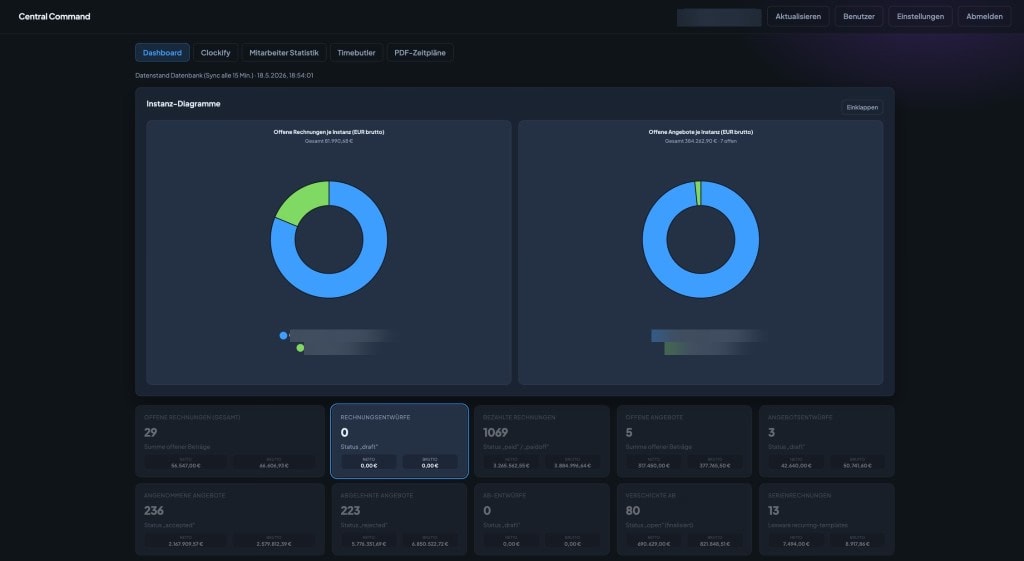
Polyglot architecture: Go in your existing system
Polyglot architecture with Go
Go extends existing stacks – instead of rebuilding everything
- Clear contracts (OpenAPI / Protobuf) between all layers
- Go handles performance-critical paths
- Existing systems stay productive during extension
Performance
Low latency under many parallel requests.
Simplicity
Small codebase, fast onboarding for teams.
Cloud-native
Kubernetes-ready services without heavy runtime overhead.
Security
Static types, go vet, golangci-lint in CI.
Golang development: when Go is the right choice
The matrix shows when Golang development pays off – and when an existing stack is enough. That keeps the decision factual rather than technology-driven.
| Situation | Recommendation | Rationale | Effort |
|---|---|---|---|
| Latency-critical API under high load | Dedicated Go service | Fast binaries, high concurrency | medium |
| Infrastructure or CLI tool, small image | Go | Statically typed, container-friendly | low–medium |
| Worker/batch (ETL, ERP sync) | Go worker | Idempotent, observable, retry-safe | medium |
| Existing PHP/.NET/Node stack holds | Polyglot integration instead of rewrite | Go only for performance hotspots | low |
| UI-heavy standard CRUD app | Existing framework | Go adds little value here | — |
„Go enforces clarity: small binaries, explicit error handling and concurrency without callback hell – ideal for services that must stay stable under load.“


Go in practice
Go projects stay lean when domain logic is separate from HTTP handlers and contexts are used for cancellation.
- context.WithTimeout on all external calls
- Graceful shutdown in Kubernetes
- Semantic versioning for APIs
- Runbooks for queue backlogs
We check whether Go truly solves your problem – or whether an existing stack is enough.
From commit to production – Go in the CI/CD pipeline
Go builds fast and ships small artefacts – ideal for automated pipelines with tests, linting and container deploy.
- Git-Commit
- PR-Review
- Branch-Strategie
- Unit-Tests
- Lint & SAST
- Contract-Tests
- Docker-Image
- Artefakt-Signatur
- SBOM
- Staging → Prod
- Blue/Green
- Rollback-Ready
- Latenz & Fehlerrate
- Alerting
- Log-Aggregation
Unsere Pipelines: Jede Stage schlägt fehl, bevor Fehler in die nächste wandern. Kein manuelles Deployment in Produktion — alles geht durch die Pipeline, dokumentiert und rollback-fähig.
Frequently asked questions
Frequently asked questions about Go development
Go vs. Node, Python and Java – when is Golang worth it?
When is Go worth it instead of Node.js?
Go beats Node.js when you need many parallel connections, strict latency targets or lower memory footprint – API gateways, sync workers or infrastructure services.
Node.js remains strong for I/O-heavy CRUD APIs and teams already fluent in JavaScript. Content-heavy web frontends stay on React or Next.js; Go handles the performant backend layer.
In an architecture workshop we check whether switching delivers measurable gains or whether optimising the existing stack is enough.
When is Go a better choice than Python?
Python leads for data science, ML and rapid prototypes.
Go wins for always-on services with high concurrency, small container images and predictable resource usage – ERP sync, event consumers or internal platform tools. In polyglot setups we pair Python ML inference APIs with Go workers for queue processing.
Does Go fit our existing PHP, .NET or Java landscape?
Yes – Go complements monoliths rather than replacing them overnight.
We define clear HTTP or gRPC contracts, contract tests and shared observability. Typical pattern: a new Go microservice for performance-critical paths alongside Laravel, Odoo or .NET, migrated step by step.
Which use cases do you typically build in Go?
HTTP and gRPC APIs, queue workers, DevOps CLI tools, file and ETL pipelines, real-time sync between ERP and shop, and infrastructure services behind Kubernetes.
Go is less ideal for complex desktop UIs or heavy ORM-centric business applications.

Check whether Go fits
In a short call we clarify whether Golang solves your bottleneck – or whether your current stack is enough.
Frameworks, testing and security
Which Go web framework do you recommend?
Often stdlib net/http with chi or gin as a lean router – only as much framework as needed.
For internal service communication we use gRPC with Protobuf contracts. We avoid heavy frameworks when maintainability and small binaries matter most.
gRPC or REST – which protocol when?
REST (JSON over HTTP) for external partner APIs and browser clients.
gRPC for internal microservices with high throughput and strict contracts. Both are documented and covered by contract tests so breaking changes surface before deploy.
How do you test and review Go code?
Table-driven unit tests, integration tests with Testcontainers, benchmarks for hot paths, golangci-lint and go vet in every CI pipeline.
Pull requests require green tests and coverage thresholds on core packages.
How do you secure Go APIs?
JWT or OAuth2/OIDC as appropriate, rate limiting, input validation, context.WithTimeout on external calls, TLS everywhere and secrets only via environment variables or a secret manager.
We integrate govulncheck and SAST in CI.
Cost, Kubernetes and operations
What does Go development cost at Groenewold IT?
Focused Go services (one API with auth, DB, tests and deployment) typically start from around €18,000.
Larger platforms with multiple services and Kubernetes operations are quoted individually after a workshop. Go often reduces ongoing cloud cost through lower RAM usage – not always initial build cost.
How do you deploy Go services on Kubernetes?
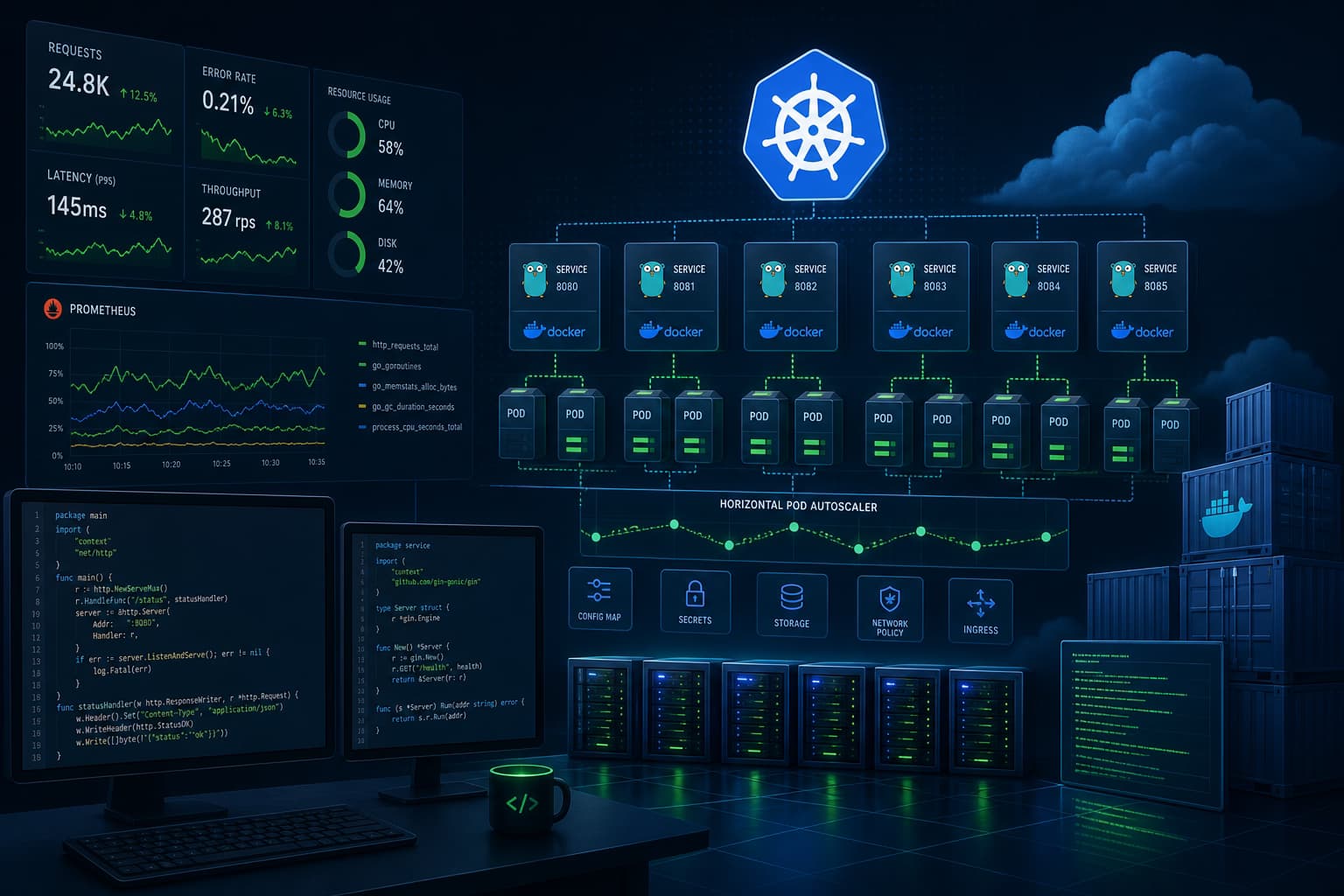
Multi-stage Docker builds, health and readiness probes, graceful shutdown on SIGTERM, HPA for load spikes and Helm or GitOps for reproducible releases.
Go’s fast startup suits scale-to-zero with Knative or Cloud Run when a full cluster is overkill.
Which monitoring and logging do you use?
Structured logging, Prometheus metrics, OpenTelemetry traces and alerting via Grafana or managed services.
Every external call carries trace IDs; dashboards show latency, error rate and queue depth with runbooks for common incidents.
What happens after go-live – maintenance and handover?
We hand over documented repos, CI/CD and runbooks; optional maintenance contracts available.
Your team can extend Go independently; onboarding sessions and pairing in the first weeks are common.
Do you deliver Go development from Germany?
Yes – engineering and project ownership Made in Germany from Leer/East Frisia, named contacts, GDPR-aware processes and no anonymous offshore chain.
Code, documentation and deployments belong to you.
Decision logic: Go development
Go development delivers performant APIs and workers—when latency, concurrency, or cloud-native is the focus.
| Use case | Benefit | Differentiation | Outcome | Next step |
|---|---|---|---|---|
| Microservices with high load | Go backends with low footprint | Not legacy VB6 topic | Scalable services | Project check |
| API gateway and integration | Go + interfaces from one partner | Not app frontend development | Stable integration layer | API integration |
| Operations after go-live | Maintenance and monitoring | Development ≠ IT support | Sustainably operable services | Software maintenance |
Scope: Go for performance APIs
Go for high-performance APIs and microservices—architecture: technologies; enterprise: enterprise software development.
Related paths and adjacent topics
Service overview: Software & platforms (overview)
More services in software & platforms
Adjacent service categories
Start your Go project
Whether API, worker or microservice – we clarify scope, architecture and operations in a no-obligation call.
Choose a Go service from load profile and operating model
Go is an option for clearly bounded APIs, workers and data processing with many concurrent operations. A stack change is not a goal in itself. If an existing Node.js, PHP or .NET application handles the measured load reliably, we do not recommend a rewrite based on theoretical benchmarks alone.
Before implementation, we capture request patterns, data volume, interfaces, timeouts and failure paths. We publish comparison figures only with the test environment, dataset and method. API integration defines system contracts, while a software architecture review assesses alternatives to changing stacks.
Operational handover includes reproducible builds, tests, metrics, logs, deployment documentation and runbooks. Kubernetes is optional; containers, VMs or a managed runtime depend on load, team capability and the existing platform. For I/O-heavy backends, Node.js development can be the more suitable route.

Up to 50% of your investment via BAFA/KfW
Use our funding calculator to see which government grants may apply to your project.
Björn Groenewold – Managing Director