Groenewold IT Solutions LogoGroenewold IT Solutions – Home
Enterprise software development – scalable B2B systems
250+ projects · 5.0 on Google · 100% in Germany

Enterprise software delivery with tenancy, SLAs and supply-chain rigor

For mid-sized companies: integration-heavy releases for corporates and regulated sectors – delivery and project ownership from Germany (Leer/East Frisia), named contacts, no offshore guesswork.

  • 250+ delivered projects
  • 5.0 stars on Google
  • 100% engineering in Germany

Enterprise software development becomes a board-level topic when standard products hit their limits. Common triggers are multi-tenancy across divisions, proven compliance, high availability, and clean connections to ERP, CRM and identity systems. Organisations that need custom enterprise software for multiple sites or regulated data do not want an isolated side app. They need clear domain boundaries, versioned APIs and release schedules that partners and group IT can rely on.

We deliver bespoke B2B software solutions with measurable milestones, documented architecture decisions and integration logic that stays maintainable after go-live. International searches often use the phrase enterprise software development Germany to signal expectations around privacy, auditability and predictable governance. Organisations use the term custom enterprise solutions when modular platforms, interface contracts and observability must be planned together as one system. The German engineering tradition of a Lastenheft and Pflichtenheft still shapes how buyer requirements and supplier specifications are separated cleanly in tenders.

Groenewold IT Solutions from East Frisia supports large enterprises and ambitious mid-market firms. We work from outline specification through architecture, build, acceptance and hypercare. For connecting to your landscape, see our API and integration development for enterprise landscapes, the custom software development overview and, for desktop-heavy cores, desktop software development for Windows clients.

Custom enterprise software for companies: availability and multi-tenancy

Enterprise applications differ from typical SMB products through higher demands on availability, multi-tenancy and international scale.

Enterprise systems run around the clock. They serve multiple business units or subsidiaries. They must adapt to changing compliance rules. At the same time, business teams expect short release cycles and stable connections to ERP, CRM and legacy systems. We use explicit architecture choices, automated quality checks and documented interfaces. Your software works today and stays maintainable in five years.

High availability

Redundant architecture, load balancing and planned downtime close to zero.

Multi-tenancy

Multi-tenant models and clear data isolation across business units or customers.

Complex authorisation

Roles, rights and audit logs aligned with corporate policy and compliance.

International scale

Languages, time zones, regional compliance and global infrastructure.

Bespoke B2B software solutions: services from kick-off to operations

From discovery to operations, we cover what fits your situation:

Requirements analysis

Together with business and IT: scope, integration points and constraints.

Software architecture

Scalable, maintainable design—from monoliths to microservices, cloud-native where it fits.

Development

Agile delivery with code quality, reviews and documented interfaces.

Quality assurance

Automated tests plus performance and security checks before rollout.

DevOps

CI/CD, infrastructure as code, monitoring and fast, controlled releases.

24/7 support

Optional operations and support with defined SLAs for critical systems.

Enterprise software development Germany: technology stack, cloud placement and compliance

We use proven technologies for scalability, security and integration—from microservices and Kubernetes to leading cloud platforms.

Microservices & APIsKubernetes & containersAWS / Azure / GCPEvent-driven architecturesSecurity & compliance by design

See also: Microservices, Kubernetes, APIs & interfaces.

The tech stack alone means little without clarity on where workloads run and how they are managed. In enterprise programmes, we work with your IT team to decide whether workloads go on a hyperscaler, private cloud, hybrid setup or partly on-premises. The decision is based on data classification, latency, compliance and your existing operations team. Identity (IAM), network separation, secrets management and monitoring must be consistent. Without these foundations, microservices and Kubernetes become hard to manage quickly.

We recommend defining reference architectures and guardrails early. This includes approved languages, standard monitoring libraries, API versioning rules and documented exception processes. Many teams stay productive without each squad reinventing its own approach. We also advise on managed versus self-operated services and basic cloud cost management. Scaling should not surprise the budget.

Custom enterprise solutions: how enterprise software differs from standard products

Scalability: Enterprise systems serve thousands of users and large data volumes—many standard products target tens. Architecture and infrastructure are designed for growth from day one.

Security: Role models, SSO, audit logs and compliance requirements versus simple password logins. Enterprise software meets sector regulation and certification where needed.

Integration: Dozens of interfaces to ERP, CRM, identity and third parties versus standalone setups. Enterprise applications are part of a landscape.

Multi-tenancy: Several tenants (divisions, subsidiaries) with clear isolation versus a single install. Maintenance and updates stay central without operating many divergent instances.

Availability: 99.9% SLA targets, redundancy and near-zero planned downtime versus best-effort operations for critical business flows.

Internationalisation: Languages, time zones, currencies and regional compliance (e.g. data residency in the EU). Many standard products cover only one language and market.

Compliance: Sector rules such as MaRisk/BAIT, KRITIS-style expectations or authority requirements—enterprise software is built for audit and review.

Operations: 24/7 support, response times and escalation paths versus office hours only—for business-critical systems someone must be reachable.

Cost: Higher upfront investment that often pays back through efficiency, less retrofitting and central control over the long term.

Custom enterprise software for companies: architecture patterns and core integration

Microservices: Independently deployable services with clear ownership; communication via APIs or events—suited to large teams and changing requirements.

Event-driven architecture: Loosely coupled systems exchanging events—minimal coupling and easier extension.

CQRS: Separate read and write models so each path can scale and optimise differently.

Domain-driven design: Architecture aligned with the business domain; bounded contexts and a shared language between business and IT reduce misunderstandings.

API gateway: Central entry for clients with authentication, rate limits and a unified external surface—clients do not talk to every service separately. More: Custom software development, API development, Software maintenance.

Saga pattern: Distributed workflows without ACID across service boundaries—each step is a local transaction; failures trigger compensating actions to keep the business consistent.

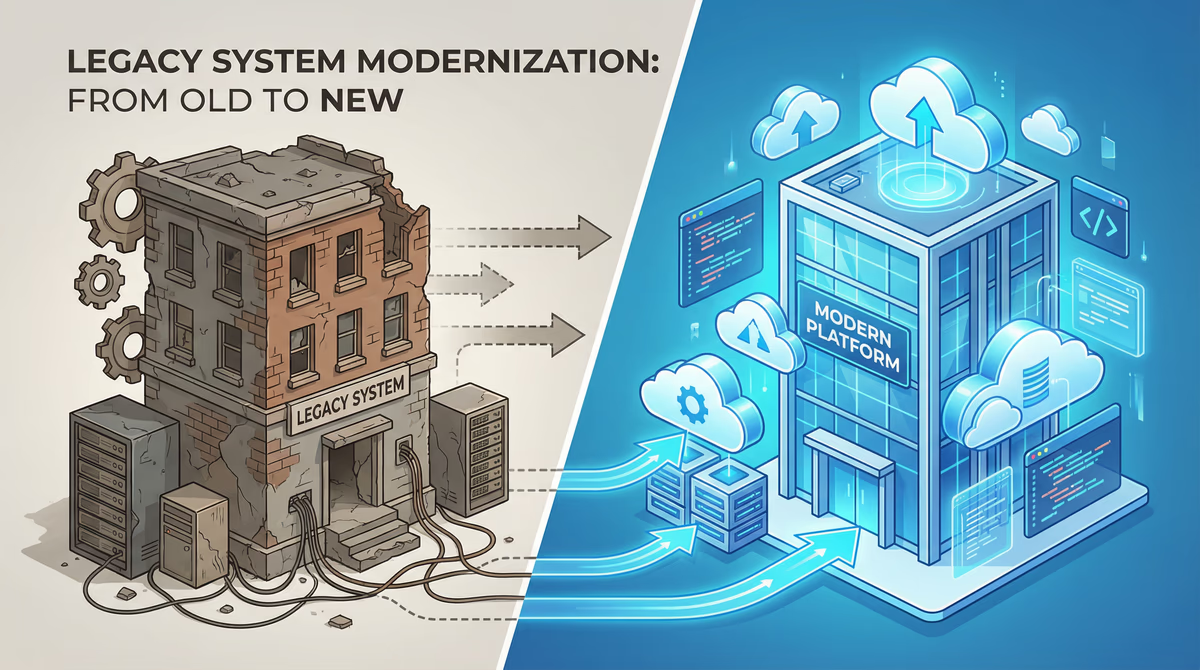
Strangler pattern: Gradually replace legacy by routing traffic to new modules while old endpoints remain—lower operational risk than a single cutover.

Patterns only help with clear operating rules: API versioning, error contracts between services and monitoring that ties business and technical KPIs—otherwise you get pattern islands with complexity but little operational gain.

Bespoke B2B software solutions: typical programme sizes, timelines and integration windows

Mid-sized enterprise application (e.g. internal order management, divisional specialist system): about 4–6 developers, 6–9 months, budget often from roughly EUR 150k—consolidating processes or replacing a legacy stack.

At this scale, a proof of value after 8–10 weeks is worthwhile. This is a working increment accepted by real users in a pilot unit. It includes KPIs such as lead time and defect rate, plus documented interfaces to neighbouring systems. This avoids modules that never reach production. We plan hypercare and key-user training alongside go-live.

Large platform (e.g. multi-tenant B2B marketplace, customer portal with many integrations): about 6–10 developers, 9–15 months, budget often from roughly EUR 300k. This needs explicit architecture, API strategy and staged approvals.

Here, integration windows and dependency chains are the bottleneck. Every external interface needs test data, a staging counterpart and a named vendor contact. We plan milestones around end-to-end journeys such as quote–order–payment–billing, not just component teams. Capacity targets are set early so performance testing does not start two weeks before launch.

Mission-critical system (e.g. real-time production control, core business platform): about 8–15 developers, 12–24 months, budget often from roughly EUR 500k. Availability, compliance and 24/7 operations dominate planning and QA.

For critical systems we define RTO and RPO and run repeatable disaster-recovery drills. We also set up clear incident escalation. Regulatory and internal audit requirements are met through traceable evidence: change logs, access records and approvals. Optional: certification or penetration test cycles so security is proven in practice, not just on paper.

Enterprise software development Germany & custom enterprise solutions: cloud, data, change and programme steering

Cloud strategies for enterprise landscapes

A workable cloud strategy combines workload placement, network and identity design and operating models. We help set up landing zones, policy-as-code and regular reviews. This prevents individual applications from creating endless exceptions to security and cost rules. Hybrid setups get clear data boundaries and replication patterns instead of vague plans to sync everything.

Data management and quality

Enterprise software depends on trustworthy data. Master data, reference data and event streams must be reliable and usable for analysis. We support master data governance, lineage-aware interfaces and separating operational from analytical paths. This keeps reporting from blocking production. Data quality rules are applied where they make business sense, with monitoring for deviations.

Change management and organisation

Technology alone does not ship major releases. Change management means training, communicated cutover windows, guided hypercare and feedback loops with business and operations teams. We document decisions (ADRs) and write release notes that key users can understand. We plan the handover from development to operations explicitly. Knowledge must not disappear when the project closes. More on custom software development and interfaces.

Steering, release trains and acceptance in large IT programmes

Enterprise software development needs clear decision paths. Without governance, architecture debates never close. Without release trains, teams clash on conflicting dependencies. We establish lean governance: recurring architecture forums with documented decisions, fixed integration windows and acceptance criteria per milestone. Business knows when to engage. Engineering knows which interface versions are final.

On large platforms, we fix critical non-functional requirements early: performance under load, disaster recovery and access models. We build these into automated tests to avoid costly surprises before production. Acceptance is supported with explicit test data, defined scenarios and escalation paths. Go-live dates are based on evidence, not negotiation. Where helpful, we run workshops with ERP and CRM partners so interface contracts and SLAs are written down.

With multiple vendors, someone must own end-to-end validation across system boundaries. We can take that integration role or support your enterprise architecture team. The goal is always measurable KPIs and low-risk rollouts, not big-bang releases.

Frequently asked questions

Enterprise software development – FAQ

Strategy, effort and delivery model

How does enterprise software differ from packaged products—and when is custom enterprise software for companies with multiple sites worth it?

Enterprise software targets connected processes, peak load and proven compliance. It is not just a feature checklist. Custom enterprise software pays off when multi-tenancy, complex role models or deep ERP/CRM integration are core needs. Standard products often cannot meet these needs without heavy workarounds.

Teams searching for enterprise software development in Germany typically pair technology choices with data residency, auditability and aligned integration windows. We do not default to building everything custom. We focus on modules with real competitive advantage and clear interface contracts. This keeps bespoke B2B software solutions measurable rather than open-ended.

How do we prioritise bespoke B2B software solutions alongside SaaS and ERP extensions—and where do custom enterprise solutions fit?

Bespoke B2B software solutions make sense where your processes are a differentiator or where data must stay under your control. SaaS remains the right choice for common functions and fast user scaling. Custom enterprise solutions combine modular cores with versioned APIs, events and access control. Proprietary logic must not sit outside the ERP. Enterprise delivery means coordinated release trains.

What SAP or Salesforce ships must not break your custom components unexpectedly. We document assumptions, load targets and escalation paths early. This prevents custom enterprise software from becoming a permanent construction site.

What do enterprise programmes typically cost and how long do they take—and how should we budget enterprise software development Germany?

Budget and duration depend on integration depth, regulatory requirements and non-functional targets such as availability and recovery time. Smaller modules often start in the low six figures (EUR). Large programmes over several years can reach the mid to high six figures. A solid outline specification comes first in all cases.

Enterprise software development in Germany is not just higher day rates. Acceptance effort, security reviews and operational handover all matter to CFOs and CIOs. We structure roadmaps into shippable releases with clear proof-of-value rather than big-bang deliveries. Optionally we add basic cloud cost management for predictable spending.

How do we integrate new modules into ERP, CRM and identity estates—and what role do custom enterprise solutions play at interfaces?

Integration is not an afterthought. We define interface contracts, test data for staging and named owners at vendors before teams start building in parallel. Custom enterprise solutions rely on stable APIs or event-driven connections. Fragile point-to-point scripts that break on the next vendor release are not acceptable. Enterprise-grade delivery includes monitoring and audit traces across system boundaries.

For complex integrations with legacy systems, the work can span years. We run integration boards and use end-to-end journeys like order-to-cash as the real acceptance test.

Which security and compliance guardrails do we apply in enterprise delivery—from GDPR to sector audits?

Security by design means role-based access, short-lived tokens where possible, encryption for data at rest and in transit, and traceable change and access logs for audits. Enterprise software development in Germany explicitly factors in EU hosting, data classes and processor agreements. Bespoke B2B software solutions are reviewed against OWASP guidelines and sector requirements.

Where KRITIS or financial regulation applies, we include penetration tests and recurring review cycles. This way, custom enterprise solutions remain manageable for your information security team, not just impressive on demo day.

Björn Groenewold – Geschäftsführer Groenewold IT Solutions

Discuss an enterprise programme

Conversation with our lead architect—requirements, architecture and next steps.

Schedule a call

Talk to our lead architect

Planning an enterprise programme or integration into group IT? We discuss requirements, architecture and next steps—without obligation.

Schedule an appointment

Up to 50% of your investment via BAFA/KfW

Use our funding calculator to see which government grants may apply to your project.