Groenewold IT Solutions LogoGroenewold IT Solutions – Home
React Native development – cross-platform apps for iOS and Android with React and TypeScript
250+ projects · 5.0 on Google · 100% in Germany

React Native development: cross-platform apps with native performance

For mid-sized companies: one codebase for iOS and Android, native modules where needed, fast iteration with React expertise – delivery and project ownership from Germany (Leer/East Frisia), named contacts, no offshore guesswork.

  • 250+ delivered projects
  • 5.0 stars on Google
  • 100% engineering in Germany

React Native – mobile from the React ecosystem

React Native uses React skills for iOS and Android – sensible when web and mobile should share types, design tokens and API clients.

We build store-ready apps, internal tools and companion apps to web portals – with clear separation of UI, navigation and data access.

Technology overview: React Native Development – stack details on our technology page. See also MVP development and app development.

React Native vs Flutter – cross-platform development for iOS and Android compared
Björn Groenewold
„React Native pays off when web and mobile speak the same language: shared TypeScript types, one API layer and a clear split between UI and business logic—or the app becomes an expensive second frontend with no synergy.“
Björn GroenewoldDipl. Inf.Managing Director & CTO

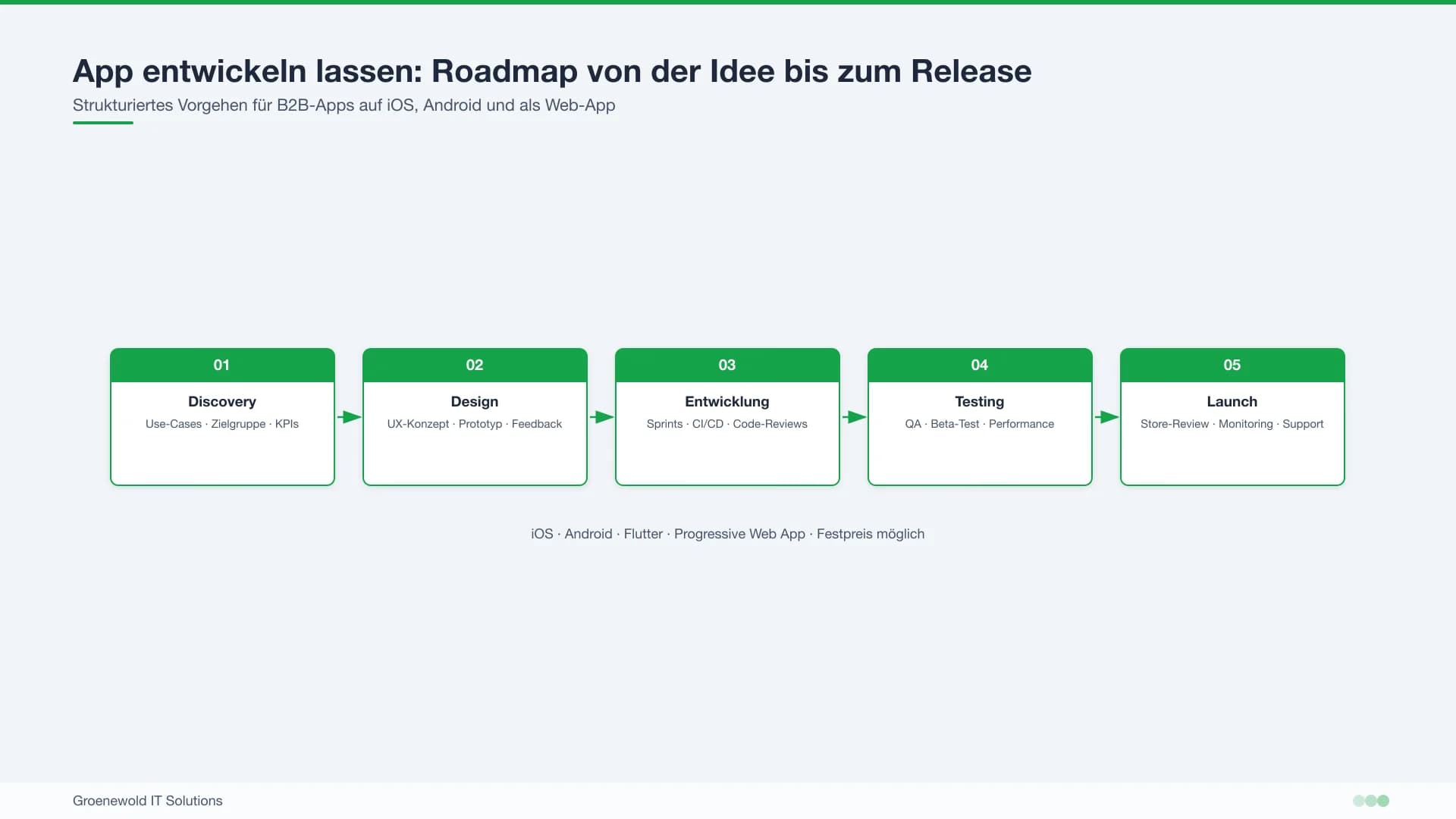
From idea to store – React Native roadmap

Store-ready apps need more than mockups: architecture, API contracts, device testing and review prep belong in a plan—not in the sprint before launch.
App development roadmap – planning, design, development, testing and store launch for React Native

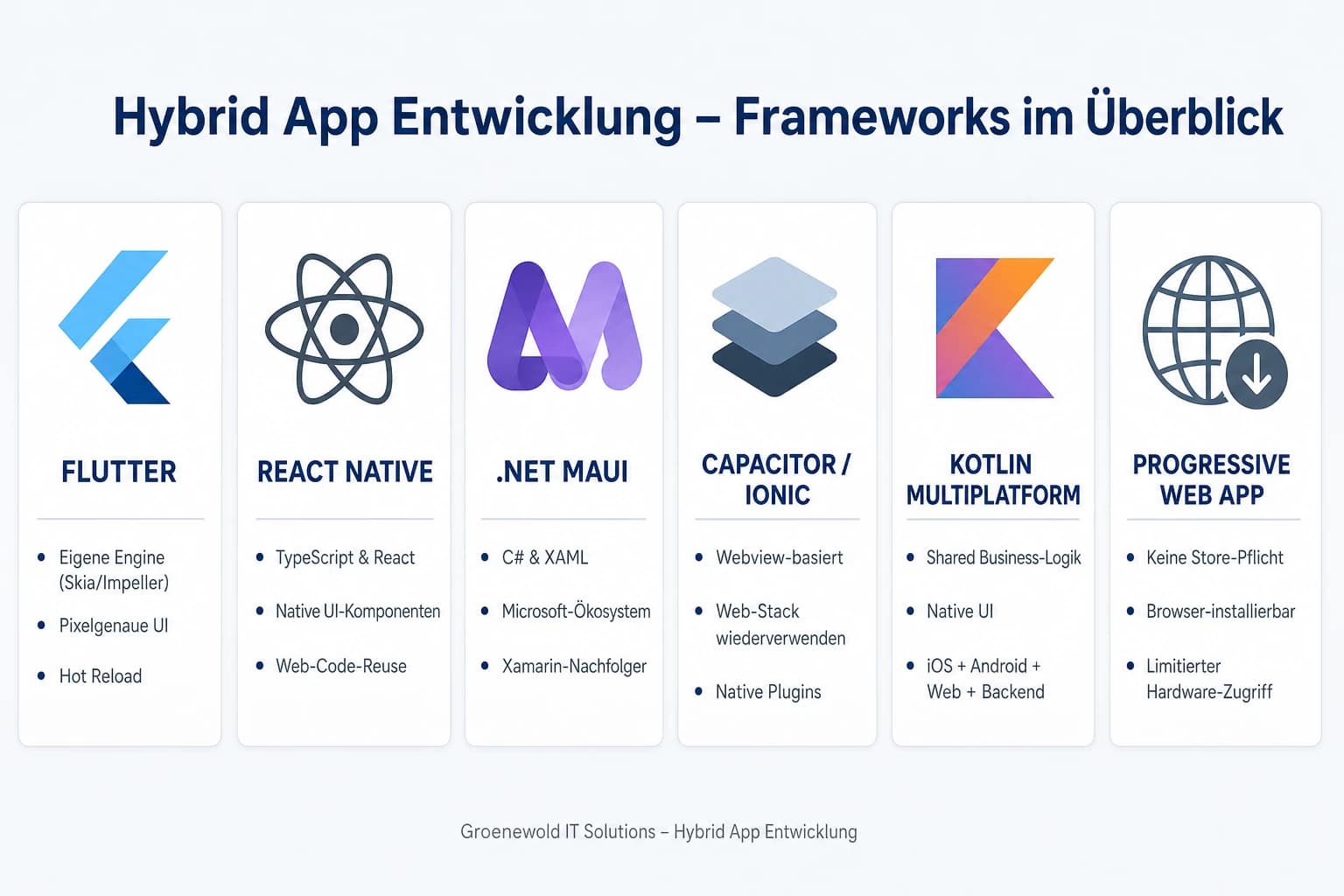
Hybrid frameworks at a glance – React Native in context

React Native shares the market with Flutter, Capacitor and native stacks. The graphic shows typical use cases—we recommend the stack by team, performance and integration needs, not by trend.
Framework comparison for cross-platform apps – React Native, Flutter, Capacitor and native development
Detailed comparison: Flutter vs React Native

React Native technology stack and ecosystem

React Native builds on React, TypeScript and a JavaScript runtime (Hermes). We connect backend, push and monitoring via REST/GraphQL, Node.js or existing APIs—aligned with your IT landscape.

React Native logo – cross-platform mobile frameworkReact Native
React logo – UI library for web and mobileReact
TypeScript logo – type-safe app developmentTypeScript
Node.js logo – API backend for mobile appsNode.js
Firebase logo – push, analytics and CrashlyticsFirebase
Flutter logo – alternative cross-platform platformFlutter

Web + mobile

Shared TypeScript types and API clients with Next.js/React—less duplicate maintenance between portal and app.

iOS & Android

One code path for two stores—with targeted native bridges only where hardware or MDM requires it.

Operations & releases

CI/CD, Crashlytics, OTA (Expo) and store tracks—updates on a plan instead of reactive fire drills after OS jumps.

Stack details and native bridges: React Native technology; API backend often with Node.js development.

Typical React Native scenarios in practice

Mobile B2B app screenshot – dashboard and task lists in React Native

B2B companion app

Internal tools and customer portals as mobile add-ons to web—roles, push and offline for field teams.

Field service app screenshot – mobile data capture and sync

Field service & offline

Forms, barcode and GPS on the road—sync strategy and conflict resolution planned from day one.

Consumer app store screenshot – React Native UI on iOS and Android

Consumer & store launch

Store-ready apps with review prep, analytics and feature flags for controlled rollouts.

View all mobile app references

Our React Native services

From PoC app to enterprise rollout.

Greenfield apps

Expo or bare workflow – decision based on native needs and release process.

Web + mobile

Shared TypeScript types and API layer with Next.js/React frontends.

Enterprise rollout

MDM, SSO, secure storage and logging for B2B users.

Maintenance & upgrades

React Native version jumps, dependency updates, store compliance.

TypeScript

End-to-end type safety with your web team.

Expo/bare

Pragmatic choice per native API needs.

Design systems

Components aligned with web branding.

CI/CD

Automated builds and TestFlight/internal tracks.

React Native in practice

Stable apps separate navigation, state and API layers; we avoid business logic in screens and test critical flows with Detox/Appium.

  • React Query for server state
  • Secure Enclave/Keychain for tokens
  • Feature flags for store rollouts
  • Crashlytics + structured logs

If your web already runs on React/Next.js, React Native is often the fastest path to mobile.

Frequently asked questions

FAQ on React Native development

Technology, costs and stack choice

React Native or Flutter – when does each stack make sense?
React Native fits when your web already runs on React or Next.js and mobile should share TypeScript types, hook patterns and API clients. Flutter fits greenfield teams without JS mobile experience and heavy custom UI. See our Flutter vs React Native comparison – we advise stack-neutral and do not push a framework by default.
What does React Native development cost – and how transparent is the quote?
MVPs with core workflows typically start from around €20,000; larger B2B apps with roles, offline and integrations often fall in the €40,000–100,000 range. Sharing one API with web often saves backend budget. We separate app, backend and operations in the quote – no hidden store or maintenance items. See our app development cost calculator and a discovery call with scope sketch.
How long until a React Native store launch?

A lean MVP with 5–8 core screens and API integration is often store-ready in 8–12 weeks – including testing on target devices and review prep. Mid-size B2B apps with offline, roles and integrations typically need 4–6 months. The biggest time factor is not JSX itself but clear prioritisation and fast feedback loops with business and IT.

We work in two-week sprints with demos – so you see progress before the full budget is spent.

Expo or bare React Native – what do you recommend?
Expo suits fast MVPs, OTA updates and teams without deep iOS/Android knowledge. Bare workflow when special native SDKs (BLE, payment hardware, MDM) are mandatory. We start pragmatically: Expo first while no documented native gap exists – migration to bare is planned when requirements grow. See React Native as a technology on our technology page.

Web + mobile, operations and compliance

How do we benefit from an existing React or Next.js team?
Your web team already knows component thinking, TypeScript and state management – we transfer that to mobile with React Navigation, React Query and shared API clients. Design tokens and types from your Next.js frontend reduce duplicate work. We train on RN-specific topics (safe area, push, store builds) when needed instead of building a completely separate mobile team.
Do you handle maintenance, OS updates and store submissions after launch?
Yes – optionally with SLA for bug fixes, React Native version upgrades, dependency updates and feature sprints. iOS and Android version jumps need regular adjustments; without care, store ratings and stability drop. We support App Store and Play Store processes, Crashlytics and release tracks. See software maintenance.
How do you connect React Native to existing ERP, CRM or Node backends?
We use your existing REST or GraphQL APIs – auth (OAuth2, JWT), error handling, offline cache and retry logic are modelled cleanly in the client. If no API exists yet, we build the backend in parallel (e.g. Node.js, Laravel or .NET) and keep contracts between app and server in sync. Critical business logic stays in the backend – that simplifies security reviews and later extensions.
GDPR, hosting and Made in Germany – what matters for React Native projects?

Development and alignment run from Leer (East Frisia) – no offshore subcontractors. We process personal data only via documented APIs and hosting locations that match your data protection role. Push, analytics and crash tools are chosen GDPR-consciously and transparent in the privacy policy. Made in Germany means: a reachable contact, German contracts and handover-ready source code in your repository.

When is React Native not the right choice?
React Native is less ideal when you need only one platform and already have a strong Swift or Kotlin team, when the app needs extremely platform-specific OS features without bridges, or when the whole product should live as a PWA in the browser. We often recommend native development, Flutter or pure web apps instead. Our project check clarifies this in minutes based on your target users and IT landscape.
Is React Native suitable for B2B apps with offline and field service?
Yes – typical scenarios are field service with barcode/GPS, offline forms and roles (technician, dispatcher, admin). We plan sync strategies, conflict resolution and secure token storage from day one. We explicitly test performance on older Android devices – Hermes, memoisation and lean lists often help. See mobile app references.

Request React Native project

Describe target users and must-have flows – we outline MVP scope, architecture and a realistic timeline Made in Germany.

React Native Development: structured delivery approach

Björn Groenewold

Up to 50% of your investment via BAFA/KfW

Use our funding calculator to see which government grants may apply to your project.

Björn Groenewold – Managing Director

React Native Development & Agency Germany | Groenewold IT Solutions